Qantas A380 suffers wing damage and multiple system failures on 1st flight after 6 years in storage

December 11, 2025
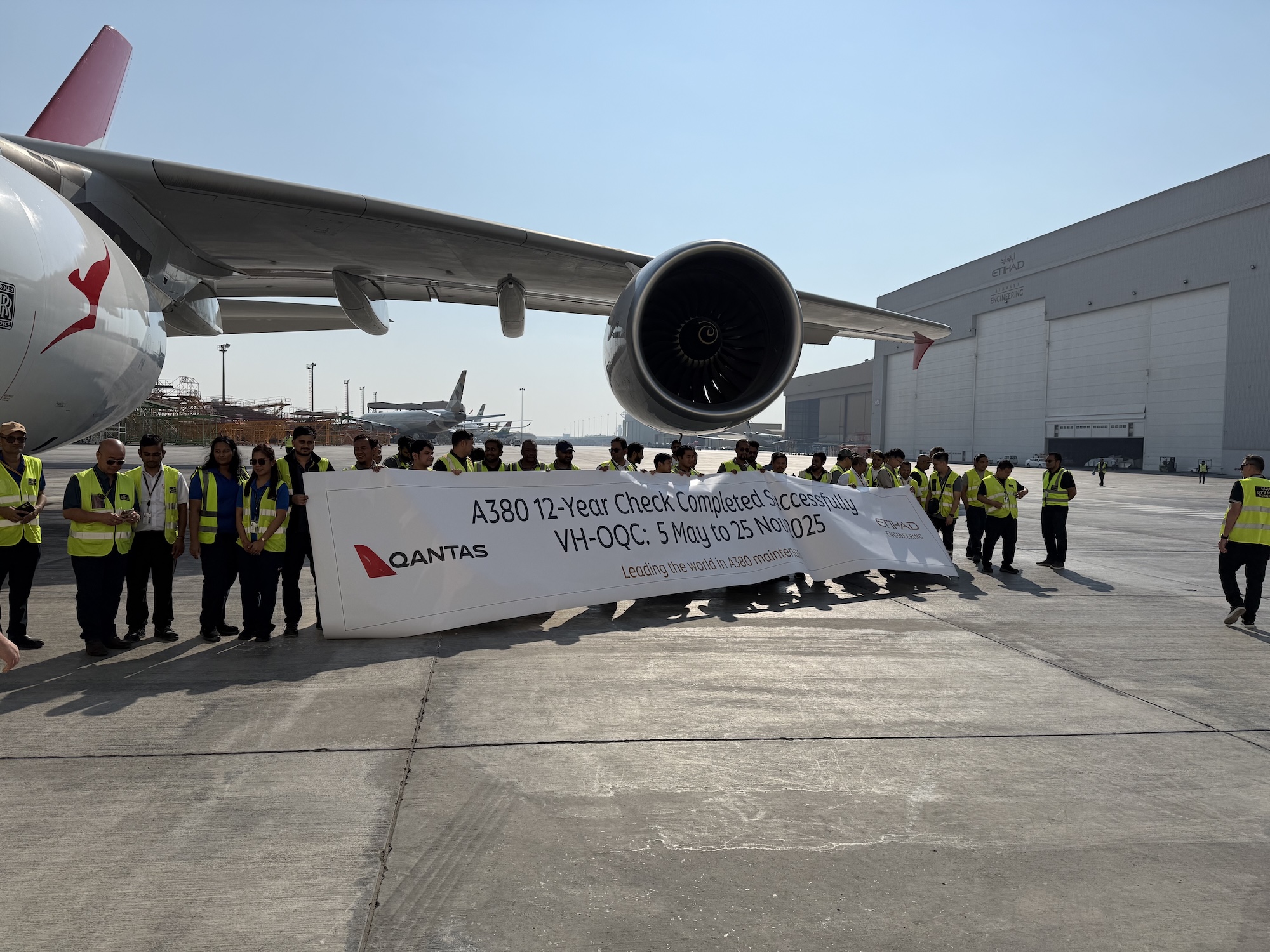
Qantas’ highly anticipated return to service of its 10th Airbus A380 — VH-OQC “Paul McGinness” — has run into trouble.
On 7 December 2025, while operating QF11 from Sydney to Los Angeles, passengers reported technical issues and visible wing damage. Upon landing at Los Angeles International Airport, engineers discovered damage to a leading-edge slat on the left wing, which necessitated the aircraft’s grounding for repairs.
The event occurred just five days after the European Union Aviation Safety Agency (EASA) issued an Airworthiness Directive regarding Airbus A380 slats, and nine days before the directive was to take effect.
The aircraft was the last Qantas A380 to return to service after being in storage for six years. It had just undergone extensive maintenance as part of its 12-year check.
Qantas’s last parked A380’s triumphant return runs into an unexpected setback
Just before the incident, Qantas issued an official press release celebrating the return of VH-OQC (MSN 22) to service after nearly six years in storage. The aircraft is dubbed “Paul McGinness,” in honour of one of the Qantas founders.
“Bringing an A380 back into service after nearly six years in storage is no small feat. Teams of engineers around the globe came together to complete more than 100,000 hours of work to prepare the aircraft for flying again, from extensive checks to heavy maintenance, landing gear replacement, a full cabin refresh and assessment flying, with parts shipped by land, sea and sky,” Qantas International CEO Cam Wallace said.
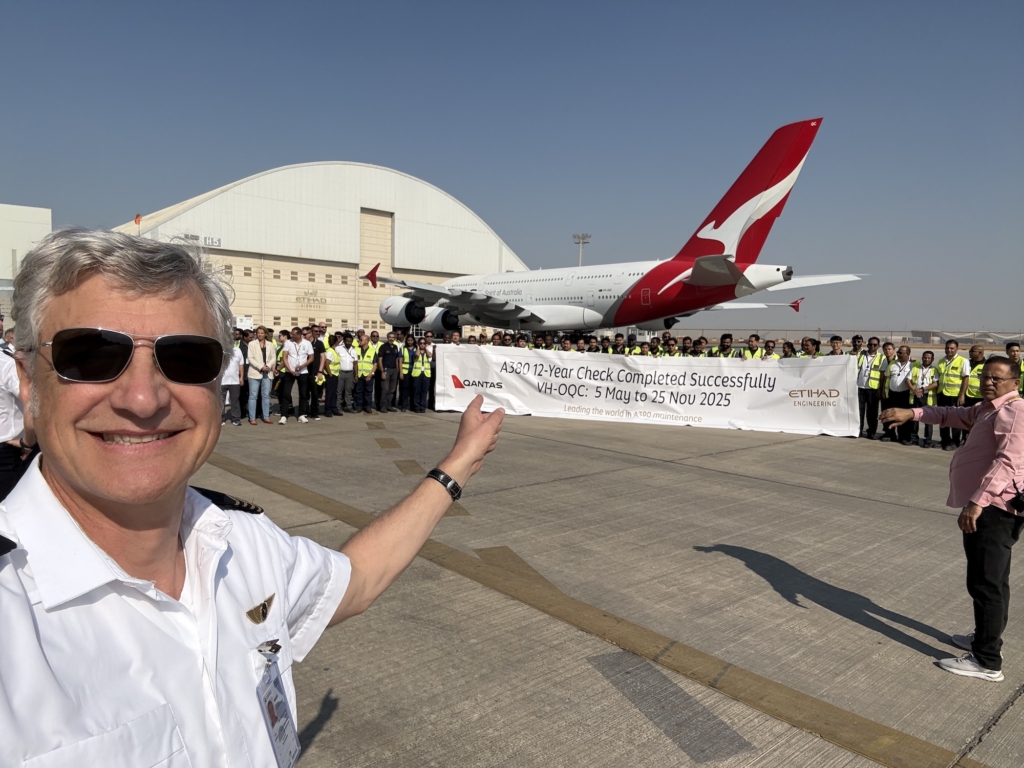
The airline described the 12-year check as “the largest maintenance programme ever undertaken for the Qantas A380 fleet.”
Qantas intended the aircraft to boost capacity on long-haul routes, mentioning “destinations like Dallas, Singapore and Johannesburg” in its announcement. But the celebration of the renewed fleet capability was followed by a high-profile setback during the aircraft’s first flight to Los Angeles.
Qantas A380 VH-OQC suffers wing leading-edge slat damage & passenger experience failures on flight to Los Angeles
Passengers aboard QF11 described a series of issues that extended beyond the structural concern. Passengers posted complaints about in-service failures on social media after the flight landed, as reported by Aero South Pacific.
Australian television presenter Lynn Gilmartin, who was among those on board, posted footage and commentary on Instagram. While the post no longer appears on her Instagram account, News.com.au and other outlets captured a screenshot.
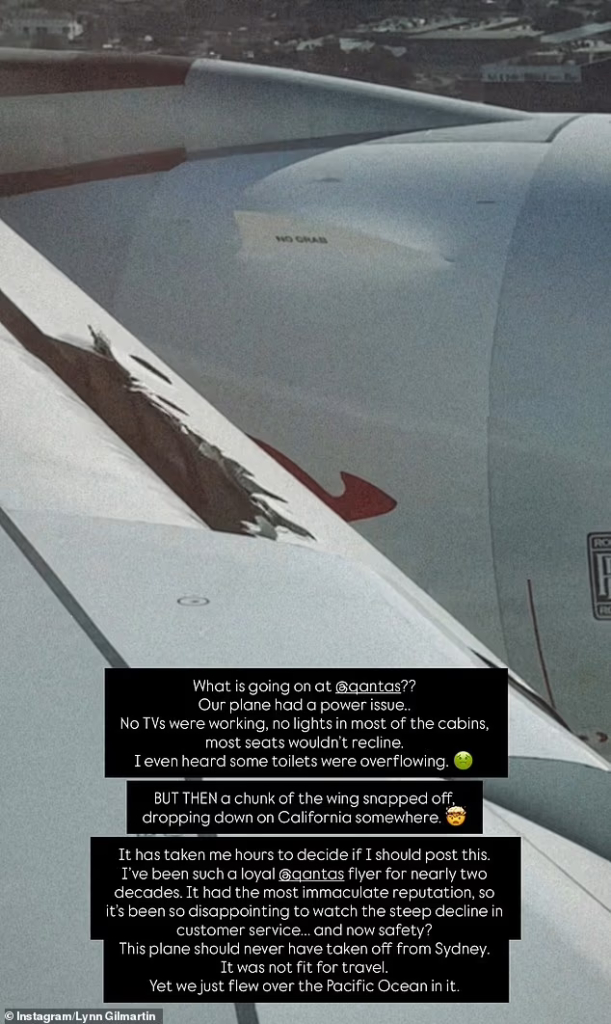
Gilmartin wrote:
“What is going on at Qantas? Our plane had a power issue… No TVs were working, no lights in most of the cabins, most seats wouldn’t recline. I even heard some toilets were overflowing. BUT THEN a chunk of the wing snapped off, dropping down on California somewhere.”
In her post, Gilmartin adds that, as a loyal Qantas flyer “for nearly two decades,” she hesitated to share her experience publicly, taking “hours to decide,” but that she saw the event as both a service and a safety failure for the airline.
“This plane should never have taken off from Sydney. It was not fit for travel. Yet we just flew over the Pacific Ocean in it,” Gilmartin concluded.
Qantas responds to A380 failures during 1st flight back in service
A Qantas spokesperson acknowledged the slat issue, telling Aero South Pacific, “A section of the slat on the left wing of one of our A380s was found to be damaged after landing in Los Angeles, Sunday local time. The aircraft operated normally and landed without incident. Engineers are now replacing the slat so it can return to operations this week.”
The Daily Mail quotes a Qantas spokesperson responding to Gilmartin’s other claims:
“It was the slat on the wing which was seen, I wouldn’t say it was a chunk. It’s used when the aircraft take off or land. It was looked at by engineers when it came into LA and after a part comes in from Dubai, it will be in operation again on Thursday. The A380 is very popular and it’s a very busy time of year.”
Qantas also confirmed that in-flight entertainment was unavailable for most of the flight, but did not address other issues with lighting, seating, or lavatories.
The airline’s spokesperson added that Qantas had compensated passengers on the flight with “points or some flight credits as a way of saying thank you for bearing with us during that disturbance.”
Other Airbus A380 wing slats have fallen apart
As AGN first reported in July, wing slat defects on Airbus A380s have affected multiple airlines.
A safety investigation carried out by France’s Bureau d’Enquêtes et d’Analyses pour la sécurité de l’aviation civile (BEA) into an incident involving Emirates flight EK77 on approach to Nice Côte d’Azur Airport in August 2023 found bonding defects within the composite trailing edge of the wing slat. As a result, ruptures can occur between the honeycomb core and the upper and lower skin layers of slats.

Airbus simulations showed that the damage does not significantly affect lift or overall flight safety margins. Based on these simulations, the BEA reclassified the Emirates A380 event as an incident rather than an accident.
However, three of Singapore Airlines’ A380s subsequently ran into similar issues. As AGN previously reported, Airbus was preparing to issue two service bulletins in January 2026 that would require repetitive inspections of the leading-edge slats during scheduled A- and C-maintenance checks.
The European Union Aviation Safety Agency (EASA) was overseeing Airbus’ investigations and corrective actions on this fault.
EASA publishes AD calling for wing slat and droop nose assembly part confirmation
On 2 December 2025, EASA issued Airworthiness Directive 2025-0270. It does not directly mention the bonding defects found by the BEA investigation, but does require operators of A380s to identify part numbers and the configuration of leading-edge wing slats and droop nose assemblies.
EASA calls on operators to verify these against an updated Airbus Illustrated Parts Catalogue and to take corrective action if any components do not match approved configurations.
According to EASA, the directive was prompted by concerns about outdated or incorrect slat interchangeability information in maintenance documentation, which could result in incompatible parts being in service. It was described as a preventive airworthiness measure. The AD becomes effective on 16 December 2025.

In the case of VH-OQC, the slat damage occurred after the directive was published but before its compliance deadline, meaning the aircraft was not yet legally obligated to undergo the newly mandated verification checks even though its specific component family is now under scrutiny.
Furthermore, while the AD called for checks on certain non-compliant parts, Qantas’ A380 (MSN 22) was not included in Group 1 for priority checks, which must be conducted within a 36-month window.
It is also currently unknown whether this AD resulted from Airbus’s investigation into the delamination issue identified by BEA in its investigation of the Emirates A380, and whether the AD is directly tied to that fault. AGN has reached out to Airbus for comment.
The other issues passengers experienced on the flight are unusual for an aircraft that has recently undergone extensive maintenance as part of a return-to-service process. However, in-flight entertainment failures can occur unexpectedly.
ATSB is assessing Qantas A380 wing slat failure
As several Australian news outlets have reported, the Australian Transport Safety Bureau (ATSB) has received a mandatory occurrence report and is assessing whether a full safety investigation is justified.
Areas of interest may include whether the aircraft’s extended storage and reactivation processes contributed to degradation, and whether the damaged slat exhibited any signs of manufacturing or bonding defects.
Qantas has stated that the aircraft will return to service once the replacement slat is installed and all checks are complete. Operators and regulators alike will likely monitor this event alongside the upcoming EASA AD compliance period, especially as global fleets of A380s continue operating well into their second decade of service.
For Qantas, the unexpected grounding tarnishes what was meant to be a jubilant return to full international long-haul operations for “Paul McGinnes.”
Featured Image: Qantas