2nd test flight for NASA’s X-59 quiet supersonic aircraft ends early after system warning

March 23, 2026
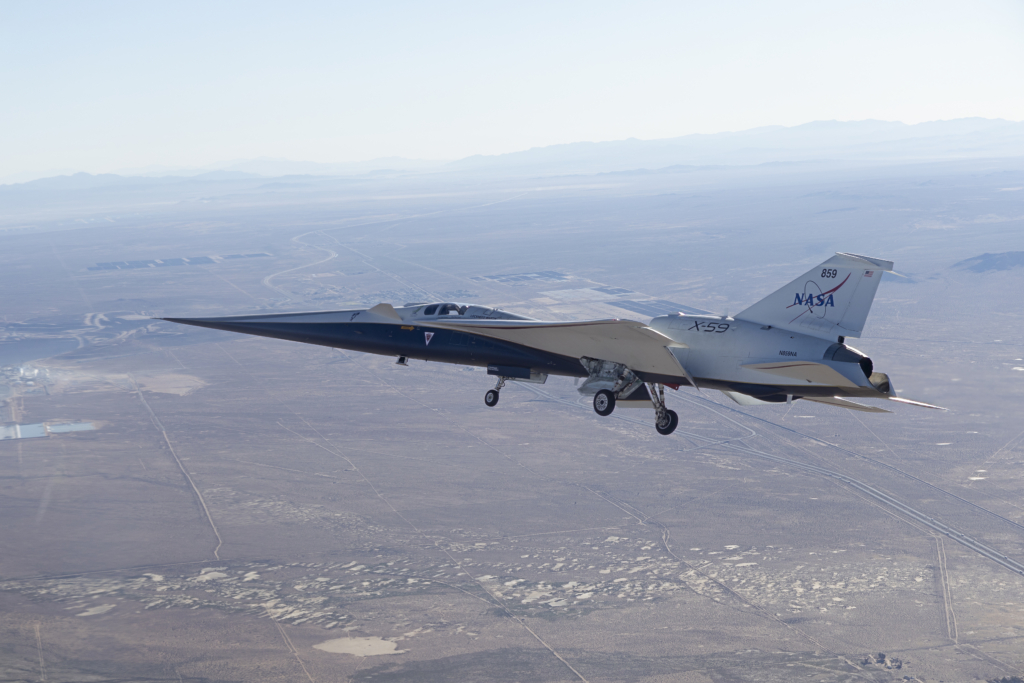
![NASA's X-59 Quesst [registration N859NA '859'] is seen in-flight over California during the experimental supersonic aircraft's brief second test sortie on 21 March 2026. Image: NASA/Jim Ross](https://aerospaceglobalnews.com/wp-content/uploads/2026/03/X-59-Second-Flight-21-03-26-NASA-Jim-Ross-crop-scaled.jpg)
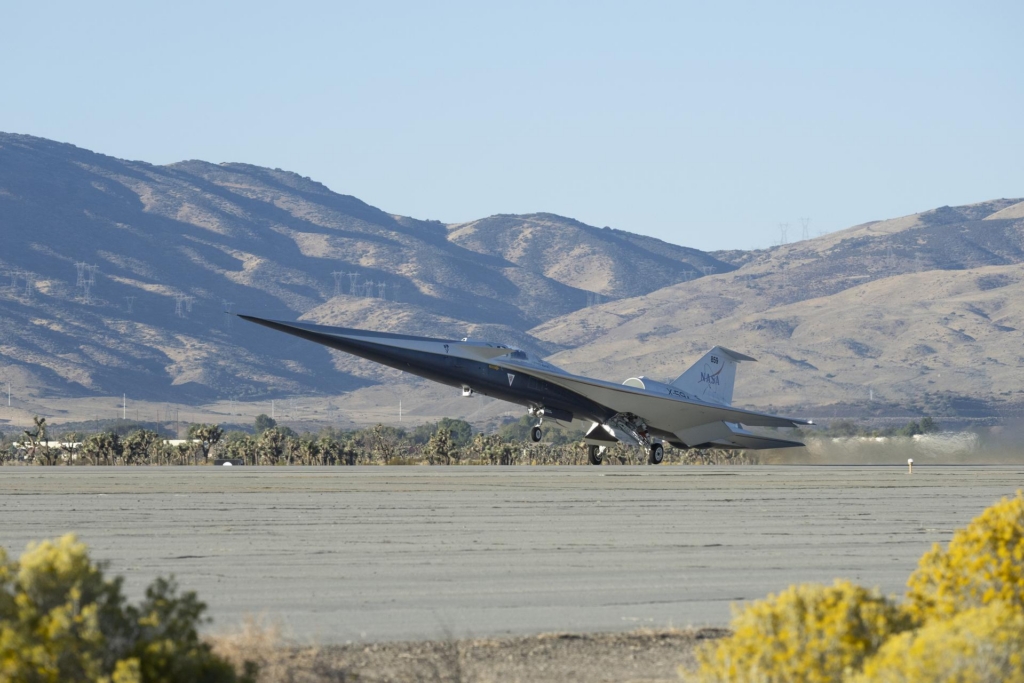
NASA’s experimental X-59 aircraft, central to its Quiet Supersonic Technology (Quesst) mission, returned to the skies over California on 21 March for its second test flight, but the sortie was cut short after just nine minutes due to an onboard system warning.
With test pilot Jim ‘Clue’ Less at the controls, the aircraft departed Edwards Air Force Base at 10:54 PST following a series of ground checks. However, the warning prompted an immediate return-to-base, with the X-59 landing safely at 11:03 PST.
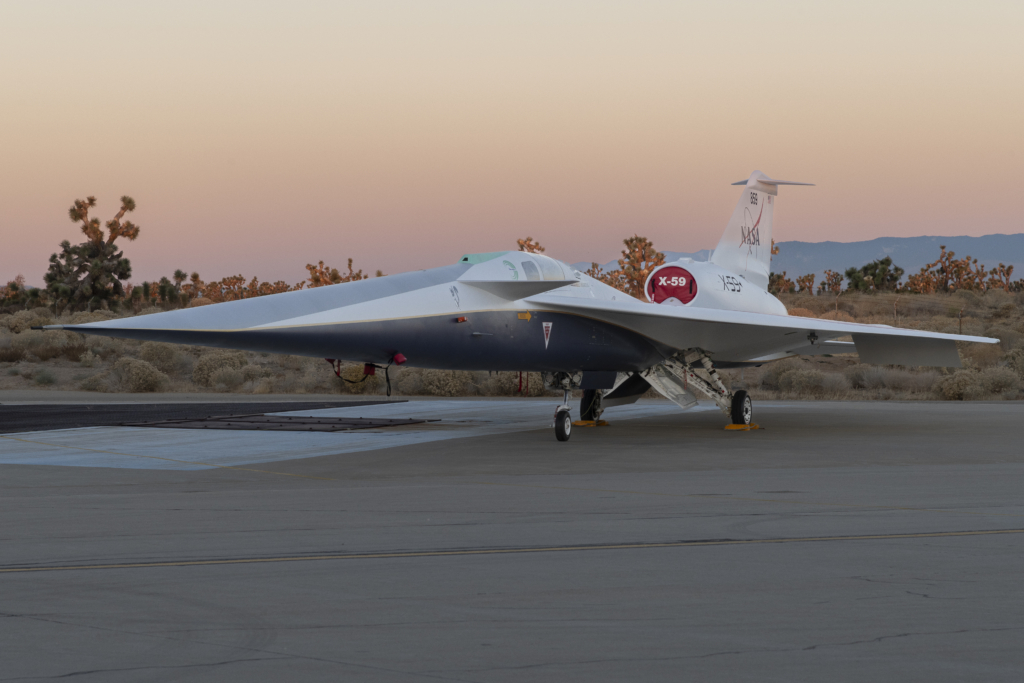
Before being cut short, the sortie was intended to expand the X-59’s flight envelope, building on its maiden flight on 28 October 2025. That first mission saw the aircraft reach 12,000ft and 200kts, with this second test planned to push performance further to 20,000ft and 220kts during a one-hour profile.
Reflecting on the abbreviated flight, test pilot Jim ‘Clue’ Less said: “I certainly hoped to have more to talk about than nine minutes of flight, but the plane performed great. The take-off roll and lift-off was uneventful and we were climbing out, getting ready to set up for the first test point when we got the warning, which required an immediate return-to-base…”
After taking off at 10:54 a.m. PDT, NASA's quiet supersonic X-59 aircraft returned prematurely following a return-to-base call. The pilot and aircraft landed safely and successfully. More information is forthcoming. https://t.co/cFTERKA4g9 pic.twitter.com/eTzlCmuLKQ
— NASA Aeronautics (@NASAaero) March 20, 2026
“Although I had not intended to have to land quite as urgently for my first landing, the plane performed beautifully,” he added.
“The control room team backed me up; they were all working just great [and] firing on all cylinders and we got the plane back about nine minutes after take-off. The landing was uneventful. Roll out and stopping was all as we expected. As we like to say, it was just like the simulator [and] that’s what we want to hear.”
NASA charts success despite second X-59 flight being cut short
During a post-flight teleconference on 21 March, representatives from NASA and Lockheed Martin Skunk Works confirmed the X-59 had safely returned to its hangar at Armstrong Flight Research Center, with teams now investigating the cause of the warning.
Despite the curtailed sortie, the Quesst programme team stressed that valuable data had still been gathered to support ongoing testing.
Speaking on the call, Bob Pearce, Associate Administrator for NASA’s Aeronautics Research Mission Directorate, said,
“Every test flight is a step towards proving [the X-59’s] airworthiness and that’s the goal right now so we can start the Quesst mission. We want to collect all the data we can and evaluate the system. So today, flying for nine minutes, provided nine minutes more data than we had yesterday…”
He stressed that the programme remains inherently complex, describing the X-59 as an “unprecedented” aircraft that brings together a large number of integrated systems, all of which must be tested together to uncover and resolve issues as they emerge.
Pearce added that NASA is deliberately taking a cautious, methodical approach to the campaign, allowing each flight to “unfold” while prioritising safety and mission success. The ultimate aim, he noted, is to enable routine supersonic flight over land without the disruptive sonic boom, but only once the aircraft’s performance and reliability have been fully proven.
“We let these flights unfold [and] we approach this experimental flight cautiously. While we’re pursuing revolutionary aviation research like this to enable supersonic flight over land without making the loud sonic boom, we’ve got to do it in a way that’s safe and ensures mission success,” he explained.
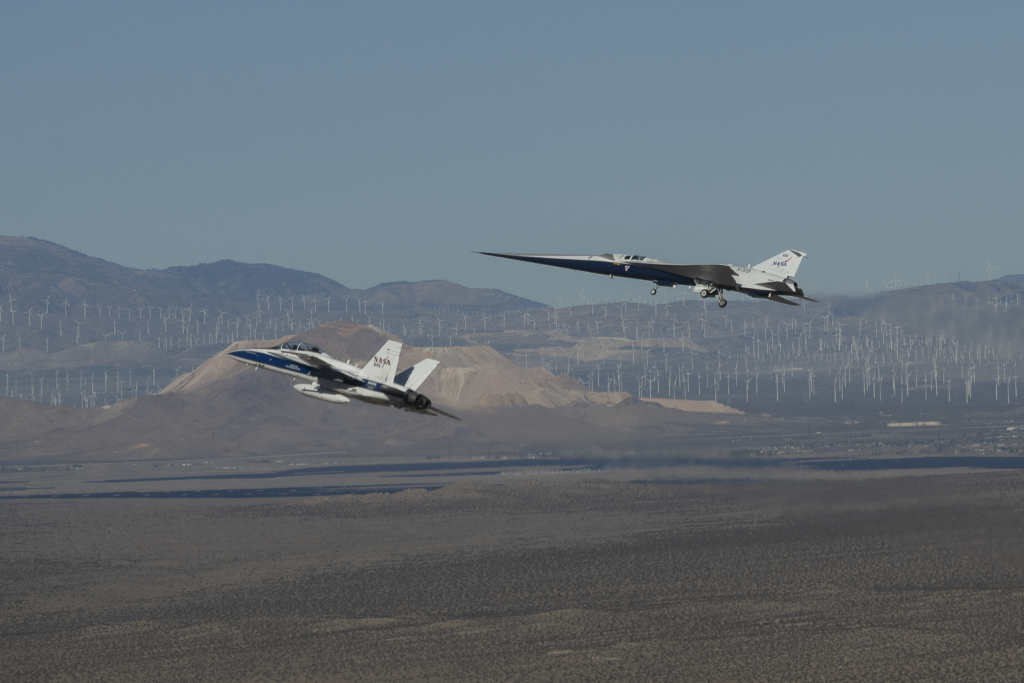
Despite the early return, NASA was able to gather additional data on the X-59’s performance and control laws. The sortie also included the aircraft’s first heavyweight landing and marked the initial use of string gauges, providing the loads team with valuable data to validate structural airworthiness and safety margins.
The aircraft will remain grounded while engineers investigate the cause of the warning, but the programme team remains focused on returning to flight. The X-59 is expected to complete more than 100 test sorties from Edwards before progressing to the next phase of the Quesst mission.
X-59 Quesst: The key to reshaping supersonic air travel?
Jointly developed by NASA and Lockheed Martin Skunk Works, the X-59 represents a bold leap forward in aircraft design, combining cutting-edge aerodynamics with an innovative approach to supersonic flight.
Unlike traditional commercial supersonic jets – such as Concorde – which produce a disruptive sonic boom upon breaking the sound barrier, the X-59 is engineered to minimise this effect, replacing the thunderous boom with a quieter ‘thump’.
This is achieved through its uniquely long and slender, dagger-shaped fuselage – which is 99ft 7in (30.35m) long with a wingspan of 29ft 6in (9m) – along with its carefully designed vertical stabiliser and single, top-mounted F414-GE-100 afterburning turbofan engine.
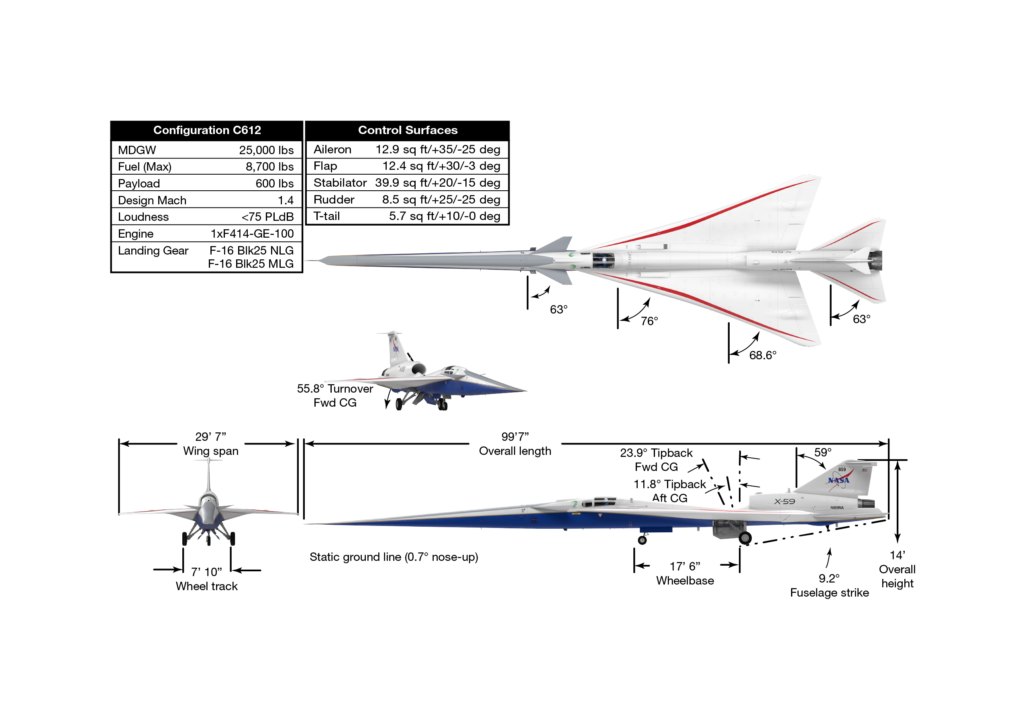
The extremely slender, yet purposeful, design of the X-59 means that it lacks a forward-facing cockpit windscreen, which itself has been replaced by the innovative eXternal Vision System (XVS).
Developed by NASA Langley, the unique XVS is a suite of 4K ultra-high-definition (UHD) cameras, sensors and multifunction displays (MFDs) that projects real-time forward imagery into the cockpit to provide an accurate picture of what lies ahead of the X-59 in flight. This concept dates back to NASA’s High-Speed Research Program in the 1980s and 1990s, but earlier technology lacked the fidelity and latency required for safe flight.
Together, these design qualities aim to reshape and separate the shockwaves generated when flying supersonic overland, so they reach the ground as a soft, neighbourhood-friendly ‘thump’ that is projected to be below 75 PLdB (Perceived Level of Noise). For comparison, Concorde’s sonic boom reached between 105-110 PLdB.
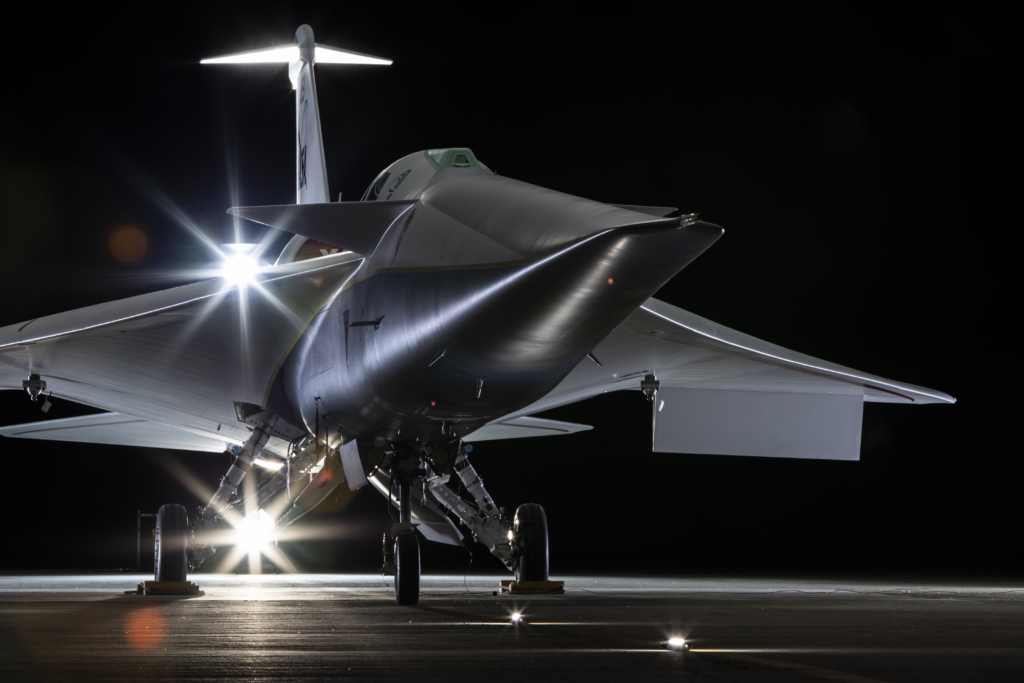
The aircraft’s ability to fly faster than sound without disturbing communities below has profound implications for commercial aviation, potentially unlocking supersonic air travel routes over land that were previously restricted due to noise regulations – something that was a key hinderance in Concorde’s success.
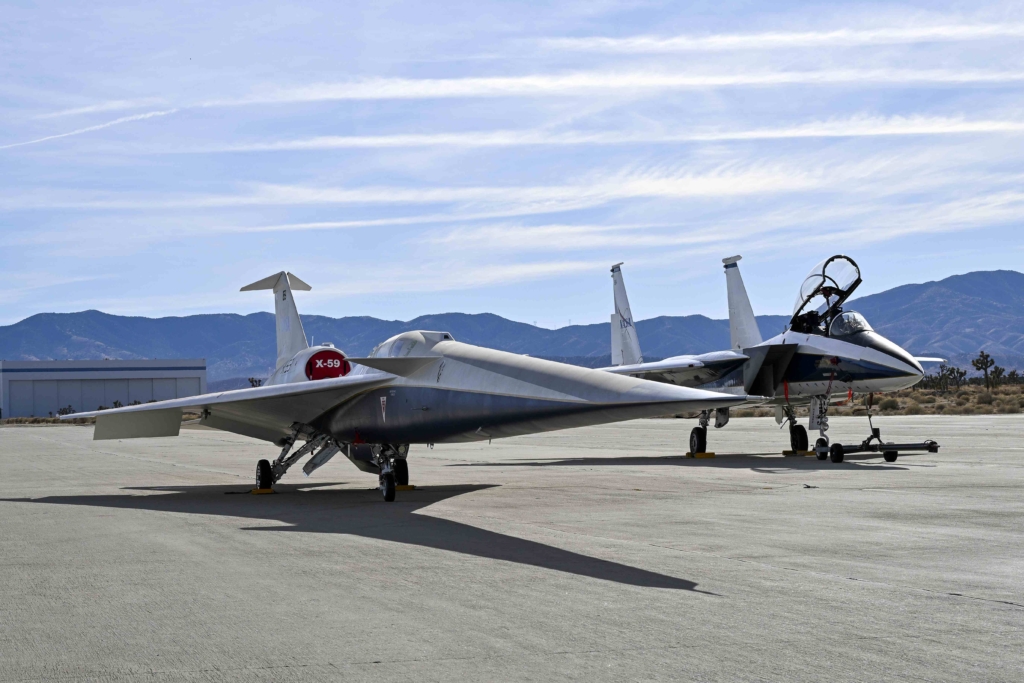
The X-59 is a key element of NASA’s Quesst mission, which aims to demonstrate that supersonic travel over land can be conducted quietly, safely and in an environmentally sustainable and economically viable manner. By testing the X-59’s performance, technology and noise-reducing design qualities, NASA hopes to provide critical data that will enable future commercial supersonic aircraft to be certified to fly over land.
NASA’s X-59 flight testing: The roadmap from now
While the first phase of NASA’s X-59 test sorties aims to expand the aircraft’s flight envelope to its desired parameters, the second phase will serve as the acoustic validation for the experimental jet’s quiet supersonic ‘thump’. These tests will be carried out within the confines of Edwards AFB’s restricted test ranges.
Once this has been completed with a fully verified low-boom signature, NASA will begin the community overflight phase of the Quesst mission. For this, the X-59 will fly several supersonic missions over selected communities to gather data from the residents’ response to the quieter ‘thump’, which will validate its low-boom design and inform future noise-based civil supersonic flight regulations.
In support of these test activities, a NASA-operated F-15D research aircraft, complete with a newly installed near-field shock-sensing probe, will be used to capture shockwave data from the X-59 as it flies faster than the speed of sound. A timeline for these activities has yet to be finalised, but these tests are expected to take place over areas of different geographical and atmospheric conditions.
Ultimately, the broader significance of the X-59 extends beyond technical achievement. It represents a pivotal step toward redefining the speed and convenience of air travel, reducing flight times on long-haul routes and fostering a new era of quieter, faster supersonic transportation. Its success could open up a new frontier for the civil aviation industry, transforming the way we think about global connectivity.
Featured Image: NASA’s X-59 Quesst (registration N859NA ‘859’) is seen in-flight over California during the experimental supersonic aircraft’s brief second test sortie from Edwards AFB on 21 March 2026. Image: NASA/Jim Ross