On-time non-performance: The 5 worst airlines for delays in the USA this year

December 22, 2025

US carriers struggled with punctuality this year, leaving millions of passengers waiting longer than expected. Although overall performance varies by season, several airlines rank poorly for on-time performance, defined by the Bureau of Transport Statistics as flights arriving within 15 minutes of schedule.
US airlines ranked by on time perfomance
According to BTS data for the first six months of this year, compiled by USAFacts, the five worst US airlines for on-time performance were:
- PSA with just 65.7% of its flights on time
- Frontier with 70%
- Air Wisconsin with 71.3%
- United Express with 72.6%
- American Airlines with 73.6% of its flights on time
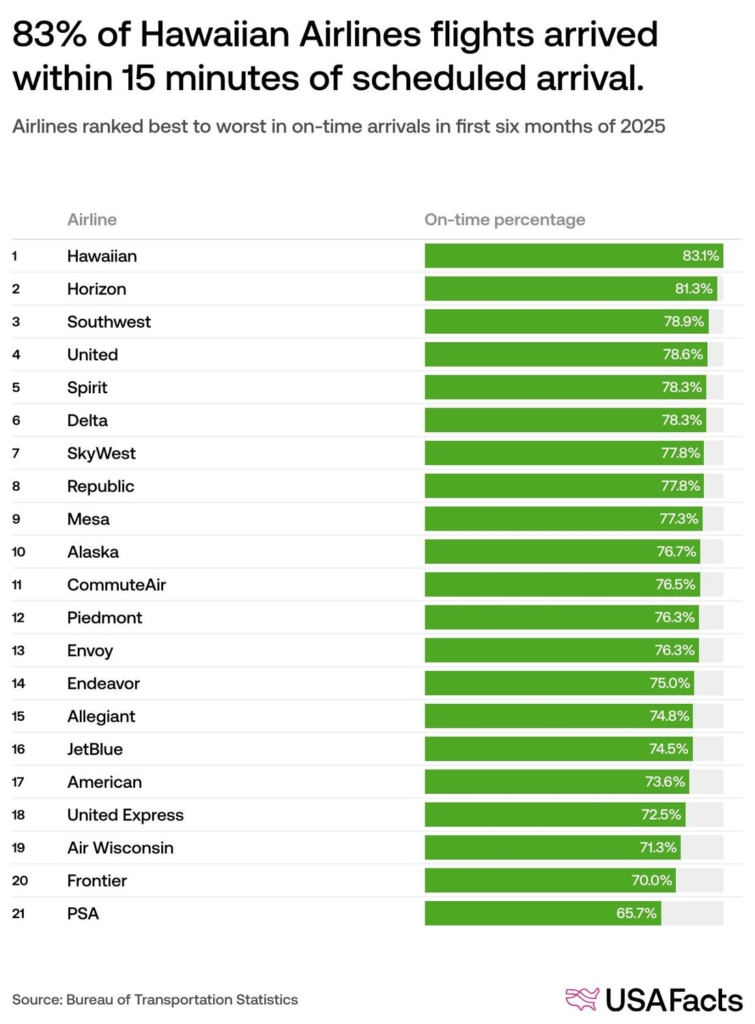
The five best performing airlines, landing as scheduled, were:
- Hawaiian Airlines with 83.1% of its flights on time
- Horizon with 81.3%
- Southwest with 78.9%
- United with 78.6%
- Spirit with 78.3%
What’s been delaying airline flights in the US this year?
There are seven primary causes of flight disruptions, as categorised by the Bureau of Transport Statistics. System-wide, the majority of flights (76.49%) arrived on time based on BTS data available from January through September 2025, but this still leaves nearly a quarter of all flights facing some disruption.
- Weather accounted for 0.96% of delays. Seasonal weather volatility remains among the leading systemic causes of delays nationwide. Severe weather at either the departure or the arrival airport will disrupt schedules and cause delays that might cascade through the system.
- Air carrier factors accounted for 6.57% of delays. Airline operations can encounter disruptions that delay flights. Issues such as aircraft maintenance events, crew scheduling conflicts, or baggage-loading problems can prevent flights from departing on time, potentially leading to carryover delays throughout the day.
- National Aviation System issues accounted for 6.26% of delays. Air traffic control staffing shortages or heavy airport congestion may prompt regulators to temporarily suspend takeoffs and landings. These delays also cascade through the system, potentially impacting hundreds of flights.
- Security issues accounted for 0.04% of delays. TSA or other security holdups may prevent passengers from arriving at the gate on time, delaying the aircraft’s departure.
- Late-arriving aircraft were the leading cause of disruption this year, accounting for 7.8% of delays. When an inbound flight is delayed, it affects the outbound schedule. However, the inbound delay may be attributable to one of the previous factors.

There were 5,242,921 flight operations in all, through September of this year, in the United States.
- Flight cancellations accounted for 1.51% of flight operations; however, flights may also be cancelled for other leading factors, such as weather, aircraft maintenance events, or NAS issues. BTS registered 76,476 flight cancellations through September.
- Diverted flights accounted for 0.3% of flight operations. There are times when flights may not land at their intended destination due to several factors, including weather, aircraft issues, passenger disruptions on board, or air traffic control requirements; however, such occurrences are rare. There were 15,750 flight diversions through September.
Air traffic controller staffing & government shutdown impact
One of the big stories of 2025 was the impact of the US government shutdown, which had lingering effects on aviation staffing and capacity.
The FAA implemented temporary flight operations cuts at dozens of airports due to air traffic control staffing constraints, reducing capacity by up to 10% during peak periods.
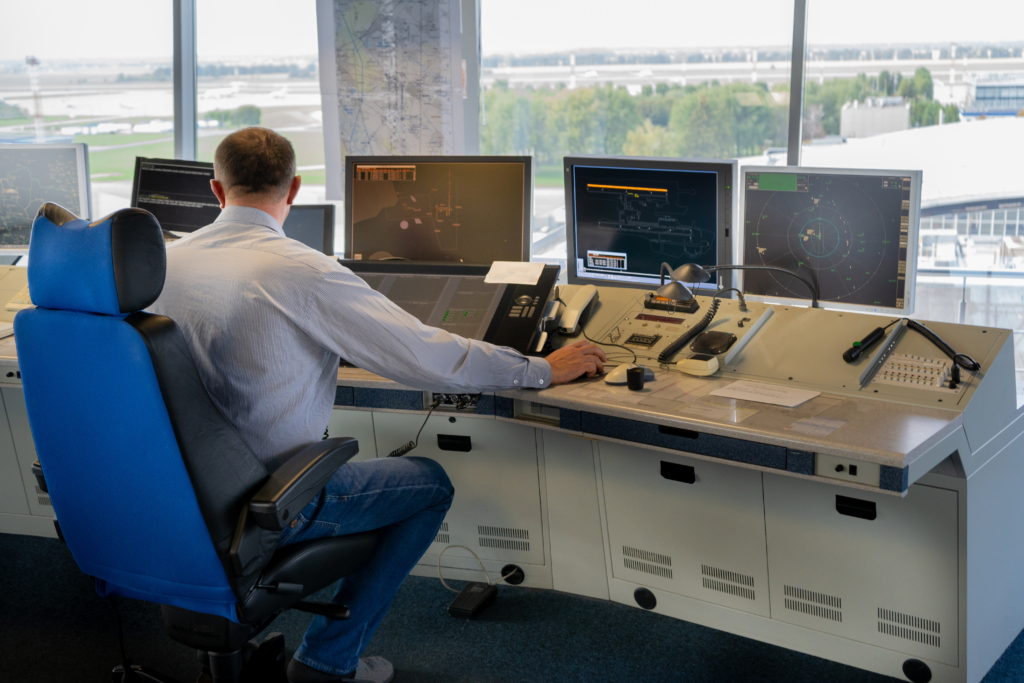
These operational limits caused persistent system-wide delays and knock-on effects across hubs, especially in the Southeast and Midwest, where controller staffing ratios are critical.
Even after funding resumed, airlines and airports reported residual scheduling congestion.
Technical and operational disruptions
This year also saw major airline-specific disruptions. United Airlines and others were affected by significant IT scheduling outages in late summer and early fall, which cascaded into thousands of flight delays as crews and aircraft were misaligned. Airlines suffered operational challenges disrupting flights, especially at large hubs.
In November, some carriers reported fleet and scheduling stresses due to software updates required for Airbus A320-family aircraft to address solar radiation interference with ELAC systems. Although the issue was addressed quickly, positioning aircraft for the required maintenance caused some flight disruptions.
Airports with the most flight delays in 2025
Passengers are more likely to experience delays when flying from or to specific airports.

According to BTS data compiled by USAFacts, the five worst airports in terms of delays were:
- Washington, DC (DCA) – 67.2% on time arrivals
- Newark (EWR) – 70.8%
- Dallas-Ft. Worth (DFW) – 71.5%
- Philadelphia (PHL) – 73.6%
- New York LaGuardia (LGA) – 73.8%
Can passengers avoid flight delays?
Airline operations are vulnerable to several factors that may cause schedule disruptions, some of which are outside of an airline’s control. Booking flights with carriers that have a strong on-time performance record is no guarantee that a severe weather event or airspace issue won’t delay your flight. Nevertheless, it reflects well on the airline’s operations and can be used as a gauge of future performance.
Since flight complications accumulate during the day, the best way to avoid flight delays is to book flights that depart first thing in the morning whenever possible. It’s also advisable to plan leisure family trips when weather conditions are less likely to cause disruption in the area where you are travelling, for example, avoiding the peak winter storm season in the north (around February) and the peak hurricane season around the tropics (around September).
Of course, the best policy when flying is to always pack your patience.
Featured Image: American Airlines