Lufthansa is the latest to move to Starlink as traditional IFC providers struggle to compete with LEO

January 14, 2026

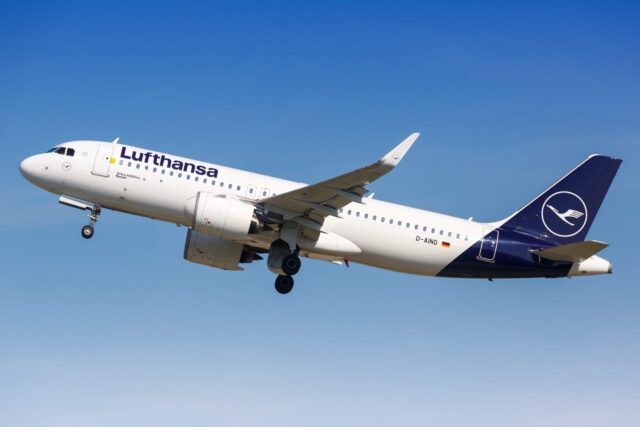
The Lufthansa Group has announced an in-flight connectivity (IFC) partnership with SpaceX’s Starlink to equip its entire global fleet—more than 850 aircraft across all member airlines—with high-speed satellite internet access.
The agreement marks one of the most ambitious in-flight connectivity transformations in European aviation and aligns with Lufthansa’s ongoing investment in premium passenger experience and digital innovation.
What the Lufthansa-Starlink deal entails
Under the new agreement, Starlink’s broadband internet service will be rolled out across the group’s airlines—including Lufthansa Airlines, SWISS, Austrian Airlines, Brussels Airlines, ITA Airways, and others—beginning in the second half of 2026, with full deployment targeted by 2029.
The satellite-based system promises faster speeds, lower latency, and broader coverage than traditional in-flight connectivity platforms, enabling streaming, video conferencing, cloud work applications, and other bandwidth-intensive services at altitude.
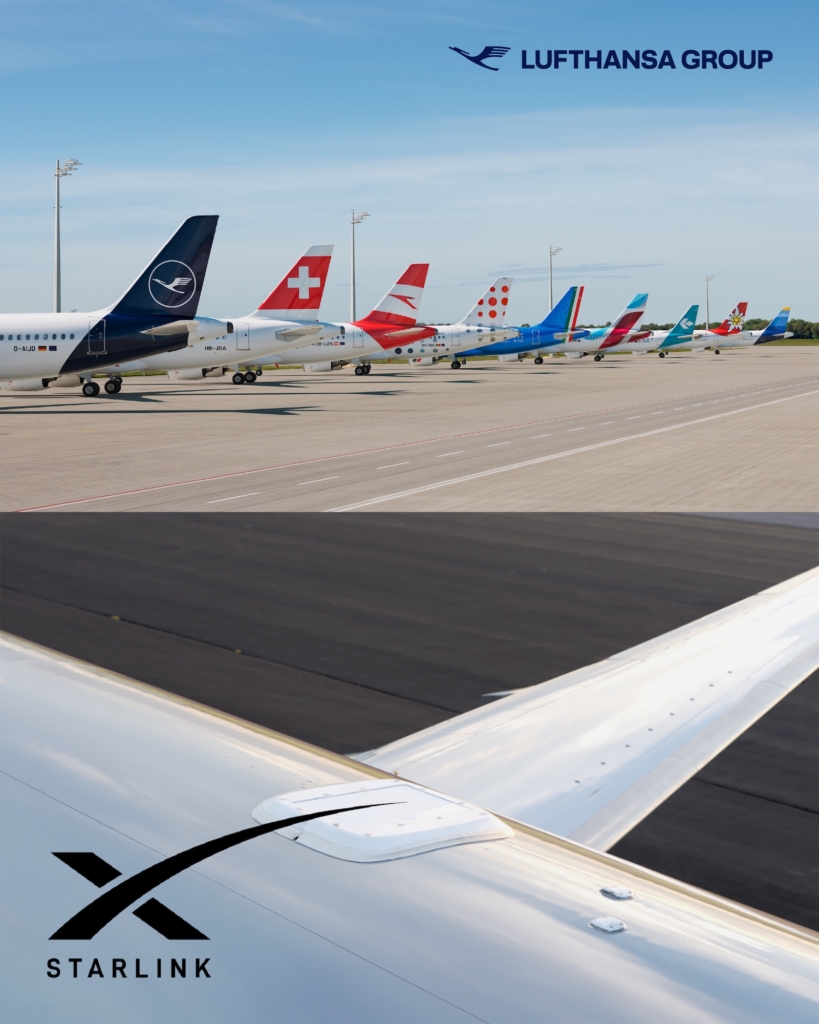
“In our anniversary year, in which we are celebrating Lufthansa’s 100th birthday, we have decided to introduce a new high-speed internet solution from Starlink for all our airlines,” says Dieter Vranckx, Chief Commercial Officer of the Lufthansa Group..
“The Lufthansa Group is taking the next step and setting an essential milestone for the premium travel experience of our customers. Connectivity on board plays an important role today, and with Starlink, we are not only investing in the best product on the market, but also in the satisfaction of our passengers.”
As part of the rollout, Lufthansa Group plans to offer the enhanced Starlink WiFi free of charge for its frequent flyers and Travel ID members across all travel classes.
Lufthansa in-flight connectivity before Starlink
Before announcing the Starlink partnership, the Lufthansa Group had primarily relied on its FlyNet in-flight internet service—a Panasonic Avionics satellite-linked WiFi service developed in partnership with Deutsche Telekom.
The service has evolved since its initial introduction, historically offering basic internet access—with usage fees for full connectivity—while lighter services, such as messaging or limited free access, are also available.

While FlyNet and similar legacy systems provided essential connectivity, which is better than having no WiFi at all, performance has varied. Some passengers have reported slow or inconsistent speeds—particularly on long-haul flights. More passengers now have expectations of ground-like broadband in the skies.
Starlink’s rapid ascent in airline in-flight connectivity
With major airline announcements, Starlink’s entry into the airline industry is significantly changing the in-flight connectivity market, delivering terrestrial broadband experiences in the skies.
Built on a low-Earth orbit (LEO) satellite constellation—with thousands of satellites already in service—Starlink reduces signal latency and increases capacity when compared with traditional geostationary (GEO) satellite systems that orbit much farther from Earth. Lower latency and higher throughput enable smoother video streaming, real-time applications, and corporate productivity services on board.
Over the past two years, Starlink has gained traction among several major carriers: United Airlines, Qatar Airways, Emirates, Air France, IAG, and others have either announced plans to equip aircraft with Starlink internet or already rolled out such plans. The Lufthansa Group announcement puts it among the largest airline fleets committed extensively to the technology.
The in-flight connectivity market gravitates to LEO satellite networks
Latency, driven by the distance between the receiving antenna and the satellite in orbit, and satellite coverage, driven by the scope and range of the constellation, are two key factors driving in-flight WiFi service quality. GEO satellites cover larger areas, but have higher latency. LEO satellites have more limited coverage areas, so more satellites are required in the constellation to ensure a seamless connection in-flight, but they have significantly lower latency.
Starlink’s LEO constellation is the most advanced and widely deployed globally for broadband satellite internet. Its large constellation enables high-speed, low-latency coverage that’s attractive for gate-to-gate in-flight connectivity. The service is not the only competitor in the in-flight connectivity segment; other LEO constellations are also targeting airlines, and some established in-flight connectivity providers are striking partnerships with those services to retain their market share.

OneWeb (now part of the Eutelsat Group) operates its own LEO constellation and is a principal competitor to Starlink for broadband LEO connectivity. In 2023, it merged with French satellite operator Eutelsat, combining resources and spectrum to expand its global LEO coverage. OneWeb has partnerships in aviation connectivity, including collaborations with service providers to offer LEO-based internet to aircraft.

Amazon’s Project Kuiper is a planned LEO broadband network designed to deliver global internet access, including future aviation use cases. It has begun deploying satellites, with thousands planned over the coming years.
JetBlue Airways announced a partnership leveraging Kuiper LEO satellites for improved onboard WiFi beginning in 2027—marking one of the first airline deals for the constellation. Amazon continues to expand its hardware portfolio to support high-performance LEO connectivity for enterprise and aviation customers.
Telesat Lightspeed is a planned LEO constellation designed to serve global broadband markets, including aviation. While still under deployment, Lightspeed is positioned as a LEO alternative to Starlink and OneWeb.
How in-flight connectivity services are shifting and blending orbits
Other in-flight connectivity providers are responding to Starlink by combining satellite orbits to offer in-flight connectivity that can compete with its high-speed service.
Viasat has been a long-time provider of satellite broadband—historically via geostationary (GEO) satellites—and a major competitor in airline connectivity, especially in North America. Viasat provides internet to carriers such as Delta and American via high-throughput satellites. The IFC provider’s GEO services have higher latency than LEO services, but the company is innovating in multi-orbit and hybrid solutions to remain competitive.
Intelsat, now part of SES, has also been an established player in in-flight connectivity, growing through satellite services and through its acquisition of Gogo’s airline business. Although largely GEO/MEO (mid-earth orbit) now, combined with broader SES capabilities, it can support LEO through partnerships such as OneWeb integration.

Saudia’s new high-speed in-flight WiFi is powered by Neo Space Group (NSG), a Saudi IFC provider backed by the Public Investment Fund (PIF). The service delivers broadband internet at speeds up to 300 Mbps (with future upgrades planned to 800 Mbps), free for all passengers, and allows multiple device connections and streaming/video conferencing at altitude.
While NSG doesn’t run its own satellite constellation, it leases capacity from Luxembourg’s SES via the SES Open Orbits multi-orbit platform, which integrates GEO and MEO satellite capacity to offer broad coverage and performance suitable for airline use.
This solution is not a pure LEO service like Starlink or OneWeb. Instead, it’s built on a multi-orbit architecture in which NSG provides airline-facing connectivity, and SES delivers satellite broadband—competing with traditional GEO/MEO and emerging LEO providers.
What Lufthansa’s Starlink deal means for passengers and the airline industry
Starlink’s ability to deliver up to hundreds of megabits per second per aircraft, along with the maturity and size of its satellite constellation, has been a strong catalyst for growth, attracting carriers who want to offer competitive in-flight digital experiences that mirror ground-based connectivity quality as a core part of their passenger experience.
Robust internet service is increasingly a baseline expectation for air travel. For passengers, the Starlink rollout promises a leap in in-flight internet performance, with fast, reliable broadband becoming a brand differentiator for the growing segment of digital-native passengers. It also appeals to premium and business travellers, ensuring that working in the air feels as seamless as on the ground.

For the airline industry, high-speed, reliable satellite broadband has become a core strategic differentiator, with more airlines offering free connectivity bundled with loyalty program membership. With the rapid rise of Starlink, the in-flight connectivity space is now a heated competition in which passengers are definitely the winners.
Featured Image: Lufthansa Group