How Lockheed Martin’s X-62A VISTA is teaching artificial intelligence to fly fighter jets

December 30, 2025

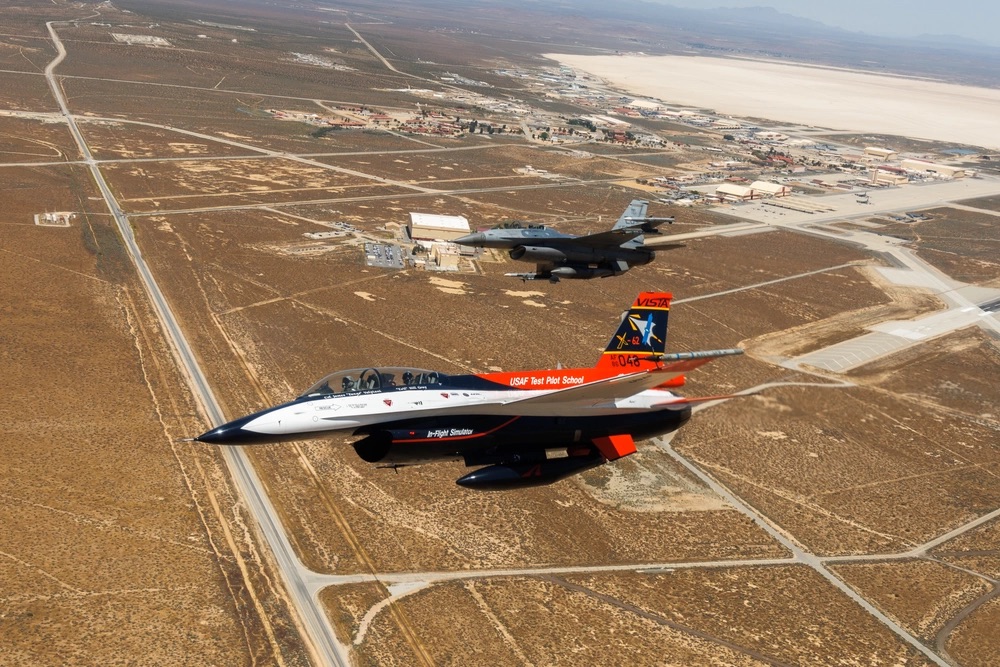
On the sun-bleached flight line at Edwards Air Force Base, an orange-and-white F-16 lifts off looking much like any other fighter. There is no visual clue that this jet is doing something that no operational aircraft is allowed to do.
Inside the cockpit, control is being handed to software. Not autopilot logic or scripted manoeuvres, but artificial intelligence systems learning, in real flight, how to fly, fight and make tactical decisions at jet speed.
This aircraft is the Lockheed Martin X-62A VISTA, a one-off test platform that has become one of the most important laboratories in the United States’ push towards autonomous air combat. It is not a prototype fighter, and it will never deploy.
Its role is harder, and arguably more consequential: to determine whether artificial intelligence can be trusted in the most unforgiving environment aviation has to offer.
From F-16 fighter jet to AI flying laboratory
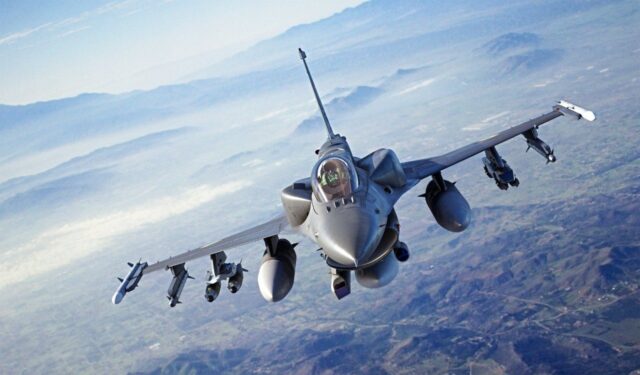
The X-62A VISTA began life as a standard F-16D Block 30, the two-seat variant of the Fighting Falcon. Its second career started in the early 1990s, when it was converted into the Variable In-Flight Simulation Test Aircraft, or VISTA.
First flown in 1992, VISTA could deliberately alter its flight characteristics while airborne, allowing test pilots to experience the handling qualities of aircraft that did not yet exist, or that would be too unstable to fly safely in prototype form. For decades, it has been central to training at the US Air Force Test Pilot School, exposing students to extreme and unconventional flight regimes.

In 2001, the aircraft was redesignated NF-16D, the “N” prefix marking it as permanently modified for experimental work. But as autonomy research accelerated, the aircraft’s ageing systems became a limiting factor. To keep pace, VISTA needed a fundamental rebuild.
The X-62A VISTA was redesignated as a US Air Force X-plane
That rebuild culminated in June 2021, when the aircraft was redesignated X-62A VISTA. In US military aviation, the X prefix is reserved for aircraft exploring genuinely experimental territory, placing VISTA in the same lineage as the Bell X-1 and the X-15.
The redesignation followed a major upgrade programme known as GEN2020, which modernised the jet’s flight computers, software architecture and safety systems specifically to support artificial intelligence and autonomy research. VISTA was formally recognised as a national asset, and the test pilot school became the only one in the world operating an active X-plane as part of its curriculum.
How the X-62A VISTA simulates other aircraft in flight
What makes VISTA unique is its ability to behave like other aircraft while remaining physically an F-16. This capability is built around the VISTA Simulation System, developed by Calspan, combined with Lockheed Martin’s model-following flight control algorithms.
Together, these systems allow the jet’s natural aerodynamics to be overridden in software. Control laws can impose the handling qualities of aircraft that exist only as digital designs, including uncrewed combat air vehicles or deliberately unstable configurations that would never be flown as prototypes.
Crucially, those control laws can be developed and installed in months rather than years, allowing rapid iteration that mirrors the pace of software development rather than traditional aircraft programmes.
The X-62A VISTA enables safe testing of autonomous flight
Flying artificial intelligence in a fast jet introduces obvious risks, which VISTA manages through what engineers describe as a “safety sandbox”. The aircraft retains a two-seat cockpit, with a safety pilot able to instantly disengage autonomous control. Automatic trip systems can also revert the aircraft to a known safe state if predefined limits are exceeded.

Unlike many autonomy programmes that remain confined to simulators or tightly segregated ranges, VISTA operates in real, controlled airspace. Autonomy algorithms must respect airspace rules, range safety constraints and operational boundaries, forcing AI systems to behave within conditions far closer to those they would face in service.
This approach dramatically increases testing tempo. With a human safety pilot onboard, engineers can push autonomy systems harder and faster, evaluating new algorithms in real flight up to an order of magnitude quicker than traditional uncrewed testing would allow.
The X-62A VISTA and the rise of AI-driven air combat
VISTA now sits at the centre of autonomy research led by the Air Force Research Laboratory, including Skyborg and Autonomous Air Combat Operations, as well as DARPA’s Air Combat Evolution work under DARPA.
These programmes are not aimed at replacing pilots, but at defining how humans and machines fight together. VISTA allows autonomy systems to be tested while simulating the performance of platforms such as the MQ-20 Avenger or future collaborative combat aircraft, exploring how many vehicles a single pilot could realistically command and which decisions should remain human-owned.

When artificial intelligence takes control of a fighter jet
In December 2022, the programme reached a watershed moment. Across 12 flights at Edwards, AI agents autonomously flew the X-62A while executing advanced fighter manoeuvres. Beyond-visual-range engagements and within-visual-range dogfighting scenarios were flown under different autonomy architectures, sometimes with software swapped between sorties in a matter of minutes.
Over more than 17 hours of autonomous flight, the aircraft remained within real-world airspace limits while optimising performance. Engineers observed that AI’s advantage was not aggression, but speed, evaluating options and adapting manoeuvres faster than a human pilot could physically react.
Some early behaviours were tactically sound but deeply counterintuitive to experienced pilots, underscoring the challenge ahead: aligning machine logic with human trust.
Why the X-62A VISTA matters to the future of fighter aviation
VISTA’s value extends beyond autonomy. Historically, it has been used to de-risk flight control laws for aircraft such as the Joint Strike Fighter before their first flights, helping bridge the gap between digital simulation and physical reality.
Today, operated through a partnership between the test pilot school, Calspan and Lockheed Martin Skunk Works, it plays a similar role for artificial intelligence.
The X-62A VISTA does not signal the imminent arrival of pilotless fighters on operational flight lines. Instead, it represents something more disciplined: a controlled, safety-driven pathway for understanding how artificial intelligence behaves in the air, and where its limits must be set.
In a future where algorithms increasingly shape combat decisions, VISTA ensures that when AI finally earns a role in the cockpit, it will do so having already flown, learned and been challenged in the real sky.
Featured image: Lockheed Martin