RELOS: India agrees to open its airbases to Russia in new military aviation pact

December 16, 2025

When Russia’s State Duma rose to ratify a logistics agreement with India this month, it did more than approve a legal document. It quietly reopened an operational runway linking two armed forces whose defence relationship has shaped Asia’s aviation and military landscape for more than six decades.
Signed in Moscow on 18 February 2025 and now cleared by both chambers of the Russian parliament, the Reciprocal Exchange of Logistics Support, or RELOS, agreement gives Indian and Russian military aircraft, warships and troops structured access to each other’s bases, airfields and ports.
With President Vladimir Putin signing the pact into federal law, it is now only a formal exchange of ratification instruments away from entering into force.
For the air forces of both countries, RELOS represents far more than refuelling rights. It restores predictable interoperability at a moment when India’s aviation footprint is widening across the Indo-Pacific, and Russia is recalibrating its posture across Eurasia and the Arctic.
How the RELOS pact reshapes India-Russia military aviation cooperation
At its core, RELOS establishes procedures for the movement and support of military aircraft in each other’s territory, spanning airspace access, airfield infrastructure, ground handling, maintenance and logistics. In practice, it means Indian Air Force (IAF) aircraft can operate from Russian bases stretching from the Pacific to the Arctic, while Russian aircraft gain reciprocal support in India.
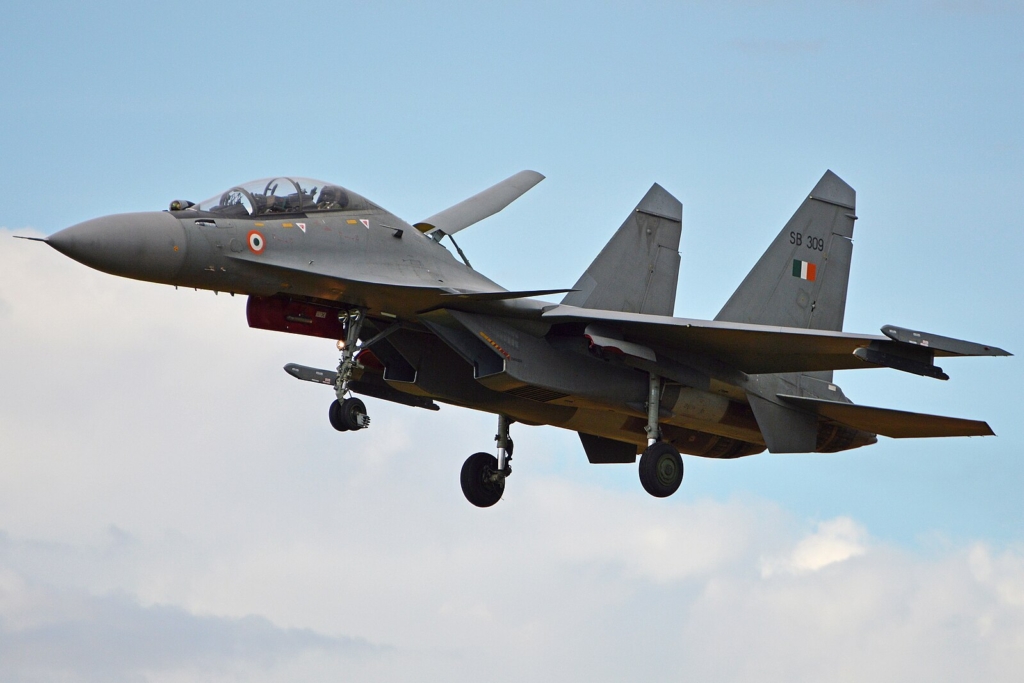
For New Delhi, which still relies heavily on Russian-origin platforms including the Su-30MKI, MiG-29 and the S-400 air defence system, the pact also eases the flow of spares, repairs and life-cycle support. For Moscow, it reinforces a familiar message: India remains among Russia’s most durable strategic partners, even amid shifting global alignments.
Vyacheslav Volodin, Chairman of the State Duma, framed it as continuity rather than change. “Our relations with India are strategic and comprehensive in nature. By ratifying this agreement, we take another step toward reciprocity, openness and the development of relations,” he said, noting that both nations “share a long history” and “treat each other kindly.”
Decades of India-Russia defence aviation cooperation underpin RELOS pact
The aviation dimension is unavoidable given history. Since the 1960s, India’s air force has been defined by Soviet and Russian aircraft, from the MiG-21s that trained generations of pilots, to the MiG-27s and MiG-29s that patrolled its borders, to the Su-30MKI that remains its frontline fighter.

More than 200 industrial facilities in India were built with Soviet and Russian assistance, many linked to aviation, missiles and high-technology systems. Licensed production lines, overhaul centres and component factories helped India sustain its fleets domestically.
RELOS does not rewrite this legacy. It simply updates the logistics backbone needed for the relationship to weather another decade of geopolitical turbulence.
Operational impact of the India-Russia logistics pact on air forces
An official at India’s Ministry of Defence said the agreement “plugs India into a geography its air force rarely accesses.” Russian bases such as Vladivostok, Petropavlovsk-Kamchatsky and Murmansk, they noted, offer forward locations for maritime surveillance, cold-weather flight trials, Arctic research and long-range deployments.
“For Russia, Indian airfields, from the Andaman and Nicobar Islands to forward bases in the Himalayas, offer operational flexibility in the Indian Ocean and South Asia.”

The pact also covers naval aviation, smoothing coordination for joint exercises such as INDRA, where air, sea and land operations run in parallel. It simplifies clearances, reduces deployment time and creates predictable logistics, which is critical for modern air operations.
Just as importantly, it provides a pre-negotiated mechanism for rapid aviation support during humanitarian and disaster relief operations, an area where India increasingly acts as a first responder.
Putin’s India visit and the political signal
Ratification came days before President Putin’s early-December visit to India, where he held extensive talks with Prime Minister Narendra Modi and announced an economic cooperation roadmap to 2030.
The defence pact reinforces a clear message: even as India diversifies suppliers and Russia adjusts to new geopolitical realities, the aviation and military bridges built over decades still matter.
RELOS will take effect once both sides exchange ratification documents. When that happens, the two air forces regain something they have lacked for nearly twenty years, a modern, predictable framework for operating from each other’s territory.
As the MoD official put it, “For India, this enhances reach. For Russia, it reinforces relevance. For both, it signals that even as they pursue new partners, the runway between Moscow and New Delhi remains open, active and strategically important.”
Featured image: Dmitry Zherdin / Wikimedia