


Emirates SkyCargo introduces its first Boeing 777 passenger-to-cargo converted freighter

4 min read
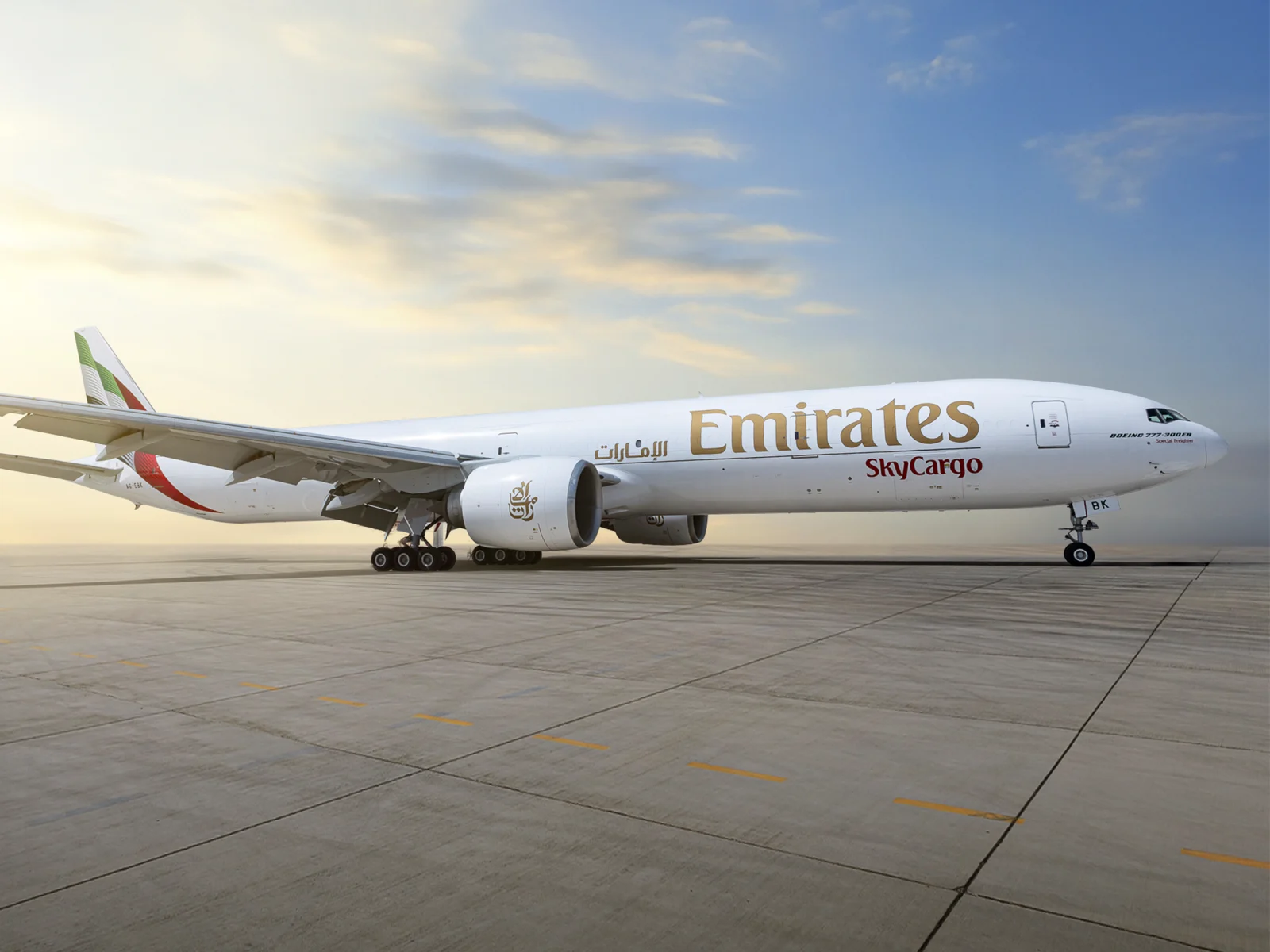
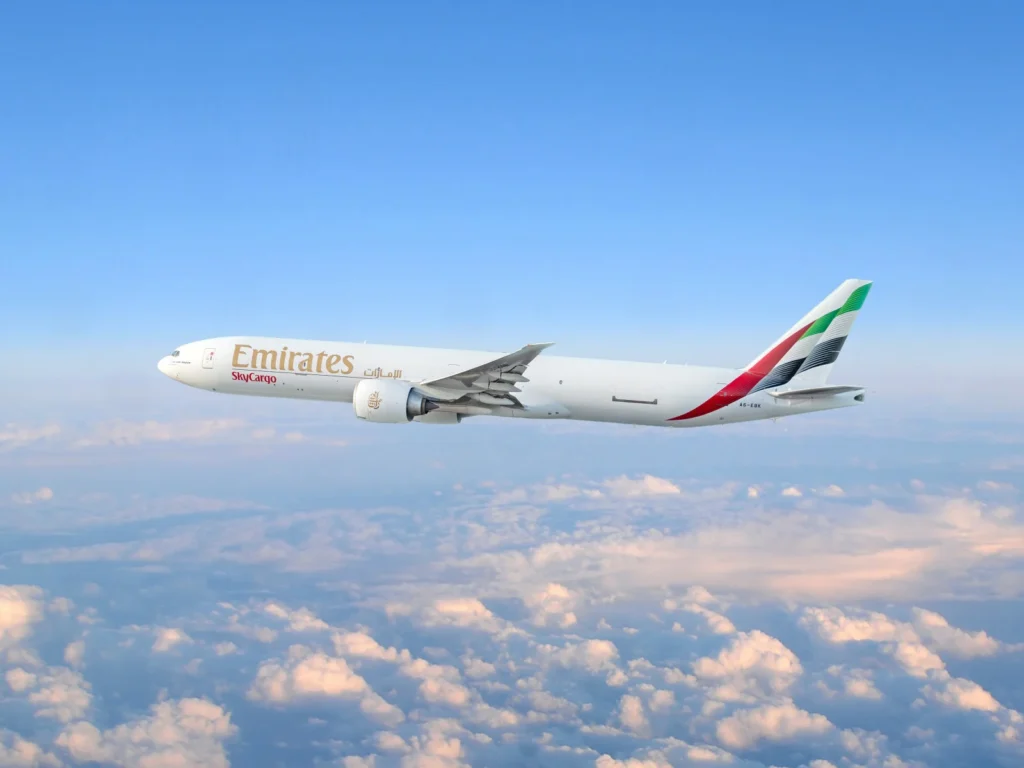
Emirates SkyCargo has introduced its first Boeing 777-300 converted freighter. The aircraft, first introduced by Emirates in 2006 as a passenger carrier, has been converted into a dedicated freighter to supplement the company’s cargo fleet, adding capacity at a fraction of the cost of purchasing an entirely new aircraft.
Emirates SkyCargo adds its first Boeing 777 converted freighter
The first passenger-to-freighter-converted aircraft has just joined Emirates SkyCargo’s growing cargo fleet.
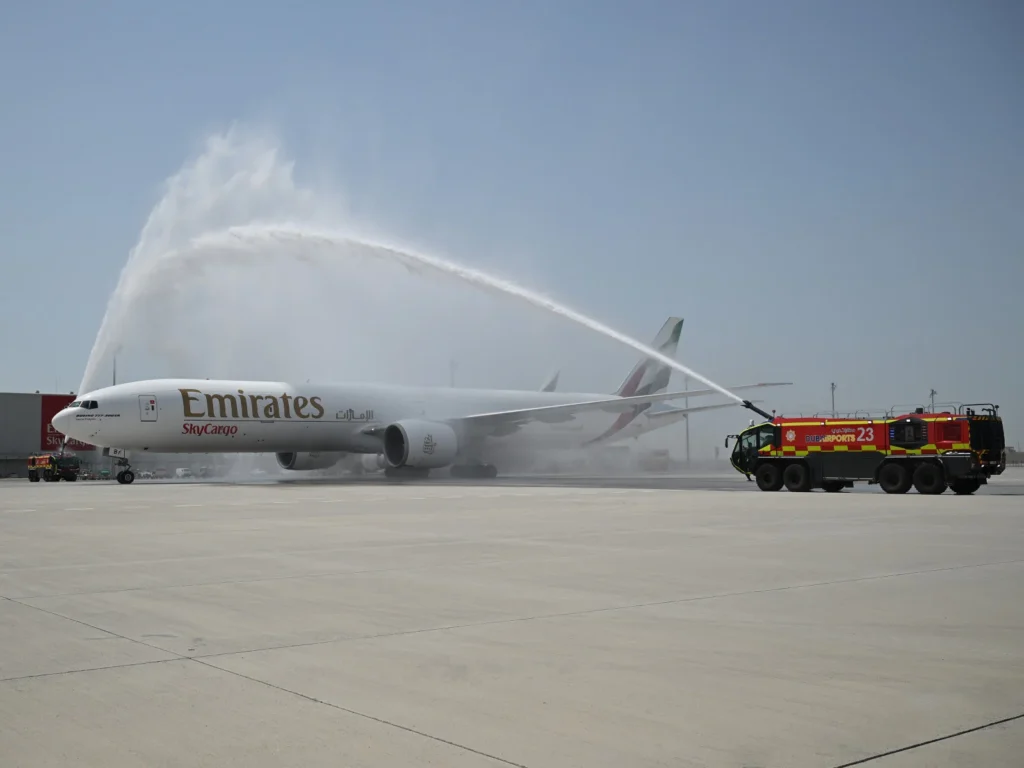
Registered as A6-EBK, the aircraft (referred to as a 777-300ERSF) has become the sixth new freighter aircraft inducted into Emirates SkyCargo’s operations since March 2026 as the operator expands its worldwide network of dedicated all-cargo services.
The aircraft is the first of five Boeing 777-300ERSFs that will join the fleet by the end of 2027, joining 17 Boeing 777Fs already operated by the carrier. The aircraft re-entered service after its conversion by flying from Dubai to Hong Kong on 30 June as flight EK9860.
According to an Emirates SkyCargo statement, the converted Boeing 777-300ERSF offers 100 tonnes of payload capacity and 811 cubic meters of cargo volume, representing a 25% increase in cargo volume over the Boeing 777-F production freighters operated by the company.
With 47 pallet positions, the converted aircraft also accommodates 10 additional pallet positions when compared with the Boeing 777F production freighter, “making it ideal for transporting volumetric cargo such as e-commerce goods which currently constitute around 20% of global air cargo tonnage, with further growth projected in the next few years, added the airline.
How to transform a Boeing 777-300ER into a dedicated freighter
As a first step in the conversion process, the aircraft’s interiors, including the seats, overhead stowage, galleys and lavatories, were all completely removed. This allowed engineers in Tel Aviv (where the conversion was undertaken) to modify the interior of the aircraft to accommodate cargo pallets.
The ability to load and accommodate industry-standard cargo pallets required the installation of a large main deck cargo door on the left-hand side of the fuselage aft of the wing.
One of the most significant steps in the entire conversion process, creating the opening for this door, required significant structural reinforcement and replacement of large sections of the fuselage structure, said Emirates SkyCargo.
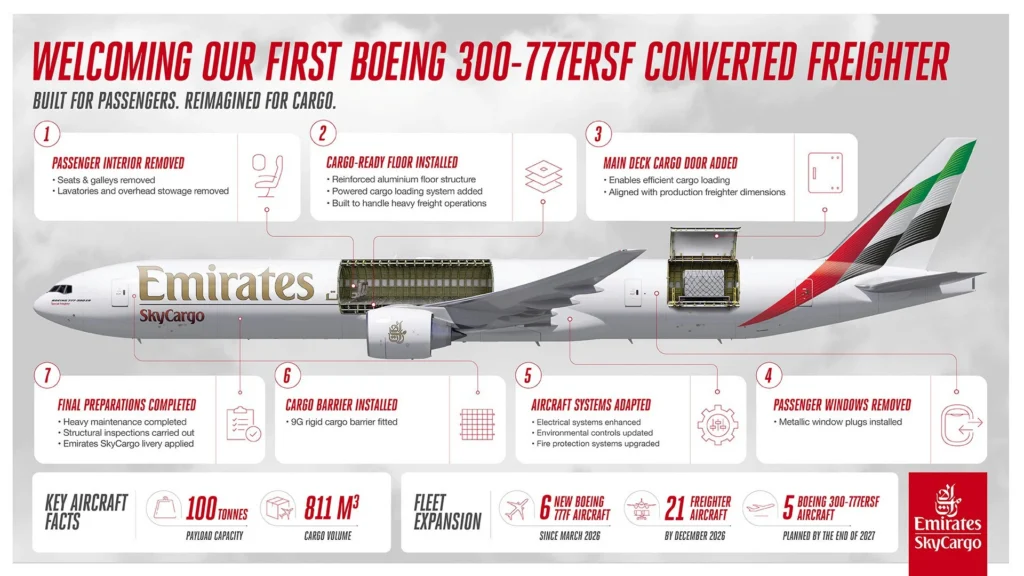
Next, a rigid barrier capable of absorbing impacts up to 9 G (9 times the force of gravity) was fitted at the front of the main deck, consistent with regulatory and safety configurations on a production freighter.
To support the crew and additional crew members, a crew rest area and supplementary seating were installed during the conversion.
The flight deck was also modified to accommodate additional controls for environmental and safety systems, optimised for cargo transportation.
In order to support heavier cargo pallets on the main deck of the aircraft, the floor structure used for passenger transport was completely removed and replaced with reinforced floor beams and a higher-capacity floor structure capable of supporting concentrated loads from heavy pallets and cargo handling equipment.
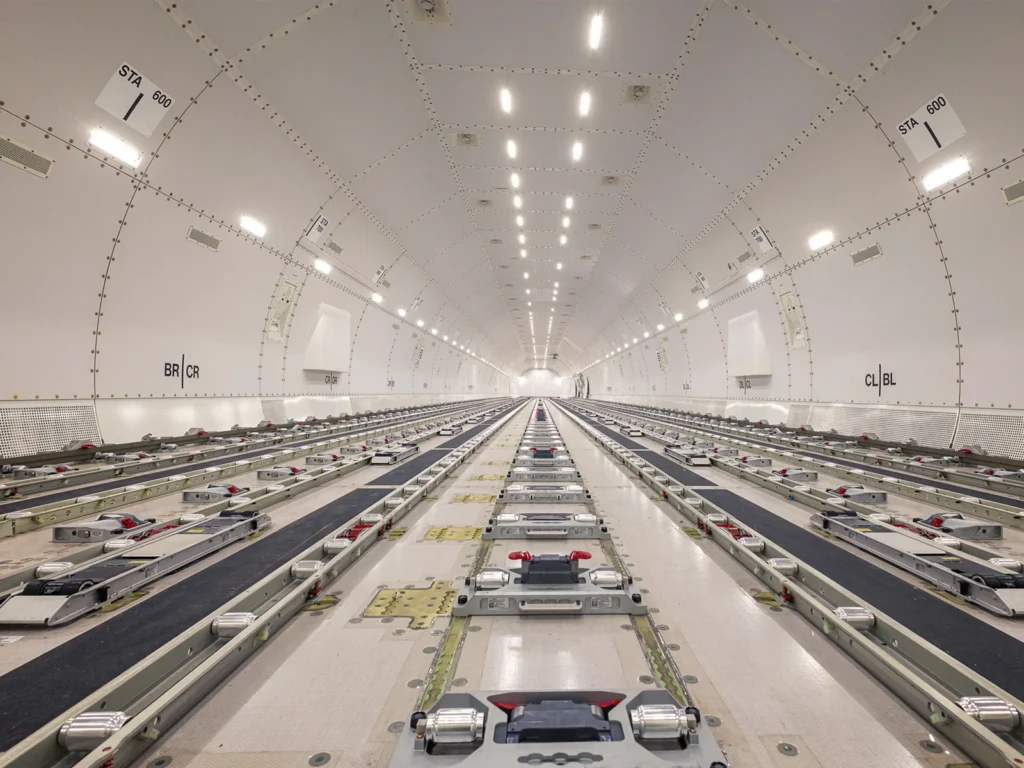
The conversion process included the installation of a complete cargo loading system consisting of powered rollers, locks and guides, permitting ground crews to move large cargo units efficiently through the aircraft and secure them for flight.
Additionally, an advanced cargo monitoring system, including smoke detection and fire suppression, was installed in accordance with regulations.
The conversion needed to achieve regulatory approval to demonstrate that the process met strict requirements around compliance with safety standards covering structural strength, systems reliability, fire protection and flight performance.
This was demonstrated through extensive documentation, ground tests and flight evaluations before the aircraft could start transporting cargo.
Finally, as a last step in the conversion process, the aircraft also received a full repaint and application of the latest Emirates SkyCargo livery ahead of its first commercial flight as a dedicated freighter.
Providing additional capacity for future expansion
According to Badr Abbas, Emirates SkyCargo’s Divisional Senior Vice President, the induction of the company’s first converted Boeing 777-300ERSF into operational service represents the next stage of the company’s fleet expansion plan to meet growing demand for its all-cargo services.
“Combined with our growing fleet of Boeing 777F production freighters, we have already been able to scale our global freighter network from just over 40 destinations in February this year to 62 destinations currently and growing.”
“We are providing our global customers with scalable cargo capacity and ultimate flexibility and connectivity when moving cargo to and through our hub in Dubai.”
Emirates SkyCargo has ambitious fleet expansion plans
As part of its ambitious expansion strategy, in addition to four more 777-300ERSF aircraft by the end of 2027, Emirates SkyCargo will also be taking delivery of five additional factory-built Boeing 777F aircraft by December 2026. The next 777-300ERSF will arrive by the end of 2026, with a further three due by the end of next year.
According to the carrier, “This expansion of capacity is allowing Emirates SkyCargo to provide further customer choice and flexibility as well as support critical global supply chains and trade lanes.”
Featured image: Emirates SkyCargo
Sign up for our newsletter and get our latest content in your inbox.


More from

October 25, 20265 min read


