US Air Force A-10 Warthog retirement: What’s the latest?

December 26, 2025

While the USAF wants to retire all of its A-10s, it appears that it will be required to stick to a phased approach, with the last Warthogs retiring in fiscal 2027. As a twist, the remaining A-10s in service are being adapted for a drone hunter role.
A-10 Warthog inventory to drop to 103
For years, the USAF has been asking Congress for permission to retire its fleet of Fairchild Republic A-10 Thunderbolt “Warthog” ground attack aircraft. Washington consistently forbade the Air Force from retiring these aircraft until the F-35A entered service in large enough numbers.

In its fiscal 2026 request, the Air Force once again asked to retire all of its remaining Warthogs. However, it appears that once again, Washington will only permit a phased retirement.
The United States Senate Committee on Armed Services draft budget for fiscal 2026 comes with a Department of Defense budget of $878.7 billion, with a total National Defense Topline budget of $924.7 billion.
The draft budget carries the provision that it “prohibits the Air Force from retiring A-10 aircraft, such that the inventory would drop below 103 aircraft in FY26.”
A phased approach to A-10 retirement
The War Zone states, “Fiscal Year 2024 began on Oct. 1 of last year; there were 218 A-10s in service across the Air Force.”
In the fiscal 2025 President’s Budget Request, the Air Force asked to divest 56 A-10s. The document also provided for divesting another 59 Wathogs in fiscal 2026, 68 in fiscal 2027, the remaining 35 in fiscal 2028, and none in 2029 and thereafter.
This appears to be the path being followed by the Senate Committee. Starting with the fiscal 2024 inventory of 218 Warthogs, the USAF retired 56 in fiscal 2025, leaving them with an inventory of 162.
Now the Senate Committee is working to cap the minimum inventory levels at 103, which would represent another 59 retirements in fiscal 2026. This is in line with the 2025 President’s Budget Request.
#a10 #warthogs at our Heritage Flight 🐗
— Davis-Monthan Air Force Base (@DMAFB) March 11, 2024
📌Davis-Monthan AFB, Az (Feb. 28-Mar. 3) pic.twitter.com/QJGoaGPRx0
Separately, the document also showed divesting of the remaining ageing F-15C/Ds in fiscal 2025 and 2026 and the beginning of retiring the remaining B-1 Lancer fleet, starting with nine in 2028 and 10 in 2029.
More A-10s are turning up at the boneyard
In December 2024, The War Zone reported the US Air Force had sent at least 39 A-10s to the Davis-Monthan boneyard. That was more than double the number (17) it sent in 2023.
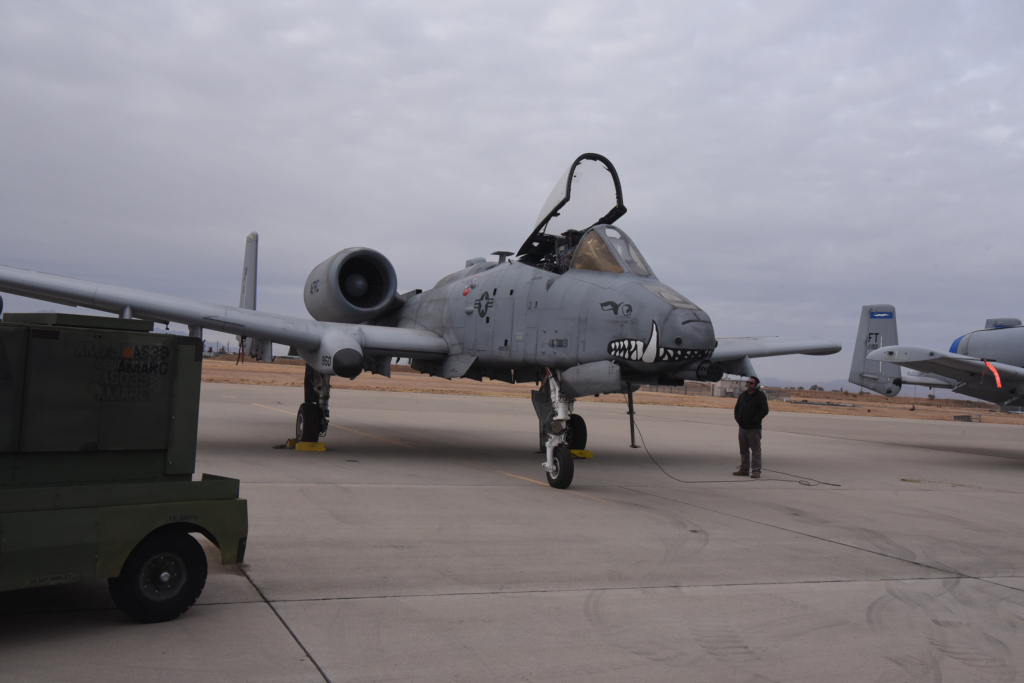
In its March 2025 report, AMARG reported having a total of 95 A-10 Warthogs in inventory (both A-10A and A-10C models). Up to that date, another seven were listed as having arrived in 2025.
The AMARG Experience website lists another seven examples arriving between May and June 2025. It is unclear how many the Air Force has sent to the boneyard in fiscal 2025, but it will likely be somewhere around the 56 it is authorised to divest.
Get the latest aerospace defence news here on AGN.
The ending of the close air support role
The F-35 family is designed to replace a range of platforms, including F-16s, A-10s, F/A-18s, and AV-8Bs in the US military. Many point out that the F-35A can’t offer the same ground support as the A-10 can. That is very much true, but it’s not intended to.

The F-35 family has three variants. Of these, the F-35B and F-35Cs are not even fitted with internal cannons and need to carry an external GPU-9/A gun pod. The F-35A does have an internal cannon, but it carries a 25mm GAU-22/A autocannon with just 180 rounds.
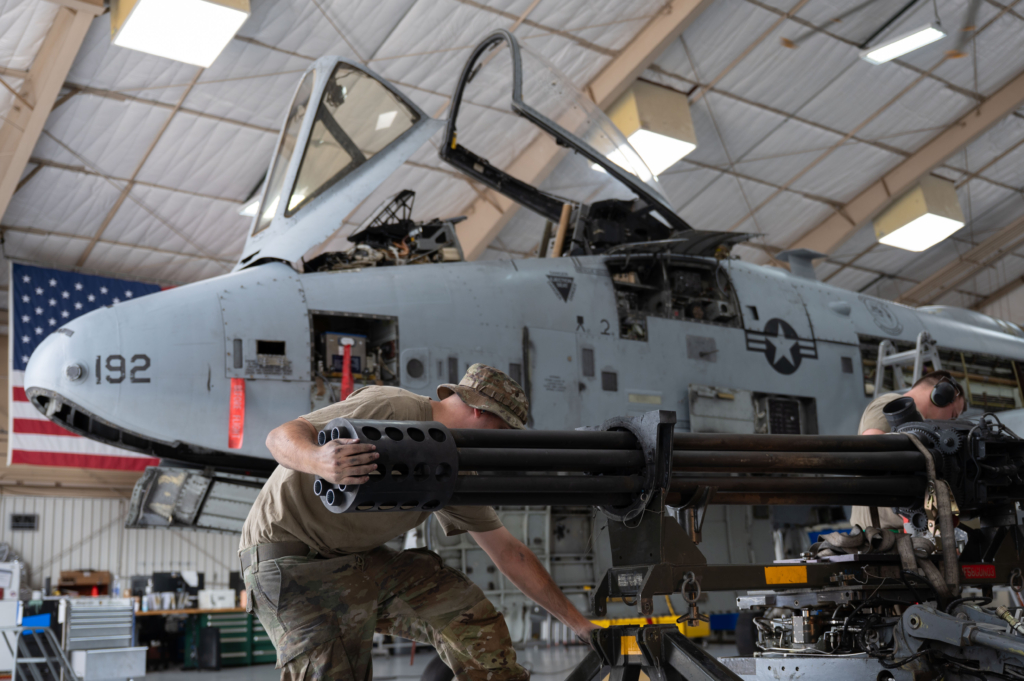
Even the F-16 carries 511 rounds (20mm ). By contrast, the A-10’s 30mm GAU-8/A Avenger carries 1,174 rounds.
While it is debated how much the A-10 was a tank killer in the Gulf War, there is little doubt that it has no chance of being a tank killer in a future peer-on-peer conflict. F-35A is not designed for Close Air Support (CAS) missions the way the A-10 was because that is no longer how the Air Force plans to fight.
Warthogs! Thank you for your service.
— Davis-Monthan Air Force Base (@DMAFB) February 8, 2024
After nearly 50 years at Davis-Monthan Air Force Base, the 355th Wing has begun divesting its fleet of A-10 Thunderbolt II aircraft.
Article: https://t.co/aUQQwqpU4C pic.twitter.com/NLJv06lpXz
Even the US Army trains to use its Boeing AH-64E Apaches in a deep strike role, targeting enemy logistics, and less in a Close Air Support role.
Drone hunting: the Warthogs’ final mission?
While the A-10 Warthog may have been designed to hammer massed Soviet armour formations coming through the Fulda Gap in Western Germany, fate is rarely what is expected.

In October 2025, The War Zone reported that not only has the A-10 Thunderbolt been hurriedly modified to carry Advanced Precision Kill Weapons System II (APKWS II), but kill markings reveal it has successfully shot down drones.
One A-10 (named “Ares”) was seen sporting two kill markings depicting Shahed-style one-way attack drones. The nose art also suggests the A-10 employed a Small Diameter Bomb (SDB) and its autocannon during the same deployment.
This A-10 was one of 12 Warthogs that were in theatre in the Middle East during the 12-day war between Iran and Israel when the US bombed Iran’s nuclear facilities during Operation Midnight Hammer and shot down numerous Iranian munitions.
TABOR61 arriving back in Portsmouth after a six-month deployment as part of Operation Inherent Resolve! 🐗 pic.twitter.com/mI3VYZ8221
— Alex (@mhtplanes) October 7, 2025
ARKWS IIs are 2.75-inch (70mm) Hydra rockets transformed into drone and cruise missile killers. These offer the Air Force major advantages over their more advanced air-to-air missile counterparts.
The rockets are relatively cheap, allowing them to engage masses of enemy drones and other aerial threats economically. They are comparatively numerous, allowing aircraft to carry many more of them and engage many more targets in a given mission. Finally, the US just has thousands of these rockets in stock.
TABOR61 (mixed the callsigns on the first flight 😅) arriving at PSM after a trip from Lajes! pic.twitter.com/pJwwJAgtJL
— Alex (@mhtplanes) October 10, 2025
The A-10 was envisioned as a tank hunter, but it seems set to end its days as a drone hunter. It was an attack aircraft built around its 30mm GAU-8/A Avenger autocannon, but its final years were to be a rocket delivery truck. It was built for close air support, but switched to an air-to-air role at the eleventh hour.
That said, in permissive environments, Close Air Support is not dead. In December 2024, an A-10 Warthog was filmed firing its autocannon in anger in a Close Air Support role in Syria.
Featured Image: United States Air Force