USAF welcomes delivery of first operational T-7A Red Hawk

January 13, 2026
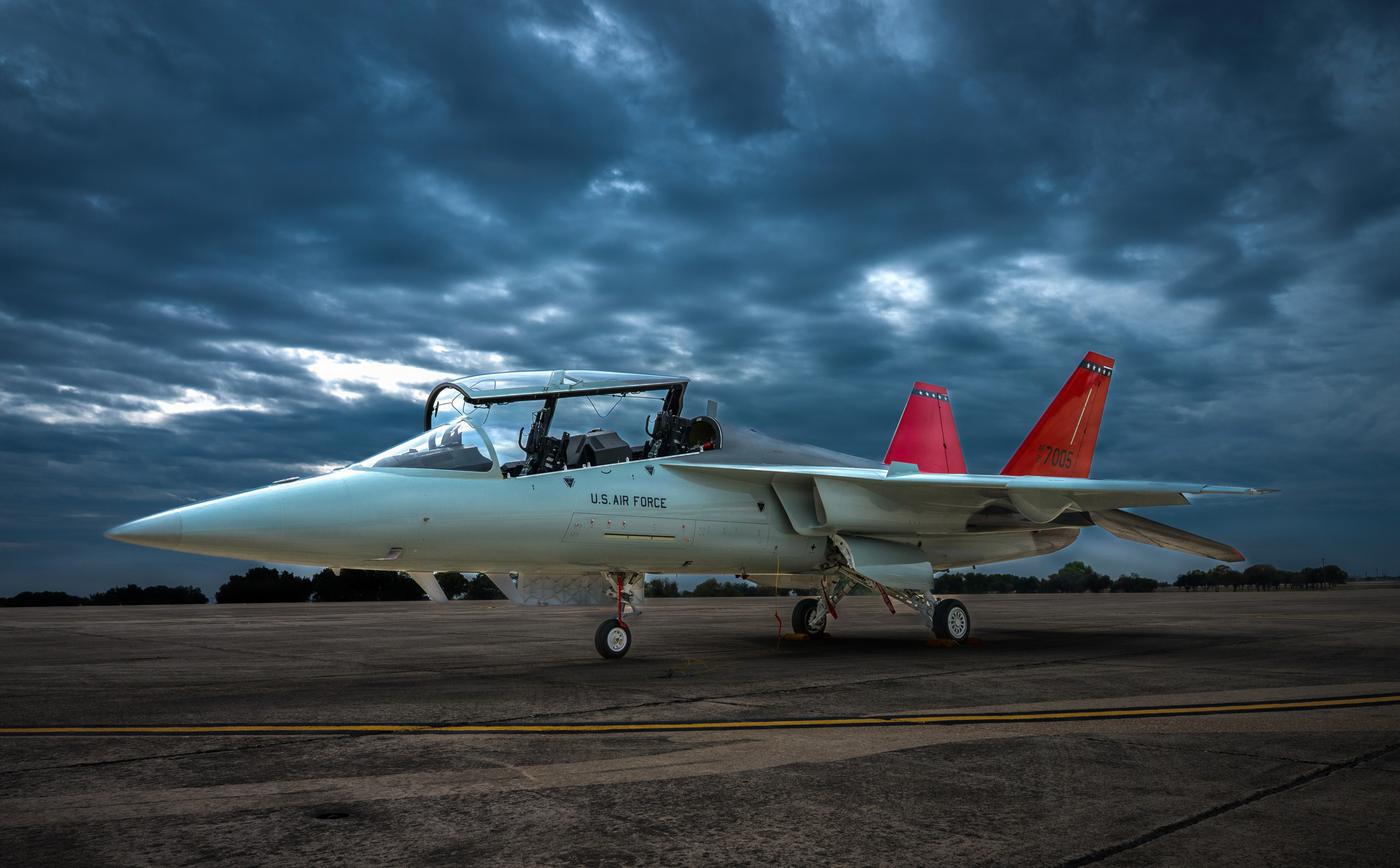
The US Air Force (USAF) ushered its first new-generation T-7A Red Hawk advanced jet trainer into operational service on 7 January, when a formal arrival ceremony for the type was held at Air Education and Training Command’s (AETC’s) headquarters at Joint Base San Antonio-Randolph (JBSA-R) in Texas.
This recent ceremony comes after the USAF’s first operational T-7A (serial 21-7005) was delivered to the Texas base from Boeing’s fighter production plant in St Louis, Missouri, on 5 December. Having now arrived at JBSA-R, the new aircraft has formally joined the 12th Flying Training Wing’s (FTW’s) 99th Flying Training Squadron (FTS).
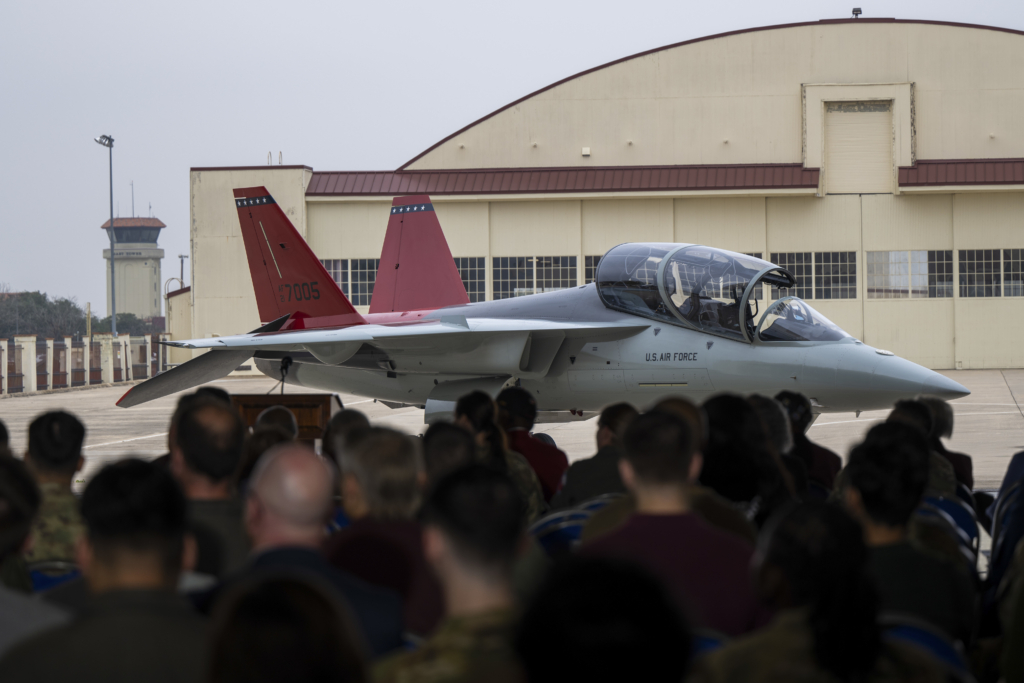
A previous operator of the T-1 Jayhawk multi-engine jet trainer, the 99th FTS – whose lineage goes back to the Tuskegee Airmen – has become the first USAF squadron to begin its transition to the Red Hawk. As a result, the unit will lead early operational efforts to help refine training concepts and establish the conditions for the USAF’s future T-7A squadrons.
Lt Col Michael Trott, the officer commanding the 99th FTS, described the importance of his unit’s new mission: “The 99th will re-write what pilot production looks like and shape the future of pilot training for the next generation of warfighters for America.”
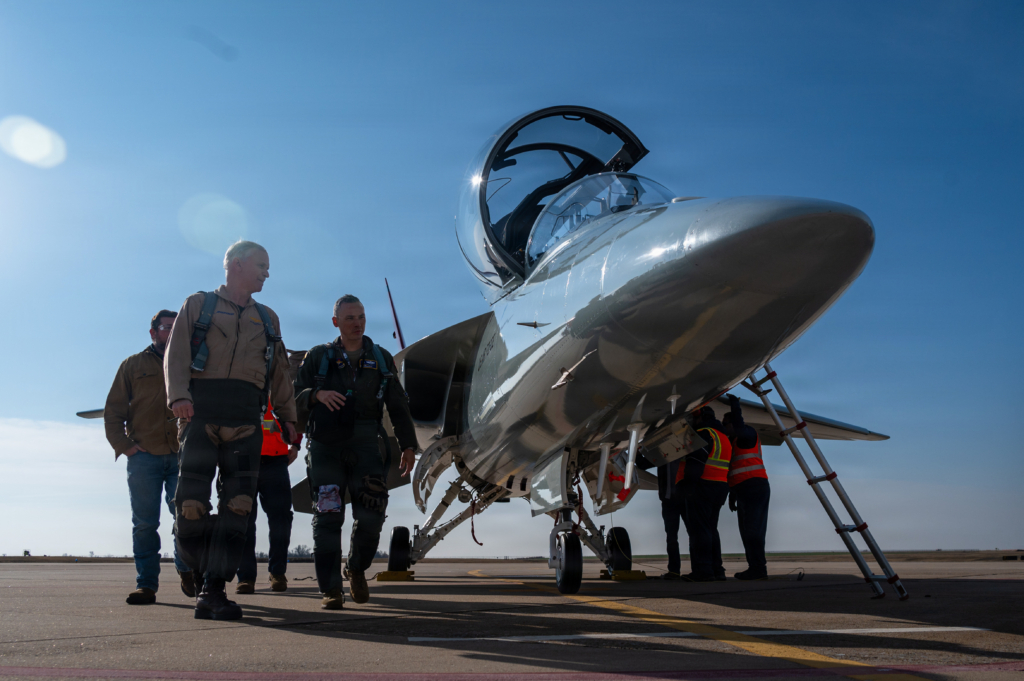
So far, Boeing has delivered five production-representative Red Hawks to the USAF. Of these initial Red Hawks, four are currently assigned to the 416th Flight Test Squadron (FLTS), which is leading the test and evaluation campaign for the new advanced trainer at Edwards Air Force Base (AFB) in California. The fifth of these jets (21-7005) has now been delivered to the 99th FTS, which is set to field an initial force of 14 jets by 2027.
In total, the USAF plans to field a 351-strong fleet of T-7As. The platform is expected to achieve Initial Operational Capability (IOC) in 2027. A firm production decision on the T-7A was initially expected to be made in 2025, but the USAF delayed this until 2026 and instead opted to acquire four more production-representative test airframes from Boeing.
The USAF plans to purchase 14 production-standard T-7As in FY2026, with the goal of increasing its annual purchase to between 40-60 aircraft by 2033.
T-38C: Beginning of the End
This recent delivery marks the beginning of a new era in the training of future USAF fighter pilots as the service presses on with its quest to modernise its primary jet trainer fleet. For more than six decades, the service’s now-veteran T-38C Talon fleet has formed the backbone of its fast-jet training syllabus.
However, due to its advanced age and circa-1960s design, the Talon fleet is now struggling with maintenance issues and unavoidable obsolescence, becoming more expensive to maintain and no longer being representative of the technologies and capabilities offered by modern combat jets, such as the F-22 Raptor and F-35 Lightning II.
It lacks the modern digital systems and avionics required to prepare new-generation pilots for complex, multi-domain warfighting in fifth- and future sixth-generation fighters, like Boeing’s F-47.
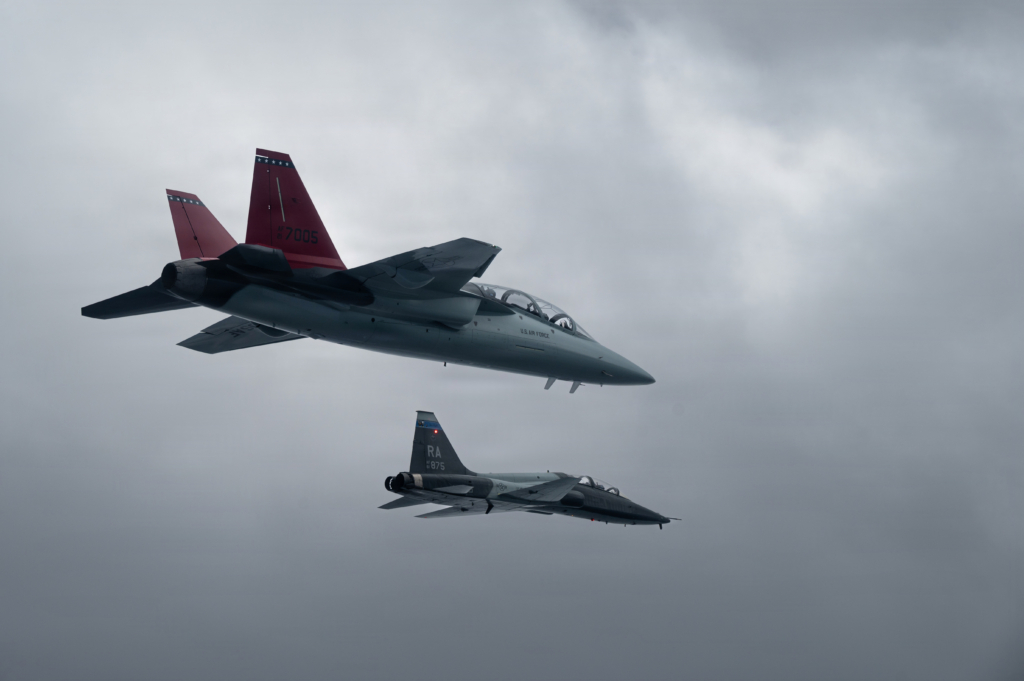
While the USAF will eventually replace its ageing T-38Cs with the T-7A, but this process won’t start until enough Red Hawks have been handed over to the service. According to Cirium, the USAF still maintains a fleet of more than 480 T-38s. Despite this, USAF officials have cited availability issues with the platform as contributing to ongoing delays in the fast-jet pilot training pipeline.
T-7A Red Hawk: A Modern Jet Training Solution
The new T-7A represents a major step-change in the USAF’s ability to train its new-generation fighter pilots.
Commenting on this, Lt Gen Clark J Quinn – the officer commanding AETC – said: “The T-7 isn’t simply a modern upgrade. It’s a generational leap that will be an important part of AETC for decades to come… The arrival of the T-7A is not the finish line. It marks the beginning of the work ahead to deliver training that produces ready, capable pilots for the future of the Air Force.”
Unlike the T-38, the Red Hawk has been built with advanced digital engineering and modern fly-by-wire avionics, complete with an all-glass digital cockpit and an open-systems architecture that allows the type to evolve alongside future training requirements and emerging technologies through hardware/software updates.
The T-7A also forms part of an integrated holistic system of advanced simulators – namely via the inclusion of a Ground-Based Training System (GBTS) and Live-Virtual-Constructive (LVC) environments – to reduce costs while addressing more complex flight training scenarios on the ground.
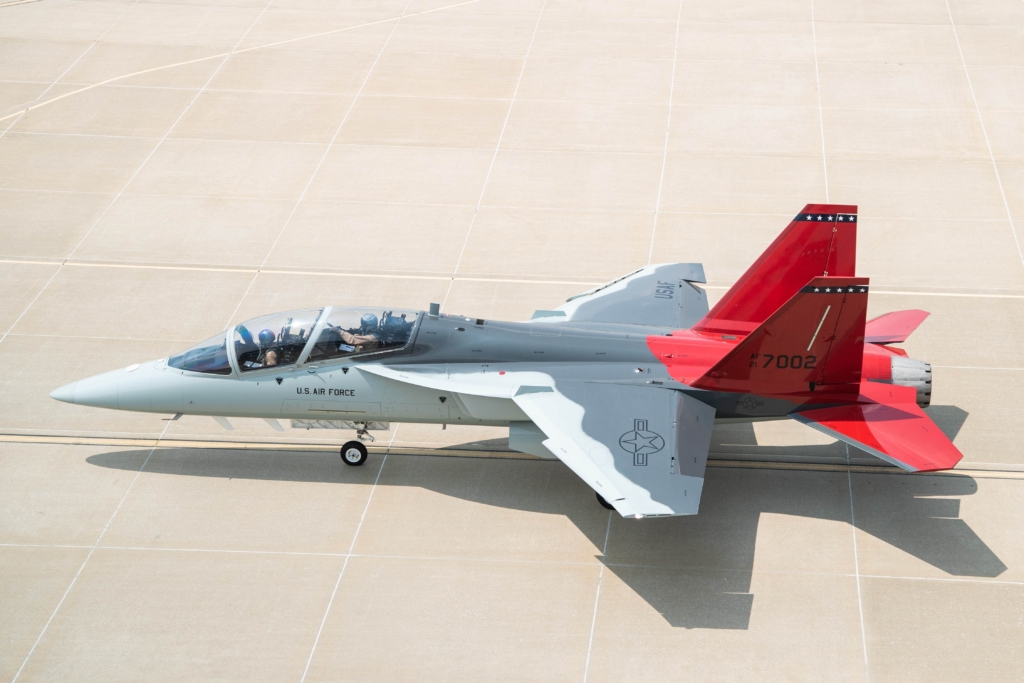
Jointly developed by Boeing and Saab, the first Red Hawk prototype for the USAF’s competitive T-X programme was unveiled on 13 September 2016.
Powered by a single GE Aerospace F404 afterburning turbofan engine – producing up to 17,200lbf (77kN) of thrust with afterburner – the design featured two vertical stabilisers with a traditional two-seat tandem cockpit configuration and retractable tricycle landing gear.
The Boeing-Saab team’s first T-X prototype took flight on 20 December 2016, before the USAF formally selected the solution as the winner of the T-X programme in September 2018.
Since its selection by the USAF, the T-7A Red Hawk has become the focus of other air arms that are looking to recapitalise their advanced jet trainer fleets. A navalised version of the Red Hawk is currently in contention for the US Navy’s ongoing Undergraduate Jet Training System programme, which aims to replace the service’s ageing fleet of T-45C Goshawks.
Meanwhile, BAE Systems has also teamed up with Boeing and Saab to pitch the T-7A as a viable replacement for the Royal Air Force’s (RAF’s) veteran fleet of Hawk T1/T2 jet trainers, which have been plagued by engine-related maintenance issues over recent years. Australia, Brazil, Japan and Serbia have also been linked with a potential Red Hawk purchase.
Featured image: USAF/Benjamin Faske