US Marines revive historic MV-22 Osprey squadron as ‘Black Knights’ return to flight

January 21, 2026

After a five-year hiatus, the US Marine Corps’ (USMC’s) Marine Medium Tiltrotor Squadron 264 (VMM-264) ‘Black Knights’ has returned to flight. It completed its first post-reactivation flight with the MV-22B Osprey at Marine Corps Air Station (MCAS) New River in North Carolina on 6 January.
The squadron was originally deactivated on 24 June 2020 as part of wider US Marine Corps force redesign measures. Its formal reactivation, marked by a ceremony at MCAS New River on 11 December 2025, reflects a reassessment of operational demand rather than a reversal of Force Design principles.
A subsequent force management analysis identified a requirement for an additional MV-22B squadron on the US East Coast to ensure sustained assault support capacity for II Marine Expeditionary Force (MEF).
Assigned to the 2nd Marine Aircraft Wing’s (MAW’s) Marine Aircraft Group 26 (MAG-26), the reactivation of VMM-264 represents a targeted adjustment to USMC force structure, aimed at maintaining balance within the MV-22 community while meeting the operational tempo and readiness demands placed on II MEF.
During the recent reactivation ceremony, Col Daniel Kaiser – the officer commanding the 2nd MAW’s MAG-26 – praised VMM-264’s long history and its role in expanding the MV-22B’s role and capabilities during the early years of its operational USMC employment.
“VMM-264 carries a distinguished legacy, having been established in 1959 and providing decades of critical support to Marine Air-Ground Task Force operations around the globe,” Kaiser said.

“Upon transitioning to the MV-22 Osprey in 2009, the squadron played a pivotal role in developing and advancing the MV-22 as the [USMC’s] premier assault support platform… MAG-26 is proud to welcome this storied unit back into the fold and looks forward to the significant contributions the ‘Black Knights’ will bring in support of the ‘Carolina MAGTF’,” he added.
Lt Col Paul Lancaster formally assumed command of the squadron during the ceremony. “This reactivation brings the necessary balance and capacity to the MV-22 community and supports the continued evolution of Marine Corps aviation,” he said.
Early history of VMM-264 ‘Black Knights’ and UH-34 helicopter operations
The ‘Black Knights’ were first activated on 30 June 1959 at MCAS New River as Marine Medium Transportation Squadron Light 264. The unit initially operated the piston-engined UH-34 Seahorse, a multi-role assault helicopter that would later see extensive combat service during the Vietnam War.
The squadron quickly established itself as an operational aviation element. In late 1961, it supported humanitarian assistance and disaster relief efforts in Belize following Hurricane Hattie, marking one of the earliest uses of USMC aviation assets for HA/DR missions, a role that has since become a core Marine Corps competency.
In February 1962, the unit was redesignated as Marine Medium Helicopter Squadron 264 (HMM-264) – a designation it would retain for more than 40 years.
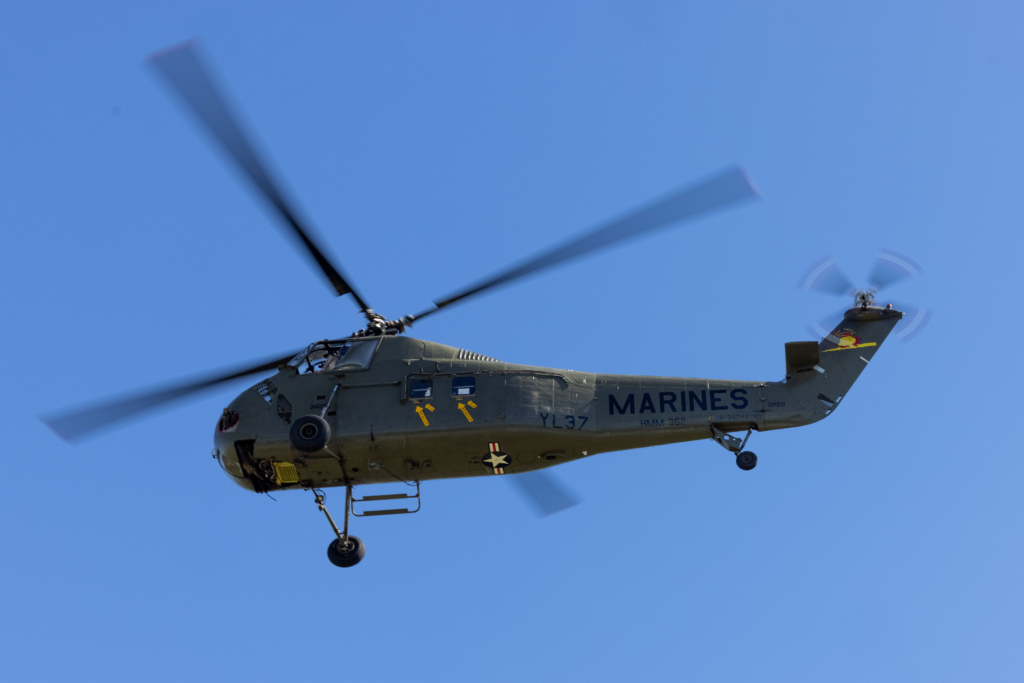
One of the squadron’s defining early moments came on 28 April 1965 during the Dominican Civil War. Embarked aboard the Essex-class amphibious assault ship USS Boxer (LPH-4) as part of the 6th Marine Expeditionary Unit, HMM-264 conducted Operation Power Pack, evacuating more than 600 US citizens from Santo Domingo.
The mission marked the USMC’s first all-helicopter night assault into an unsecured landing zone under combat conditions and the first ship-to-shore heliborne lift over a hostile beach without supporting forces ashore.
Some three years later, in 1968, the ‘Black Knights’ bade farewell to the last of its ageing fleet of UH-34 Seahorse helicopters as part of the unit’s transition to the tandem-rotor CH-46 Sea Knight.
While HMM-264 was not part of any combat operations that occurred during the 1970s, the unit frequently deployed as the Aviation Combat Element (ACE) for various East Coast-based MEU and Marine Amphibious Unit (MAU) deployments.
VMM-264 operations in the 1980s and 1990s with the CH-46 Sea Knight
In 1983, the squadron deployed to Beirut, Lebanon, as part of the Multinational Peacekeeping Force. Four years later, it became the first ACE to deploy with AV-8B Harrier IIs while embarked aboard the Tarawa-class amphibious assault ship USS Nassau (LHA-4), reflecting the growing integration of fixed- and rotary-wing capabilities within Marine expeditionary operations.
The 1990s proved particularly busy for the ‘Black Knights’. In January 1990, HMM-264 participated in Operation Top Kick – a USMC sea-based presence mission off Colombia in support of a presidential drug summit in Cartagena, which was held from 6-16 February that year.
In early 1991, the unit deployed as the ACE for the 24th MEU Special Operations Capable (SOC) – typically abbreviated as MEU(SOC) – aboard the Iwo Jima-class amphibious assault ship, USS Guadalcanal (LPH-7). During this cruise, the ‘Black Knights’ provided supplies to isolated Kurdish refugees in northern Iraq and Turkey as part of Operation Provide Comfort.
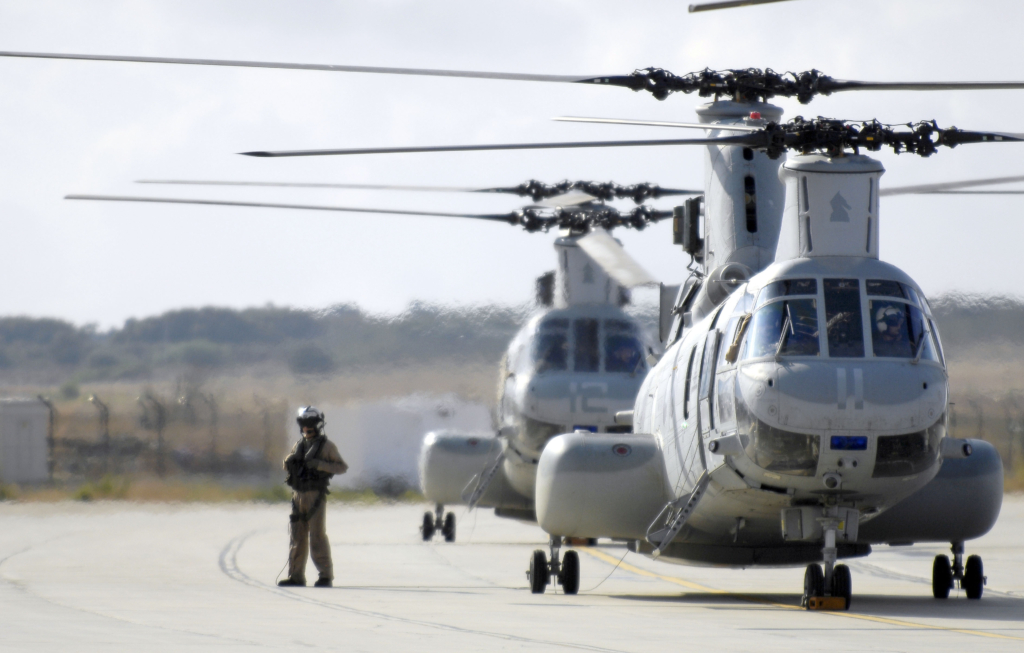
Later in the decade, the ‘Black Knights’ deployed repeatedly to the Balkans, supporting NATO and UN operations in Bosnia and Herzegovina. These missions combined HA/DR, enforcement of no-fly zones, and armed reconnaissance, underscoring the flexibility expected of Marine assault support aviation in complex multinational environments.
‘Black Knights’ VMM-264 operations during the Global War on Terror
Following the 9/11 terror attacks on 11 September 2001, HMM-264 – along with the rest of the US military – joined the Global War on Terror.
From 5 March to 24 October 2003, the ‘Black Knights’ embarked for a deployment aboard the Wasp-class amphibious assault ship, USS Iwo Jima (LHD-7), as part of the 26th MEU. During this eight-month cruise, the unit conducted missions in support of both Operations Iraqi Freedom and Enduring Freedom.
In April 2003, the squadron dispatched six CH-46Es and six CH-53Es from Iwo Jima to Irbil and Mosul in Iraq – a journey of more than 495 miles, which was the longest self-deployed flight to a land-based location by any MEU at that time.
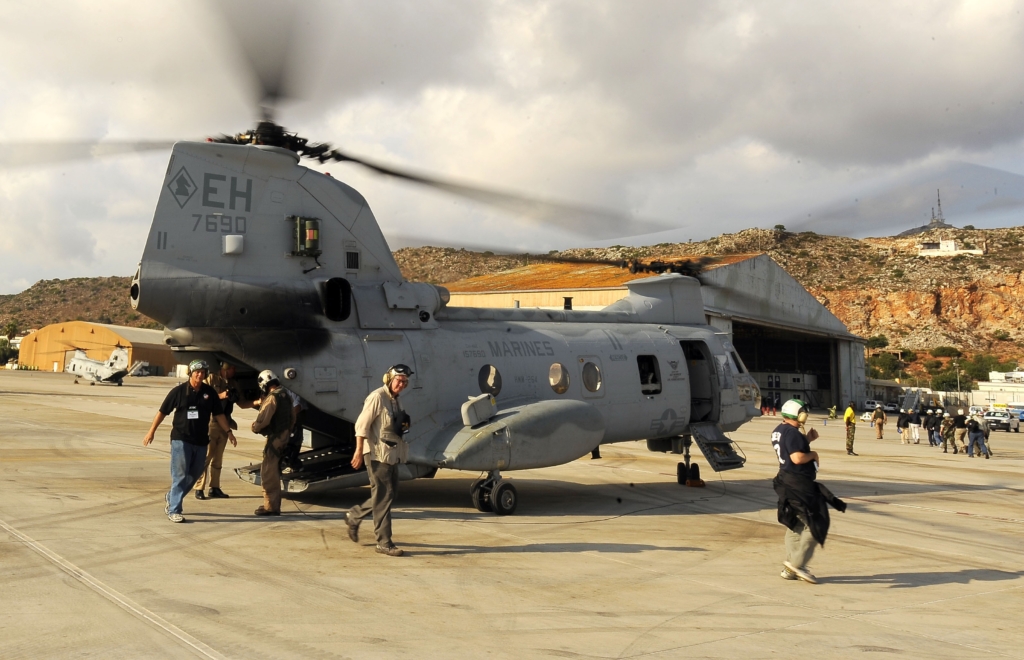
In January 2005, the ‘Black Knights’ again returned to Iraq. Based at Al Asad Air Base, the squadron directly supported Operation Iraqi Freedom by conducting casualty evacuation (CASEVAC), VIP transport and airborne assault support operations.
The unit also took part in Operation Matador – a military offensive against insurgent-held positions in Iraq’s Anbar province. Upon returning from this deployment, HMM-264 supported HA/DR efforts in New Orleans, Louisiana, following the devastation of Hurricane Katrina.
Transition to the MV-22B Osprey and redesignation as VMM-264
After completing its final CH-46 deployment in 2007–2008, the squadron transitioned to the MV-22B Osprey, marking a significant doctrinal and operational shift. Redesignated VMM-264, the unit returned to operational status with the tiltrotor in April 2009.
The Osprey dramatically expanded the squadron’s reach, speed and operational flexibility compared with legacy helicopters, and VMM-264 played an early role in proving the aircraft’s assault support capabilities. The squadron completed two Osprey deployments in support of Operation Enduring Freedom, beginning in December 2010 and January 2013, respectively.
In 2014, VMM-264 deployed to Liberia under Operation United Assistance, supporting efforts to contain the Ebola outbreak in West Africa, before being deactivated in June 2020.
VMM-264 reactivation strengthens USMC MV-22 Osprey force structure
The reactivation of VMM-264 closes a five-year gap but reflects continuity rather than nostalgia.
The squadron’s return provides additional MV-22 capacity on the East Coast, reinforcing II MEF’s ability to project combat power ashore and sustain distributed operations in increasingly contested environments.
With a history defined by adaptability, from early helicopter assault to tiltrotor operations, the ‘Black Knights’ return to flight underscores how legacy units continue to be reshaped to meet contemporary operational demands rather than preserved as historical artefacts.
Featured image: USMC/Lance Cpl Jacsive Betancourt Nava