Switzerland needs more fighter jets: Could Saab’s Gripen be a viable option?

December 20, 2025
Switzerland’s decision to cap spending on its F-35A fighter programme has raised an obvious follow-on question: could Bern look beyond Lockheed Martin to fill a growing gap in its future fighter force?
While the country remains contractually committed to the F-35, rising costs and a reassessment of Switzerland’s long-term air defence needs have created tension at the heart of its procurement strategy.
The Swiss government assesses it may require 55–70 modern fighter jets, almost double the original 36-aircraft plan approved by voters. That gap cannot be filled by F-35s alone without breaching the referendum-imposed spending ceiling.
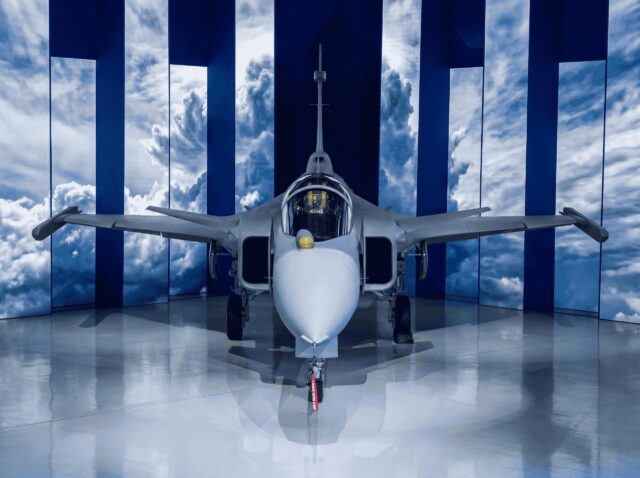
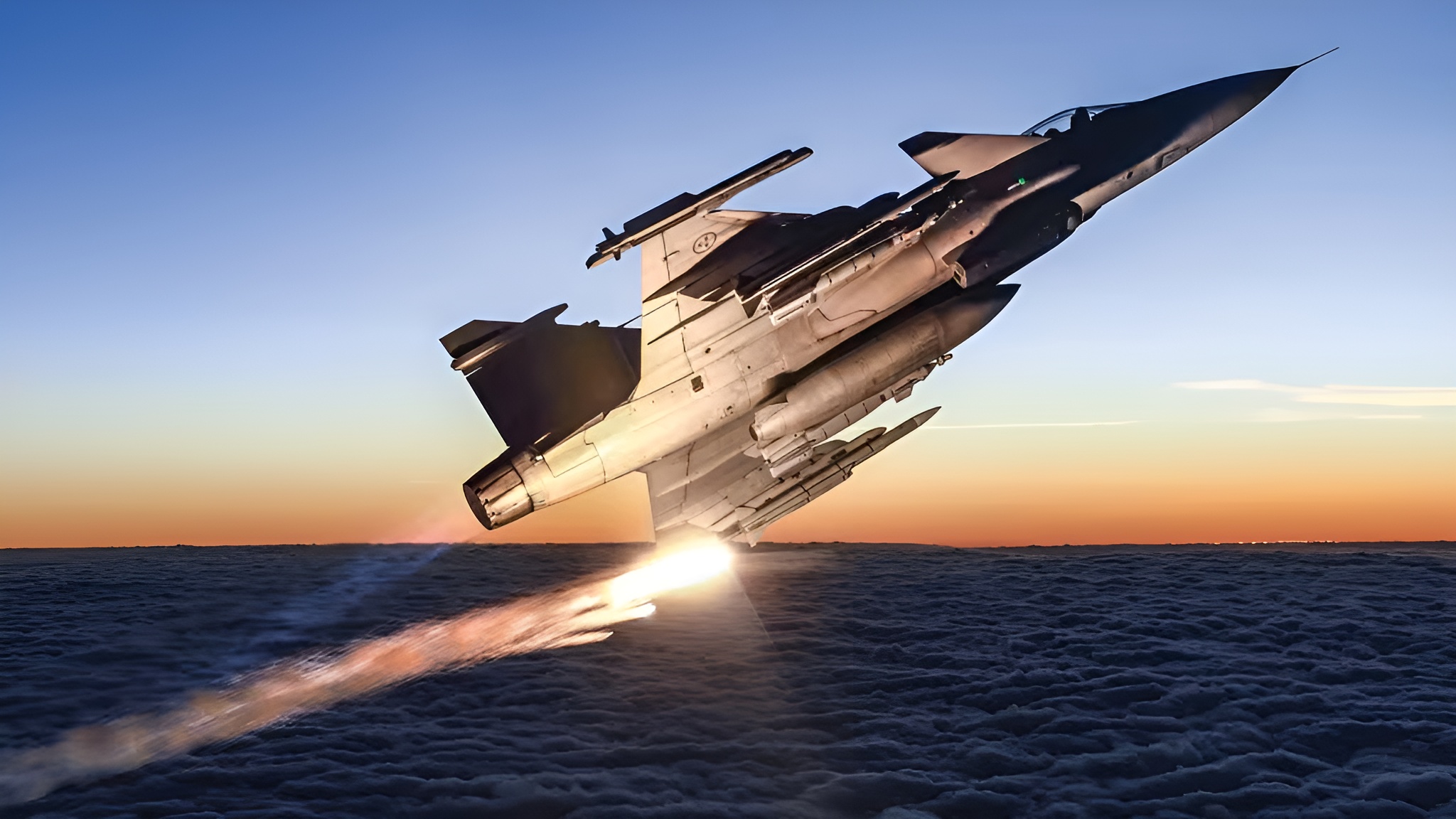
This has prompted renewed discussion over whether Switzerland could supplement its F-35 fleet with a second, less expensive fighter type, reviving comparisons with Saab’s Gripen, which Swiss voters rejected in 2014.
Why Switzerland may need more fighter jets than planned
The original F-35 decision was based on a very specific political and financial framework. Voters narrowly approved the acquisition of a new fighter aircraft in 2020, but only with a strict spending cap, indexed to inflation.
Since then, Europe’s security environment has shifted dramatically. While Switzerland remains militarily neutral, it has acknowledged that air policing, readiness, and deterrence requirements have increased.

Europe overall is rearming. European NATO member states (except Spain) have pledged to spend 5% of GDP (including 1.5% in defence-related infrastructure) by 2035. While Switzerland is not part of NATO, the deteriorating security situation is also affecting the neutral country.
The Swiss government has publicly stated that the question of acquiring additional fighter jets beyond the F-35 order will be reviewed independently of aircraft type, a carefully worded phrase that leaves the door open to alternatives.
Could Switzerland reconsider Saab’s Gripen as a lower-cost alternative?
Across the defence industry, there is a move to procure local, if not domestic, products over those supplied from overseas. Countries like India, China and South Korea are stepping up their local expertise to produce homegrown solutions for defence to bolster their independence.
In 2014, the Swiss voted to reject a purchase of the Saab Gripen fighter jet. Any move toward purchasing additional fighter jets, regardless of type, would almost certainly require another public vote.

That could be an easier sell in the current climate. Switzerland has been suffering at the hands of US tariffs, and when Swiss businesspeople arrived in the White House last month to smooth things over with gifts of Rolex watches and Swiss gold, the mood in the country turned to disgust.
Buying a European-made fighter jet could be an appealing proposition when the alternative is buying more US jets. Plus, it could now consider the Gripen E – the newest variant and a world apart from the old Gripen C/D.
But if Switzerland wants a true European fighter jet, then the Eurofighter and Rafale are the only two options. The Gripen has a US engine, and around 40% of its components are American.
Rising costs at the heart of Switzerland’s F-35 pullback
The primary reason for Switzerland’s reduction in the F-35 buy is an increase in the cost of the jets. Switzerland has zero wiggle room when it comes to procurement costs due to the unusual way defence spending is approved.
In a 2020 referendum, the Swiss people approved the purchase of a fighter jet to replace the country’s F/A-18 Hornets, but only by an extremely narrow margin of 50.1%. Importantly, the vote set a spending cap.
The cap was set at CHF 6 billion ($7.5 billion) based on the 2018 national consumer price index, allowing the amount to be adjusted for Swiss inflation. In 2025, the adjusted cap is around CHF 6.4 billion ($8 billion). It’s perhaps ironic that it’s one of the world’s richest countries that has such unique spending limits.

The cost of the F-35 aircraft itself is not high compared with 4th-generation fighters; it is often lower. However, the costs of other supporting systems, like infrastructure and software, are particularly high for the F-35.
At the time, the Swiss government stated the F-35A won with 336 points, a clear winner coming out with a lead of 95 points over its competitors. It scored the highest in three of the four main criteria.
It received the highest scores in effectiveness, boasting “a marked technological advantage”, in product support, and in cooperation. It did not score the best in offset.

The Swiss government also determined the F-35A “achieved by far the best result in terms of cost.” It added that both procurement and operation costs were “the lowest for this aircraft.” The procurement bid for 36 jets came in at CHF 5.068 billion ($6.3 billion), considerably under the Swiss financial cap of CHF 6 billion ($7.5 billion) set by Swiss voters.
The Swiss government added that the F-35A came with the lowest operating costs of all the fighter jets it evaluated. Total costs were estimated to be around CHF 15.5 billion ($19.4 billion) over 30 years, which was around CHF 2 billion ($2.5 billion) lower than the next lowest bidder.
During the competition, Switzerland considered the F/A-18 Super Hornet, the Eurofighter Typhoon, and the Dassault Rafale. It did not consider the Saab Gripen in that process.
Rising costs are far from a uniquely F-35 phenomenon. Defense Express reports that Brazil’s order for 36 Saab Gripen E’s is now eight years late and is 13% over budget. However, if Switzerland is seeking affordable mass, it could be an option on the table.
Get the latest aerospace defence news here on AGN.
Geopolitics is ever-present in fighter jet deals
The F-35 is the only fighter jet in its class. No other fighter jet on the market comes close to offering the capabilities that the F-35 does. CBC reported a leaked Canadian report found the F-35 scored a near-perfect 95% compared with the Gripen E’s 33%.

In a way, it is strange to compare the F-35 with 4th-generation fighters on a cost basis. They are very different machines offering very different capabilities.
While Switzerland is in a unique situation due to its referendum-imposed price cap, a root of the debate is geopolitical.
The current Trump administration, the talk of a ‘kill-switch’, the trade war, and more have unnerved many US allies. In Switzerland’s case, this will be particularly acute if it goes to another vote.
Pretty much sums up the mood of most Canadians after the fantastic job the US administration has done of promoting the #F35 and antagonizing most of us https://t.co/yhIYC4PM21
— Latin American Military Aviation (@LatinMilAv) November 27, 2025
Buying fighter jets ties countries together for decades. Even if the F-35 is the most capable fighter jet, many are simply unwilling to give the US that degree of influence over their national security.
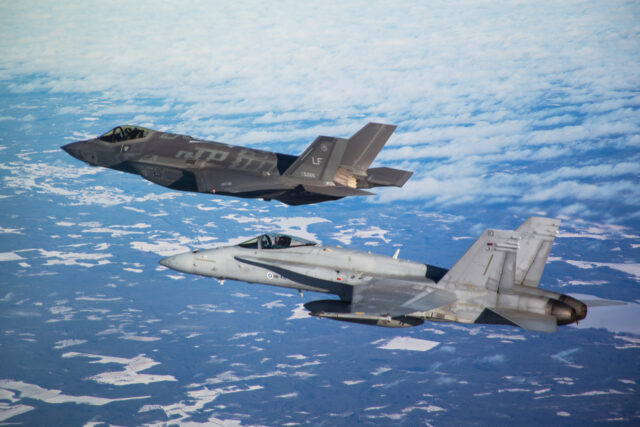
Featured Image: Lockheed Martin