ST Engineering unveils DrN-600 medium-lift cargo drone at Singapore Airshow

February 5, 2026
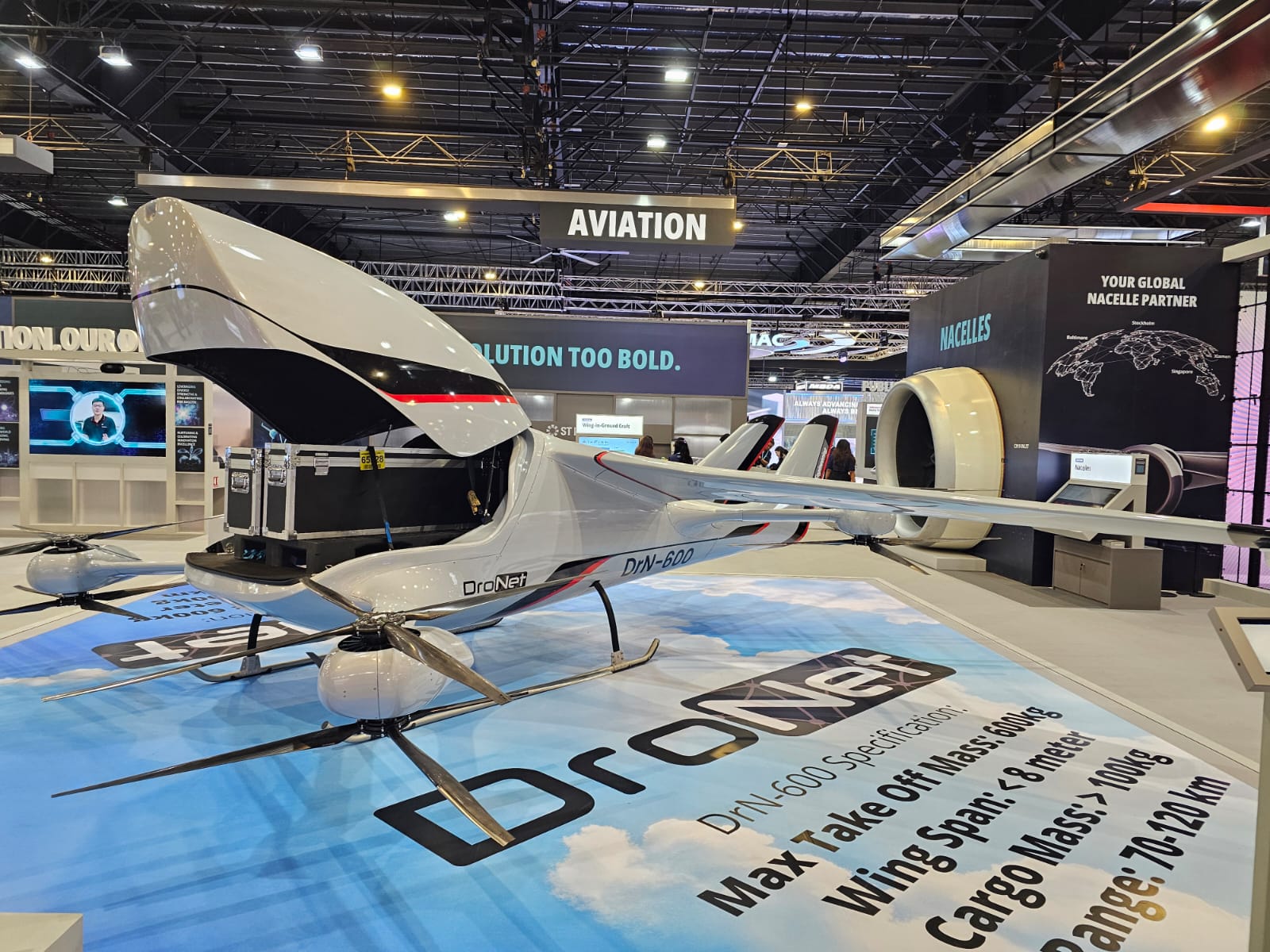
Singapore’s push to industrialise unmanned aviation took a significant step forward at the Singapore Airshow with the unveiling of the DrN-600, a medium-lift cargo unmanned aircraft system designed to bridge the gap between light delivery drones and crewed air transport.
Developed by ST Engineering in partnership with US-based AIR Inc, the DrN-600 is the group’s largest unmanned cargo aircraft to date and a clear signal of its intent to scale autonomous air logistics into commercially viable territory.
With a maximum take-off mass below 600 kg, a payload capacity of up to 100 kg, and a range exceeding 70 km, the aircraft is aimed squarely at addressing two of the biggest barriers to large-scale cargo drone adoption: technical robustness and unit economics.
A medium-lift VTOL cargo drone designed to scale
The DrN-600 sits above ST Engineering’s existing DrN family of lighter unmanned systems, which have been flying operational trials since 2018.
What differentiates the new platform is not just its size, but its ambition. With a wingspan of around eight metres, the aircraft uses a lift-and-cruise configuration, combining vertical take-off and landing capability with efficient wing-borne forward flight.
Distributed electric propulsion powered by lithium-polymer batteries underpins the design, while swappable battery packs are intended to minimise turnaround times between sorties.
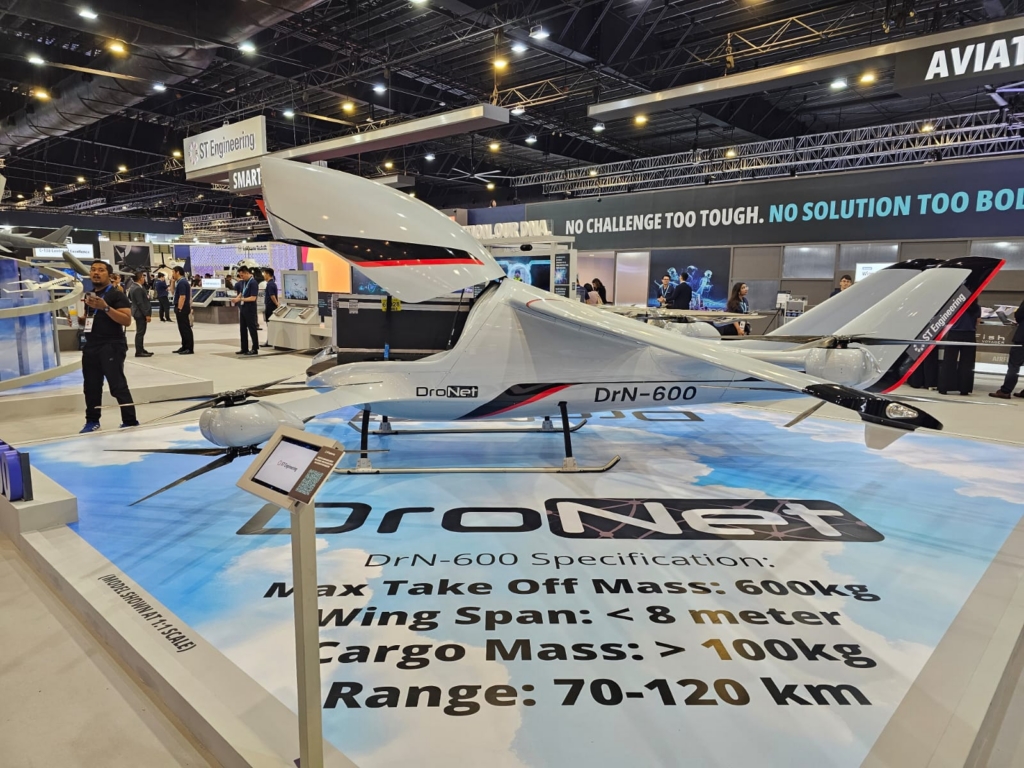
The aircraft’s cargo bay provides around 1.5 cubic metres of usable volume and is sized to accept standardised front-loading pallets, a design choice intended to simplify ground handling and integrate with existing logistics processes rather than require bespoke supply chains.
ST Engineering says this configuration enables the DrN-600 to support last-mile delivery missions in environments where conventional aircraft or ground transport struggle, including islands, mountainous regions, and remote communities with limited infrastructure.
DrN-600: Designed for certification and commercial operations
A defining feature of the DrN-600 programme is its emphasis on regulatory readiness from the outset.
The aircraft has been designed to align with European Aviation Safety Agency requirements for unmanned aircraft systems, positioning it to compete for European tenders as well as broader international markets.
“Certification is targeted for completion by 2028, with operational trials of prototype systems running in parallel to gather customer feedback and refine performance,” an ST Engineering official said.
Flight testing is scheduled to begin in the second quarter of 2026 at a location outside Singapore, reflecting the city-state’s tightly controlled airspace and the complexity of testing medium-weight unmanned aircraft.
According to the official, this measured approach builds directly on lessons learned from earlier DrN platforms, particularly in areas such as operational resilience, command-and-control reliability, and maintainability, factors that often determine whether UAS programmes progress beyond demonstration phases.
DrN-600 targets the gap between delivery drones and crewed aircraft
Globally, the cargo drone market remains fragmented. While a growing number of manufacturers offer unmanned logistics platforms, most are constrained by either short range or modest payload capacity.
By contrast, the DrN-600 targets a middle ground: heavier and longer-ranged than most multirotor delivery drones, yet far simpler and cheaper to operate than crewed aircraft.
ST Engineering executives argue this balance is critical if unmanned cargo aviation is to move from niche trials to routine operations.
For context, China’s DJI FlyCart 100 can carry a similar 100 kg payload, but only over a range of roughly 12 km and using external sling loading. The DrN-600’s enclosed cargo bay, longer range, and VTOL capability are intended to support more complex and operationally flexible logistics missions.
From commercial logistics to defence supply chains
Although positioned primarily as a commercial cargo platform, the DrN-600 also reflects ST Engineering’s broader strategy of leveraging dual-use technologies.
Speaking on the eve of the airshow, company executives highlighted the growing relevance of autonomous systems across both civil and defence domains, particularly as nations seek more resilient and sovereign supply chains.
The cargo drone’s architecture, including its propulsion system, autonomy stack, and payload modularity, could be adapted for disaster relief, humanitarian assistance, and potentially military logistics, especially in contested or infrastructure-poor environments.
DrN-600 joins broader autonomous and AI portfolio at ST Engineering
The DrN-600 was unveiled alongside a suite of new autonomous and AI-enabled systems at the Singapore Airshow, underscoring ST Engineering’s expanding focus on unmanned and digital technologies.
These included Gemini-X, an airborne tactical datalink designed to connect aircraft with ground command networks, and AXIOS, a drone-agnostic multi-payload delivery system for last-mile security and combat support roles.
For ST Engineering, the DrN-600 is less about spectacle and more about proving that medium-lift unmanned cargo operations can work at scale.
Operational trials with customers are expected to play a central role in shaping the aircraft’s final configuration ahead of entry into service, as the company seeks to align performance, reliability, and cost with real-world demand.
If certification targets are met, the DrN-600 could enter commercial service by 2028, potentially placing Singapore at the forefront of the next phase of electric, autonomous air logistics.