Exclusive: How Ukraine’s Sine.Engineering keeps drones flying in jammed airspace

January 28, 2026

As Ukraine and Russia continue to fight one of the most electronically contested conflicts in modern history, attention often focuses on the drones themselves – their range, payloads, and survivability. Far less visible, but arguably more decisive, is the software that allows those aircraft to navigate, communicate, and operate inside heavily jammed airspace.
AGN spoke with Sine.Engineering, a Ukrainian technology company specialising in communication, navigation, and control systems for unmanned aerial vehicles. The conversation with chief executive Andriy Chulyk and chief strategy officer Andriy Zvirko offers rare insight into the hidden battle for drone control in GNSS-denied skies.
At the centre of that effort is Pasika, a modular platform designed to keep UAVs functional, scalable, and controllable in some of the most aggressive electronic warfare environments on Earth.
Why navigation without GPS is critical in Ukraine’s drone war
While much is said about the physical aircraft used in Ukraine, less attention is paid to the software layers that enable them to function at all. In modern warfare, those unseen systems are often the difference between mission success and total failure.

One of the most critical capabilities for any UAV or one-way attack munition is the ability to navigate without satellite navigation. Ukraine has become a proving ground for operations in fully GNSS-denied environments, where GPS jamming is pervasive and increasingly effective.
Visitors to Ukraine frequently note that GPS simply does not work. In Russia, cellular data is heavily restricted, in part to prevent drones from using mobile networks for navigation and command and control. Any drone operating in this environment must assume that traditional navigation and communications will be disrupted, if not entirely unavailable.
The software layer behind Ukraine’s EW-resistant drones
AGN spoke with Sine.Engineering chief executive Andriy Chulyk and chief strategy officer Andriy Zvirko, to understand how software, rather than airframes, is shaping the outcome of the drone war between Ukraine and Russia.

Pasika is a modular software and communications ecosystem designed to enable coordinated drone operations in denied environments. Beyond navigation, it supports:
- Simultaneous control of multiple UAVs
- Automatic signal rerouting between drones
- Secure telemetry transmission with minimal latency
- Scalable mission management across heterogeneous platforms
Sine.Engineering doesn’t build drones and may be overlooked in favour of companies like FirePoint, which builds many of Ukraine’s long-range drones. But its role is crucial in making those platforms scalable and intelligent systems.
The company describes its focus as four core pillars: secure communications, resilient navigation, mass control, and autonomy. The system is hardware-agnostic and can be integrated into both military and civilian UAV platforms.
Magyar's update:
— 414 Magyar's Birds (@414magyarbirds) January 19, 2026
(Deep strikes geo)
Birds of USF pecked out the railway power supply in the TOT, destroyed an S-300V SAM launcher and Kim Jong Un’s MLRS, and took out two UAV depots of the 51st Army over January 17–19.
Here’s the hit list:
🔥 S-300V SAM – self-propelled… pic.twitter.com/17pDlQugNe
While Chulyk and Zvirko declined to name specific customers for security reasons, they confirmed that Pasika modules are currently deployed by more than 150 UAV development teams.
How multi-drone missions work in electronic warfare environments
Initially fielded on small tactical drones, Pasika was rapidly adapted for more complex platforms, including deep-strike systems, relay drones, and interceptor UAVs.

When AGN asked which drones it is used on, Chulyk and Zvirko replied, “We avoid disclosing specific figures or configurations due to security reasons, but its flexible architecture enables integration across multiple drone classes.”
They said, “Whether for close-range interception or long-range strategic strikes, Pasika provides a consistent comms backbone.” It is an ecosystem of communication and navigation solutions.
Pasika is designed to create a coordinated control layer to make multi-drone missions practical and scalable. This allows one operator in the field to prepare, launch, and oversee multiple UAVs from a single interface. The operator can assign mission zones and manage how the drones work together instead of controlling them one by one.
It also plays an important role in enabling other systems like vision modules and guidance software to operate effectively in EW-contested environments.

Pasika does not use terrain-following or map-of-the-earth recognition. Instead, it relies on multilateration-based navigation independent of GNSS. The company is working to integrate additional navigation systems.
AI can help, but humans are still in the loop for drones in high-intensity warfare
Pasika is not a fully autonomous swarm AI; it is still a human-centred coordination platform. It currently doesn’t use AI-based decision-making, and the company believes humans need to remain in control of mission-critical decisions.
❗️❗️Russia is increasingly equipping strike drones with Starlink terminals to bypass Ukrainian electronic warfare, — Der Spiegel.
— MAKS 25 🇺🇦👀 (@Maks_NAFO_FELLA) January 23, 2026
This allows UAVs to maintain control and navigation even during signal jamming. Ukraine is critically dependent on Starlink, so disabling coverage… pic.twitter.com/lNFS37dUaa
AI is used to enhance autonomy, but not dictate it. AI-assisted tools are used for supporting things like route planning and object recognition.
Pasika’s Secure Navigation Stack (SNS) enables drones to autonomously reach their designated area of interest, even if communication with the human operator is lost.
As Paksika is focused on resilient communication and navigation, it does not independently perform autonomous target identification or make strike decisions.
Chulyk and Zvirko added, “We are currently testing enhanced modules for automatic detection and targeting assist features. These capabilities are under active development and battlefield evaluation.”
Various Russian cavalry units have begun installing Starlink terminals on horseback. This is not just an isolated case. https://t.co/GoFZ8NGWfd pic.twitter.com/yTtpp9dCqT
— Special Kherson Cat 🐈🇺🇦 (@bayraktar_1love) January 8, 2026
The company told AGN, “Pasika has been successfully used in missions exceeding 200+ km, demonstrating its resilience and stability even in challenging electronic warfare conditions.” They added that technical details of deep-strike uses cannot be publicly disclosed.
Electronic warfare is forcing rapid evolution in drone systems
As Sine.Engineering points out, “modern war is a race of adaptations,” and “Every tactical advantage is temporary — unless the system behind it is built for change.”

They say, “We don’t bet on stability. We design for instability. That’s what sustains the edge.” Conventional six-month release cycles are unthinkable.
Pasika is built as a modular adaptive system that evolves weekly from direct battlefield feedback. It is built for rapid reconfiguration across frequencies, communication, protocols, and platform types. Even hardware is modular, able to be easily upgraded.
They point out that it’s significantly harder to design countermeasures against dynamic systems like Pasika. Notably, each fielded unit may operate slightly differently depending on mission configuration.
How Ukraine keeps drone costs low despite rising countermeasures
One of the key benefits of UAVs is that they are cheap. One belief of independent experts is that as counter-drone measures increase, the sophistication and costs of drones will rise to the point that their affordability advantage substantially erodes.

The final question AGN asked Sine.Engineering is whether Pasika will contribute to the rising sophistication and costs of drones, ultimately limiting their usefulness.
They replied, “This is a valid concern, and one we actively work to mitigate,” before elaborating that Pasika’s design principle is scalability without cost creep.
They acknowledge that adding resilience and autonomy features often increases complexity, but they prioritise accessible yet high-quality components, mass production-ready modules, and software able to run on commodity onboard hardware.
Chulyk and Zvirko said, “Our system is built to give ‘dumb’ drones smart signal handling — without requiring expensive avionics.”
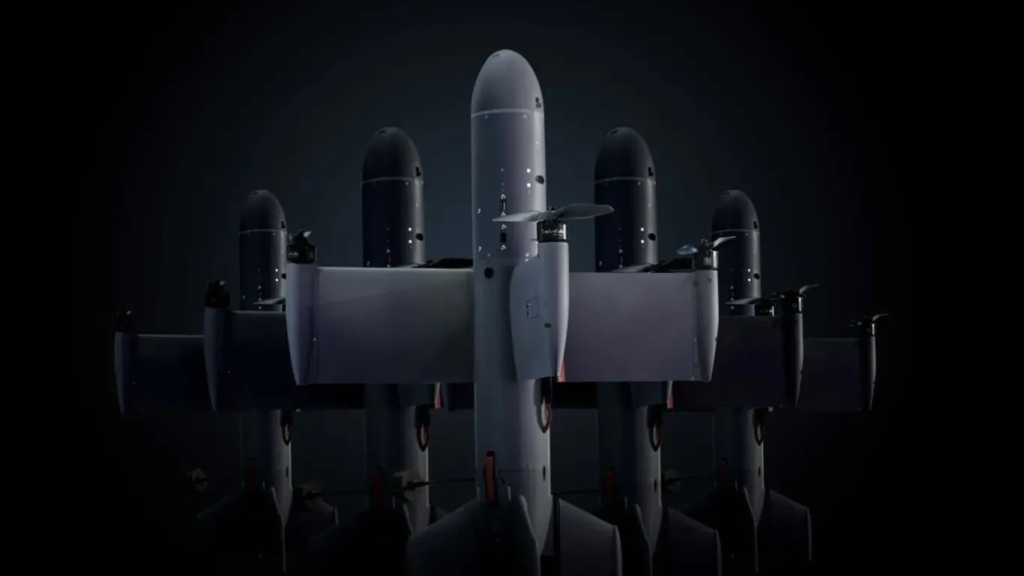
They claim Pasika allows $300-$500 FPVs to complete complex missions that would typically require more expensive platforms, because they maintain comms longer, avoid jamming more often, and deliver valuable telemetry back for future improvements.
Ukraine’s drone capabilities have developed to the point where it’s a world-leader in the sector, and it can use that to purchase aircraft like Poland’s MiG-29s.
Featured Image: Ukrainian MoD