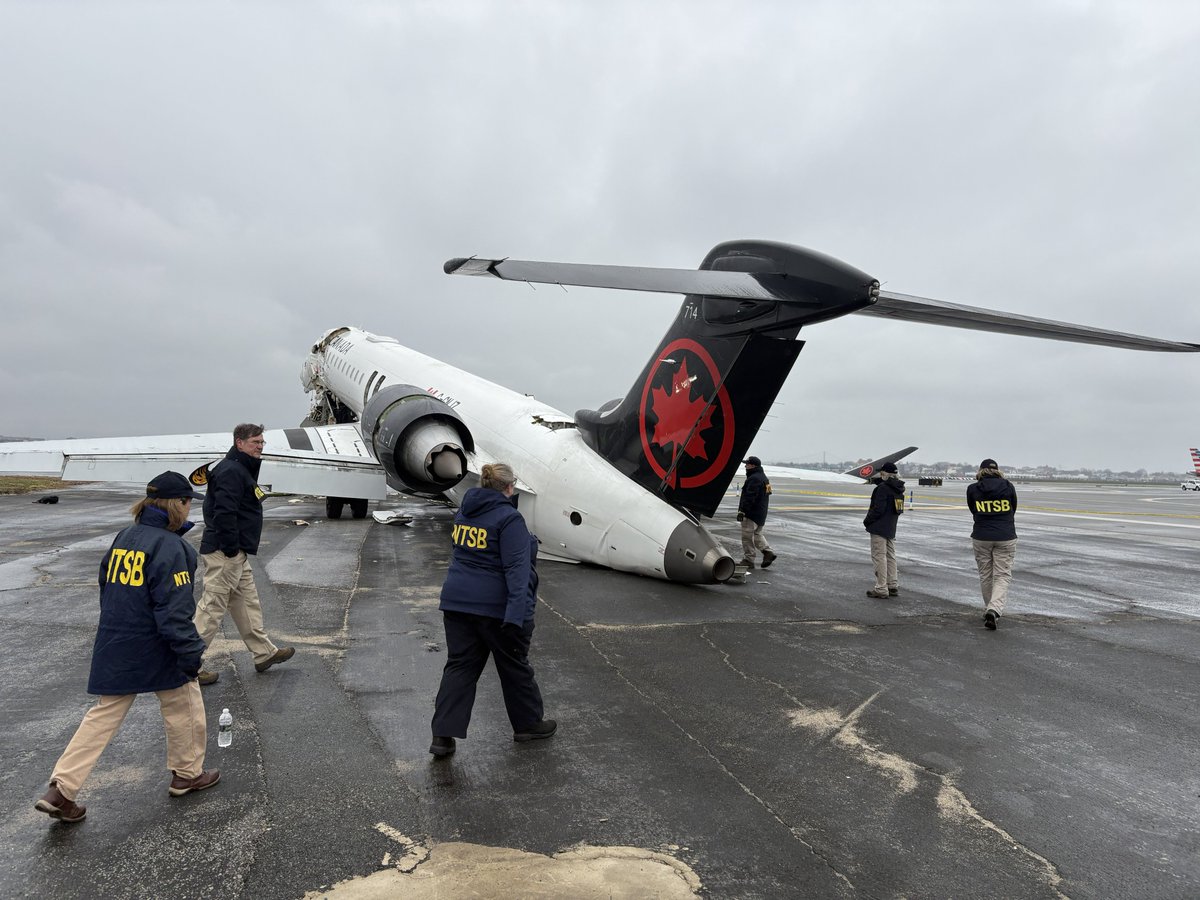
Investigators have begun reconstructing the sequence of events behind the fatal collision between an Air Canada Express regional jet and an airport firefighting vehicle at LaGuardia Airport, following two press briefings by the National Transportation Safety Board (NTSB), with the second briefing following the first full day of investigation.
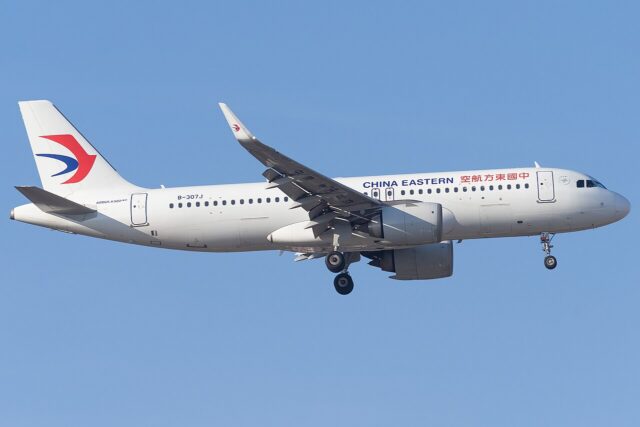
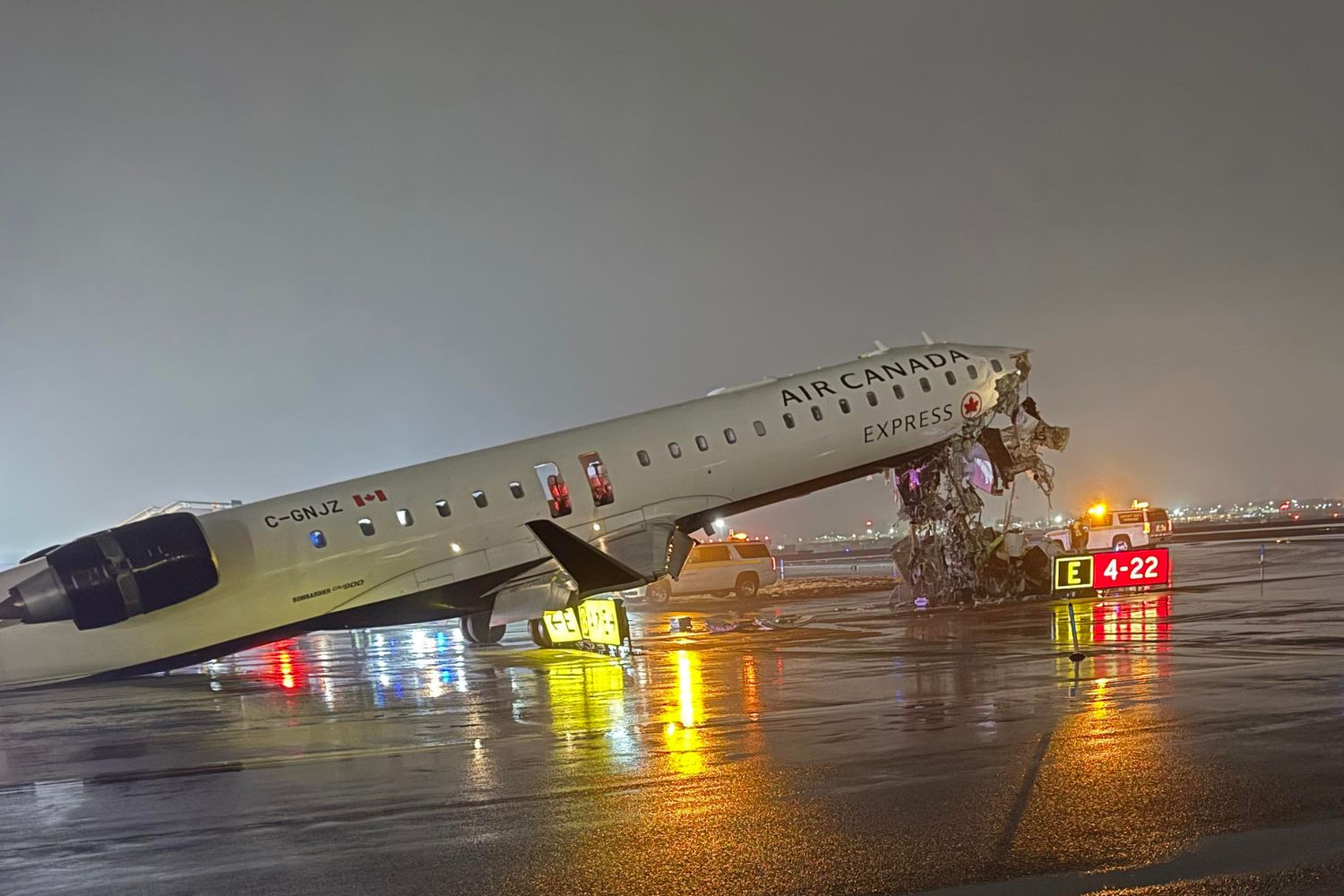
The accident occurred shortly before midnight on March 22 when a Bombardier CRJ900 operated by Jazz Aviation as Air Canada Express Flight 8646 collided with an airport rescue and firefighting vehicle while landing on Runway 4. The aircraft was carrying 72 passengers and four crew members. Two pilots died, and dozens were injured.
Timeline of events from cockpit recordings
Investigators have recovered both the cockpit voice recorder (CVR) and the flight data recorder (FDR), which have been transported to the NTSB laboratory in Washington for analysis.
According to NTSB investigator-in-charge Doug Brazy, the CVR captured more than 25 hours of audio, while the FDR recorded approximately 80 hours of flight data covering more than 400 parameters.
A preliminary review of the final minutes of the cockpit recording provides the clearest sequence of events so far.
“Three minutes and seven seconds prior to the end of the recording, the approach controller instructed the airplane to contact LaGuardia tower,” Brazy said.
Shortly afterwards, the crew configured the aircraft for landing and checked in with the tower.
“The LaGuardia tower cleared the airplane to land on Runway four,” he said.
The aircraft continued a stable approach.
“At 54 seconds, the flight crew acknowledged that the airplane was 500 feet above the ground and on a stable approach.”
The sequence changed in the final half-minute.
“At 25 seconds, truck one requested to cross runway four at taxiway Delta,” Brazy said.
The request was approved moments later.
“At 20 seconds, the tower cleared truck one and company to cross runway four at taxiway Delta.”
Seconds later, aware of the potential conflict with the aircraft landing, the controller attempted to stop the vehicle.
“At nine seconds, the tower instructed truck one to stop,” Brazy said.
However, the Air Canada Express aircraft had already touched down.
Here’s CCTV footage capturing the exact moment Air Canada Express Flight AC8646, a Bombardier CRJ-900, collided with a Port Authority fire truck at LaGuardia Airport last night. pic.twitter.com/qxGMZzKXPD
— Turbine Traveller (@Turbinetraveler) March 23, 2026
“At eight seconds, there was a sound consistent with the aeroplane’s landing gear touching down on the runway,” he said.
The controller repeated the instruction shortly afterwards: “At four seconds, the tower again instructed truck one to stop.”
The recording ended at the moment of the collision.
Transfer of control and cockpit actions
The cockpit voice recorder also captured a change in control between the pilots shortly before impact.
“We do know that the first officer was flying and transferred control to the captain,” NTSB Chair Jennifer Homendy said.
Investigators will analyse the full cockpit transcript to determine what prompted the handover.
Emergency response activity on the airfield
The firefighting vehicle involved in the collision had been responding to another aircraft.
“They were responding to a United Airlines flight 2384 at the gate, which had two aborted takeoffs,” Homendy said. “There were reports of fumes or smoke or some sort of smell in the cabin.”
Investigators are still working to confirm how many vehicles were involved in the response to the United Airlines incident and their movements.
Air traffic control staffing and roles under review
The NTSB confirmed that two air traffic controllers were present in the tower cab at the time of the accident.
“We do… know that there were two people in the cab, the local controller and the controller in charge,” Homendy said.
The controller in charge was also performing additional responsibilities.

Homendy said: “The controller in charge was also doing the duties of the clearance delivery position.”
Investigators are still determining who was responsible for ground control duties.
“We have conflicting information… we have to go through that and rectify some of those inconsistencies,” Homendy said.
LaGuardia’s runway alert system did not trigger
Investigators have also begun reviewing airport surface monitoring systems. Homendy said FAA analysis showed that no automated alert was generated.
“ASDE-X did not generate an alert due to the close proximity of vehicles merging and unmerging near the runway, resulting in the inability to create a track of high confidence,” she said.
She also confirmed that the firefighting vehicle involved in the collision did not have a transponder, which means it was invisible to the ASDE-X system.
TSA lines delay investigators in reaching the accident site
During the first press briefing, Homendy said the investigation team faced delays in arriving at the airport due to long security lines caused by the current partial government shutdown, which has left TSA agents working unpaid and has led to increased absenteeism and resignations.
“We had significant delays with investigators getting here due to backups of TSA lines,” she said. “We had one of our air traffic control specialists, who was in line with TSA for three hours until we called in to Houston to beg to see if we could get her through so that we could get her here. So it’s been a really, really big challenge to get the entire team here, and they’re still arriving as I speak.”
This is what it looks like IAH in Houston with TSA lines consistently around 4 hours long. The lines stretch down multiple levels to the basement where the airports subway system is, then loops around outside and back in the terminal.
— Brooke Taylor (@Brooketaylortv) March 24, 2026
“This is unconscionable, Congress should be… pic.twitter.com/qPK1O7idN9
Some investigators arrived at the scene in the middle of the night and early morning hours after long days of air travel, and some took rail and road alternatives, including the Chair. “I drove,” Homendy said. “We drove up, a number of us.”
During the second briefing, the NTSB Chair also noted the long TSA lines at LaGuardia. “I understand that this press conference had to move because the lines were actually wrapping around the building,” she said.
NTSB Investigation remains at an early stage with many unanswered questions
The investigation is being carried out in collaboration with representatives from the Transport Safety Board of Canada.
Homendy cautioned that the investigation is ongoing and that no conclusions should be drawn yet. “Our aviation system is incredibly safe because there are multiple layers of defence built in to prevent an accident,” she said. “So when something goes wrong, that means many, many things went wrong.”
She warned reporters that the NTSB will only share verified information. “We deal in facts. We don’t speculate,” she said. “If we are not able to verify those yet, we can’t provide those.”
Homendy emphasised that the NTSB will delve into all factors that may have contributed to the tragedy.
“At this stage of the investigation, we don’t limit ourselves, so we have questions on everything, and we look for everything. We collect everything…we may have information that comes our way that we didn’t expect. So we don’t rule anything out until later.”
The NTSB will release a preliminary factual report on the accident within about 30 days, with the final report likely to take up to two years.
Featured Image: NTSB