Who pays for net zero aviation? Airlines warn rising costs threaten fares and connectivity

April 3, 2026

For all the industry’s talk about innovation, scale-up and decarbonisation pathways, one question is now cutting through with increasing force: who is actually going to pay for net zero aviation?
At Sustainable Skies World Summit 2026, that question surfaced again and again, whether the panel was focused on SAF mandates, investment, geopolitics or non-CO₂ emissions. The answers varied, but the pattern was clear enough.
Airlines say they are already paying too much. Investors say capital is available, but only if governments create durable policy certainty. And policymakers are being asked to design markets that can accelerate decarbonisation without pricing out passengers or undermining European competitiveness.
SAF mandates are driving supply, but at a growing cost to airlines
That tension was captured sharply by Dr Preeti Jain, Head of Net Zero Research at IATA, during one discussion.
“Yes, technically, 2% SAF mandates have been met. But I would ask, at what cost?” she said. Jain argued that in 2025, airlines in the EU and UK paid around $2.9bn in SAF premiums, of which $1.4bn reflected the higher price of sustainable aviation fuel compared with conventional jet fuel.
However, a further $1.5bn was paid “in the name of compliance”, costs passed on by suppliers as a result of the mandate system itself rather than the underlying cost of producing the fuel.
Her conclusion was blunt: the industry needs “a very open, candid, honest conversation” about whether mandates alone are the right tool, or whether incentives would be more effective.
That distinction matters. It suggests the debate is no longer simply about whether SAF should be mandated, but whether the current structure is producing the most efficient outcome.
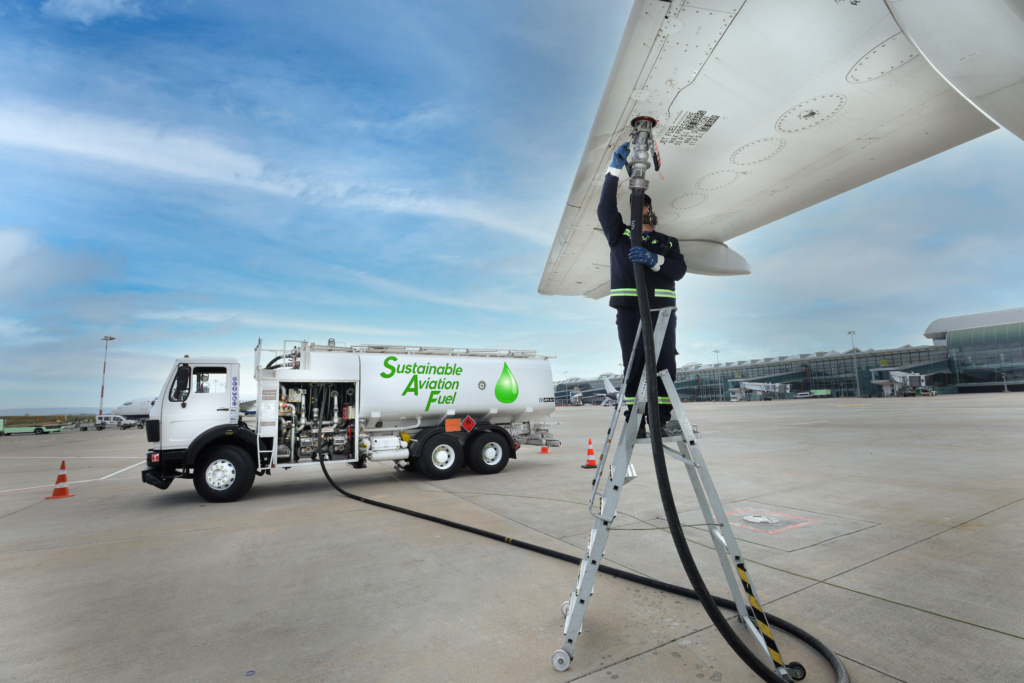
On the same panel, moderator Nikhil Sachdeva, Principal at Roland Berger, said the equivalent mandated price paid by airlines in Europe and the UK in 2025 was about $3,000 per tonne, compared with voluntary SAF prices of roughly $1,900 to $2,100 per tonne.
“That air gap was quite significant,” he said, underlining how airlines are effectively paying a premium not just for SAF itself, but for the way the market is structured.
Wood Mackenzie echoed that view in comments shared with AGN ahead of the show. Ozzy Jegunma, Senior Research Analyst for Refined Products and Transport Fuels, said market mechanisms such as contracts for difference, tax credits and floor-price guarantees are critical to unlocking investment.
Without them, he warned, “high upfront capital costs and difficulty securing long-term offtake agreements represent significant barriers to final investment decisions.”
He pointed to emerging policy tools as evidence of how governments are beginning to address the problem, including the EU’s pilot double-sided auction for e-SAF and the UK’s strike price-based revenue certainty mechanism, both designed to reduce risk and improve investor confidence.
In other words, the market is not refusing to fund net-zero aviation; it is refusing to fund it blindly.
Net zero aviation funding depends on policy certainty, not capital availability
That same dynamic was echoed in the summit’s investment discussions. Vanessa Lowe, Vice President Global Banking at Santander, argued that the real issue is not a total absence of capital, but the conditions under which conservative lenders can deploy it.
“You have to have visibility,” she said, “in particular, the revenue generation. For offtake contracts, you have to have certainty over the technology, the procurement strategy, the construction strategy, over these sources, not just in the short term, but over the long term.”
Sameer Savani, Transport Managing Director at Connected Places Catapult, made much the same point more directly. Investors, he said, are “not really funding a technology potential. They’re looking for that kind of policy anchoring.”
The problem, in his view, “wasn’t the availability of capital”, but the lack of flow-through caused by policy uncertainty.
That uncertainty is not theoretical. IWood Mackenzie’s Jengunma warned that major production projects remain highly exposed to political change and shifting policy frameworks. Developers, he said, are increasingly trying to build in flexibility around feedstocks, product mix and routes to market so they can survive rule changes or deteriorating economics.
European airlines warn rising decarbonisation costs risk fares and connectivity
If investors want policy certainty, airlines want something else as well: relief.
In a declaration issued the day after Sustainable Skies, Airlines for Europe warned that EU airlines and passengers “cannot keep absorbing ever-growing regulatory and cost burdens”.
The association said regulatory costs for A4E airlines have tripled since 2014 to €15.5bn annually and are set to rise to €27.6bn per year by 2030. It called for urgent action on ETS, SAF costs, airport charges and air traffic management, arguing that higher fares and weaker connectivity will follow unless the burden is brought under control.
That position aligns closely with the messages coming from airline representatives at the summit. The underlying complaint is not that decarbonisation should stop, but that Europe is in danger of asking its airlines and passengers to subsidise the transition faster and more heavily than competitors elsewhere.
Yet there is another complication, and it makes the “who pays?” argument even harder to settle. Aviation is still debating what, exactly, it is paying to solve.
Non-CO2 emissions and contrails add uncertainty to aviation’s net-zero costs
That was evident in the non-CO₂ discussions, where speakers repeatedly stressed the need for trials, validation and operational learning before regulation becomes more prescriptive.
In comments sent to AGN before the event, Erin Smith, Senior Sales Manager at Estuaire, argued that neither operational mandates nor pricing non-CO₂ effects into existing carbon frameworks should be the immediate priority. “We need demonstrated feasibility and measurable impact before introducing binding regulation,” she said.
The summit panels backed that up. Opening the session, Ian Jopson, Sustainability Director at NATS, said the industry position is that scientific uncertainties must be addressed through better data, targeted SAF use, large-scale trials and engagement with academia and experts.
Adam Morton, Head of Technology – Sustainability & Strategy at the Aerospace Technology Institute (ATI), added that none of the contrail trials so far had involved 1,000 aircraft, and that much larger and more complex trials will be needed before routine rollout is realistic.
Marylin Bastin, Head of Aviation Sustainability, EUROCONTROL, also warned that operational trade-offs cannot be ignored. In simulations looking at contrail avoidance in medium to high traffic conditions, she said, “We will face a reduction of capacity up to 20%.”
That matters because delays themselves create knock-on emissions and costs. Lahiry Ranasinghe, Director of Sustainability at easyJet, described current contrail avoidance work as “very manual”, adding that existing flight planning systems are not yet set up to integrate prediction tools seamlessly.
Who pays for net-zero aviation remains unresolved as costs rise
All of which brings the industry back to the same uncomfortable place. Net-zero aviation is not a bill that can be sent neatly to one address.
Governments are being asked to de-risk first-of-a-kind projects and provide long-term policy stability. Investors are willing to back credible projects, but only when revenue frameworks and rules are durable.
Airlines are already shouldering compliance and fuel costs, and are warning that passengers will not absorb endless increases without consequences for demand and connectivity.
And when it comes to non-CO₂, the sector is still working out how much of the problem can be mitigated operationally, and what that mitigation would cost.
The question, then, is no longer whether aviation will pay for net zero. It already is. The real battle is over whether the costs are being shared in a way that is economically rational, politically sustainable and operationally workable.
At the moment, that answer still looks unsettled.
Featured image: stock.adobe.com