US Marine Corps 2026 aviation plan puts attritable drones at the centre of future airpower

February 11, 2026
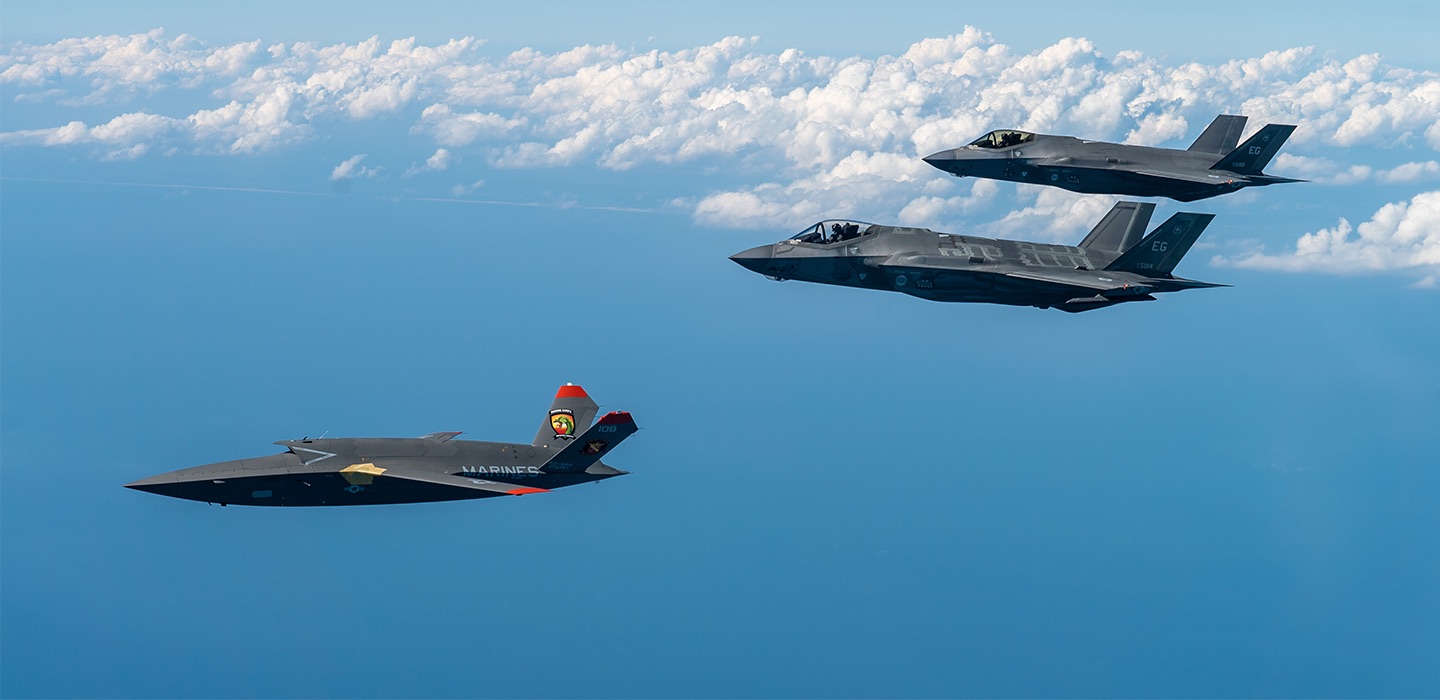
The 2026 Marine Aviation plan makes clear that uncrewed systems are no longer experimental adjuncts to the US Marines’ airpower. They are becoming structural components of how the Corps expects to fight.
Rather than presenting drones as revolutionary silver bullets, the United States Marine Corps frames them as “low-cost” and “risk-worthy” capabilities designed to enhance the effectiveness of crewed aircraft, particularly the F-35, in a peer or near-peer fight.
The document reads like it was written with a hard fight in mind. It assumes airspace will be contested, supply lines disrupted, and aircraft lost. In that kind of environment, uncrewed systems are not a nice-to-have – they are how Marine aviation keeps operating once the first losses are taken.
The Corps’ experimental arm, the Expeditionary and Maritime Aviation Advanced Development Team (XMA-ADT), is now driving four future capability lines that collectively outline a shift toward distributed, attritable, and scalable airpower. These initiatives are not framed as technology showcases. They are presented as operational necessities.
US Marines outline four uncrewed aviation priorities
The 2026 Marine Aviation Plan focuses on four defined capability lines that together outline how Marine aviation expects to fight in a contested environment. Under the banner of the Expeditionary and Maritime Aviation Advanced Development Team, the Marines are concentrating their efforts on MUX TACAIR, the Aerial Logistics Connector, Precision Attack Strike Munition and Future Attack Strike.
Each addresses a different vulnerability, combat risk, logistics exposure and scalable strike, but all are tied to the same objective: sustaining combat power under pressure.
MUX TACAIR: the Marine Corps’ attritable collaborative combat aircraft effort
MUX TACAIR is the most visible of the four initiatives. It is explicitly designed to enhance F-35 effectiveness by adding a “low-cost, risk-worthy capability” to the tactical fight. The plan references manned–unmanned teaming demonstrations between F-35s and Kratos’ XQ-58 surrogate platform, along with upcoming taxi testing and a conventional take-off and landing variant.

The emphasis is not on replacing crewed fighters, but on extending their reach and survivability. MUX TACAIR platforms are expected to push sensors forward, carry additional weapons, and complicate adversary targeting. In practical terms, they are intended to operate where commanders may hesitate to send pilots.
The plan also notes the establishment of a MUX TACAIR Transition Task Force to oversee the the fielding of the capability in early 2026, signalling a move beyond pure experimentation.
Aerial Logistics Connector: cargo drones for contested supply lines
If MUX TACAIR addresses combat risk, the Aerial Logistics Connector addresses logistical vulnerability.
ALC is designed to move supplies to distributed Marine units operating along the First Island Chain and other contested regions. The concept reflects a sober assumption: traditional airlift platforms may be too exposed in high-threat environments. Cargo drones offer a way to sustain expeditionary forces without risking scarce manned transport aircraft.

ALC reinforces a central theme of the plan: distributed operations only work if sustainment survives.
Precision Attack Strike Munition: scaling lower-cost strike capacity
PASM points toward scalable, lower-cost strike capacity. While the plan does not fully detail specific airframes, the concept emphasises expanding the Corps’ ability to deliver precision effects without relying solely on expensive crewed platforms.
In an attritional fight, mass matters. PASM appears designed to provide that mass in a way that tolerates loss.
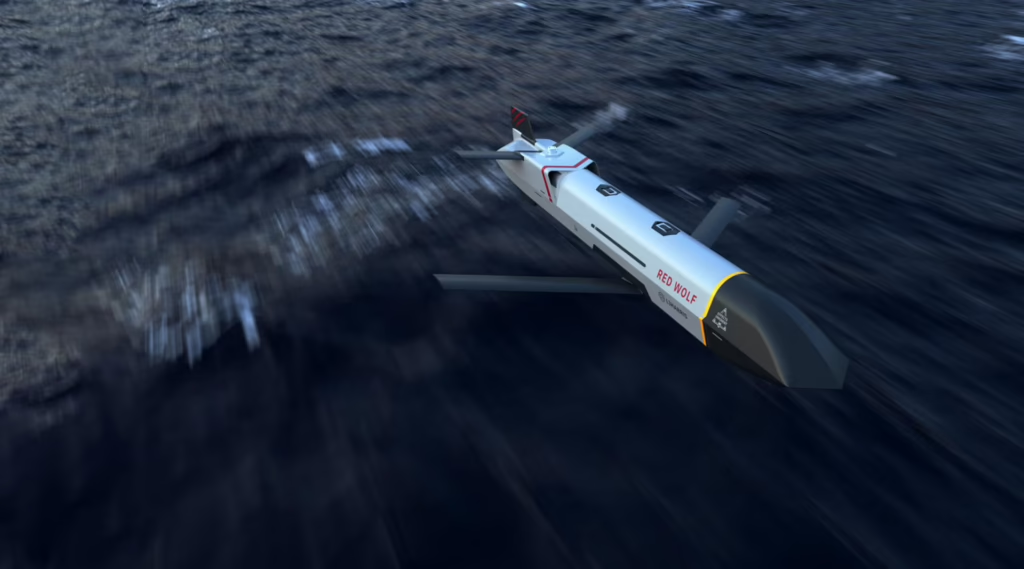
L3Harris Technologies has been selected by the U.S. Naval Air Systems Command to develop, test and manufacture Red Wolf vehicles for the Marine Corps’ Precision Attack Strike Munition programme. Red Wolf extends the range of weapons launched from vertical take-off and landing platforms to proven distances of 200 nautical miles, far exceeding the single-digit range of other rocket-launched missiles.
Future Attack Strike: autonomy and distributed fires at scale
FASt extends this logic further, focusing on future strike architectures that combine autonomy, modular payloads and distributed employment. Rather than concentrating lethality in a small number of exquisite aircraft, the Marines are exploring how to distribute it across multiple, more expendable systems.
The four lines of effort signal that uncrewed systems are no longer peripheral experiments. They are becoming integral to how the Corps intends to project power inside contested zones.
US Marines evaluating General Atomic’s YQF-42 collaborative combat aircraft
General Atomics announced yesterday that it was selected by the Marine Corps for evaluation in the Marine Air-Ground Task Force Uncrewed Expeditionary Tactical Aircraft (MUX TACAIR) Collaborative Combat Aircraft (CCA) programme.
GA-ASI was selected by the U.S. Marine Corps for evaluation in the Marine Air-Ground Task Force Uncrewed Expeditionary Tactical Aircraft CCA program.
— General Atomics Aeronautical Systems, Inc (GA-ASI) (@GenAtomics_ASI) February 10, 2026
This selection initiates the integration of a Marine Corps mission kit into the #YFQ42A and the rapid development on of… pic.twitter.com/7EMfuRgmuQ
General Atomics will integrate a Marine Corps mission kit into the YFQ-42A surrogate platform for assessment.
YFQ-42A is one of the aircraft selected by the Air Force for its CCA programme, and it successfully achieved its first flight last year.
General Atomics says the Marines are seeking to rapidly develop autonomy for a government-supplied mission kit (aka digital brain) for use in expeditionary operations.
The mission kit is “a cost-effective, sensor-rich, software-defined suite capable of delivering kinetic and non-kinetic effects.”

This appears to be related to Increment 2 and Increment 3 capabilities set for 2030-2035 and 2035-2040 timelines, respectively.
The Marines are looking for loyal wingman drones that will be cheaper, available in greater numbers, act as force multipliers, and be used in environments too risky for the F-35. At the same time, an aircraft like the YFQ-42 is not a cheap disposable asset.
What the 2026 Marine aviation plan tells us about UMSC uncrewed priorities
The clearest signal from the 2026 plan is that the Marine Corps is preparing for a fight in which aircraft losses are not hypothetical. The repeated description of uncrewed systems as “risk-worthy” suggests a deliberate acceptance that some platforms will be sent into environments too dangerous for pilots. Rather than trying to eliminate risk, the Corps is looking to manage it, shifting exposure from people to hardware.
Survivability also appears to carry more weight than traditional measures such as sortie generation. The document repeatedly refers to Distributed Aviation Operations and decision-centric concepts, both of which assume contested airspace and fragile logistics. In that framework, uncrewed aircraft are tools for pushing sensors forward, extending networks and sustaining kill chains when fixed bases and conventional airlift are under pressure.
There is also a clear emphasis on autonomy and digital integration over airframe glamour. The plan talks more about mission kits, manned–unmanned teaming and scalable architectures than about fleet sizes or production numbers. That suggests the Marine Corps sees software, connectivity and adaptability as the enduring advantage, with airframes serving as platforms for those capabilities rather than ends in themselves.
What the 2026 Marine Aviation Plan does not do is promise drone swarms or sweeping technological upheaval. Instead, it outlines a force designed to absorb losses, adapt under stress and keep fighting in contested conditions. In that sense, the Corps’ uncrewed strategy is less about transformation for its own sake and more about building resilience into its future airpower.
Featured Image: Kratos Defense