Japan tests mini Subaru jet-powered drones in push for loyal wingman capability

November 25, 2025
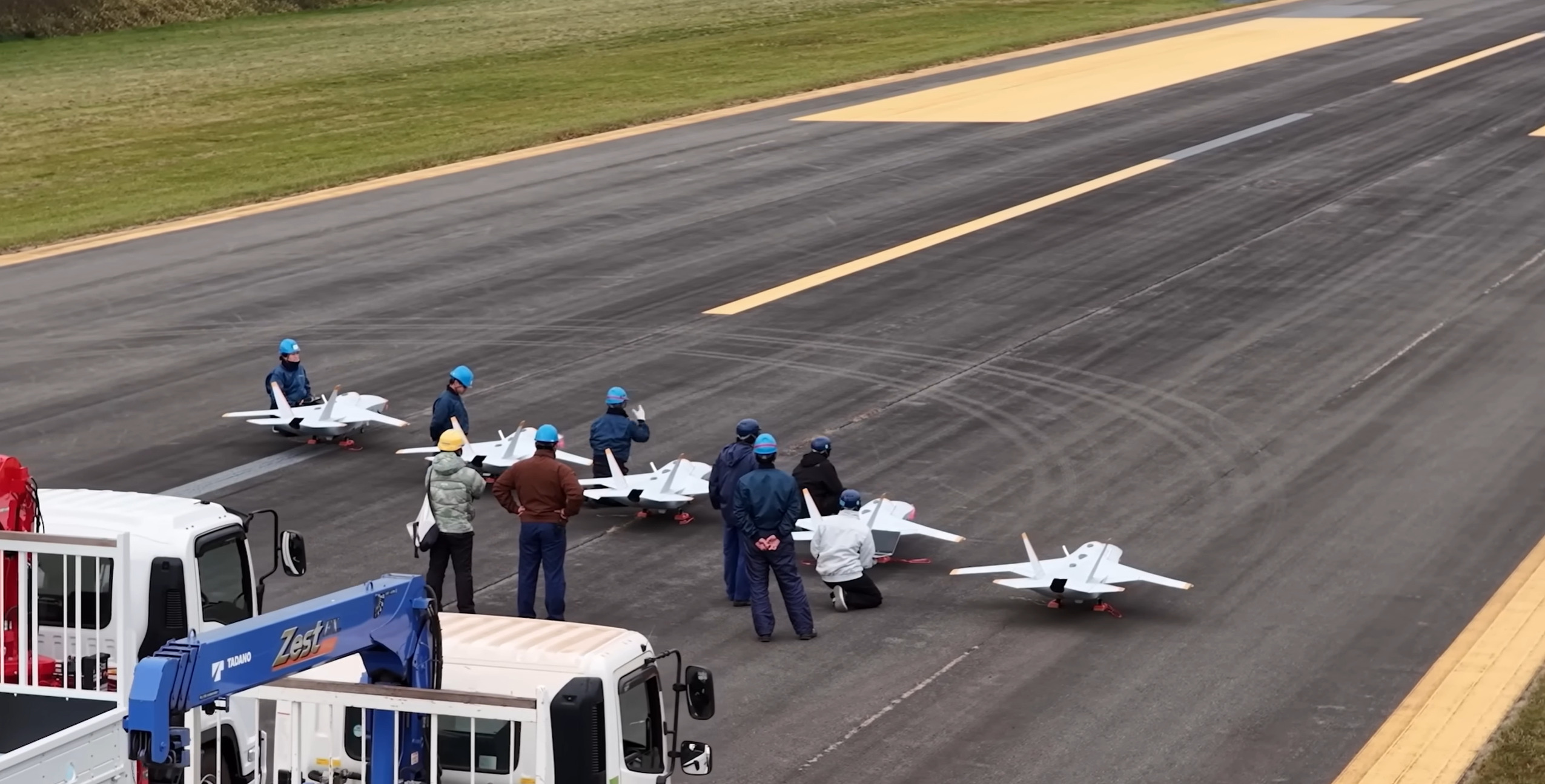
Japan is working to develop Manned-Unmanned Teaming (MUM-T) capabilities for its military, with key contractors including Subaru and Mitsubishi. Subaru has built eight mini demonstrator UAVs as Japan develops its own loyal wingman drone capabilities.
Subaru develops experimental drones for MUM-T testing
Last week, the Japan Ministry of Defence’s Acquisitions, Technology and Logistics Agency (ATLA) released a video showing five small-jet-powered aircraft taking off and conducting manoeuvres.
The aircraft are sub-scale demonstrators and are too small to carry any reasonable amount of fuel or payload. The tests took place in October and were managed by Japan’s Air Systems Research Center.
The video loaded on ATLA’s YouTube channel explains, “The Aviation Equipment Research Institute is conducting research into unmanned aircraft that can work in conjunction with manned aircraft.”
The second part of the video description reads, “As part of research into remotely controlled support aircraft technology, flight tests were conducted using an unmanned experimental aircraft and a manned helicopter to simulate mission maneuvers and five-aircraft formations.”

In the video, the helicopter is a member of the UH-1 ‘Huey’ family (specifically a Subaru Bell 412EPX). In the helicopter cockpit, the crew can be seen controlling the drones with hand-held tablets.
Japan is developing its own loyal wingman programme
ATLA issued a news release on 20th November saying it is researching remotely controlled support aircraft technology. ATLA said it is “conducting research into unmanned aircraft capable of cooperation with manned fighter aircraft.”

The agency wrote, “Going forward, we will analyse the obtained data, verify the effectiveness of the technology, and steadily advance research and development toward the realisation of future unmanned aircraft.”
ATLA stated that the tests are obtaining data necessary for research, including generating flight paths and the workload of pilots operating the unmanned aircraft.

Mitsubishi Heavy Industries is also designing two types of loyal wingman drone concepts to operate alongside its future GCAP fighter jet. Its concepts include a missile-like drone concept. Japan is also cooperating with partners in the US.
Get the latest aerospace defence news here on AGN.
Japan rearming to counter an increasingly capable China
Since World War II, Japan has relied heavily on the US for military aircraft and has locally produced its fighter jets under license. It is even a very rare example of a country permitted to assemble its F-35As locally.
The military is a very sensitive issue in Japan, partly because of the role the military had in overthrowing its liberal government of the 1920s. Faced with an increasingly armed and assertive China, voices in Japan for rearmament are growing louder. At the same time, the US is pushing Japan to increase its military funding.

Japan also has an ageing population, which will make increasing its manpower difficult. To compensate, the country is looking to autonomous systems to provide increased combat capabilities.
At the same time, for the first time since WWII, Japan is working with the Europeans (specifically the United Kingdom and Japan) to develop the next-generation Tempest/GCAP fighter jet. It is expected to enter service around 2035.
Unlike the USAF’s NGAD programme, GCAP does not include the development of loyal wingman drones. Tempest/GCAP is being developed to be a system of systems commanding autonomous loyal wingman drones, but what those drones will be remains unclear.
See how GCAP is fostering close collaboration between the UK, Italy and Japan to deliver world-leading future combat air capability ✈️
— BAE Systems Air (@BAESystemsAir) November 12, 2025
Discover the latest Global Combat Air Programme news here 👇https://t.co/owuTw79oys pic.twitter.com/tm1TnYbiaM
According to Professor Justin Bronk, Tempest/GCAP is being developed to counter future Chinese fighter jets.
Japan wants it to be in service quickly to counter China’s increasingly capable aircraft. Bronk has told the UK Parliament that the United Kingdom will “be facing Russians carrying Chinese weapons, Chinese sensors and, probably, Chinese tactics and training” in the 2030 to 2040ish timeframe.