Watch: Dramatic footage of Iran drone striking Dubai Airport near Airbus A380s

March 7, 2026
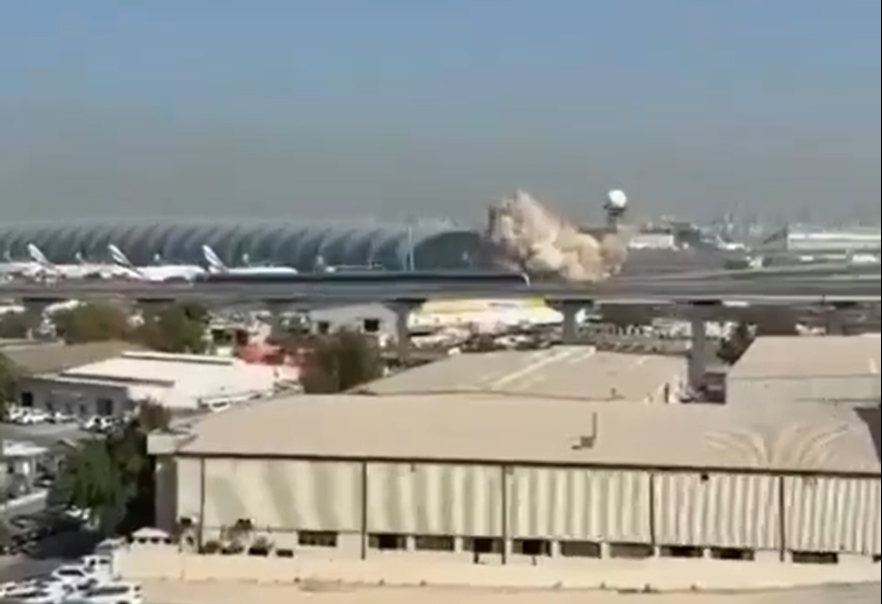
Today, an Iranian one-way attack drone made it through air defence and struck the Dubai International Airport near Concourse A. The attack further disrupts highly constrained flights in the region, while Iran may not be able to stop itself from attacking.
Iranian drone hits Dubai Airport
The drone appeared to miss Concourse A, but landed closely just at the end of the Concourse. It is unclear how much damage was done, although the blast looks close enough to have blown windows in.
Another Iranian attack drone hit Dubai International Airport, barely missing Concourse A. pic.twitter.com/axvNdrXUFn
— OSINTtechnical (@Osinttechnical) March 7, 2026
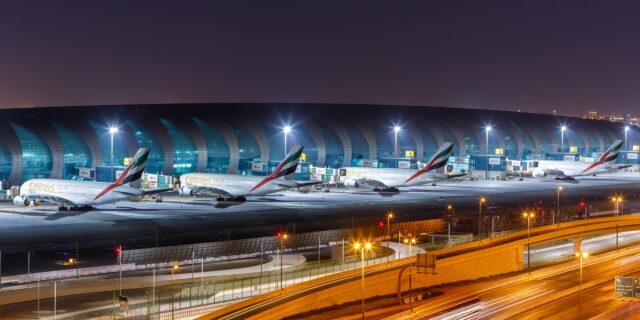
The impact was also within a few hundred metres of a row of parked Emirates Airbus A380s. The blast looks too far away to seriously damage the aircraft.
Emirates briefly issued a statement saying all flights to and from Dubai have been suspended until further notice. It instructs passengers not to go to the airport and that Emirates will be sharing updates as they become available.
The statement ended by saying “All city check‑in points across Dubai are temporarily closed until further notice.”
That statement was soon deleted and replaced with a new statement saying that Emirates has now resumed operations and passengers can come to the airport.
Our post from 11:08am Dubai time regarding operational status is no longer current, and has been deleted to avoid causing unnecessary confusion.
— Emirates Support (@EmiratesSupport) March 7, 2026
Emirates has resumed operations. Passengers who have confirmed bookings for this afternoon’s flights may proceed to the airport. This… pic.twitter.com/j6niNfBCoI
While Iran’s rate of missile and drone launches has been falling dramatically over the past week, it is not yet zero, and some munitions do manage to make it through air defence.
During the campaign, the UAE air defence has been enormously successful in intercepting the vast majority of missile and drone attacks.
However, no air defence network provides 100% protection, and a few seep through. Around 8% of ballistic missiles and 7% of drones have not been intercepted by the UAE air defence.
Iran’s President says Iran will not attack UAE and Gulf states
Ironically, the attack comes as the Iranian President, Masoud Pezeshkian, said these attacks would cease. He said on TV today, “Here, I must apologize to the neighboring countries that were affected by attacks from Iran. On my own behalf and on behalf of Iran, I apologize.”
#BREAKING: Iran's President Masoud Pezeshkian: "Here, I must apologize to the neighboring countries that were affected by attacks from Iran. On my own behalf and on behalf of Iran, I apologize."
— Wladimir van Wilgenburg (@vvanwilgenburg) March 7, 2026
"I hope that, based on the decision taken yesterday in the Provisional Leadership… pic.twitter.com/fb5dlSzpPW
Pezeshkian then added, “I hope that, based on the decision taken yesterday in the Provisional Leadership Council, which has now been communicated to the armed forces, from now on they will not attack neighboring countries or fire missiles at them unless those countries attack us first.”
These may be empty words, as the extent of operational control that the central Iranian leadership has over its regional forces is questionable.
Get the latest aerospace defence news here on AGN.
Why Iran may be unable to stop attacking its neutral neighbours
This is due to both the US and Israel targeting Iran’s command and control and its ability to communicate with its various forces effectively. It is also partly due to measures Iran took ahead of the campaign in anticipation of its command structure being degraded.
📊 GCC Integrated Defences: What Are Interception Rates by Weapon Type? And what data doesn’t tell us?
— Ibrahim Jalal | إبراهيم جلال (@IbrahimJalalYE) March 6, 2026
🇦🇪 UAE: Ballistic 92% (181/196) — Cruise 100% (8/8) — Drone 93% (1,001/1,072)
🇶🇦 Qatar: Ballistic 96% (99/103) — Cruise 100% (5/5) — Drone 55% (30/55)
🇸🇦 KSA: Ballistic 100%… https://t.co/zCAzzBmUR1 pic.twitter.com/BQ5FByTx4w
Learning from its 12-Day War with Israel and the US in 2025, Iran decided it could not just retaliate against Israel. After the war, its long range-munitions were heavily degraded, and only its relatively limited number of longer-ranged missiles have the range to reach Israel.
It was decided that a better way to exert pressure was to target the US’s Arab Gulf state allies. This plan would seek to induce economic pain targeting shipping, commercial aviation, etc.
But importantly, the Wall Street Journal wrote that Iran implemented “a decentralized approach that allows individual commanders the autonomy to keep up the fight if cut off from their superiors.”
Decentralization may explain why Iranian drones were fired at friendly Oman, causing the Iranian government to apologize, only for more to be fired at Oman later.
🚨 Iranian attack on Azerbaijan was carried out not by a Shahed drone, but by a long-range Arash-2. pic.twitter.com/SNmgF21k7H
— The Azeri Times (@AzeriTimes) March 5, 2026
It could also explain the ballistic missile attack on Turkey and Thursday’s drone attack on Azerbaijan’s Nakhchivan International Airport, an attack Iran denied. Reports indicate Azerbaijan may be preparing a response.
Featured Image: X