Germany’s €5.3bn Eurofighter Typhoon deal makes it the launch customer for next-gen Tranche 5 jets

October 16, 2025
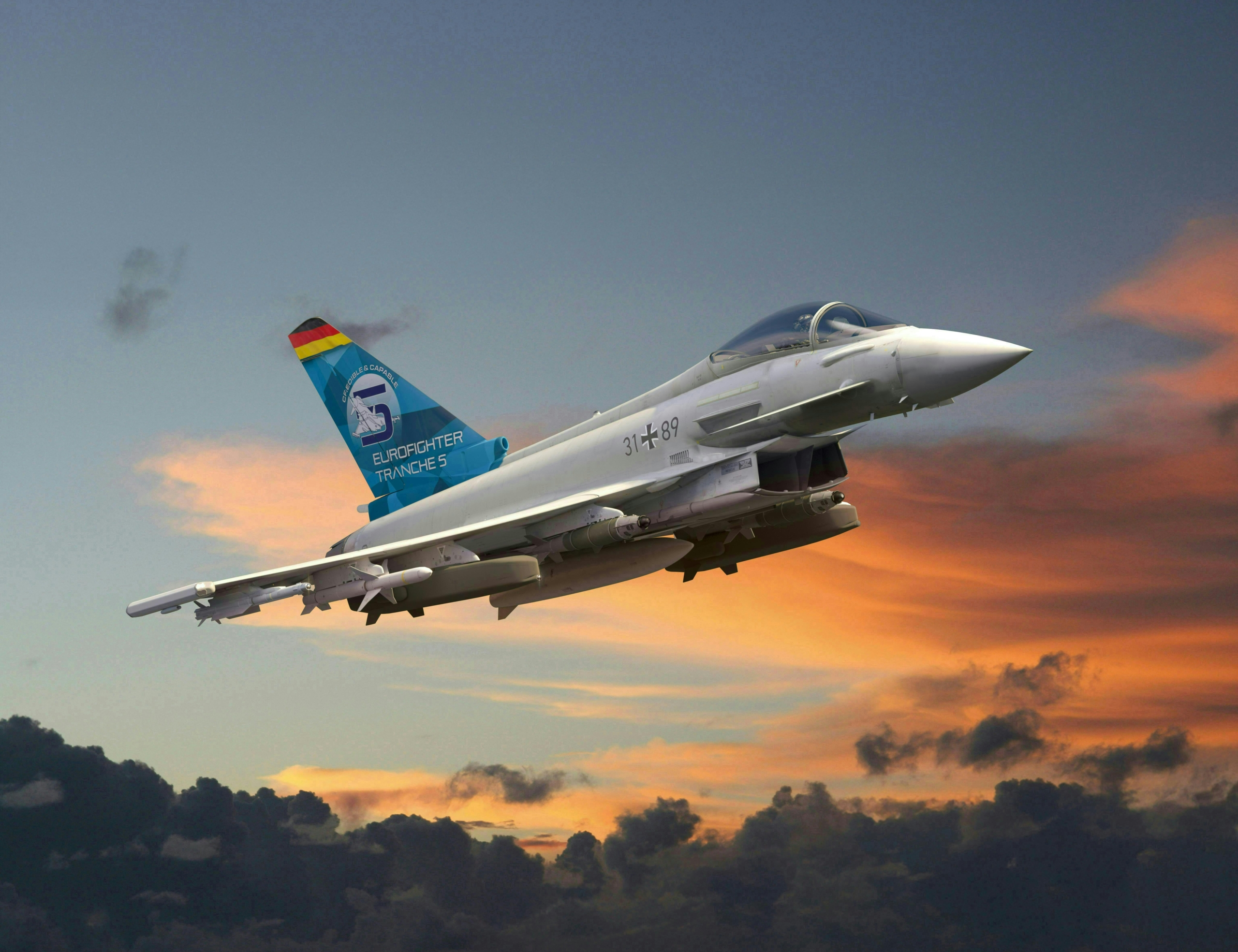
Germany has become the latest country to order the Eurofighter Typhoon. Yesterday, it officially placed an order for an additional 20 aircraft, which are expected to be received between 2031 and 2034.
The order is the first for the latest Tranche 5 variant of the Eurofighter programme, and will make Germany the launch customer for this next-generation aircraft.
Germany orders 20 new Eurofighters
The order for 20 Tranche 5 Eurofighters is in addition to the 38 Eurofighters Germany already ordered as part of Project Quadriga, dating from around 2020. Eurofighters are expected to remain in service until beyond 2060.

According to the Eurofighter Consortium, as these jets enter service, they will replace part of Germany’s ageing fleet of variable-sweep wing Panavia Tornados, which are scheduled to fully leave its fleet by 2030. Germany is also rapidly procuring 35 F-35As to take over the nuclear sharing roles of the Cold War-era Tornado.
Meanwhile, Spain recently ordered another 25 Eurofighters, Italy ordered another 24, while Turkey is in the process of purchasing 40. A total of 762 examples have been ordered by nine countries, rising to around 802 and ten countries if Turkey is included.
GERMANY PLACES ORDER FOR 20 EUROFIGHTER JETS
— Eurofighter Typhoon (@eurofighter) October 15, 2025
The leaders of #Eurofighter and NETMA (the NATO Eurofighter and Tornado Management Agency) today signed the contract for 20 German Air Force Eurofighters in Manching, the final assembly base of Airbus in southern Germany.
Jorge… pic.twitter.com/axPOZ7m4ev
The UK has not ordered any in years, and it is unclear if it will order more. The RAF is the first to retire Tranche 1 Eurofighters, with Babcock looking for ways to recycle them.
What’s new about the Tranche 5 Eurofighter Typhoon?
These Tranche 5 jets will represent the cutting edge of European fighter jet engineering. They will equip the jets with the latest Airbus E-Scan Active Electronically Scanned Array (AESA) radar, Saab Arexis electronic warfare sensor suite, and other significant technological upgrades compared to jets already in service.

The addition of the new AESA radar will significantly improve the jet’s ability to detect and track targets while also performing electronic warfare. The Arexis suite will boost the aircraft’s ability to operate and survive in contested airspace.
Tranche 5 will also introduce significant improvements in computing power, sensor fusion and mission-system architecture, providing the digital backbone required for future electronic combat and suppression-of-air-defences missions. These upgrades form the foundation for the planned Eurofighter EK (Elektronischer Kampf) variant, which will take over the Tornado ECR’s specialised SEAD/DEAD role later in the decade.
Bundestag approved more of Saabs #AREXIS Electronic Warfare system for 🇩🇪 #Eurofighter fleet.
— Gripen News (@GripenNews) October 8, 2025
Good to see more produced units of this excellent and modular European #EW-technology. It's on #Gripen E.
Arexis https://t.co/UOapzDOrMV
Source: https://t.co/ly6j4oj5gq pic.twitter.com/Mpkq7C6NO7
The Eurofighter continues to be powered by the Eurojet EJ200, derived from the Rolls-Royce XG-40 technology demonstrator. Although the Tranche 5 order does not include a new engine, the EJ200 remains one of the most advanced powerplants in its class, offering high thrust-to-weight performance and modular growth potential for future upgrades. Alongside the French Rafale’s M88, it is one of the few Western-built combat engines not sourced from the United States.
Bridging the gap until FCAS enters service
Germany is one of the primary partners in the Eurofighter Consortium. Along with the United Kingdom, it has a 33% ownership, with the remaining 33% split between Italy and Spain.

While the F-35 stealth fighter may be the most advanced fighter jet on the market, fourth-generation jets, like the Eurofighter, work well being paired with fifth-generation fighters. In RAF service, the F-35 is known as the ‘assassin’ while the Eurofighter Typhoon is called the ‘thug’.
The order also helps Germany to keep its fighter jet industry humming until it can switch over to producing sixth-generation FCAS fighter jets, assuming that project with France doesn’t fall apart. Likewise, in the UK, Eurofighter production needs to continue until the sixth-generation GCAP/Tempest fighter enters production in the 2030s.
Featured Image: Airbus