Meet the Flying Scooter: Coolfly’s bonkers eVTOL makes its CES 2026 debut

January 6, 2026

Aviation start-up Coolfly Aircraft is bringing its Urban eVTOL aircraft to CES 2026, an ultralight design intended to make low-altitude flight feel less like piloting an aeroplane—and more like gliding to work.
Coolfly calls it a breakthrough in personal aviation. Sceptics may call it bananas. Either way, the company’s CES debut is hard to ignore: a single-person, electric vertical-takeoff aircraft that can be flown standing up, with no pilot’s license required.
In essence, it’s a flying scooter, and Coolfly believes it could work.
Standing to fly: Why this eVTOL concept feels different
Unlike most eVTOL concepts that resemble compact helicopters or flying cars, Coolfly’s aircraft is closer in spirit to a Segway or electric kick scooter, except it uses rotors and operates above the ground.
The pilot stands upright on a small platform, controlling the aircraft through intuitive body movements rather than traditional flight controls. According to the company, the design deliberately avoids the complexity of cockpits, seats, pedals, and sticks.
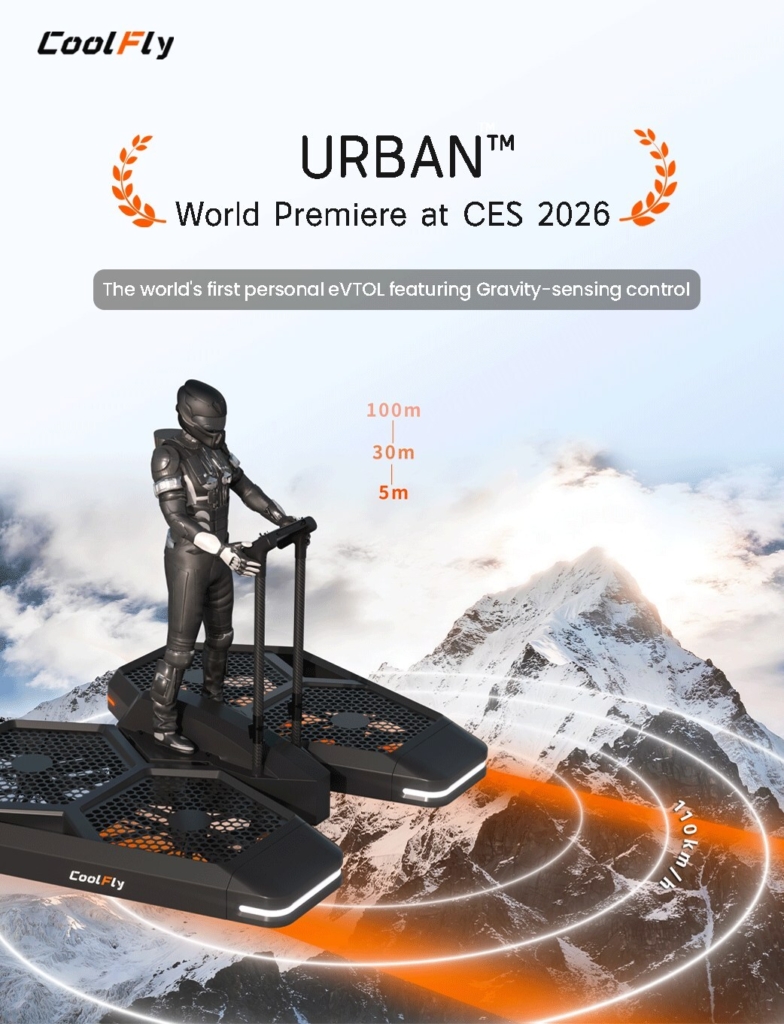
The company’s pitch to potential customers is clear: step on, power up, lift off.
“We are not just manufacturing aircraft; we are architecting a new way of life,” said the CEO of Coolfly. “Our rapid rise is rooted in an unwavering commitment to safety and reliability. Under the tailwinds of favourable global policies, we aim to make personal flying vehicles as ubiquitous as bicycles—affordable and accessible to consumers worldwide.”
Coolfly also offers a seated variant of the aircraft for those who find standing while flying too unnerving.
By keeping the aircraft ultralight—around 110 kg (242 lb)—Coolfly says the vehicle fits within FAA Part 103 ultralight rules, meaning it does not require a pilot’s license or medical certification when flown within limits.
An aircraft for the “low-altitude economy”
The Coolfly eVTOL is not an air taxi, and it’s not meant to replace helicopters. The company’s flying scooter operates in the low-altitude band below roughly 30 meters, with a top speed of around 100 km/h (62 mph).
It would support short hops and scenic routes, helping to avoid surface congestion, but it’s not designed for cross-city commutes at 1,000 feet.
The company is positioning the aircraft squarely within what it calls the emerging “low-altitude economy,” a space it claims is gaining attention as regulators modernise ultralight and recreational aviation rules.
New FAA MOSAIC reforms are expected to make lightweight electric aircraft more accessible, giving concepts like Coolfly’s stand-up eVTOL a clearer path to real-world use.
AI would keep the rider upright and flying steady
The notion of balancing on a flying scooter with no hardware around you might seem nerve-wracking to many, but Coolfly says its onboard systems do most of the hard work.
The aircraft uses AI-assisted gravity sensing to enable posture-based control, allowing you to lean into your intended flight path. Intelligent path-planning software would help avoid obstacles.
The company also provides redundant flight sensors for added safety. An enclosed propfan design reduces the rider’s exposure to rotors below.
In practice, the rider isn’t “flying” in the traditional sense—they’re directing the aircraft, with software smoothing movements and maintaining stability.
It’s closer to riding an e-bike with assist than learning to hover a helicopter.
Who is this flying scooter actually for?
Coolfly isn’t chasing airline partnerships or urban vertiports. Its ambitions are narrower and more personal.

The company sees use cases including:
- Short-range urban mobility
- Tourism and sightseeing
- Security patrols and emergency access
- Recreational flying
- Even competitive racing formats
Because the aircraft is electric, compact, and relatively low-cost compared to larger eVTOLs, Coolfly’s eVTOL could be deployed in places where helicopters are impractical or unwelcome.
While recreational flying and sightseeing might gain traction, the most compelling application is in emergencies, when it could aid recovery efforts over fields blocked by debris, such as after a hurricane or tornado.
The only downside of that application is that it is a single-person vehicle and cannot evacuate people from the disaster area. Still, it might enable rescue workers to pinpoint the locations of people in need, guide field clearance efforts, and support the delivery of emergency supplies.
Competitive racing applications are also likely—the novel eVTOL would certainly attract the daring.
How much would a Coolfly flying scooter cost?
The company has already launched pre-sales of its flying scooter on its website, with deliveries planned for 2028. Production capacity through 2027 is already sold out.
It’s priced in the lower range of a luxury car. Coolfly is selling the scooter for $99,999 before taxes and fees and requires a $9,999 non-refundable deposit with each order, with the balance payable before delivery.
Why Coolfly debuted at CES 2026
CES has increasingly become a launchpad for mobility concepts—from autonomous cars to electric aircraft —and Coolfly’s flying scooter fits squarely into that tradition of future-facing, conversation-starting tech.
“CES is the most vibrant stage to showcase our latest R&D achievements in manned eVTOLs,” the Coofly team stated in the company’s announcement.
At CES 2026, the company is showcasing both standing and seated variants, but the stand-up version best reflects its philosophy of providing an aviation solution, stripped to its essentials, that is accessible to more potential ‘pilots.’
While other eVTOL startups promise to reshape cities from the sky, Coolfly is bringing a sci-fi vision of personal transport to life. The company believes it can fly; perhaps others at CES will agree.
Featured Image: Coolfly Aircraft
Sign up for our newsletter and get our latest content in your inbox.