Airline history: What happened to UK carrier British Caledonian Airways?

February 28, 2026
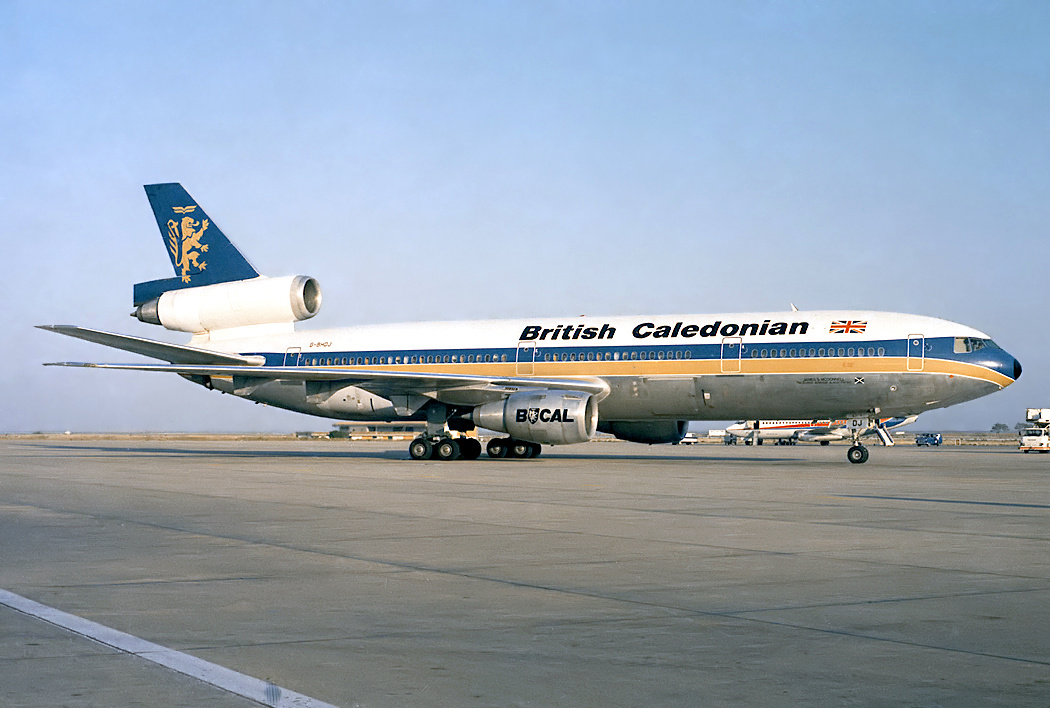
British Caledonian Airways operated from 1970 until 1988, when it merged into British Airways. During its existence, the airline operated an eclectic fleet of both single and twin-aisle aircraft and flew to a wide range of domestic and international destinations.
However, as losses mounted and competition increased, the airline was unable to sustain its independent position in the UK market and became the target of a hostile takeover by arch-rival British Airways.
The birth of British Caledonian Airways
British Caledonian Airways was formed in November 1970, following growing concerns that the state-owned airlines British European Airways (BEA) and British Overseas Airways Corporation (BOAC) were becoming too dominant in the UK market and forming a duopoly presence.
The two carriers would later merge, forming British Airways in 1974 and becoming even stronger in their home marketplace.
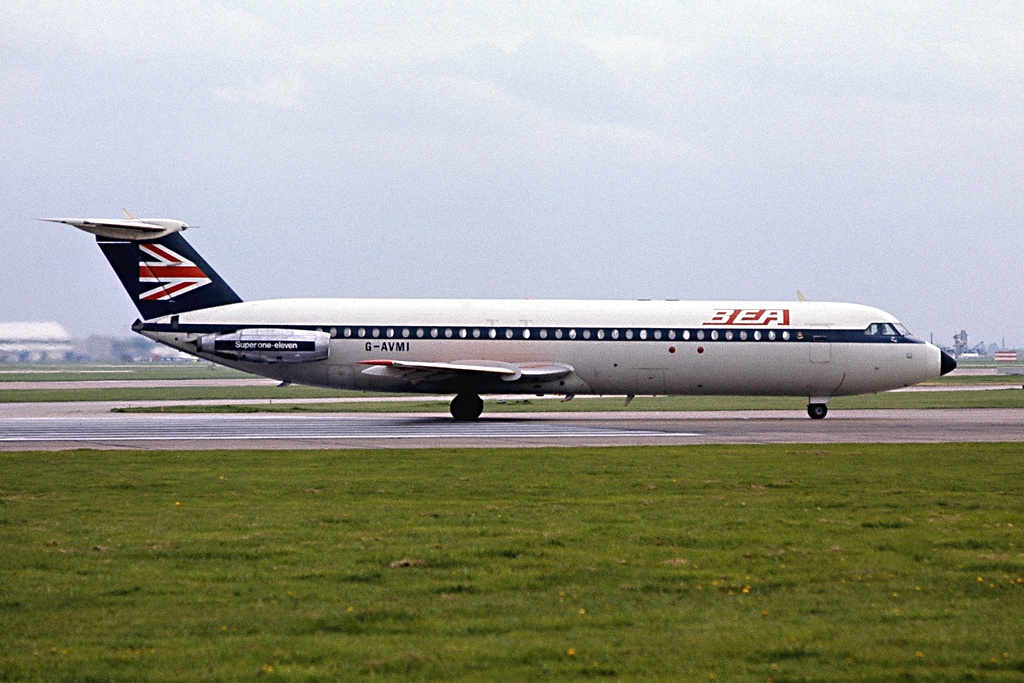
Unlike its competitors, British Caledonian was privately owned and would operate outside of the framework set up by state ownership, giving it some leeway over its fleet and route network decisions.
British Caledonian’s formation followed the release of a Labour Party-commissioned parliamentary report in 1969 (the Edwards Report) entitled ‘British Air Transport in the Seventies’that forecast the requirements for commercial aviation in the UK in the 1970s and beyond. This report represented the first in-depth look at the British civil aviation scene since the end of World War Two.
The report proposed that BEA and BOAC be merged into a single entity, primarily to cut costs, reduce duplication and pool resources. Subsequently agreed upon in the UK parliament, the formation of British Airways began in 1971 and was concluded in 1974.
However, the report also proposed that a second national carrier be formed to increase competition in the UK market and limit British Airways’ dominance, which it was feared would lead to a rise in air fares for the consumer.

Providing a favourable regulatory framework for the establishment of a second British carrier, the UK government encouraged Sir Adam Thompson, the founder and chairman of small Scottish-based carrier Caledonian Airways, to purchase British United Airways (a small regional operator with a presence at London Gatwick Airport (LGW) and to seek additional private capital to expand.
This would allow the newly formed British Caledonian to establish itself in the UK market and acquire new long-haul aircraft to compete head-to-head with BOAC (and later British Airways).
1970 – British Caledonian Airways begins operations
On 30 November 1970 (St. Andrew’s Day in Scotland, the country’s patron saint), Caledonian Airways completed the purchase of British United Airways (BUA) from British and Commonwealth for £6.9 million.
Rebranded as British Caledonian Airways, the new airline established its headquarters and central hub at British United’s London Gatwick base, away from the main hubs of BEA/BOAC at London Heathrow (LHR) and located some 30 miles south of central London.
However, even if the newly formed carrier had preferred to operate from Heathrow and compete directly with the state-owned airlines, it was prohibited from doing so.
As BEA and BOAC held dominant positions at the west London airport, it was envisaged that British Caledonian would fare better by not competing in the very same London market as the two carriers, and was forced to remain at Gatwick, where BUA already had staff and a maintenance base.

To try to set a more level playing field between British Airways at Heathrow and Gatwick and to attract more connecting passengers, British Caledonian later established a shuttle helicopter service between the two London airports in 1978.
The service, operated by a Sikorsky S-61 helicopter and branded as ‘Airlink’, would operate multiple times per day in each direction, allowing passengers to connect between flights split between two airports.
Route handover was part of the deal to form British Caledonian
As part of the deal to set up British Caledonian, the two state-owned carriers were forced to hand over some of their routes to the startup carrier.
These included lucrative routes from London to East and West Africa and to Libya, the latter being a vital trade route for UK-based oil companies. Other routes were also picked up by British Caledonian as they were either dropped by other carriers or remained unserved at the time.
In addition to these initial routes, British Caledonian also purchased operating licenses to several North American destinations. This included New York and Los Angeles, which were both introduced in 1973 in competition with BOAC, Pan Am, and TWA.
This move was permitted under a transatlantic bilateral agreement known as ‘Bermuda Two’, which allowed two carriers from the UK and the US to operate on any route between the two signatory countries.
The British Caledonian fleet in the 1970s
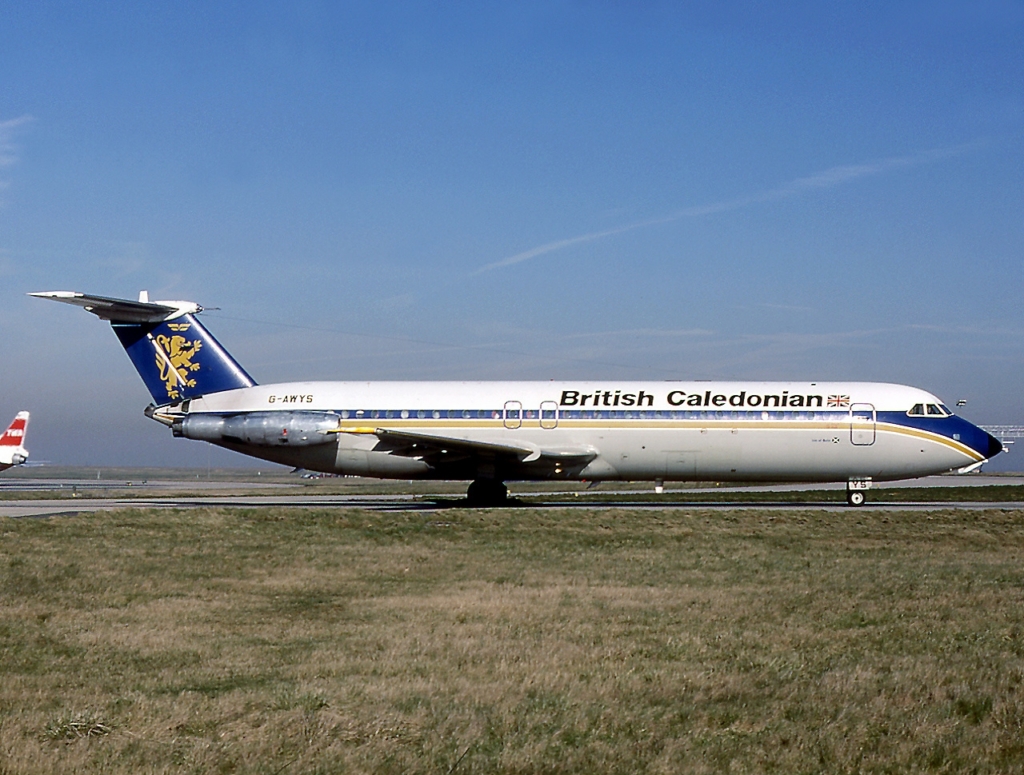
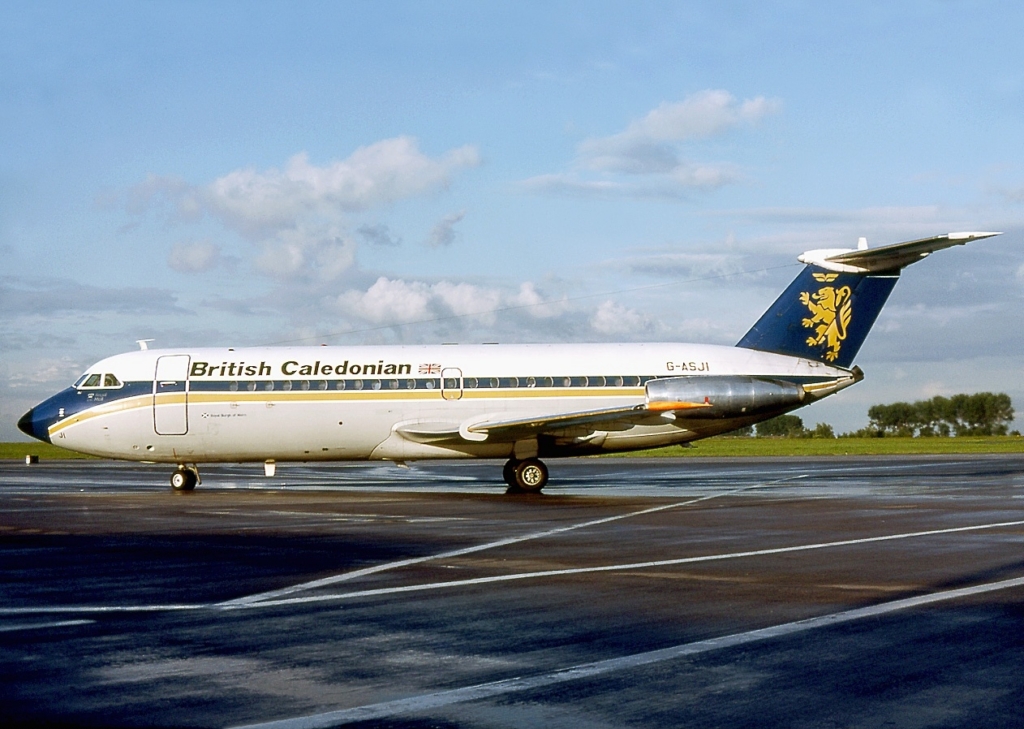
With rapid route expansion, the new carrier set about building a fleet of suitably capable short and long-haul aircraft. Its domestic and European route network relied on the British Aircraft Corporation (BAC) 1-11 narrowbody twinjet – ideal for operating from smaller airfields as well as major international hubs.
The airline operated eight of the shorter BAC 1-11-400 series (acquired through BUA) while it also acquired 12 longer BAC 1-11-500s, which provided further range and capacity.
For its long-haul needs, the airline acquired seven Boeing 707s while also retaining four Vickers VC10s from BUA for its services to African destinations.
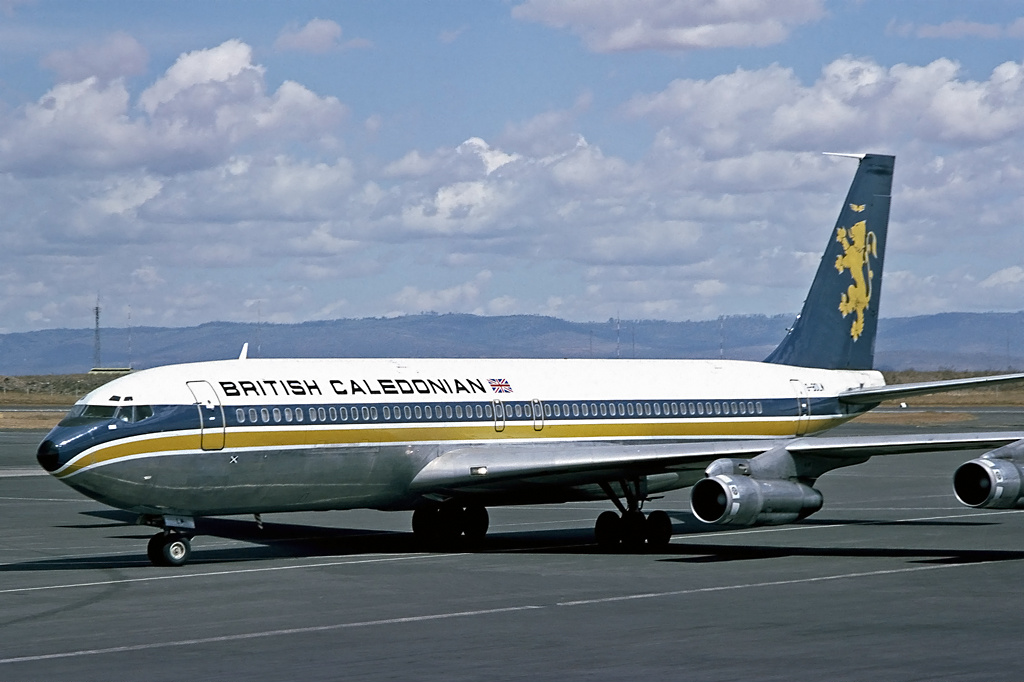
All aircraft (including those acquired from BUA) were repainted into a British Caledonian livery featuring a yellow Scottish Lion Rampant on the aircraft’s navy blue tail. Yellow and blue cheatlines would flow along the length of the aircraft fuselage, with a Union flag and large British Caledonian titles appearing in black above the window line.
Additionally, and in keeping with the airline’s Scottish routes, the carrier continued to name its planes after famous Scottish people or places. This was a tradition that Caledonian Airways had stuck to during the years before it merged with BUA to become British Caledonian.
Into the 1980s – new aircraft and new routes
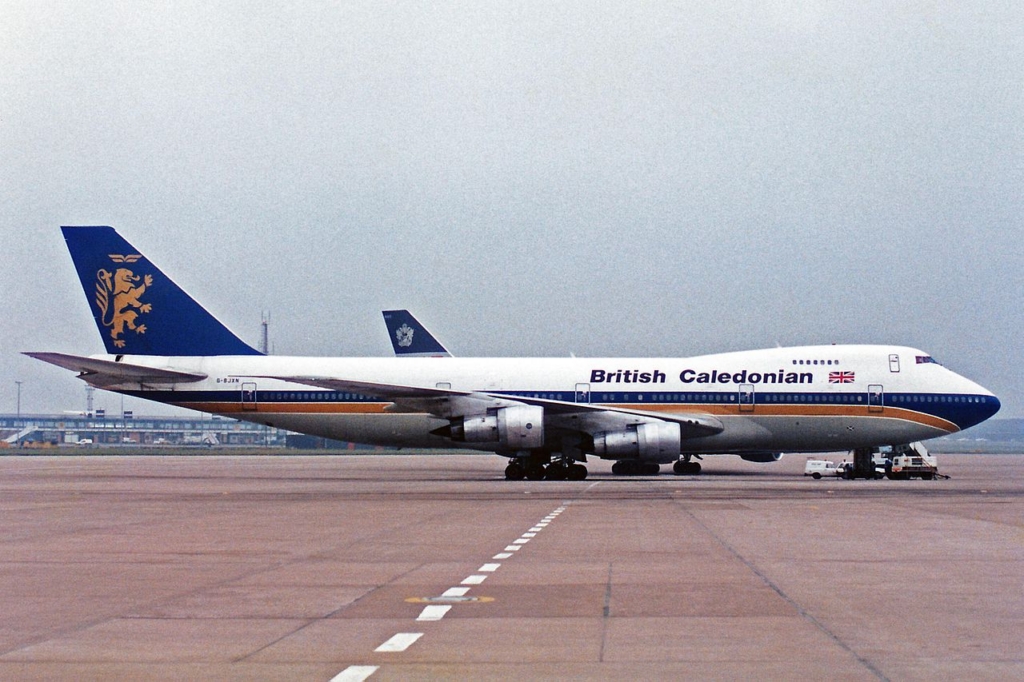
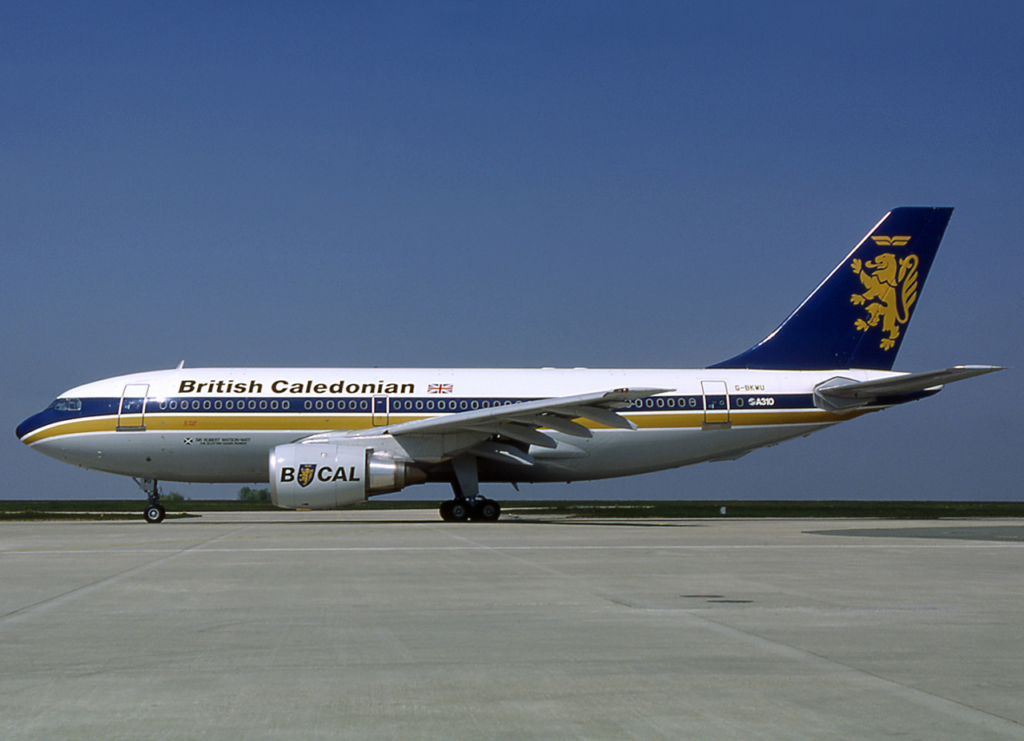
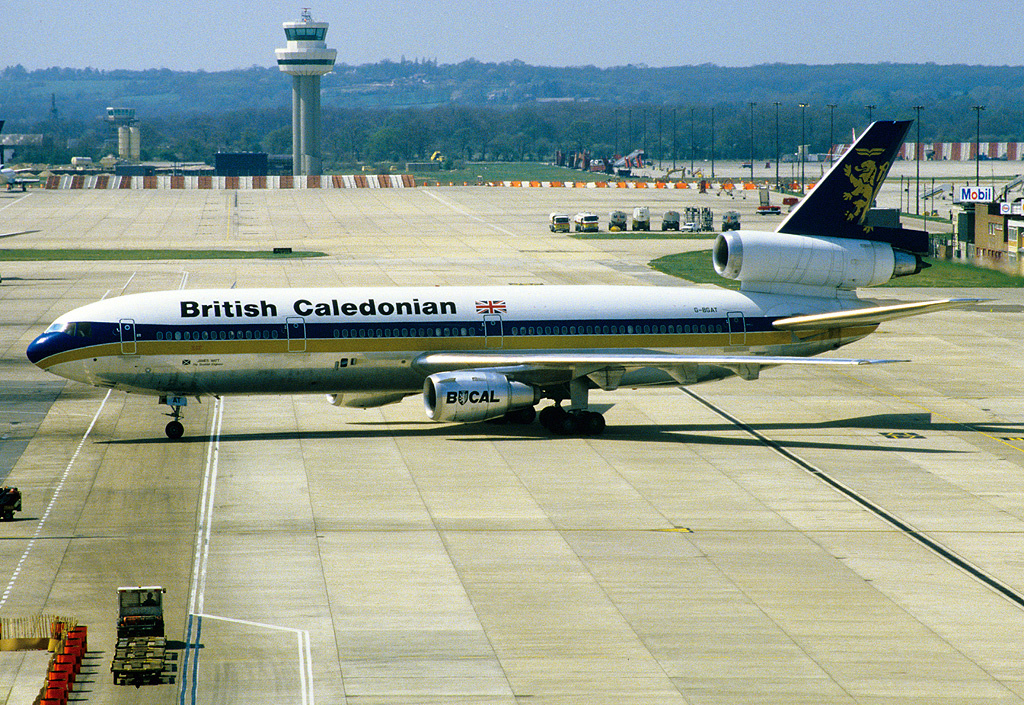
As the 1980s began, British Caledonian was prospering. It had begun to replace its ageing Boeing 707s and VC10s with significantly larger McDonnell Douglas DC-10s and later ordered two Airbus A310s to operate on its African routes.
It also acquired its first Boeing 747-200. The airline also became the first UK airline to order the Airbus A320, a new single-aisle twinjet from the Airbus stable.
Despite being far larger than the One-Elevens it was to replace, the Airbus A320 offered significant savings over its older British counterpart, with associated seat costs up to 27% cheaper than the British jet.
By this stage, British Caledonian employed around 4,500 people and had grown to become the UK’s largest privately owned airline, competing head-on with British Airways on several key routes.
Additionally, the airline was a full member of the International Air Transport Association (IATA) from its inception, having inherited BUA’s membership.
British Caledonian’s route network expanded in line with the carrier’s strategy to create a competitive network of scheduled services, predicated on attracting connecting traffic, capturing some of British Airways’ market share, and providing an extensive and attractive offer to Londoners and part of the surrounding population.
As well as operating a network of domestic services across the UK, including key routes between London, Manchester, Glasgow, and Edinburgh, the airline was flying daily to New York-JFK (JFK), Chicago (ORD), and Los Angeles (LAX).
The airline would later add Houston (HOU) and Atlanta (ATL) to its North American network, marking the first time that a privately owned British airline offered regularly scheduled flights between the United Kingdom and the US. Of course, this would change again when Virgin Atlantic started flying to Newark from Gatwick in 1984.
Further expansion throughout the 1980s
As well as building up a healthy network of domestic, European and international long-haul services, in 1981, British Caledonian Airways wished to become the first privately owned airline to fly between the UK and Australia. It proposed DC-10 flights between Gatwick and Brisbane, with stops in Colombo and Melbourne.
The other route it wanted to offer was Gatwick to Adelaide, with a stop in Perth. The proposal was for two flights per week in each direction.
The proposal to serve cities in Australia failed after British Airways and Qantas complained about British Caledonian’s proposal, saying it would adversely affect their duopoly on the ‘kangaroo route’ between the two countries.
Failing to secure the right to fly to Australia, British Caledonian Airways looked to expand eastwards with a flight between Gatwick and Hong Kong with a stopover in Dubai. This application initially failed after British authorities in Hong Kong feared that the homegrown carrier Cathay Pacific would be squeezed out of the UK-Hong Kong market.
The decision was later reversed after Cathay Pacific was allowed to fly to Gatwick via Bahrain, and British Caledonian acquired a second and third Boeing 747 to service the route.
Seeking new opportunities, with the failure of UK-based budget airline Laker Airways in 1982, British Caledonian snapped up a number of the former Laker DC-10s and flew them under the ‘British Caledonian Charter’ brand for several UK-based cruise operators and inclusive tour companies. The operation was eventually wound back into the mainline operation, with the ex-Laker DC-10s being sold.
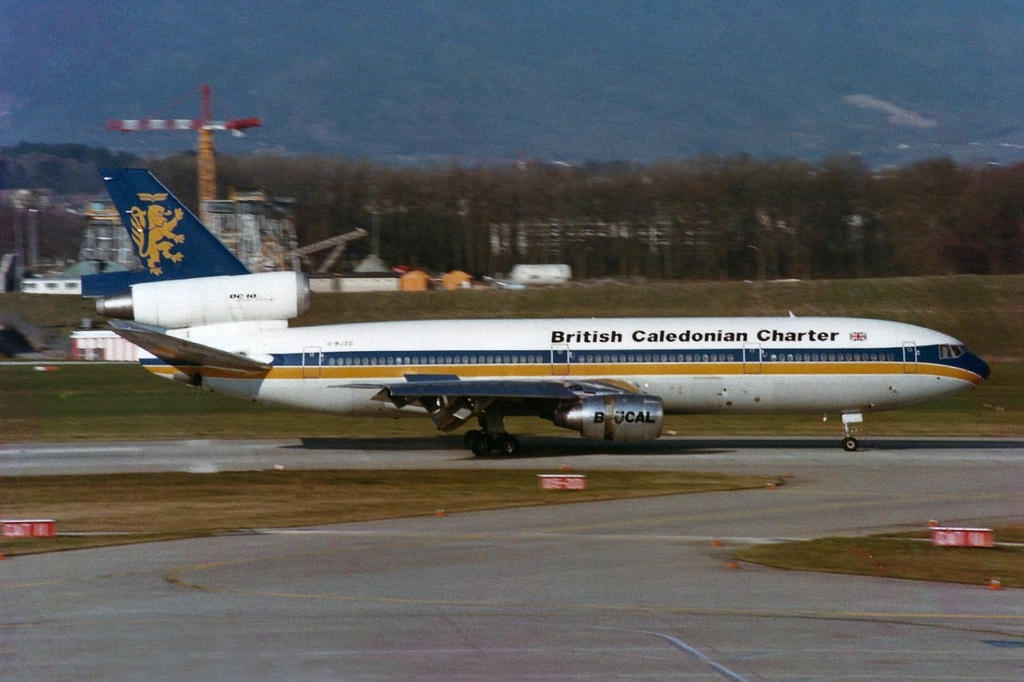
With an expanded fleet and route network, throughout the early 1980s, British Caledonian developed relationships with other airlines serving Gatwick at the time and built up a dominant presence at the airport.
By the mid-1980s, the Gatwick apron was awash with tails adorned with the Lion Rampant logo of British Caledonian, with the carrier becoming one of the largest operators at the airport.
However, things were beginning to unravel behind the scenes. The 1982 Falklands War had an adverse impact on the number of passengers travelling, while jet fuel prices continued to rise following unrest in the Middle East.
Meanwhile, competition on routes across the Atlantic began to increase with carriers such as Continental, American Airlines and Delta all entering the Gatwick market, along with Virgin Atlantic from the UK. These issues combined to drive British Caledonian into severe financial difficulties, just 15 years after it had first been established.
A bounce back before a crisis at British Caledonian
Some cost-cutting measures, including the cessation of the Airlink helicopter operations in 1986 and the retirement of some of the older DC-10s, saved the airline from bankruptcy. In fact, a string of healthy yearly profits followed, which led the board at British Caledonian to consider floating on the London Stock Exchange.
However, things would unravel once more. Geopolitical issues at some of its key destinations played a part in British Caledonian’s unsettling, including the 1986 Chernobyl disaster, which prevented US travellers from coming to Europe for fear of nuclear fallout.
At the time, transatlantic flights accounted for 25% of the airline’s revenue. US travellers also feared the prospect of Libyan operatives bombing an airliner in retaliation – a fear that came to pass in 1988 with the downing of Pan Am Flight 103.
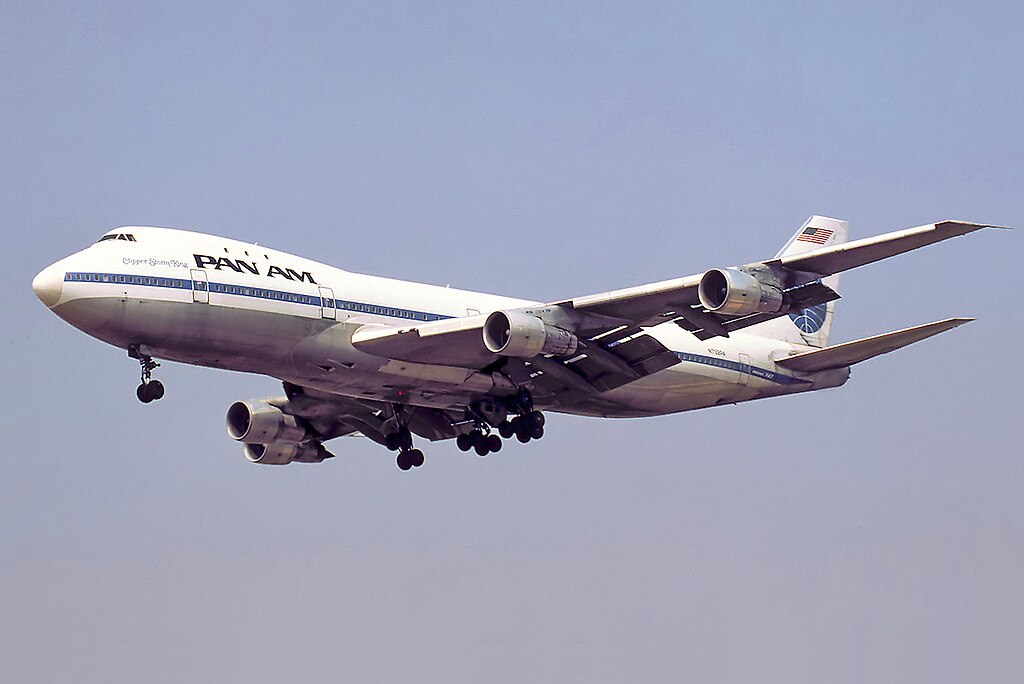
Also, in April of that same year, the US air attacks on Libya effectively wrote off British Caledonian’s lucrative route to Tripoli, which had been served daily from Gatwick by Airbus A310. In the space of a single year, British Caledonian went from making a profit of £19.3 million to a loss of £14.4 million.
Forced to sell assets to survive, British Caledonian Airways started to look to merge with another airline to stay alive. It had become apparent by that time that British Caledonian was simply too small and niche to compete effectively with larger UK and US carriers.
It was also unable to price match with its larger competitors or offer effective connecting flights through its smaller network.
British Airways offers a way out for British Caledonian
Facing bankruptcy, which had been compounded by a UK Government decision to privatise British Airways in 1984, the writing was on the wall for British Caledonian. The airline knew that a post-privatisation British Airways, with its market share, route structure, fleet size, and financial muscle, would simply force British Caledonian out of business once and for all.
As a final attempt to survive, British Caledonian asked the UK government to allow it to operate some of British Airways’ lucrative routes and start flying from Heathrow Terminal 4, the home of British Airways long-haul services at the airport.
However, this was seen as a last desperate attempt to save itself and was rejected by both the UK government and by British Airways.
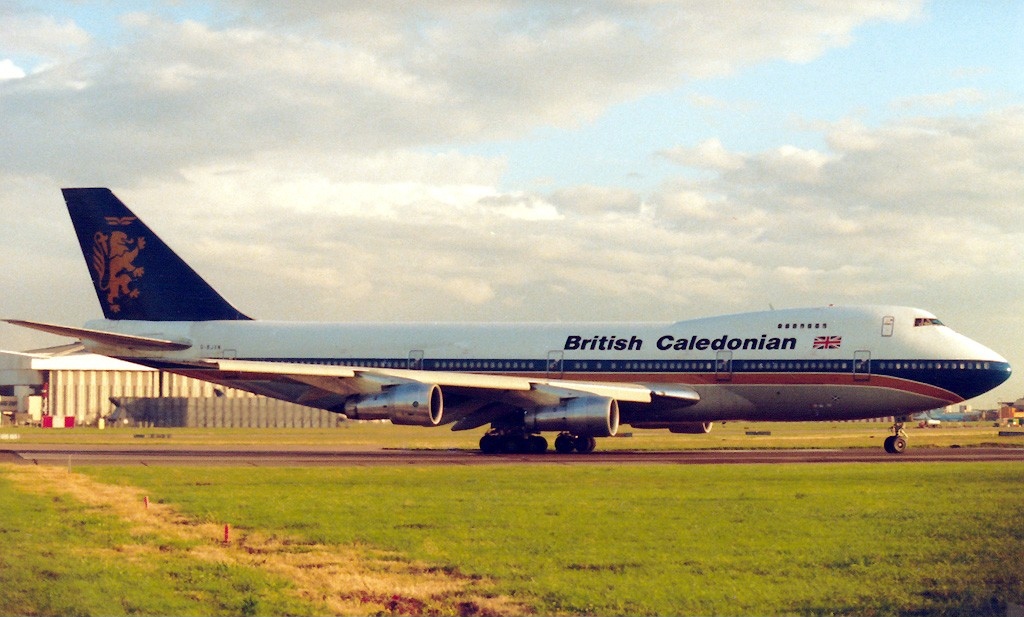
On 16 July 1987, British Caledonian and British Airways announced that the companies would merge with British Airways, acquiring British Caledonian’s assets for £237 million. Other airliners entered the bidding, with SAS offering £110 million for 26% of the floundering airline.
However, British Airways made a revised bid to counter the SAS offer and also set about a marketing campaign to tell consumers and the wider travel industry why the British Airways takeover of British Caledonian was in the country’s “best interests.”
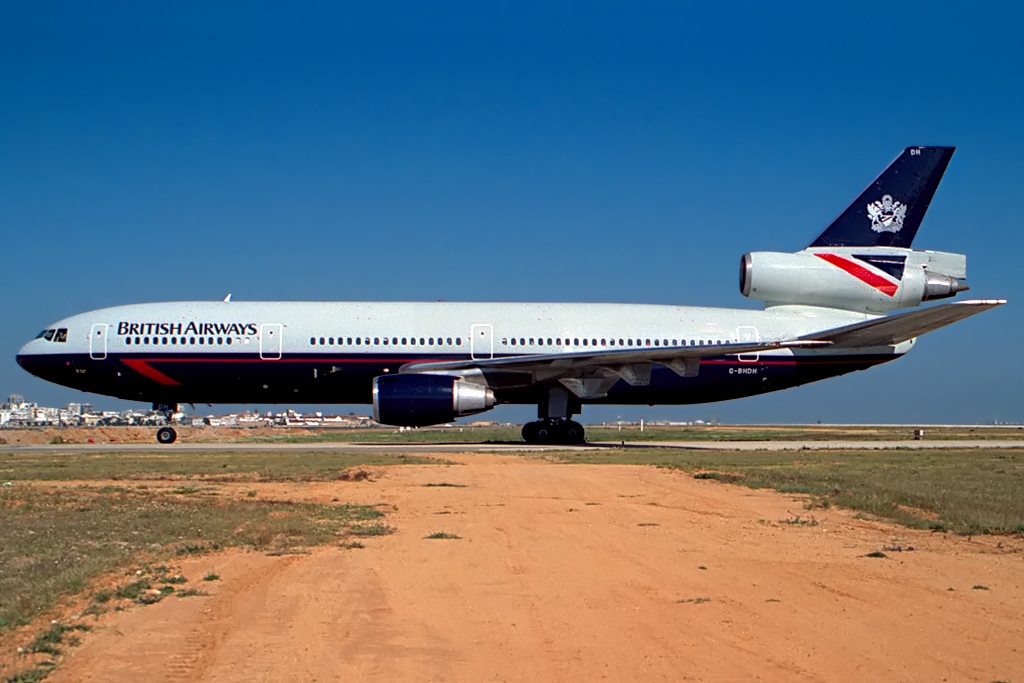
The deal was finally accepted by shareholders at both airlines and the UK Government at the start of 1988. At midnight on 14 April 1988, British Caledonian Airways ceased to exist as an airline and became part of British Airways.
Its aircraft slowly acquired the grey and navy blue livery of the larger airline, and the famous British Caledonian cabin crew uniforms, in their various shades of Scottish tartan, were confined to aviation folklore.
However, as a postscript to the story, British Airways did honour the British Caledonian name for several years after the takeover.
The airline’s charter operation, then named British Airtours, was renamed Caledonian Airways. Even the Lion Rampant logo had a second lease of life, appearing on the tails of Caledonian’s Boeing 737s, 747s, 757s and later Lockheed TriStars.
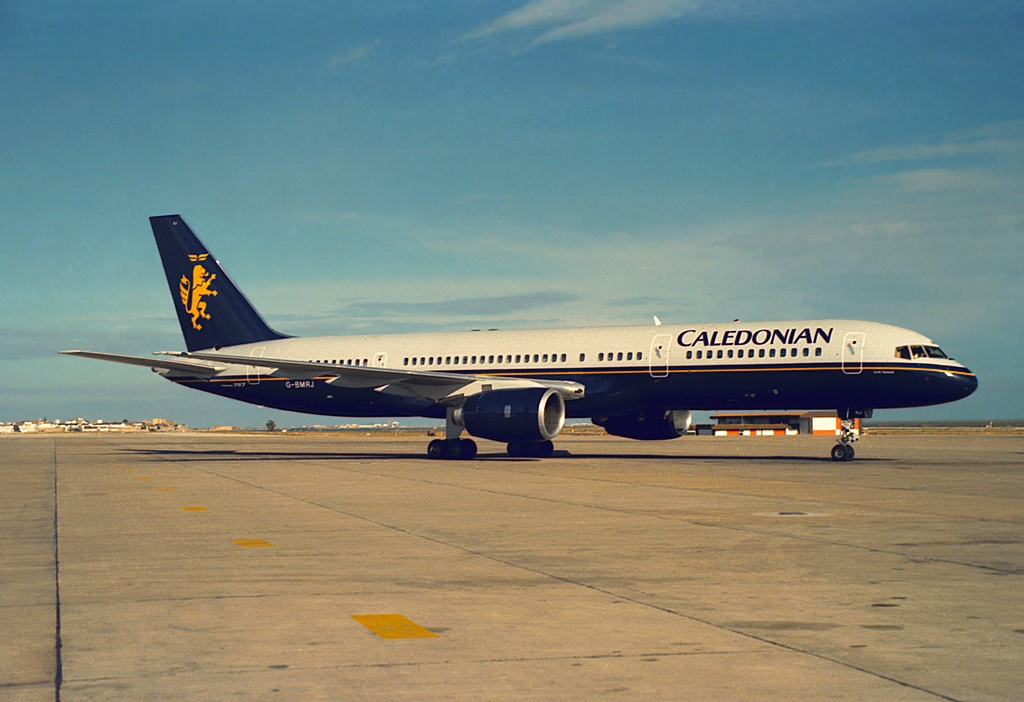
Pedro Aragão / Wikimedia Commons
The airline and the logo would both eventually disappear in 2000 when Caledonian merged with Flying Colours Airline to form JMC Airlines, the precursor to Thomas Cook Airlines in the UK.
Featured image: Pedro Aragão / Wikimedia Commons