How alcohol testing rules for pilots keep the skies safe – and how they differ across countries

January 11, 2026
Ensuring that flight and cabin crew are fit for duty is a central part of how regulators and the crew themselves maintain safety.
Around the world, regulators impose strict alcohol-related rules on flight crew, backed by legislation and operational testing regimes designed to prevent impaired performance.
While the objective is the same in each jurisdiction, the way alcohol testing is implemented does vary slightly between countries.
UK aviation alcohol limits and ramp testing explained
Under UK law, the permitted alcohol limits for aviation personnel are set well below those applied to motorists.
The regulations specify a maximum alcohol concentration of 9 microgrammes per 100 millilitres of breath. Equivalent limits apply for other testing methods, with a threshold of 20 milligrams per 100 millilitres of blood and 27 milligrams per 100 millilitres of urine.
Alcohol testing has become an established element of aviation oversight through the Civil Aviation Authority’s ramp inspection programme.
Inspectors are empowered to test pilots and cabin crew during routine ramp checks, targeting individuals who are assigned to operational duties at the time of inspection.
Testing may be conducted on a random basis or where there is reasonable suspicion that a crew member may be impaired.

Breath alcohol tests are carried out using approved devices that meet recognised European standards. If a crew member registers a result above the permitted limit, a confirmatory test is conducted, typically after a short waiting period, to ensure accuracy.
The maximum allowable level is significantly below the legal driving limit – 80mg of alcohol per 100ml of blood (or 35 micrograms per 100ml breath).
Any crew member exceeding this limit or refusing to submit to testing is immediately removed from duty and prevented from operating the flight. The matter may also be referred to licensing authorities or law enforcement, depending on the circumstances.
The legal basis for these powers is embedded in UK aviation safety regulations, which were amended following Brexit to retain and adapt European Union operational safety requirements.
Alcohol testing is now a formal and expected part of ramp inspections, applicable to UK-registered operators as well as foreign airlines operating flights to or from the UK.
Alcohol testing rules for pilots in Europe
Across Europe, alcohol testing requirements are broadly aligned through common aviation safety regulations, which mandate that national authorities include alcohol testing as part of aircraft ramp inspections.
These rules apply to both domestic operators and aircraft from third countries operating within European airspace.
However, European states retain discretion to impose stricter national standards, leading to variation in how alcohol rules are applied in practice.

Italy provides one of the clearest examples of this divergence. There, aviation authorities enforce a zero-tolerance policy for alcohol among flight crew and cabin crew on duty.
Under the Italian regime, any detectable level of alcohol constitutes a breach. Testing is carried out using evidential-grade breathalysers, and the results can be used in administrative or judicial proceedings. As in the UK, testing applies only to crew members performing operational roles, and safeguards are in place to protect personal data.
The contrast between Italy’s zero-alcohol standard and the UK’s low-threshold approach highlights how countries can interpret shared safety objectives differently.
FAA alcohol testing programmes for pilots
In the United States, alcohol testing is governed by a different regulatory model. Rather than relying primarily on ramp inspections, the Federal Aviation Administration requires airlines to implement comprehensive alcohol and drug testing programmes covering all safety-sensitive personnel, including pilots.
These programmes mandate testing in specific circumstances, including random selection, reasonable suspicion, post-accident situations, and return-to-duty cases following a violation.
Airlines are responsible for administering the programmes under FAA oversight, with detailed rules governing how tests are conducted and recorded.
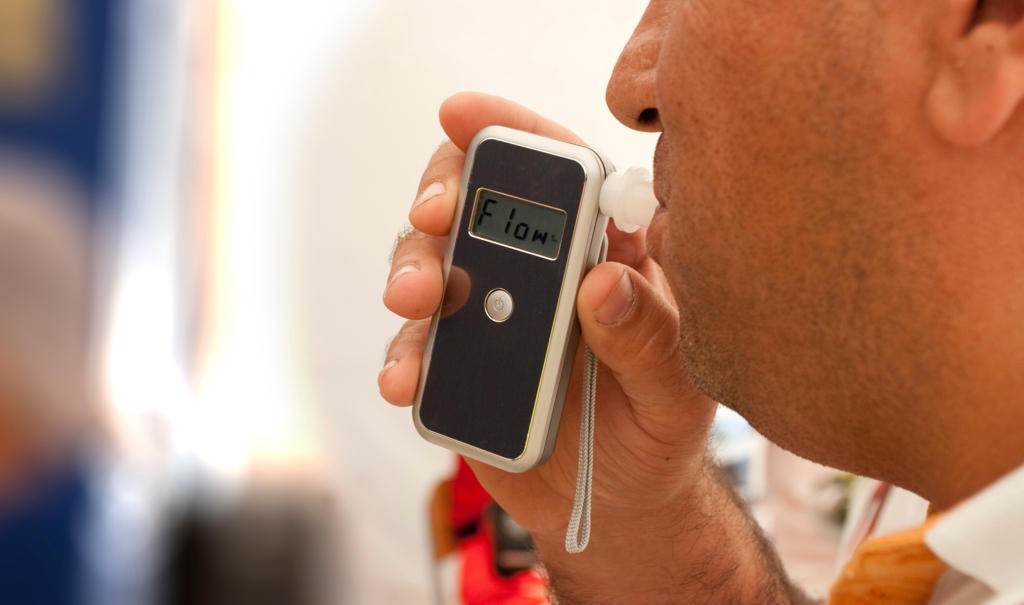
Under US regulations, personnel are immediately prohibited from carrying out safety-sensitive duties if a mandated alcohol test records a breath alcohol level of 0.04% or greater.
Crew members are also stood down on a temporary basis if testing shows a breath alcohol concentration in the range of 0.02 to 0.039, even where the higher threshold has not been exceeded.
US regulations specify a higher threshold than those used in the UK or parts of Europe, but this is offset by strict behavioural rules.
Pilots are prohibited from flying with any measurable impairment and are expected to observe a minimum eight-hour period between consuming alcohol and reporting for flight duty – a concept referred to as “bottle to throttle.”
Violations can result in immediate removal from flight duties, mandatory evaluation, and potential loss of licence.
Why pilots are subject to very strict alcohol limits
Alcohol consumption affects reaction time, judgement, coordination and decision-making – all critical functions for pilots and cabin crew operating complex aircraft in dynamic environments.
Even small amounts of alcohol can degrade performance, particularly when combined with fatigue, jet lag or high workload.
Aviation regulators, therefore, apply limits that are far stricter than those used for road transport.
There have been cases in the past of crews in breach of these regulations.
A Delta Air Lines captain was sentenced to 10 months in prison in 2024, after reporting for duty at Edinburgh Airport while exceeding the permitted alcohol limit ahead of a transatlantic passenger flight.
The incident occurred in June 2023, when the pilot was preparing to operate a scheduled service from Edinburgh to New York.
During a routine security check, airport officers searched the individual’s hand luggage and discovered two bottles of the herbal liqueur Jägermeister, one of which had already been partially consumed.
Subsequent breath testing confirmed that the pilot’s alcohol level was more than double the maximum allowed under UK aviation regulations.
The case was heard at Edinburgh Sheriff Court, where the offence was described as a serious breach of aviation safety rules designed to protect the travelling public.
The court was told that the individual, a 63-year-old resident of the US state of Georgia, had previously received treatment for alcohol dependency.
Featured image: AI generated by Kondor83 / stock.adobe.com