Airbus unveils twin rotorcraft concepts for NATO NGRC medium-lift helicopter replacement

February 24, 2026

Airbus Helicopters has moved to shape the future of NATO’s medium-lift fleet, unveiling two distinct helicopter concepts that it believes could form the backbone of alliance operations from 2035 onwards.
The proposals, developed under NATO’s Next Generation Rotorcraft Capability (NGRC) programme, set out alternative paths – one evolutionary, one more radical – to replace ageing helicopter fleets that will begin retiring across Europe and North America in the next decade and a half.
NATO NGRC programme aims to replace ageing medium-lift helicopters
The NGRC initiative was launched to address a looming capability gap. A significant share of medium multi-role helicopters currently operated by NATO allies are based on designs that date back to the late Cold War era. Many will approach the end of their service lives in the 2035-40 timeframe and beyond.
In July 2024, the NATO Support and Procurement Agency (NSPA) awarded three detailed concept study contracts to Airbus Helicopters, Leonardo and Lockheed Martin’s Sikorsky. The task: develop potential integrated platform concepts that could meet future operational and supportability requirements for a new class of medium-lift military rotorcraft.

France, Germany, the United Kingdom, the United States, Ireland and Italy are involved through their respective industrial champions.
Each contractor is expected to explore cutting-edge technologies, digital design processes, advanced materials and innovative manufacturing approaches.
The concepts must be modular, multi-mission and fully interoperable with NATO standards, with high levels of connectivity and resilient communications built in from the outset.
Airbus was selected by NSPA in July 2024 to lead one of these NGRC concept studies, focusing on the design, development, delivery and long-term support of a future medium multi-role helicopter.
Airbus proposes twin modular rotorcraft concepts for NATO NGRC
Airbus’ submission to NATO comprises two distinct but related concepts: a high-performance conventional helicopter and a high-speed compound rotorcraft.
“We want to ensure that Europe is in a position to propose a platform that will best fit our military partners’ needs in terms of affordability, operational efficiency and maximum availability for both the conventional helicopter and for the high-speed rotorcraft. These two concepts are a basis to further exchange with our military partners on their vision and need for future military operations,” said Bruno Even, CEO of Airbus Helicopters.
Both are being developed in collaboration with RTX businesses Collins Aerospace and Raytheon, alongside European missile house MBDA. The industrial teaming reflects the multinational nature of the requirement and the expectation that any future platform will integrate advanced avionics, sensors, connectivity suites and weapons systems drawn from across NATO’s industrial base.
The central design philosophy is modularity and simplicity. Airbus says both concepts would share a common architecture, including maintenance processes, training pipelines, weapons integration and systems design. The aim is long-term affordability and fleet complementarity, rather than a single exquisite platform that is costly to build and sustain.
The company is pursuing a Modular Open Systems Architecture approach, intended to ease future upgrades and reduce integration risk over what would likely be a multi-decade service life.

Airbus has positioned the NGRC work as part of a broader evolution of the company’s military portfolio. While the NH90 continues to undergo Block 1 and Block 2 studies to shape its long-term roadmap, and platforms such as the H145M, H160M and H225M form the backbone of today’s range, Airbus is simultaneously investing in technologies that will underpin a new generation of rotorcraft systems.
“Airbus Helicopters is actively working on the future of its military range,” Even explained. “On the one hand, we are preparing the evolution of our legacy range with a continuous improvement policy. With the Block 1 and 2 studies, we have a long-term NH90 evolution roadmap.
“Our dual product range, the H145M, the H160M, and the H225M, is setting new standards for military helicopters in terms of affordability, connectivity, and maintenance,” he continued. “On the other hand, we are working on the next generation of rotorcraft systems, leveraging modular multi-platform technologies such as connectivity, cybersecurity, crewed-uncrewed teaming, multi-domain collaborative combat, survivability and battle damage repair,” he added.
These include enhanced connectivity, cybersecurity, crewed-uncrewed teaming, multi-domain collaborative combat, survivability features and improved battle damage repair concepts.
Airbus compound high-speed rotorcraft concept builds on X3 and Racer
The more radical of Airbus’ two NGRC concepts is a high-speed compound rotorcraft, drawing heavily on experience from the X3 and the more recent Racer demonstrator.
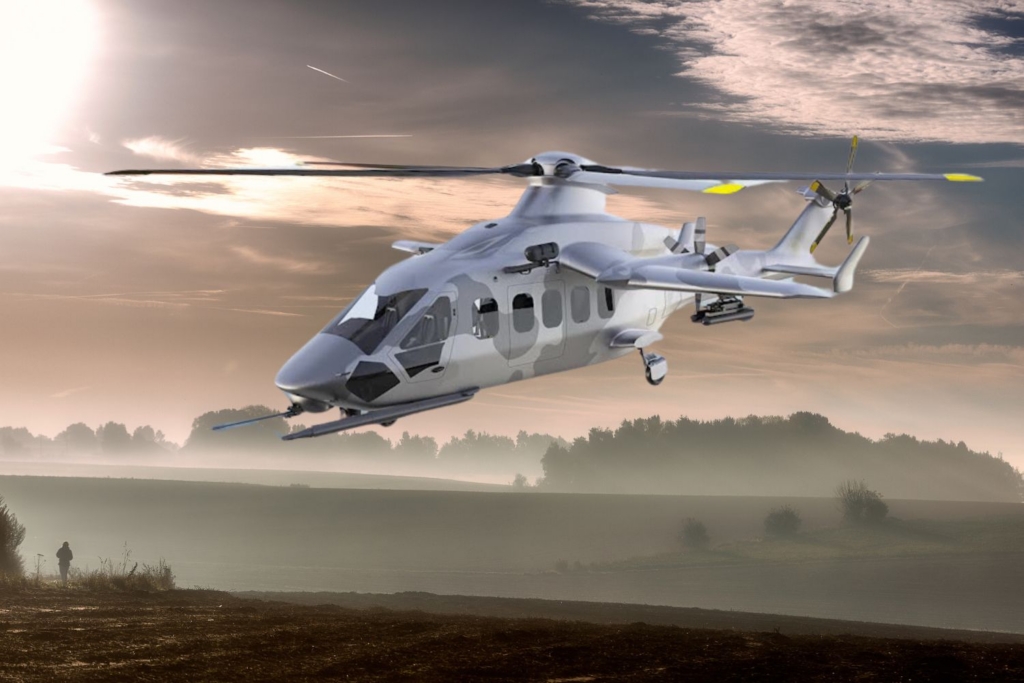
The compound configuration combines a traditional main rotor with lateral propellers mounted on short wings. This layout reduces reliance on a conventional tail rotor and channels engine power into forward thrust, enabling significantly higher cruise speeds than conventional helicopters.
The X3, first flown in September 2010, was based on a heavily modified EC155fuselage and powered by two Rolls-Royce Turbomeca RTM322 engines. It demonstrated speeds in excess of 250 mph and reached over 267 mph in a record-setting flight in 2011.
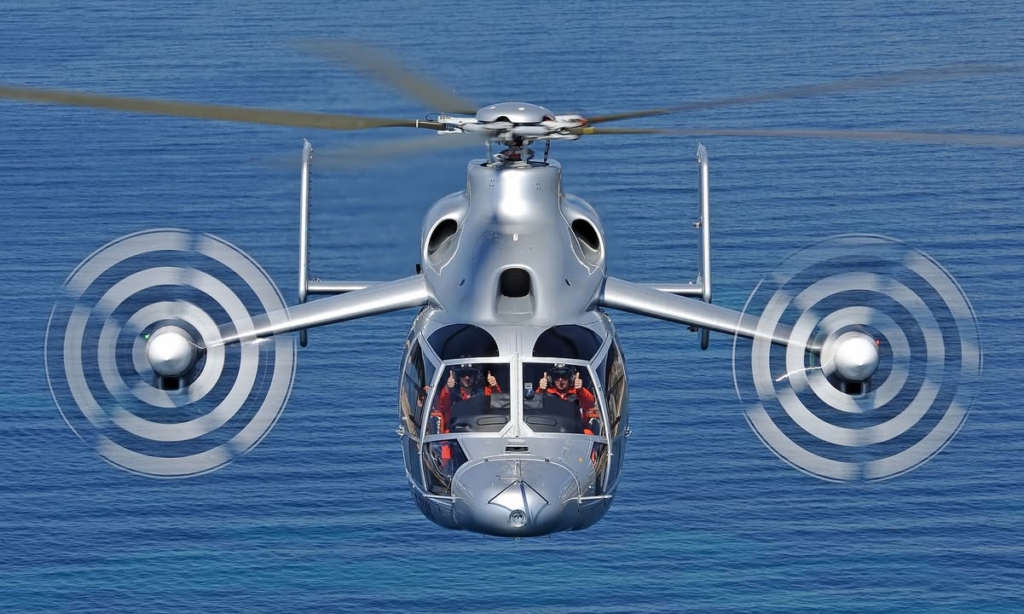
The design used side-mounted propellers to counter main rotor torque, eliminating the need for a tail rotor and improving aerodynamic efficiency. Flight testing validated the concept’s manoeuvrability and performance envelope.
Building on that groundwork, Airbus developed Racer under the European Next Generation Rotorcraft Technologies programme (ENGRT). Racer is designed to cruise at more than 400 km/h and incorporates a box-wing configuration, a hybrid metallic-composite airframe and a high-voltage direct-current electric generator. Its rear fuselage geometry has been optimised to preserve hover performance without penalising cruise efficiency.

Military pilots have flown Racer as part of flight evaluations, confirming the aerodynamic benefits of added wings and propellers. Airbus says the configuration not only increases top speed but also expands the usable flight envelope, allowing rapid acceleration, deceleration and fast climb and descent profiles.
Although Racer has been promoted for missions such as search and rescue and emergency medical services, the same high-speed attributes are directly relevant to future military operations, particularly in dispersed and contested environments where time-to-target and survivability margins are critical.
Airbus conventional medium-lift helicopter concept offers lower-risk NGRC path
Alongside the compound proposal, Airbus is offering a high-performance conventional helicopter concept. While less radical in configuration, it is intended to push the boundaries of current medium-lift designs in terms of speed, availability and maintainability.
By pairing the conventional and compound concepts under a common architecture, Airbus is signalling to NATO partners that it can provide a spectrum of capability options.
Some nations may prioritise incremental performance gains with lower technical risk, while others may seek transformational speed and mission flexibility.

Both concepts are being shaped to meet NGRC’s requirement for high connectivity, resilient communications and full NATO interoperability. The expectation is that any eventual platform will operate as a node within a broader network, supporting multi-domain operations rather than acting as a standalone asset.
Airbus’ unveiling comes as Leonardo and Lockheed Martin Sikorsky pursue their own NGRC study work under parallel NSPA contracts. The studies are intended to provide independent perspectives on how best to meet the alliance’s future medium-lift needs.
NSPA, headquartered in Luxembourg with major operational centres in France, Hungary and Italy, oversees more than 500 contractors worldwide. For NGRC, it is acting as the central acquisition and coordination body on behalf of participating nations.
Featured image: Airbus