Air Canada bets on Airbus A350-1000 to power long-haul expansion with 16-aircraft

February 12, 2026
Air Canada has signalled its most ambitious long-haul move in years, committing to up to 16 Airbus A350-1000s as it prepares to redraw its intercontinental network from 2030.
Air Canada adds up to 16 Airbus A350-1000s
Air Canada confirmed on 12 February that it has placed a firm order for eight A350-1000s, with purchase rights for a further eight, marking a decisive step in the next phase of its international expansion strategy.
Deliveries are scheduled to begin in the second half of 2030, with the order previously recorded by Airbus in November 2025 as belonging to an undisclosed customer.
The aircraft will sit at the heart of Air Canada’s long-haul fleet renewal, replacing older-generation widebody jets while opening the door to ultra-long-haul markets across the Indian subcontinent, Southeast Asia and Australia.
With a range of up to 8,700 to 9,000 nautical miles and endurance of 17 to 18 hours, the A350-1000 gives the airline flexibility to connect Canadian hubs non-stop to high-growth regions that have previously been operationally or economically marginal.
The order further deepens Air Canada’s relationship with Airbus. The airline already operates aircraft from the A220, A320, A321 and A330 families, and is preparing to introduce the A321XLR later this year.
Historically, it has also flown the A319 and A340. Alongside the new A350-1000s, Air Canada has 14 Boeing 787-10s on order, the first due by the end of 2026, underlining a twin-track widebody strategy built around next-generation efficiency.

Powered by Rolls-Royce Trent XWB-97 engines, the A350-1000 was selected for its fuel efficiency and operating economics. Air Canada estimates the aircraft will deliver up to a 25% reduction in fuel consumption compared with the aircraft it is expected to replace, reinforcing both cost and environmental objectives.
The A350-1000 is expected to feature the latest generation in-flight entertainment and connectivity, as well as Air Canada’s new cabin standard, which is being introduced later in 2026.
Why the Airbus A350-1000 matters to Air Canada
Behind the language about “new dimensions” and “next eras”, Air Canada’s A350-1000 order is a straightforward strategic move: buy more range, lower unit costs, and protect long-haul margins.
Chief Commercial Officer Mark Galardo positioned the aircraft as central to the airline’s global ambitions. In practical terms, the A350-1000 gives Air Canada the ability to operate longer sectors with better payload performance, allowing it to pursue thinner, high-growth markets without the operating penalties of older widebody types.

Chief Financial Officer John Di Bert framed the order as a disciplined capital decision rather than a vanity fleet move. The airline has repeatedly stressed its intention to keep capital expenditure at or below 12% of revenues, and the A350-1000 fits within that framework by replacing older, less efficient aircraft with a platform that improves both cost per seat and environmental performance.
While the airline hasn’t specified which aircraft the A350 will replace, it presently has a large fleet of ageing Boeing 777s. Its six 777-200s are all over 18 years old, but it’s the 777-300ERs that the A350 is most well-positioned to replace.
Air Canada’s three-class 777-300ERs seat 400 passengers, and no other modern aircraft comes close to that sort of capacity than the A350-1000. Air Canada needed a fuel-efficient, high-capacity, long-range flagship, and Airbus has filled that niche.
The order makes Air Canada only the third airline in North America to order the A350. Delta Air Lines flies 37 of the smaller A350-900s, and has 20 -1000s on order.
United Airlines, too, has an A350 order in the works, which has been lingering since 2009. The airline has previously said that it will make a decision on the Airbus widebody by the end of the decade.
Air Canada goes all in on fleet modernisation
Air Canada’s order for eight initial A350-1000s comes in addition to the 14 Boeing 787-10 Dreamliners it has on order, the first of which is due to be delivered to the airline by the end of 2026.
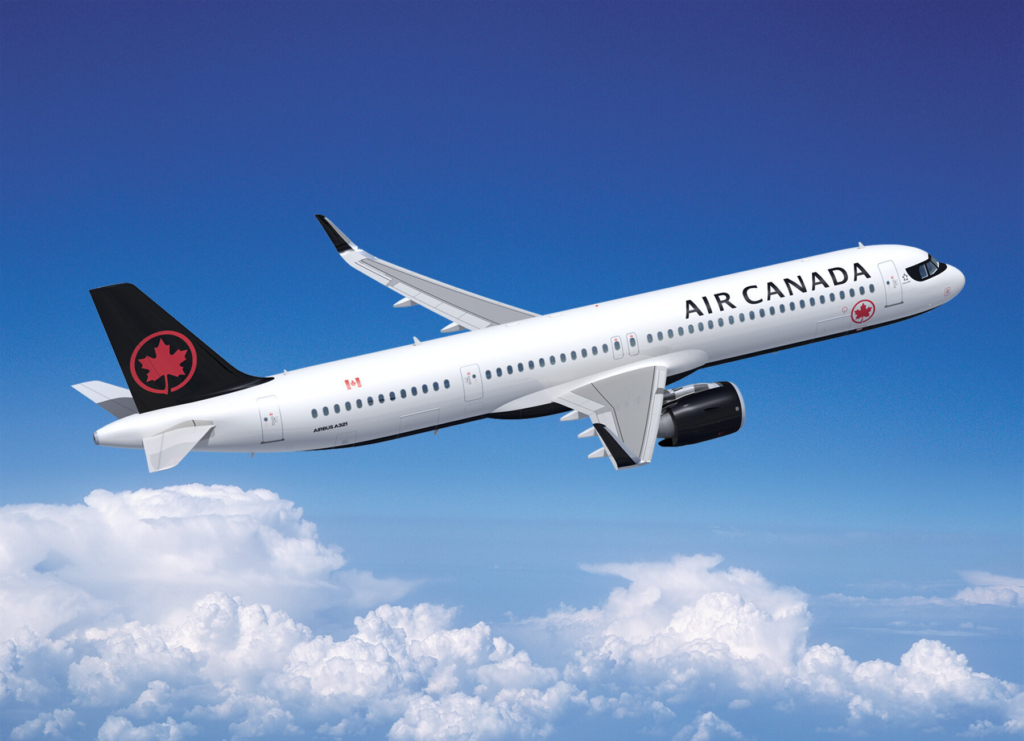
Air Canada is also set to welcome in the coming months the first of its 30 Airbus A321XLRs, which will be used for lower-density long-haul routes from Canada. The first of these routes will be Porto, Edinburgh and Toulouse.
In the meantime, Air Canada is also continuing to take delivery of Airbus’ Canadian-assembled Airbus A220, with a further 23 aircraft to be delivered to the carrier out of a firm order of 65 of the type.
Featured image: Airbus