How AI is changing the way we book private jets

February 25, 2026

Just as the commercial aviation sector applies artificial intelligence for retailing and optimised operations, the private aviation sector is also undergoing its own digital revolution, enabled by AI.
For decades, private jet bookings have been complex and time-consuming processes, with concierge agents consulting clients via a chain of emails and phone calls to ensure customers receive the service they require. Despite the back and forth, flyers have limited visibility into pricing for each trip until the transaction is nearly complete.
Two US-based companies—FlyJets and Elevate Jet—have launched AI-powered platforms designed to eliminate uncertainty and streamline the private jet search and booking processes.
They lean on large language models (LLMs), proprietary aviation datasets, and automation to deliver instant quotes, aircraft matching, and even dynamic flight-sharing.
FlyJets launches conversational private jet search with JetGPT
FlyJets has introduced JetGPT, a beta LLM-powered flight-finding assistant that replaces the traditional search interface with a conversational experience.
JetGPT lets users access:
- Real-time aircraft availability
- Transparent pricing
- Empty-leg inventory
- Flight-sharing opportunities
- Charter flights within a target budget
Rather than filtering through static listings, users can submit complex, natural-language requests—such as sourcing empty legs over a multi-day range or finding a charter within a defined price cap. The system automatically pulls operator data, applies customised logic to determine the most efficient aircraft for a given trip, generates quotes, and presents options directly to users for booking.
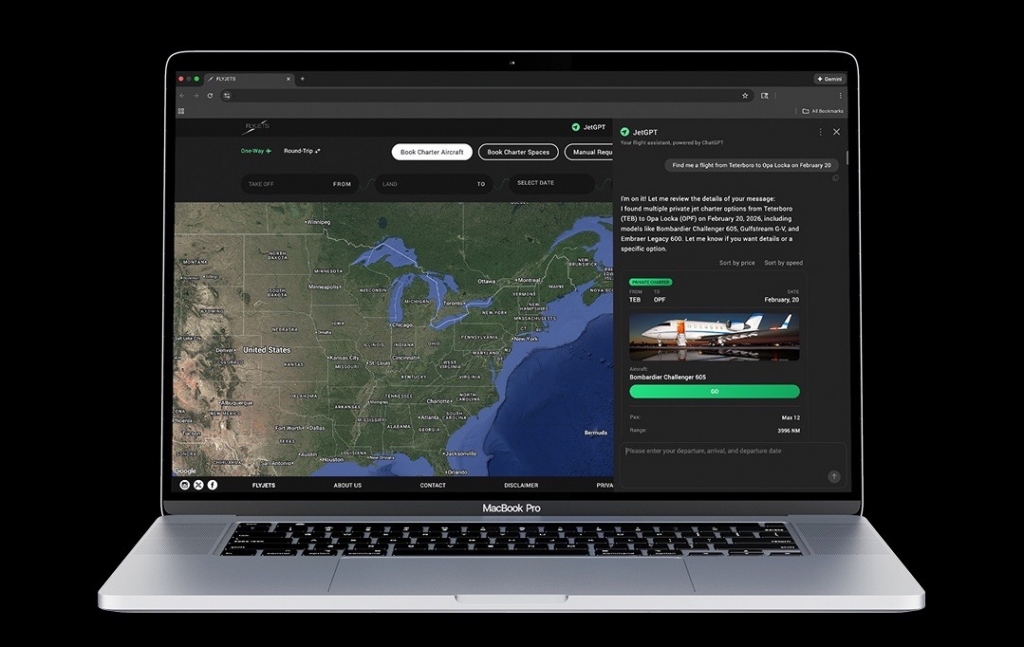
Users can prompt JetGPT with requests like, “Compile a list of all empty legs going in and out of Van Nuys Airport this month and include three photos of each aircraft.” JetGPT provides a list that can be exported to Excel or CSV, and it also offers instant booking capabilities.
Prompts can include more detailed requirements. For example, “Book a flight on a super-midsize jet from Teterboro to Opa-Locka Airport that comes to less than $22,000 all-in, if available; thereafter, sell three spaces on the flight via the Exchange for $3,500.00 each.”
JetGPT’s AI will find the flight, book (or request a booking hold), and list available “spaces” on the flight via the FlyJets app as well as through direct-to-flyer notifications.
Making the private jet search more natural and flexible
FlyJets CEO and Founder Jessica Fisher told Aerospace Global News that the company’s focus is not yet full booking automation, but search flexibility.
“We are less focused on using AI to coordinate charter aircraft bookings at this point, and primarily focused on building language models that enable maximum flexibility when searching for aircraft and flight information,” she said. “For instance, it would be very difficult to display all current aircraft bookable for charter out of a given airport in a long span of time (given ordinary UI/UX interfaces) and much easier to use a language model to pull this data.”

The challenge, Fisher explained, is gathering usable data from an inherently fragmented marketplace.
“Our system first pulls information from Aircraft Operators automatically—using customised, per spec algorithms to glean both the most efficient aircraft available per trip, and provide a quote on those planes—and then presents that information to flyers for booking,” she said.
FlyJet’s AI ‘mimics the brain’ of the scheduling team
Behind the conversational layer of JetGPT are “per operator algorithms, with which we can ‘mimic the brain’ of a given scheduling team to take the manual work out of both aircraft sourcing and quoting,” Fisher said.
FlyJets has operated since 2020 and maintains more than 30,000 members. Fisher told AGN the success of JetGPT will be measured by “the breadth of aircraft and availability we can provide, and the rate of success in terms of both outright charter aircraft and aircraft-sharing among flyers.”
Elevate Jet: AI meets 30 years of operational data
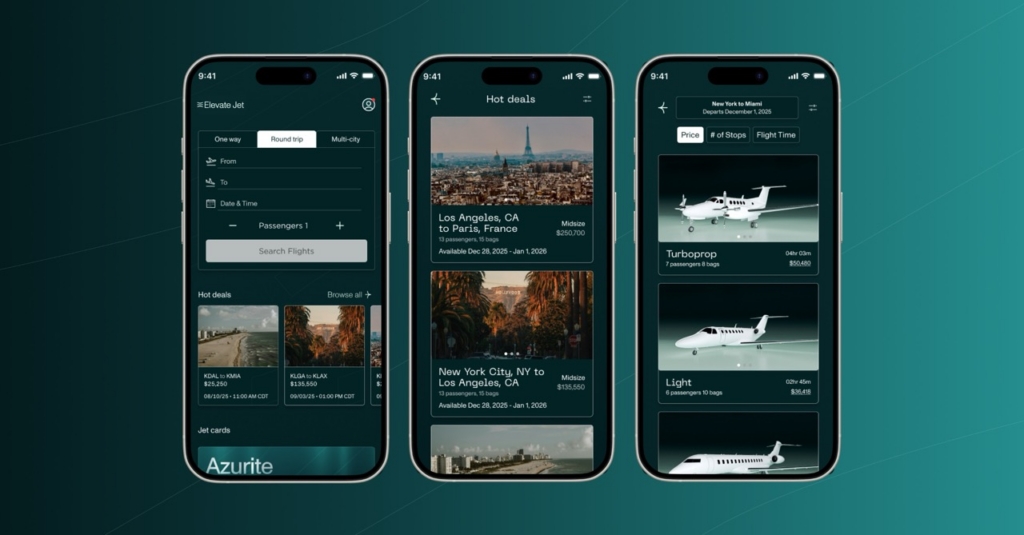
Elevate Jet is applying AI to eliminate the complexities of private jet bookings, combining instant booking with embedded operational intelligence. The company’s newly launched app is powered by a proprietary AI agent named “Ruby,” who is trained on 30 years of the company’s private aviation logistics data. Ruby analyses range, fuel requirements, crew limits, airport constraints, and aircraft availability to generate instant itineraries across six aircraft categories.

“Private aviation has always promised luxury, but too often delivers frustration,” Elevate Jet CEO Greg Raiff said in the company’s announcement. “The Elevate Jet app changes everything. In seconds, clients can see pricing, select the right aircraft, and book with confidence. It’s private jet travel reimagined for the digital age.”
Elevate Jet’s AI challenge: “Can we” vs “Should we”
Jennifer Wimberly, CTO of Elevate Jet, told AGN that deploying AI in private aviation poses different challenges. Unlike consumer travel apps, private aviation bookings involve regulatory compliance, crew duty limits, airport constraints and high-value client expectations.
“The biggest challenge was ensuring the technology served the business and not the other way around,” she said. “Private aviation is a domain where safety and trust are non-negotiable, so we had to ask ourselves both ‘can we’ and ‘should we’ at every step.
“The challenge wasn’t access to data; it was building something that generates genuine insight rather than just automation. Keeping human oversight embedded in mission-critical workflows was essential, and frankly, non-negotiable.”
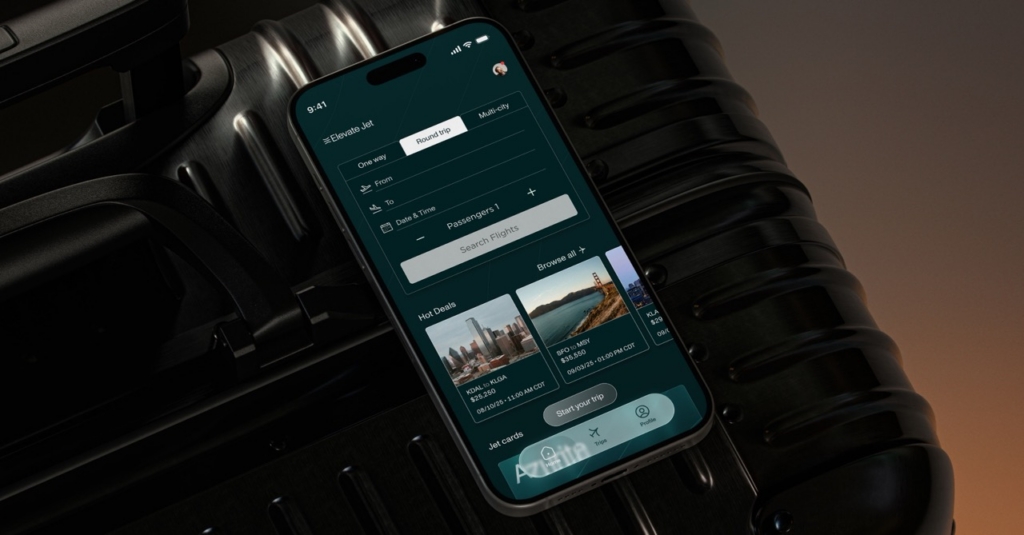
The company’s enterprise platform was designed to ensure that all the information on the flyer’s needs reaches the operator “with precision and completeness,” Wimberly said.
“The systems draw on our deep aviation data to validate feasibility before a booking is ever confirmed. From there, Ruby informs our flight logistics team, who review and confirm all requirements are met before anything is passed to the operator. That human touchpoint is intentional, and it’s how we ensure there are no gaps, no ambiguity, and full confidence on both sides of the transaction.”
Data depth is ElevateJet’s competitive advantage
Wimberly says what makes Ruby different is the depth of the company’s proprietary data, combined with Ruby’s dynamic pricing and feasibility intelligence.
“The ability to take 30 years of proprietary aviation data and turn it into real-time, actionable insight for a client at the moment of booking is genuinely transformative,” she said. “It’s not just a feature; it’s the foundation that makes instant booking in private aviation possible in a way it hasn’t been before.”

Rawan Haroun, CMO of Elevate Jet, told AGN the company aims to reach 10,000 active users by year-end, with infrastructure designed to scale beyond that target.
“Our infrastructure decisions were made with that growth in mind from day one, so whether adoption accelerates faster or slower than projected, the platform is ready,” Haroun added.
For CEO Greg Raiff, Ruby’s success will be measured by real-world results.
“Success for us is rooted in business outcomes, not technology metrics,” Raiff told AGN. “We’ll be looking at booking conversion, client satisfaction, and how meaningfully Ruby improves the speed and accuracy of the instant booking experience.
“If our clients are getting faster, more confident decisions, and our operators are receiving cleaner, more complete information, that’s success. The technology is only as good as the outcomes it drives.”
AI as a time saver in private aviation
These two AI applications take different approaches, but both aim to make private aviation easier for humans to manage, freeing up time for flyers and operators alike.
FlyJets prioritises conversational search to make the marketplace more visible and accessible. Elevate Jet has embedded AI into its operations to deliver faster results and clearer booking visibility, while preserving human oversight. Both applications recognise that the high-value transactions in private aviation demand both speed and trust.

In the private jet sector, long associated with exclusivity and concierge service, AI is not replacing the personal touch. Instead, it allows people to focus on more value-added tasks, moving away from manual data gathering toward verification, safety oversight, and client experience.
It also saves the high-net-worth individuals who book private jets their valuable time. Eliminating hours of back-and-forth coordination may be the most meaningful upgrade enabled by this new technology.
Featured Image: Elevate Jet