Passenger traffic set to more than double by mid-2040s as ACI World urges airports to prepare

February 5, 2026

Airports Council International (ACI) World’s Airport Traffic Forecast reveals that Asia Pacific will lead global passenger growth to 2054.
Global airport traffic is set to more than double by mid-2040s as aviation enters “new baseline”, according to airport trade body ACI World.
With 2024’s global passenger traffic exceeding 2019 levels, hitting around 9.4 billion passengers, it marks a shift toward more mature, sustainable growth.
That figure is now expected to more than double by the mid-2040s, reaching roughly 2.5 times current levels by 2054, according to ACI World’s latest long-term traffic outlook.

Signalling an encouraging transition from post-pandemic recovery into a new era of structurally driven growth, the ACI World Airport Traffic Forecasts (WATF) 2025–2054 outline a “new baseline” for global aviation.
With stabilised demand shaped by lasting shifts in passenger behaviour, airline networks and cargo flows, the industry is projected to record 9.8 billion passengers in 2025 and around 10.2 billion in 2026. This reflects annual growth of roughly 3–4%.
ACI World says the sector has now moved well beyond recovery mode from COVID-19, with traffic growth increasingly driven by structural demand patterns rather than short-term catch-up effects.
Global airport passenger traffic forecast to more than double by 2054
Between 2024 and 2054, global passenger traffic is forecast to expand at around a 3% compound annual growth rate (CAGR), exceeding 23 billion passengers by the mid-2040s.
By 2054, traffic is expected to be approximately 2.5 times higher than current levels, reflecting continued demand for connectivity, as well as tourism and trade, particularly in emerging markets.

Regional divergence will be a defining feature of this growth. Asia-Pacific is forecast to remain the largest aviation market, with this region alone expected to reach about 10 billion passengers by 2054.
Meanwhile, Europe is expected to handle roughly 5.1 billion passengers and North America around 4.1 billion. Africa, the Middle East and Latin America are also expected to see strong expansion, driven by economic growth, rising middle classes and increased airline capacity.
However, the airport trade body cautions that the global system is entering the second half of the 2020s smaller than pre-pandemic projections once anticipated.
This is due to the loss of an estimated four to five years of growth potential due to recent economic uncertainty and geopolitical disruptions.
The organisation also noted that the outlook remains fundamentally positive, with sustained long-term expansion anticipated.
International passenger demand outpaces domestic markets
Recent data highlights shifting demand patterns. International passenger traffic recorded robust growth, rising around 5% year-on-year, achieving 107% of the 2019 level. Conversely, domestic markets in several mature economies have stagnated or declined slightly due to structural changes and weaker internal demand.
Growth is also shown to be uneven across regions. Emerging and leisure-focused markets, including parts of the Mediterranean, Central Asia and South Asia, have exceeded 2019 traffic levels thanks to strong tourism demand and expanded low-cost carrier networks.
In contrast, some mature markets in Western and Northern Europe and parts of Southeast Asia remain below previous benchmarks. This can be attributed to environmental constraints and modal shifts toward rail and ongoing capacity limitations.
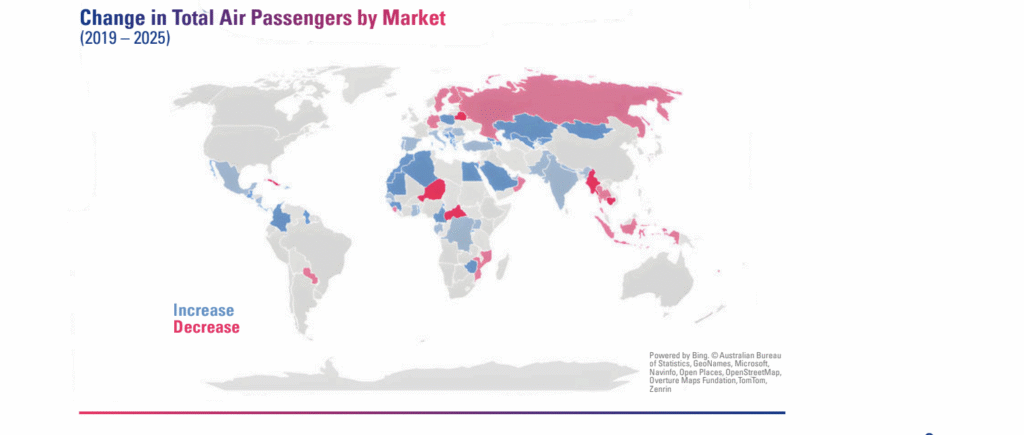
ACI underlines how this divergence illustrates the need for airports to focus on local demand drivers rather than global averages when planning capacity and infrastructure investments.
Air cargo growth driven by trade, e-commerce and supply chain resilience
The long-term outlook for air cargo is also positive, although more moderate than passenger growth. Global cargo volumes reached about 129 million metric tonnes in 2025 and are expected to rise to roughly 262 million tonnes by 2054, representing around 2.5% annual growth.
E-commerce demand and supply-chain resilience are key drivers, but geopolitical tensions and trade fragmentation are reshaping cargo flows, prompting changes in airport hub strategies and logistics networks.

Key risks for global aviation: Capacity constraints and delivery delays
Despite the strong growth outlook, ACI notes multiple challenges amid the shifting baseline for global aviation.
Aircraft delivery delays, supply chain bottlenecks, infrastructure limitations and airline capacity deployment are all expected to constrain capacity expansion in the near term.
Persistent geopolitical and economic uncertainty will continue to influence route structures, operating costs and passenger sentiment.
The trade body emphasises that uncertainty must now be factored in as a structural feature of aviation planning rather than a temporary recovery challenge, requiring airports and airlines to adopt flexible, resilience-oriented strategies and diversified traffic portfolios.
“The forecast sends a clear signal to the global aviation community: long-term growth is not guaranteed without coordinated action,” said Justin Erbacci, ACI World’s Director General.

He added that to meet rising demand, the industry must “accelerate investment in airport infrastructure, airspace capacity, and operational resilience, while strengthening collaboration across airports, airlines, governments, regulators and industry partners.”
Airports urged to plan for resilience as passenger demand rises
The new aviation baseline underlines that growth opportunities are increasingly concentrated and uneven. According to ACI World, future growth opportunities will be focused on market-specific demand drivers and risk profiles, making data-driven planning essential.
For airport operators and investors, the findings reinforce the importance of resilience-focused strategies as aviation enters a new phase of long-term expansion. While growth is expected to remain steady, the industry will need to adapt to evolving passenger behaviour, uneven regional development and ongoing capacity pressures.
“Without collective action, capacity constraints jeopardise the industry’s ability to meet the projected demand and create operational bottlenecks,” Erbacci said. “At the same time, insufficient investment to meet the projected demand would result in missed economic development opportunities at both regional and national levels.”
Ensuring the industry can sustainably absorb growth in demand is “not only an industry priority, but a global economic imperative,” he concluded.
Featured image: ACI World – Airport Traffic Forecasts 2025-2054