American Airlines cut contrails by 62% with Google AI

4 min read
American Airlines and Google have proven that artificial intelligence could become one of aviation’s most immediate and scalable climate solutions by helping aircraft avoid leaving condensation trails, better known as contrails, that contribute to global warming.
The two companies, working alongside flight planning provider Flightkeys and research group Contrails.org, have successfully integrated AI-driven contrail forecasts into the airline’s operations, enabling pilots and dispatchers to adjust routes to avoid areas where contrails are likely to form.
What are contrails—and how do they impact the climate?
Contrails form when aircraft fly through cold, humid air, creating ice-crystal clouds behind engines. While visually interesting and chemically harmless, persistent contrails can trap heat in the atmosphere and exacerbate aviation’s climate impact.
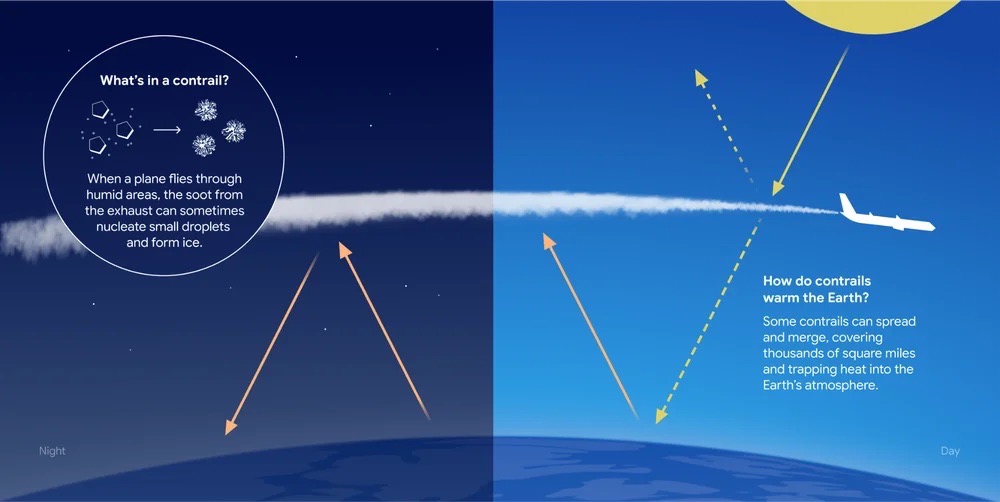
According to the International Air Transport Association, aviation accounts for approximately 2.5% of human-made global CO2 emissions. However, aviation’s climate impact includes non-CO2 emissions, also referred to as short-lived climate pollutants (SLCP).
These include:
- Contrails, which can trap heat and reflect sunlight back on the planet
- Nitrogen oxides (NOₓ) released by aircraft engines can generate ozone that can warm the atmosphere along with methane which can cool it
- Black carbon aerosols (soot) which trap heat and can also contribute to contrail formations
Some studies suggest contrails may account for a comparable share of aviation’s warming effect as CO₂ emissions, making them a critical but often overlooked target for mitigation.
“Governments and industry are right to invest in clean aviation fuels, which are essential to the long-term sustainability of aviation,” Dan Rutherford, Senior Director of Research for the International Council on Clean Transportation (ICCT), said in the announcement of a study into SLCP controls the Council published last year. “But small changes in how aircraft are flown to cut contrails may protect our climate even more in the near and medium-term.”
AI predicts where contrails will form
Google’s approach uses artificial intelligence trained on vast datasets—including satellite imagery, weather patterns and flight paths—to generate detailed contrail forecast maps.

The maps identify atmospheric regions where contrails are most likely to form. Airlines can then slightly adjust altitude or routing to avoid those zones—often requiring only minimal deviation from the original flight plan.
American Airlines integrated these forecasts into its operational systems, allowing dispatchers to suggest alternative flight paths to pilots before departure.
Real-world AI trial shows 62% reduction in contrail formations
American Airlines and Google first applied AI to contrail avoidance in 2023. Initial trials conducted on 70 flights, resulted in a 54% reduction in contrails. The trials also determined that contrail-avoidance flight rerouting could be achieved with a total fuel impact of as little as 0.3%, reducing costs and controlling CO2 emissions.
Google has published a recent update following a new study on the efficacy of scaling this AI application across an airline’s operations.
“A 54% reduction across 70 flights marked the industry’s first proof point that commercial flights could verifiably reduce their contrail impact — but identifying the right flights still required hours of manual coordination,” Google states in its announcement. “Our new study shows what happens when contrail avoidance is built directly into the tools airlines already use.”

The recent trial was conducted over 17 weeks, from January 15 to May 13, 2025, encompassing 2,400 of American’s transatlantic flights. Researchers found that the 112 flights that followed the contrail-avoidance flight paths reduced contrail formation by 62% compared to a control group, with up to 69% reduction in associated warming impact, and what they describe as “no statistically significant difference” in fuel burn.
A rare “low-cost, high-impact” climate solution for aviation
One of the biggest barriers to operational changes in aviation is cost—particularly fuel burn. But contrail avoidance appears to offer a rare win-win.
Because contrails form only in specific atmospheric conditions, only a small proportion of flights need minor adjustments to deliver significant climate benefits.
Early trials suggest these changes can often be achieved with negligible fuel penalties, making the approach far more cost-effective than many long-term decarbonisation technologies.
Scaling contrail avoidance technology across aviation
The next challenge for Google and the aviation industry will be scaling up the technology globally.
While the trial showed that pilots and dispatchers can implement contrail avoidance without major disruption, widespread adoption will require integration with global flight planning systems, adoption by multiple airlines and airspace coordination at the international level.

Google has signalled plans to expand the technology to other flight-planning platforms, embedding contrail forecasting across the industry.
“We’re excited to scale this work and continue our research and partnership with the industry to automate contrail avoidance, a solution that offers a scalable and cost-effective way to reduce the climate impact of flying. Results like these bring that reality within reach,” the company stated in its update.
Why contrail avoidance matters now
With aviation under increasing pressure to reduce its climate footprint—and with sustainable aviation fuel (SAF) supply still constrained—contrail avoidance offers airlines a near-term solution that they can deploy today.
AI-driven flight routing could become one of the most cost-effective, scalable climate solutions currently available to aviation.
For airlines, it offers immediate operational gains by using data and AI to make flying greener, as they wait for new aircraft technology development and sustainable fuel production to catch up.
Featured Image: American Airlines