The Sukhoi Su-75 Checkmate: What we know so far

8 min read
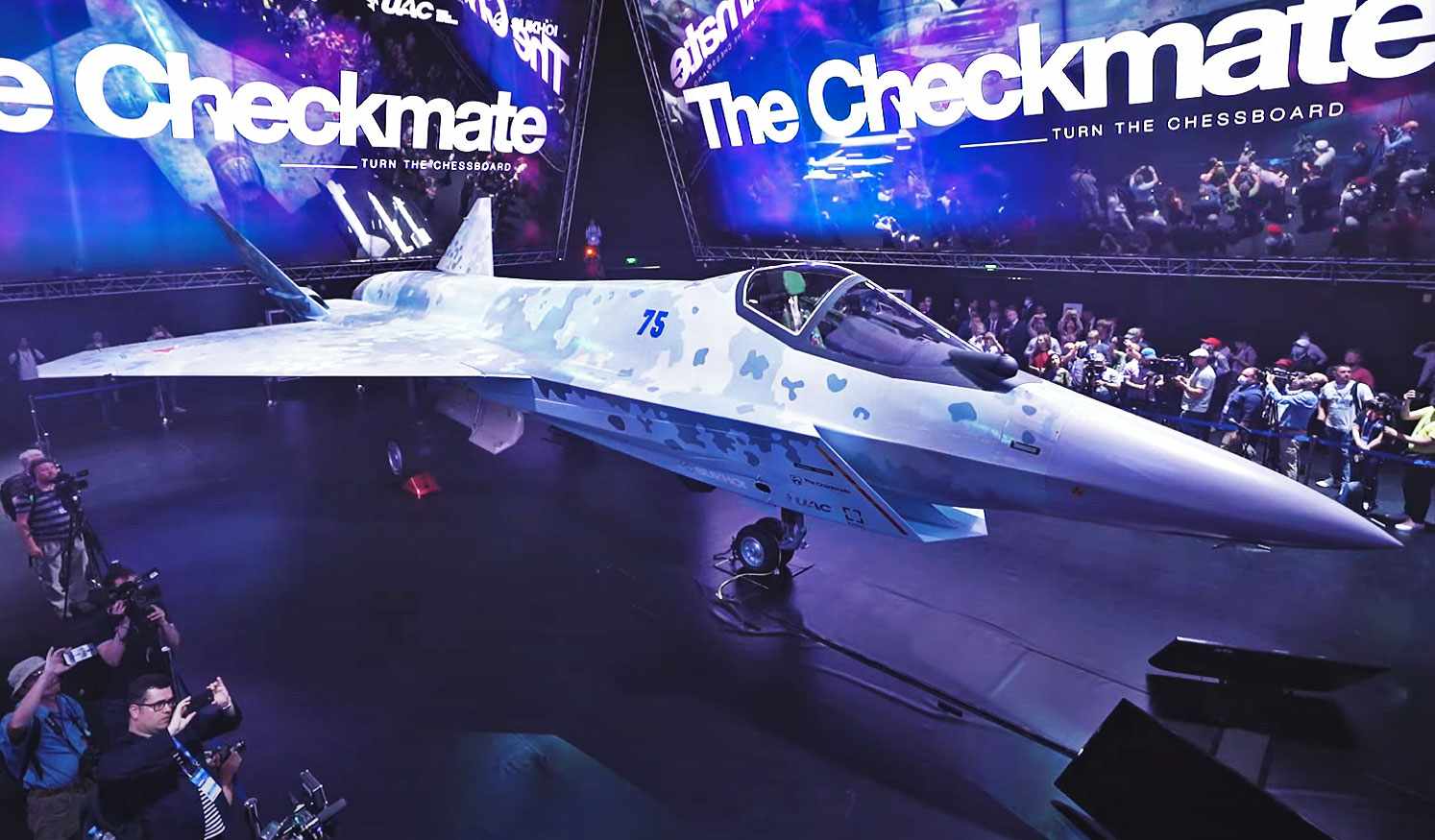
Unveiled in 2021, the Sukhoi Su-75 Checkmate is a single-engine fighter programme developed by Sukhoi under Russia’s United Aircraft Corporation. Marketed as a more affordable, export-oriented combat aircraft, the design has generated significant interest, despite much of the programme still remaining on paper.
Russia’s initial Su-75 lightweight fighter rollout
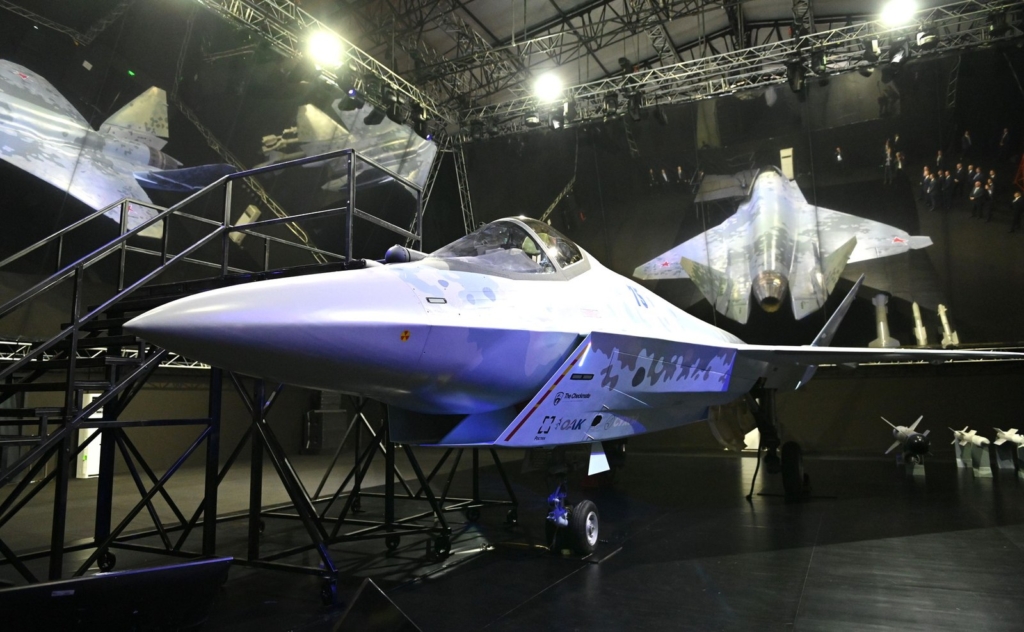
At the 2021 MAKS Air Show, Sukhoi unveiled its new lightweight fighter jet, which it called the Sukhoi Su-75 Checkmate, to much fanfare. While it is called a lightweight fighter, its size is closer to that of a medium-weight fighter.
The rollout of the mockup came with bold claims that it was a 5th-generation fighter jet, complete with an animation showing it shooting down F-35s.
| Sukhoi Su-75 “Checkmate” – known specifications | |
|---|---|
| Manufacturer | Sukhoi (United Aircraft Corporation, Russia) |
| Role | Single-engine, multirole fifth-generation fighter (export-focused) |
| Crew | 1 (optionally piloted / unmanned variant proposed) |
| Length | Approx. 17.5 metres (manufacturer data) |
| Wingspan | Approx. 11.8 metres (reported) |
| Maximum take-off weight | Approx. 18 tonnes (claimed) |
| Engine | Single Saturn AL-41F1 (with future “Izdeliye 30” option proposed) |
| Maximum speed | Mach 1.8+ |
| Combat radius | Approx. 1,500 km (claimed) |
| Service ceiling | Approx. 16,500 metres |
| Internal weapons bays | 1 main ventral bay plus side bays (configuration based on mock-ups) |
| Stealth features | Internal weapons carriage, radar-absorbing materials, reduced RCS shaping |
| Avionics | AESA radar (type not disclosed), advanced sensor fusion (claimed) |
| First flight | Not yet achieved (programme timelines have slipped) |
| Status | Under development; no confirmed production orders |
| Note: Specifications are based on manufacturer statements and public disclosures. Final performance, configuration and timelines remain unconfirmed. | |
If the published specifications were realised, the Su-75 Checkmate would sit somewhere between legacy fourth-generation fighters and the most mature fifth-generation platforms.
Its claimed combination of reduced radar signature, internal weapons carriage, modern avionics, and long combat radius suggests a step beyond upgraded fourth-generation designs, while its single-engine layout and emphasis on affordability point to a deliberately simpler, export-oriented proposition.
On paper, the concept appears coherent and competitive for air forces seeking a modern multirole fighter without the cost or complexity of top-tier systems.
But between the gloss and showmanship, observers were quick to point out that the programme did not appear to be as much a real programme, but rather a pitch to create one.
The lightweight Su-75 does not seem to have Russian state funding, and there was no indication that the Russian Air Force was interested in it. Instead, it appears it was a self-funded Sukhoi project, and Sukhoi was desperately looking for investment from future export customers.
Get the latest aerospace defence news here on AGN.
Russia claims first Su-75 flight set for 2026
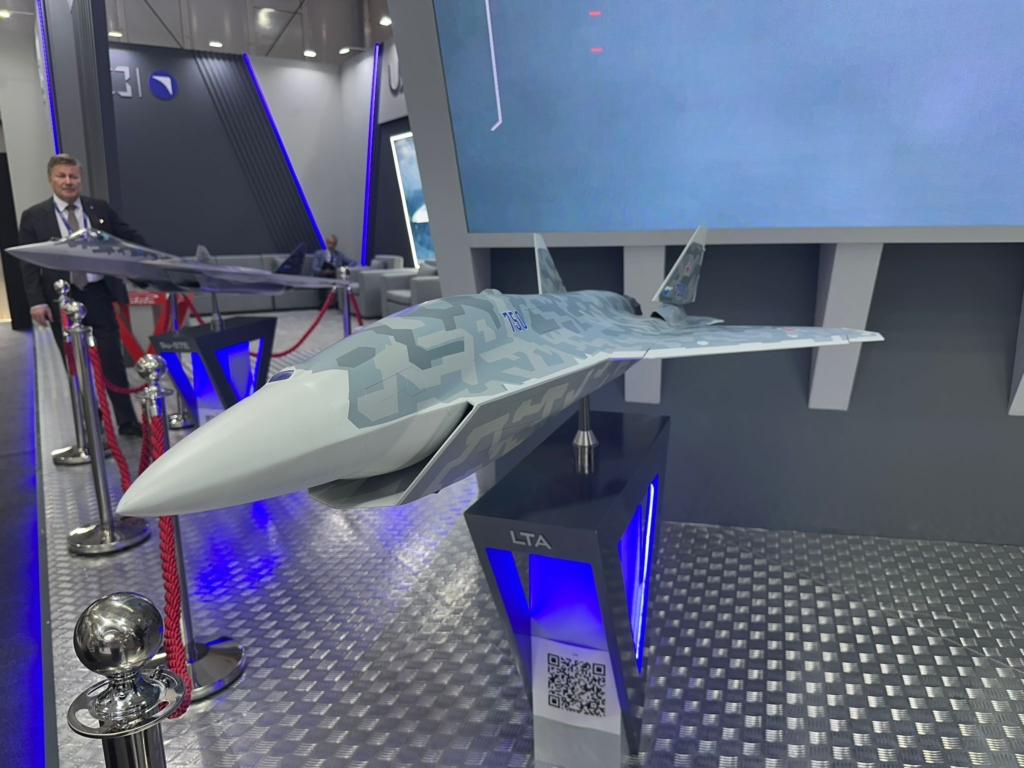
At the Dubai Airshow 2025, the Su-75 was not to be seen. The closest display appeared to be a model of a pilotless autonomous aircraft based on the Su-75.
Still, Sergey Chemezov, head of Russia’s state-run defence Rostec, claimed recently that a prototype will commence ground-based bench testing by early next year. He said, “Basically, we are almost at the stage of the testing flights, and in the near future, we will be launching it into production.”
Sergey Bogdan, Sukhoi’s chief test pilot, said, “I think this [test flight] is the beginning of 2026.” Rostec is claiming the prototype is structurally complete and is undergoing the painstaking integration work.
While it’s possible such an aircraft could be set to fly soon, such claims should be taken with a proverbial pinch of salt.
Russia’s pattern of fantastic claims
At its unveiling in 2021, UAC said work on an actual flying Su-75 prototype was underway. It said the aircraft would fly in 2023, then 2024, then 2025, and now 2026.

Separately, Russia announced in 2013 it had begun work on its Mikoyan PAK DP (MiG-41) 6th-generation fighter. In January 2021, Army Recognition reported that Russia’s Sputnik claimed the aircraft could first fly in 2023 and enter service in 2025. As of the end of 2025, there’s little indication that it remains much more than a few sketches and dreams.
In 2022, Russia claimed it would deliver 1,000 commercial aircraft of all types by 2030. As of the end of 2025, none have been delivered except for some Superjets assembled with pre-stocked components. That said, the first import-substituted aircraft appears close to delivery in 2026.
In early December 2025, Russia’s Aviastar (part of UAC) stated that two new military transport aircraft (the Il-100 Slon and Il-276) were soon to go into production. It seems these aircraft remain paper aeroplanes, with the Il-100 (formerly the Il-106) in particular existing as a few drawings.
Aviastar-SP, subsidiary of the Ilyushin company, has announced plans to begin production of two new transport aircraft: the heavy transport Il-100 and the medium transport Il-276 (SVTS). The Il-276 will be powered by two PD-14M engines, and Il-100 will be equipped with four PD-26 pic.twitter.com/pwRUXkQsEp
— H. Memarian (@HEMemarian) December 4, 2025
The Il-276 was initially developed with investment and partnership with India’s Hindustan Aeronautics Limited, but India later walked away from the project.
None of this is to say that Russia can’t develop new aeroplanes and fighter jets; it absolutely can. Only the claims of a new milestone about to be reached need to be taken with caution.
Su-75 focused on Russia’s evaporated export market
The War Zone states that the Su-75 programme is “said to be ongoing with a heavy emphasis on potential export sales.” It adds that this is likely “aspirational.” It seems like the Su-75 is being designed for a market that no longer exists, or at least not like it once did.
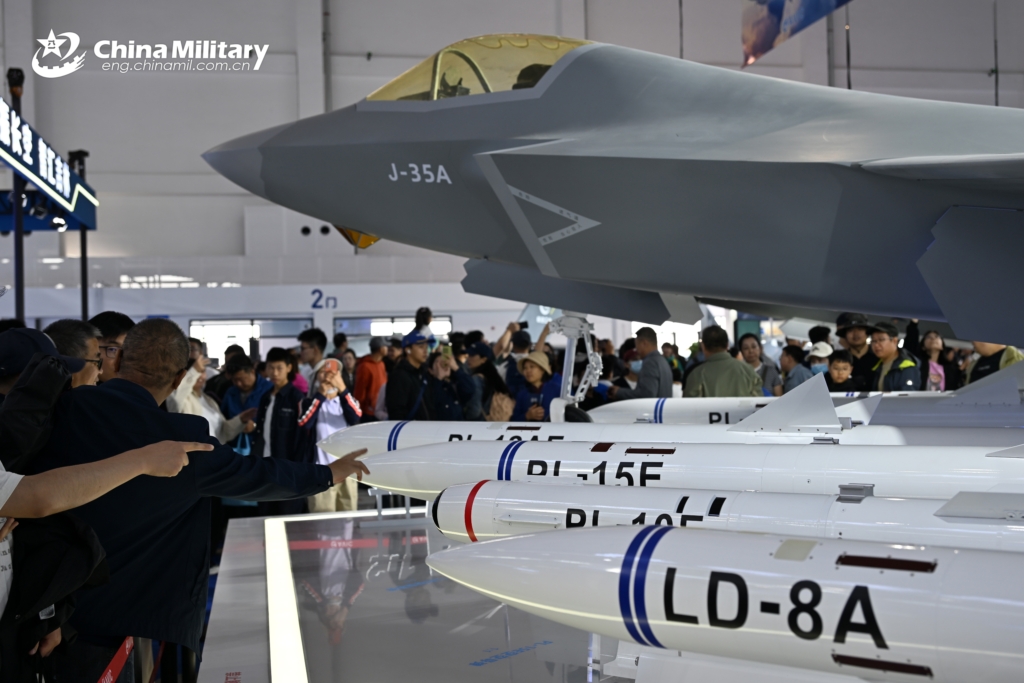
For decades, the United States and the Soviet Union were the two primary suppliers of fighter jets around the world. Russia inherited this following the demise of the USSR.
But times have changed. Russia’s two biggest customers, China and India, have largely gone their separate ways. China’s final Russian fighter jet was delivered in 2019, and now it produces its own more advanced next-generation fighters and Flanker derivatives.
India is working to develop its own fighter jet industry with emphasis on Tejas, while also diversifying to the French Rafale fighter jets. It is still to acquire 12 new Su-30MKI fighter jets, but these are produced locally under license and are only to replace losses.

Geopolitical changes mean Russia has lost all of its former Eastern European market, including Serbia, but with the exception of Belarus.
The passing of CAASTA in 2017 was a death knell for Russian fighter jet exports. Remaining customers like Indonesia, Vietnam, and Egypt abandoned Russia. Even Bangladesh is considering purchasing Eurofighters.
Russia’s remaining pool of potential customers is small. Most notably, it includes Algeria, with others being Venezuela, Iran, Belarus, Kazakhstan, Myanmar, and a few others. Syria is likely gone as a potential market following the fall of Assad, while recent talk has been about North Korea procuring older 4th-generation aircraft.
The Su-75 and its intended role
The Su-75 is intended to be a stealthy, lightweight fighter jet to replace ageing fleets of MiG-29s and MiG-21s. The 2021 mockup was around 57 feet long and had a wingspan of around 39 feet.
In its present stage of development, it is to have an increased maximum takeoff weight of 57,320 lbs (26,000 kg) and be able to carry up to 16,314 lbs (7,400 kg) of munitions from its underwing hardpoints and its three internal bays.
Some data on Sukhoi 's fighters from ROE. Su-57E, LTA Checkmate. 1/2
— Michael Jerdev (@MuxelAero) November 19, 2025
#DAS25 pic.twitter.com/unknown
It would have a top speed of between Mach 1.8 and Mach 2 with a thrust of 32,000 to 36,000 lbf. Models and renderings shown in 2025 show that its design has evolved since 2021.
The difficulties of producing fighter jets
Professor Justin Bronk has previously pointed to the Su-75 as well as the Su-57, KF-21, and others and said, “It’s comparatively easy to produce something that looks like a stealth fighter-ish thing, that will fly.”
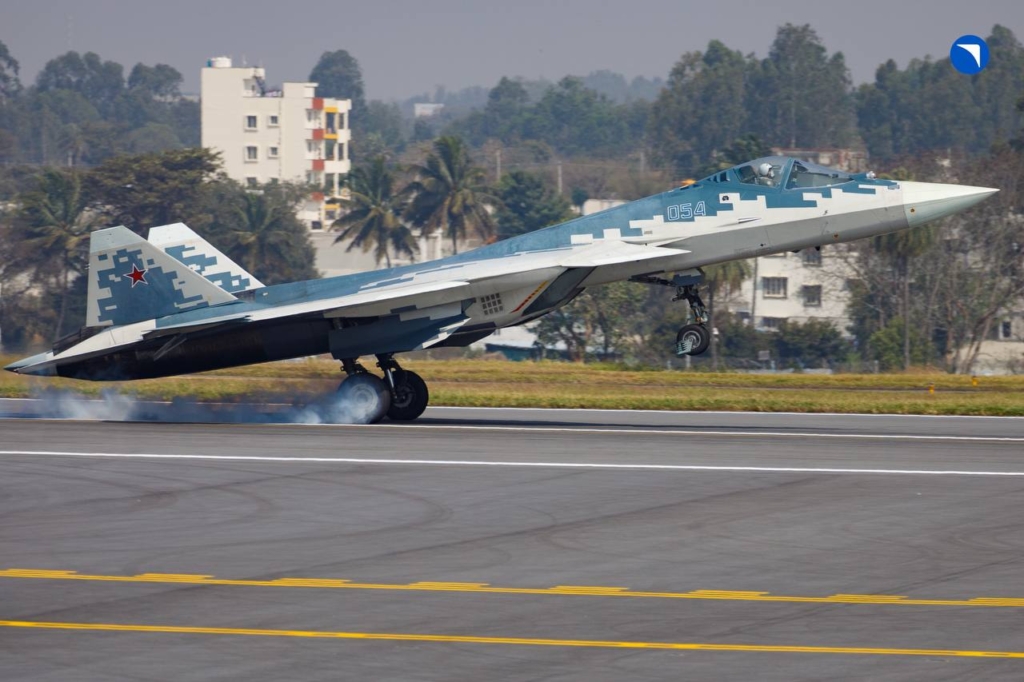
He added, “It is incredibly difficult and unbelievably expensive to sustain the production of a weapons system that works as a low observable fighter…” Put another way, even if Russia does develop the Su-75, and it looks impressive to the outside observer, that doesn’t mean it will earn the moniker “5th-gen” on the battlefield.
The Su-57 Felon is meant to be Russia’s flagship next-generation fighter jet. It was initially developed with Indian investment before India abandoned the jet.
While Russia has developed the Su-57 and brought it into service, it is only available in low numbers, with Russian industry struggling to ramp up production.
‼️ Вперше уражено Су-57
— Defence Intelligence of Ukraine (@DI_Ukraine) June 9, 2024
💥 8 червня 2024 року на території аеродрому «ахтубінск» в астраханській області рф, розташованому за 589 кілометрів від лінії бойового зіткнення, уражено багатоцільовий винищувач держави-агресора Су-57.
🔗 https://t.co/vyatL7cBjd pic.twitter.com/8wbopryp4l
There may have been a Su-57 production increase in 2025 to 30-35 units, although other sources claim Russia will only be delivering the jet in the single digits, even low single digits. April 2025, Army Recongition reported the Russian Air Force only received 19 examples in service by the first quarter of 2025.
Documents show that sanctions mean the aircraft is being delivered without some of its advertised capabilities and systems.
Some have even questioned the UK, Italy, and Japan’s ability to develop the next-generation GCAP/Tempest fighter jet, even though their combined GDP, population, and aviation industries are much greater than Russia’s. That said, the lightweight Su-75 is far from as ambitious as GCAP.
Featured Image: UAC
Sign up for our newsletter and get our latest content in your inbox.


More from

October 17, 20265 min read


October 17, 20264 min read