Air France A350 hit by birds five times but hidden radome damage went unnoticed before collapse

December 12, 2025
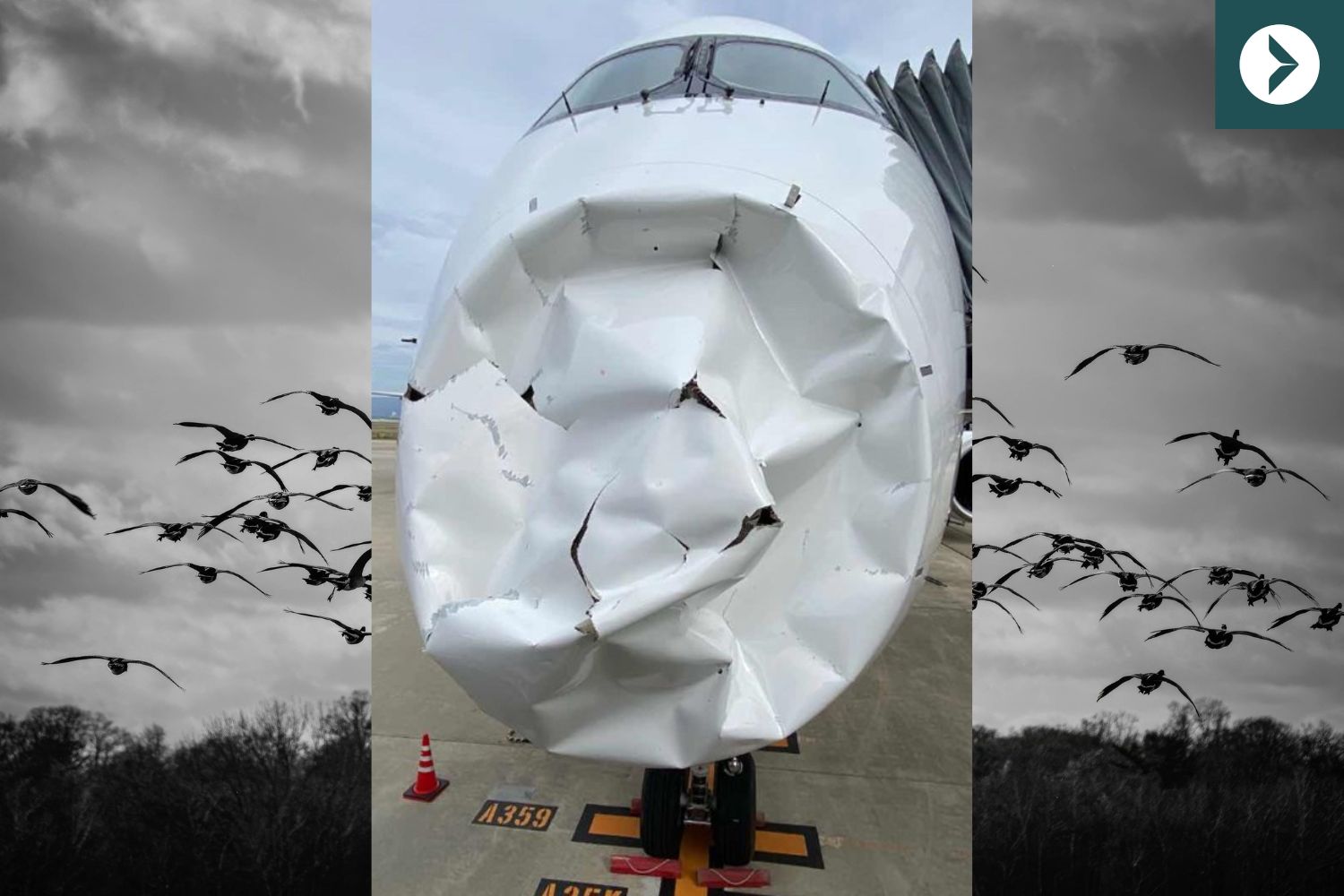
The French air safety investigation authority, BEA, has released its final report into an unusual and serious in-flight failure involving an Air France Airbus A350-900 on 28 May 2023.
The investigation reveals how the aircraft’s radome, weakened by repeated impacts and insufficient internal inspection, eventually collapsed at cruising altitude, triggering unreliable airspeed indications and forcing the crew to return to Osaka.
The report provides one of the clearest examples yet of how progressive, hidden damage to composite radomes can accumulate over time if mandatory inspection procedures are not fully carried out.
Air France Airbus A350 struck by birds and lightning
BEA’s review of the aircraft’s technical history showed that, between July 2022 and the day of the incident, the Airbus A350, registered F-HYTO, had been subjected to at least five known bird strikes, as well as a lightning strike in October 2022.
While none of these events caused visible structural deformation to the radome, Airbus procedures require the inner face of the radome to be opened and inspected after any such impact because composite delamination can occur without external marks.
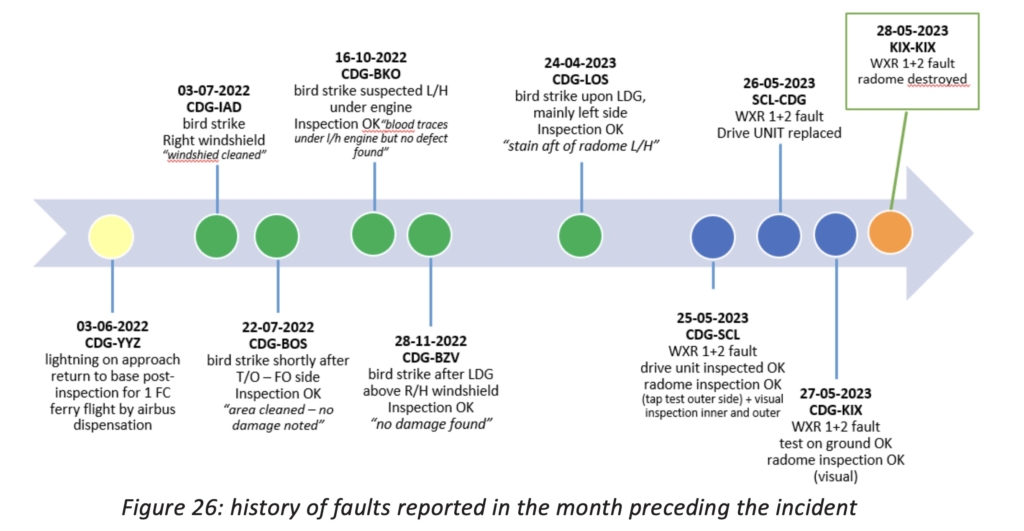
Compounding the issue, the aircraft experienced recurring weather radar faults in the days leading up to AF291’s departure from Osaka.
Under Airbus maintenance instructions, repeated radar anomalies are themselves a trigger for deeper troubleshooting, including radome opening. Yet the aircraft remained in service after external checks deemed both radar systems operational.
BEA concludes that the continued use of the aircraft, combined with incomplete inspection of the radome’s interior, allowed a substantial and progressive delamination to develop unnoticed.
AF291: The Airbus A350’s radome collapses at FL300
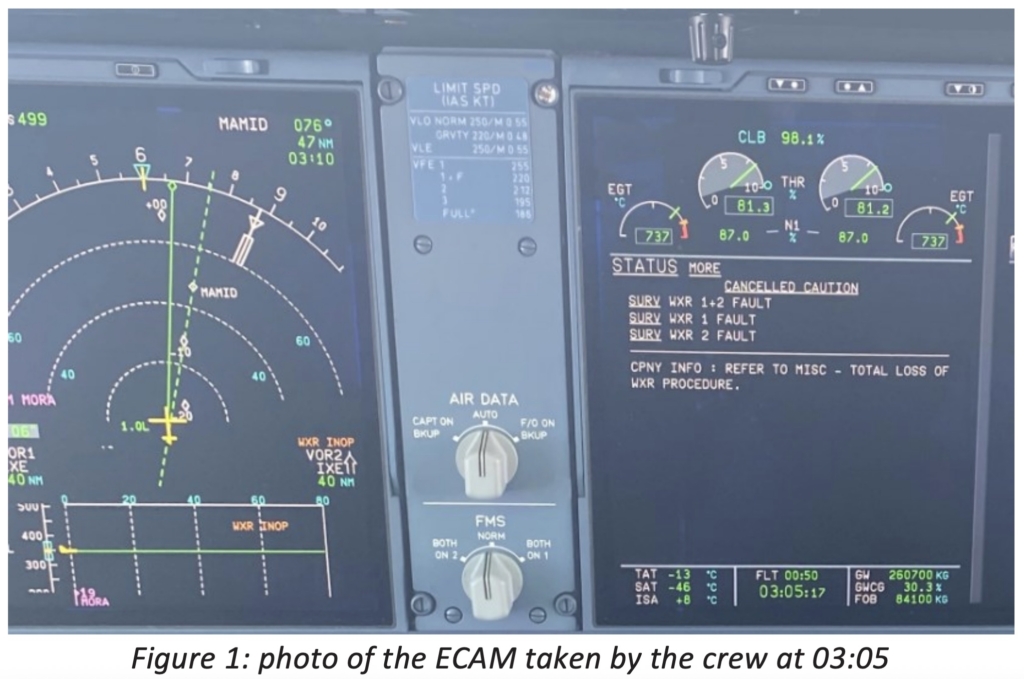
The A350 took off from Kansai International Airport with 309 passengers and 14 crew on board. Shortly after departure, the crew began receiving multiple “WXR Fault” alerts, indicating unreliable weather radar performance. Switching between radar units and altering modes made no difference.
Given the forecast weather ahead, the crew elected to turn back toward Osaka. The flight continued climbing as the crew worked the problem, unaware that the weakening radome structure was approaching a critical point.
As the aircraft descended back toward Kansai and passed FL300, the radome collapsed inward under aerodynamic load. This sudden structural failure disrupted airflow around the nose and compromised the accuracy of the aircraft’s air data probes and pressure sensors.
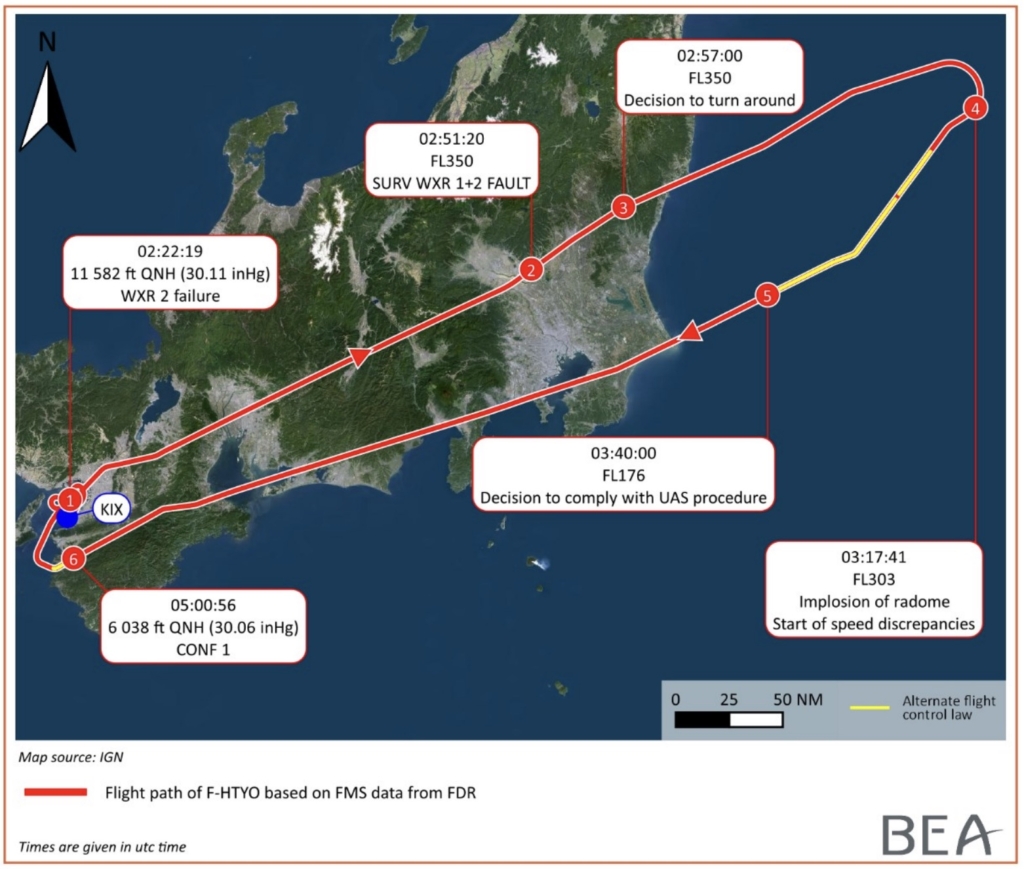
The result was divergent and fluctuating airspeed indications across the primary flight displays. These variations intensified during the approach as slats and flaps were extended.
The crew responded by disconnecting both autopilot and autothrust and flying manually. Despite the complexity of the situation, the aircraft stabilised, and the crew conducted an overweight landing without injuries.
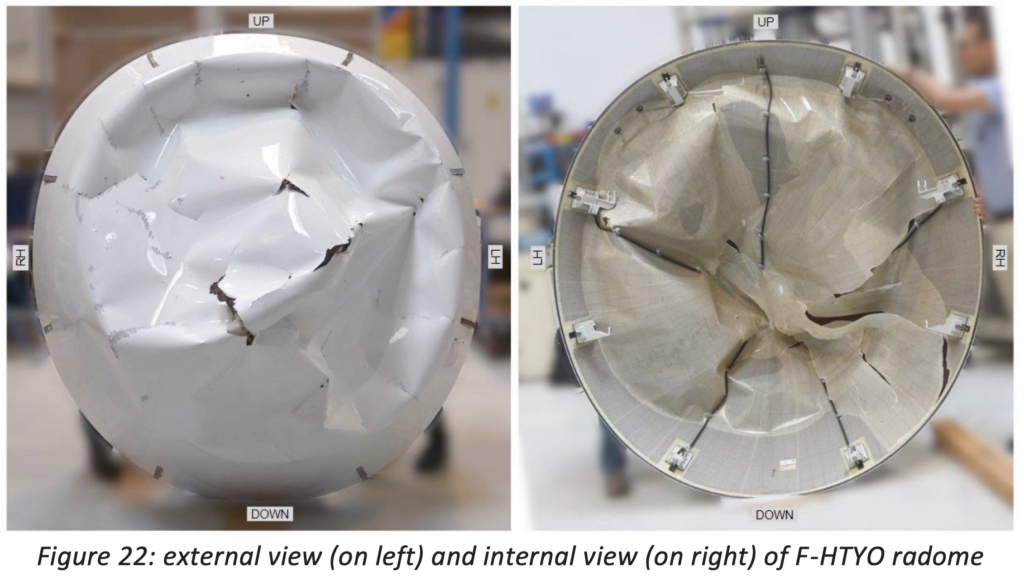
Damage was confined to the radome and associated weather radar equipment, both of which remained attached.
Internal radome damage went undetected
BEA’s materials analysis confirmed that the radome failure was the result of pre-existing delamination within its composite structure, caused by an earlier impact that went undetected. Although investigators could not determine exactly when the strike occurred, they found compelling forensic evidence that the radome had absorbed a significant blow well before the incident flight.
During laboratory examination, specialists identified avian biological residue on the surface of the radome, detectable only under ultraviolet light.
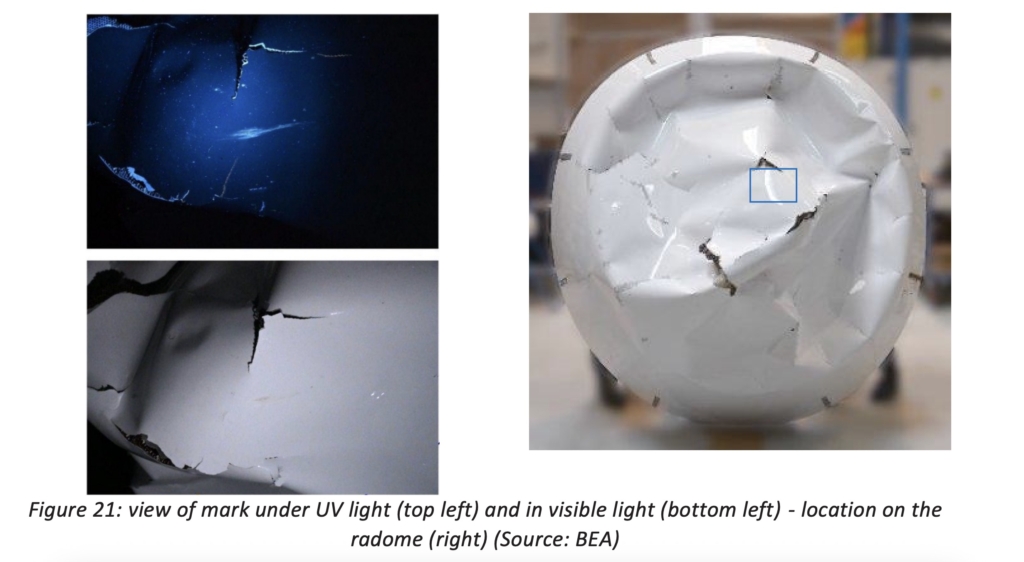
According to the report, the extent of the delamination had grown “much greater than the maximum size of acceptable damage”, and Airbus simulations showed it would have been “clearly visible” had the radome been opened and inspected in accordance with mandated procedures.
Because the inner surface was not examined after multiple bird strikes and repeated radar anomalies, the progressive structural weakening continued unnoticed until aerodynamic loads at FL300 caused the radome to collapse inward.
BEA concludes that the incident resulted from “the non-detection of damage on the inner surface of the radome”, adding that this stemmed from internal inspections that were “not adequately performed” or maintenance tasks “not adapted” to the aircraft’s history of impacts.
Airbus and Air France make changes to radome inspection procedures
The investigation has prompted both Airbus and Air France to revise their procedures.
Airbus updated the A350’s maintenance programme to strengthen radome inspection tasks and refine troubleshooting steps for weather radar anomalies. It has also revised operational documents, including the Flight Crew Operating Manual and Flight Crew Techniques Manual, to clarify when recurring radar faults should trigger structural checks.
Air France has introduced enhanced maintenance instructions requiring technicians to systematically open and inspect the inner face of the radome after any bird strike, lightning event or hail encounter. The carrier has also refreshed pilot training on the New Air and Inertia Automatic Data Switching system, which manages automatic transitions between air data sources when discrepancies appear.
BEA has issued its own safety recommendations urging “improved compliance with checks of the internal composite structure”, noting that strict adherence to these tasks is essential for identifying damage that may not be visible externally.
The agency stresses that the event, although unusual, illustrates how composite radomes can develop significant hidden degradation when mandatory internal examinations are overlooked. It concludes that rigorous, documented inspections remain the most effective safeguard against a repeat of this type of structural failure.