US Air Force hits 100 Boeing KC-46 Pegasus, reinforcing the world’s largest tanker fleet

December 4, 2025

Boeing Defense, Space & Security (BDS) delivered its 99th and 100th KC-46A Pegasus air-to-air refuelling (AAR) aircraft to the US Air Force (USAF) on December 2, marking a key production milestone for the air arm’s growing fleet of new-generation tankers.
This major delivery milestone comes less than seven years after the USAF welcomed its first two KC-46As to McConnell Air Force Base (AFB), Kansas, to join the 22nd Air Refuelling Wing (ARW) on January 25, 2019.
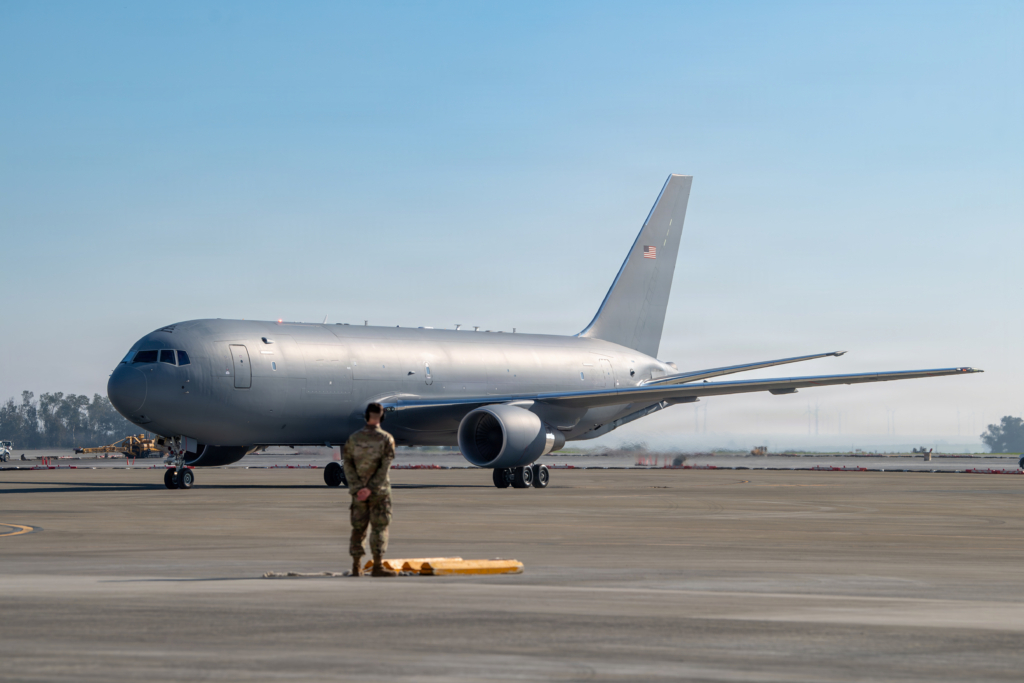
The USAF’s 99th and 100th KC-46As — serials 22-46105 (callsign WYVRN99) and 22-46106 (callsign GLDN100) — departed Boeing’s production site at King County International Airport (Boeing Field) in Seattle to begin their milestone delivery flights at 11:19 and 10:44 local time. The two aircraft then flew south together to Travis AFB, California, touching down just minutes apart at 12:47 and 12:51.
For the occasion, the USAF put senior leadership at the controls. The 99th Pegasus (WYVRN99) was flown by Lt Gen John P Healy, chief of the Air Force Reserve and commander of Air Force Reserve Command (AFRC). The 100th aircraft (GLDN100) was flown by Gen Johnny Lamontagne, head of Air Mobility Command (AMC).

“Today marks not just the arrival of the 100th KC-46 delivered, but the continued strengthening of our nation’s global reach and readiness,” said Lamontagne. “The Pegasus represents a key chapter in air mobility; one built on innovation and unwavering commitment to the mission. To the airmen who will fly, fix and support this aircraft, you carry forward a proud legacy of excellence.”
Both KC-46As will join the pooled tanker fleet at Travis AFB, where they will be operated and maintained jointly by AMC’s 60th Air Mobility Wing and AFRC’s 349th Air Mobility Wing.
The US Air Force already has by far the biggest tanker fleet in the world
The USAF is the largest and most capable operator of tanker aircraft in the world. At the time of its publication, Flight International’s World Air Forces Directory 2026 reported the US operates roughly 75% of the global tanker fleet, with a total of 610 AAR-capable aircraft in operational service.
To highlight the staggering size of the US tanker fleet, the second largest tanker operator on this list was Saudi Arabia with 22 aircraft, amounting to around 3% of the global AAR aircraft fleet.
| Rank | Country | Total tankers | Tanker types operated |
|---|---|---|---|
| 1 | United States | 610 | KC-135R/T, KC-46A, MC-130J |
| 2 | Saudi Arabia | 22 | A330 MRTT, KE-3A, KC-130H |
| 3 | Russia | 18 | Il-78 / Il-78M |
| 4 | France | 15 | A330 MRTT (Phénix) |
| 5 | Israel | 13 | KC-707, KC-130H, KC-46A (incoming) |
| 6 | Singapore | 11 | A330 MRTT |
| 7 | Japan | 10 | KC-767J, KC-130H, KC-46A |
| 8 | China | 9 | Il-78, Y-20U |
| 9 | United Kingdom | 9 | A330 MRTT (Voyager) |
| 10 | Italy | 8 | KC-767A, KC-130J |
At present, the Pegasus is supplementing the USAF’s veteran KC-135R/T Stratotanker fleet, which has long formed the backbone of the service’s AAR operations at home and abroad. Meanwhile, MC-130J Commando II tanker-transports provide an AAR capability in support of special forces operations.
In addition to these, more than 70 KC-130J Hercules tanker-transports are employed by the US Marine Corps (USMC), while the US Navy (USN) fields over ten KC-130Ts. Private contractors – such as Metrea and Omega Air Refuelling Services – can also be called upon to support US military operations.
Boeing to build even more KC-46 Pegasus for the USAF
The 100th aircraft delivery comes just a week after Boeing secured a $2.47bn contract from the USAF on 25 November to manufacture and deliver an additional 15 KC-46As under full-rate production (FRP) Lot 12. Deliveries under this latest contract – which also includes relevant software licensing, subscriptions and through-life support services – are scheduled to run until 30 June 2029.
As per the original program of record, the USAF will acquire an additional 88 KC-46As. Following the latest production contract award, the service now has 80 more Pegasus tankers on order, with the remaining eight airframes set to be acquired under the FRP Lot 13 deal, which has yet to be inked.

On top of that, the USAF plans to acquire a further 75 KC-46As as part of its ‘Tanker Production Extension’ programme, which will grow the overall Pegasus fleet to a staggering 263 aircraft. With production and deliveries now extending well into the 2030s, this acquisition plan is largely fed by the KC-46A’s planned 40-year career, which will likely see the tanker continue in operational USAF service until the 2070s at the earliest.

The USAF’s growing Pegasus fleet is now fielded across seven different locations:
- Edwards AFB, California (for testing)
- Altus AFB, Oklahoma (for training)
- McConnell AFB, Kansa
- Pease Air National Guard Base (ANGB), New Hampshire
- Seymour-Johnson AFB, North Carolina
- Joint Base McGuire-Dix-Lakehurst, New Jersey
- Travis AFB, California.
Another two operational bases – MacDill AFB, Florida, and Selfridge ANGB, Michigan – are expected to welcome the KC-46A in 2029, while McGhee Tyson ANGB, Tennessee, will receive its first Pegasus in 2031.
The KC-46 Pegasus is making its way back to brilliance
This renewed investment in the KC-46A comes after the platform suffered multiple setbacks during its initial years of operational use, caused by a host of ‘Category 1’ deficiencies. The most significant of these was related to the tanker’s unique Remote Vision System (RVS) – a critical tool for boom operators aboard the KC-46A when connecting to receiving aircraft – which has resulted in a redesign.
Along with dynamic lighting issues, which can make refuelling operations difficult to see for the boom operator in both day and night conditions, the RVS has suffered problems with depth perception, adding more risk to receiving aircraft being struck during refuelling.
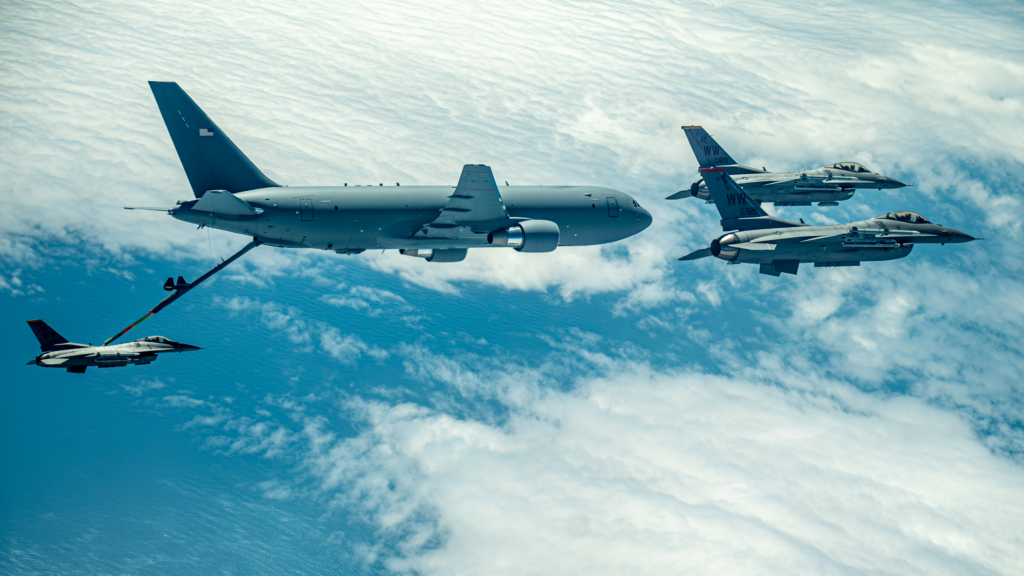
In May 2025, it was reported by Defense News that the troubled system would not be replaced by its upgraded successor, the RVS 2.0, until mid-2027.
The enhanced RVS 2.0 system will upgrade the aircraft’s four existing cameras (two long-wave infrared and two visible spectrum), while adding two more visible spectrum cameras, new sensors and screens to provide a better 3D full-colour image for boom operators.
Although RVS 2.0 was initially scheduled to be released in March 2024, the system has only just been flown on a KC-46A from Boeing Field.
The future of the USAF’s huge aerial refuelling fleet
The US is actively investing in the future of its AAR capabilities. While it is deeply invested in growing its new-generation Pegasus fleet, the nation is also addressing the shortfall in the USN’s own organic, carrier-based AAR capabilities through the acquisition of 72 MQ-25 Stingray unmanned tankers from Boeing.
The type is expected to enter operational service in 2026.

Looking further ahead, the USAF is also laying the groundwork for its future tanker aircraft under the Next Generation Air-Refueling System (NGAS), which will be used to fully replace the USAF’s ageing KC-135R/Ts. Some innovative options are on the table, including JetZero’s blended wing body concept.