


Highway takeoffs: Why the Saab Gripen’s party trick isn’t actually unique

7 min read
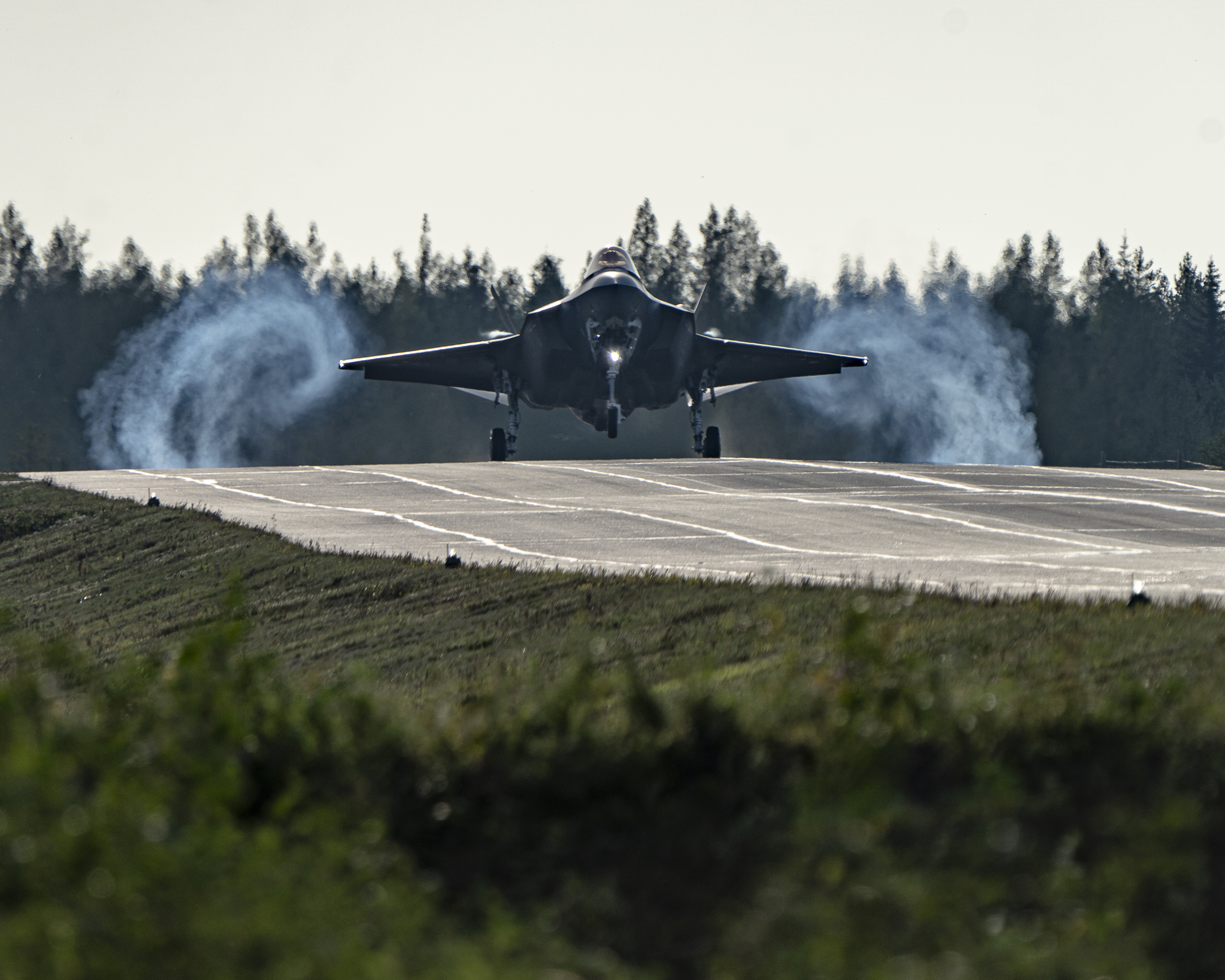
The Saab JAS 39 Gripen is marketed as a rugged jet able to take off from highway strips. While that is true, it’s something almost all Western fighter jets are able to perform. This article will focus on the ability of jets (particularly the Gripen and F-35) to take off from roadways and not on aircraft costs or combat capabilities.
Sweden’s requirements largely shared with Finland
The Saab Gripen is designed for Sweden’s distinctive requirements shaped by its formerly neutral status and its geography. The Swedish military is designed specifically to counter a Russian attack.
In this role, the Gripen is optimised for defence, including defending Sweden’s islands in the Baltic Sea. It is designed to have minimal logistics and to operate from dispersed airfields.
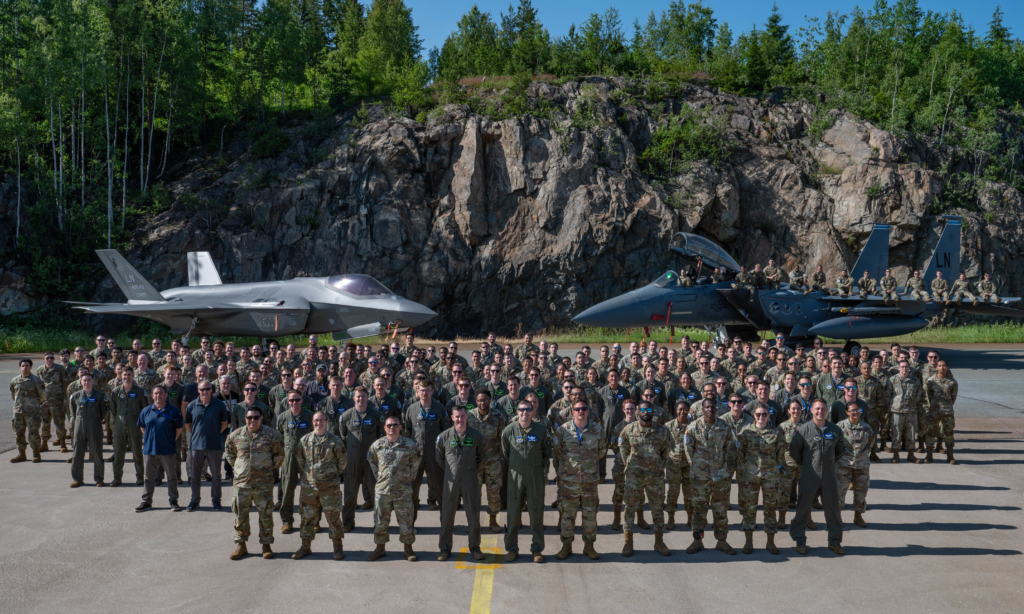
Those airfields include designated stretches of highway, often in remote sections of the forest. The aircraft also needs to operate in Arctic conditions. But this is hardly unique to Sweden, with Finland being in a similar geographic and strategic position. If anything, the Russian threat is more acute for Finland.
Someone asked me to do a comparison of capabilities between F-35A and JAS-39E Gripen. A ton of material is classified but I will do my best here.
— Heatloss (@heatloss1986) November 25, 2025
In short, Gripen is not even in the same class as F-35A. It isn't awful, but it is not a competitor with F-35. pic.twitter.com/UleeTRVA3b
The US Air Force is also currently enacting its own Agile Combat Employment (ACE) doctrine to deploy its aircraft, including its F-35As, in the event of a peer-on-peer war.
As a side point, all Western fighter jets are designed to operate in Arctic conditions. The US operates F-22 Raptors in Alaska, the USAF, Norway, and later Finland and Canada will all operate F-35s north of the Arctic Circle.
Finland has operated its Hornets (with Arctic survival kits) in Arctic conditions for decades, as did Norway with its F-16s.
The F-35A: Finland’s choice for highway take-offs
In 2021, Finland announced the F-35A was the winner of its HX competition. Finland considered the F-35, F/A-18 Super Hornet, Eurofighter, Rafale, and Saab Gripen E.
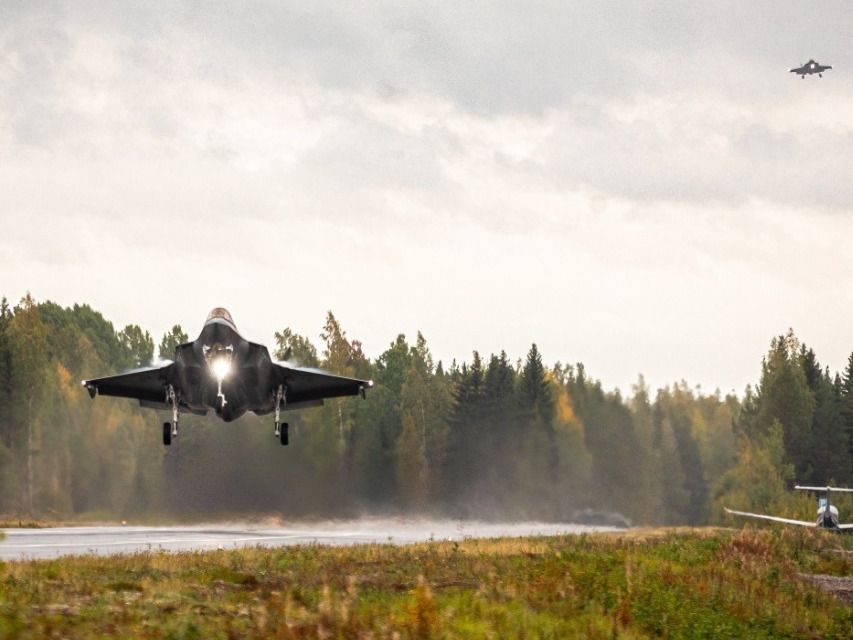
According to reporting by The War Zone at the time, the F-35 was considered the best option, even for Finland’s challenging operating environment and dispersed operations from highway strips.
It should also be noted that while Norway’s geostrategic position is different from that of Sweden and Finland, it still has some overlap. Norway also selected the F-35A.
From rigorous testing to real-world missions, the F-35 maintains unmatched capability and readiness — setting the standard for modern air dominance. ⚡ pic.twitter.com/vVSEugSZOU
— F-35 Lightning II (@thef35) November 12, 2025
In 2022, Royal Norwegian Air Force F-35s landed on a Finnish motorway for the first time for the F-35A during exercise Baana 22. The US had previously operated on highways with its F-35B STOVL variant, but not the conventional F-35A.
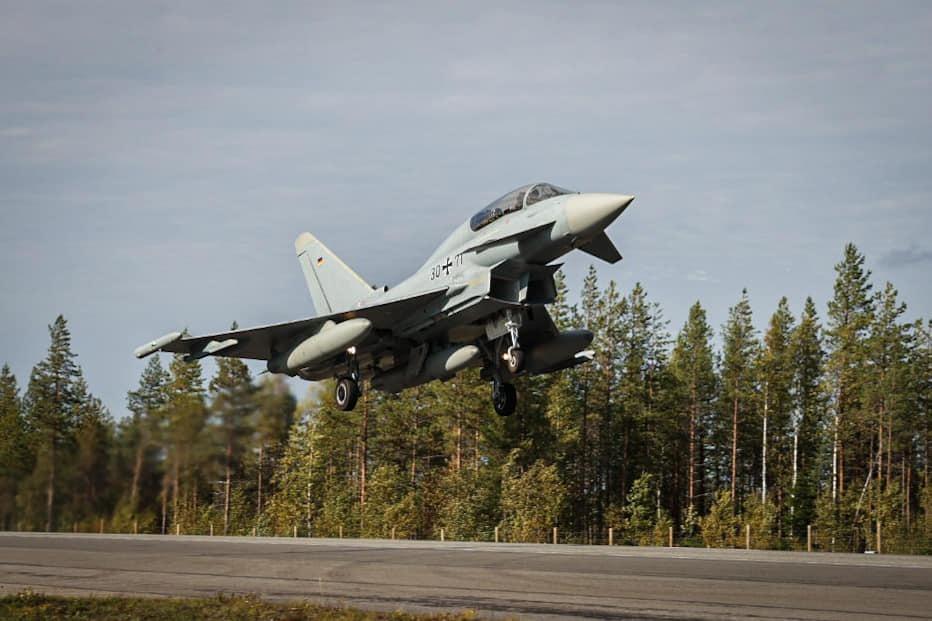
In 2024, US Air Force F-35As based in RAF Lakenheath in England landed on Hosio Highway in Finland. The highway was around 100 feet wide and was a first for the USAF. RAF Eurofighter Typhoons have also trained on Finnish highways.
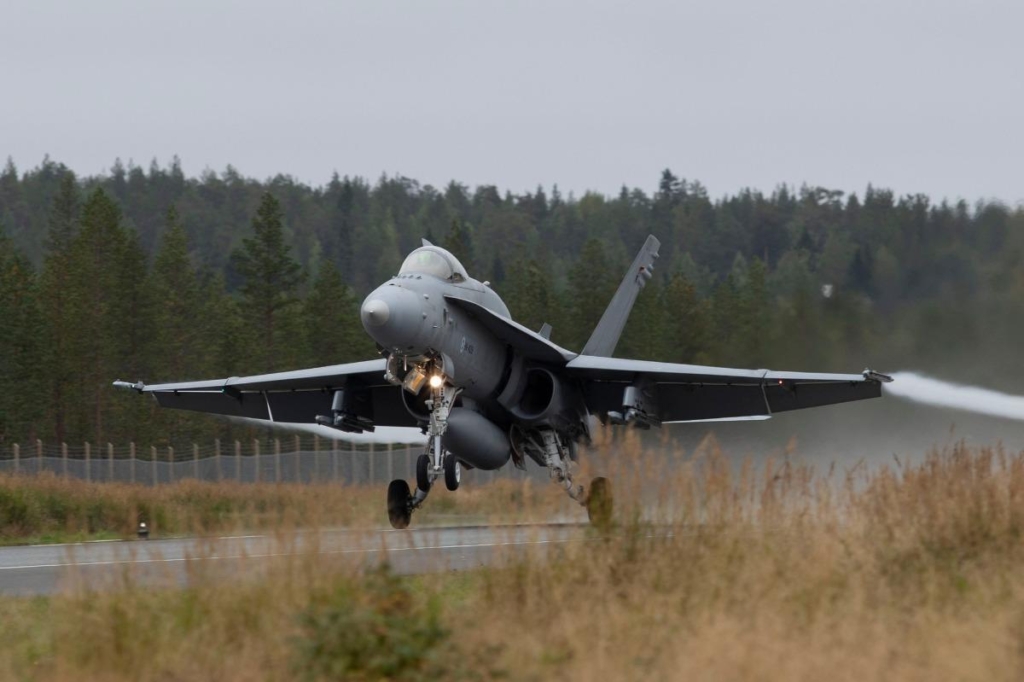
“Proving that we can execute a short field landing in these fifth-generation fighters is paramount in building confidence and showcasing our capability to reach austere landing sites when performing ACE operations,” said Capt. Jordan Kendall, 493rd FS F-35 pilot, stated at the time.
Get the latest aerospace defence news here on AGN.
The Gripen’s ability to land on roadways
OINST analyst, Thomas C. Theiner, stated, “Gripen fans confuse… operational variants, short runways, road runways, dispersed operations, conscripts, etc. and believe it is unique to the Gripen.”

He points out that the Gripen can take off from roads and short runways, but adds “these operations are limited to daytime and good weather, and that on a short runway the Gripen is limited to air-to-air loads only.”
The Gripen was designed in the 1980s for dispersed operations on Sweden’s Bas 90 bases. But every other Western fighter is also designed with that idea in mind, including the F-15, F-16, F/A-18, F-22, F-35, Eurofighter, and Rafale.
Saab says the Gripen C/D only needs around 400 metres minimum takeoff distance, assuming it is armed with lightweight air-to-air missiles and no external fuel tanks. In the Gripen E fact sheet, the minimum takeoff distance is given as 500 metres. This is with a load out of six air-to-air missiles and 50% internal fuel.
"A mixed fighter jet fleet may be a Canadian strategic necessity.."https://t.co/c6qPBSBjen
— Latin American Military Aviation (@LatinMilAv) November 28, 2025
While the Eurofighter’s minimum take-off distance when carrying a heavy load is around 700 metres, it shortens to as little as 300 metres in the relatively clean configuration considered here.
The F-35A and F-35C are often said to have the longest take-off rolls at 1,000 metres or even 2,400 metres (at MTOW), but this is misleading. In a light air-to-air configuration, the F-35A routine takes off in around 600 metres. In ferry or very light configurations, it can take off in a 450-600 metre range. In reality, the F-35’s clean take-off roll is in the same bracket as the Gripen E, Eurofighter, and Rafale.
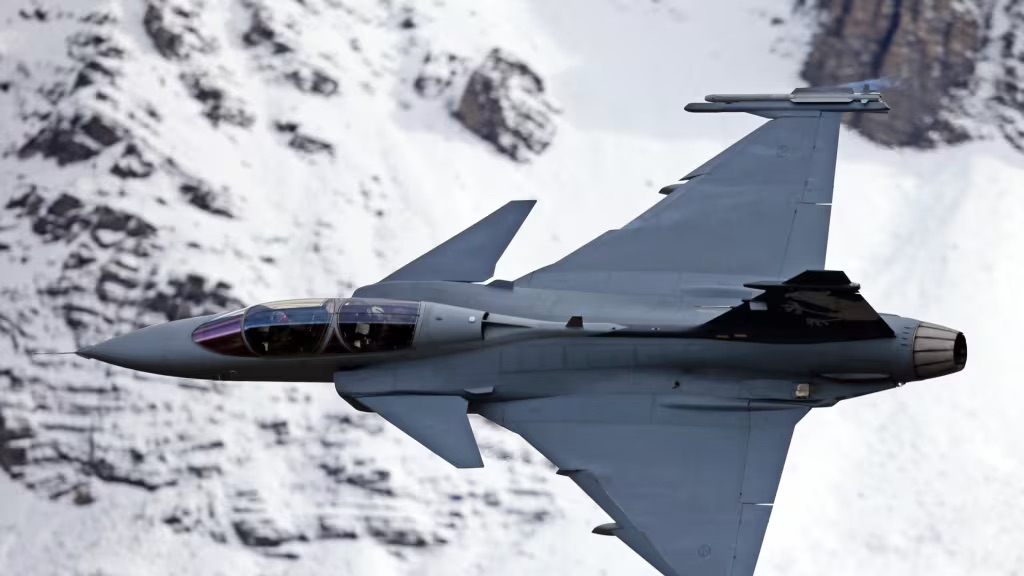
The F-35B wipes the floor with its 120-150 metres in a vertical take off, although this is with a non-useful 10% fuel load. The F-35B is rising to 500 metres with a short takeoff, with a more useful load.
Fighter jets have personalities amplified by marketing
Just because other Western jets are not advertised as designed for austere conditions, that doesn’t mean they can’t do it. The F-35 is marketed as a high-end stealth fighter designed for air penetration missions. The ability to operate in austere conditions is secondary.

The Rafale is marketed by Dassault as the “Swiss Army Knife” of fighter jets, with the company claiming it is the world’s only “omnirole” fighter. Whereas the US military has the luxury of procuring multiple specialised aircraft optimised for certain roles, e.g., the F-22 for air dominance and F-35 for penetration air strikes, EA-18G for electronic warfare, F/A-18 for carrier operations, France can’t.
As France phases out its Mirage 2000s, the Rafale will take its place as the only fighter jet in French service. This means the aircraft must be the Jack of all Trades.

It should also be noted that the Gripen is a comparatively small multirole fighter jet. This is even true for the Gripen E, which is around 25% heavier than the Gripen C. Even the legacy Hornet is considerably heavier. The F-35 and F-15EX are in a different class and are around twice the empty weight.
Other Western jets designed for aircraft carriers
The F/A-18 Hornet and its successor F/A-18 Super Hornet, along with the Lockheed Martin F-35B and F-35C variants, and the French Rafale, are designed to operate on aircraft carriers. Finland already operates F/A-18 Hornets, although these are adapted for land-based use.

The F-35B in particular is the world’s only in-production STOVL (short takeoff / vertical landing). It is able to land more or less vertically on roads. Famously, a wayward RAF Harrier Jump Jet (the F-35B predecessor) even landed on a surprised cargo ship on its way to the Canary Islands.
The Gripen is sometimes said to have robust landing gear for its dispersed options. Robust landing gear is one of the key adaptations of carrier-based aircraft, where landings are more like a controlled crash than a gentle touchdown.
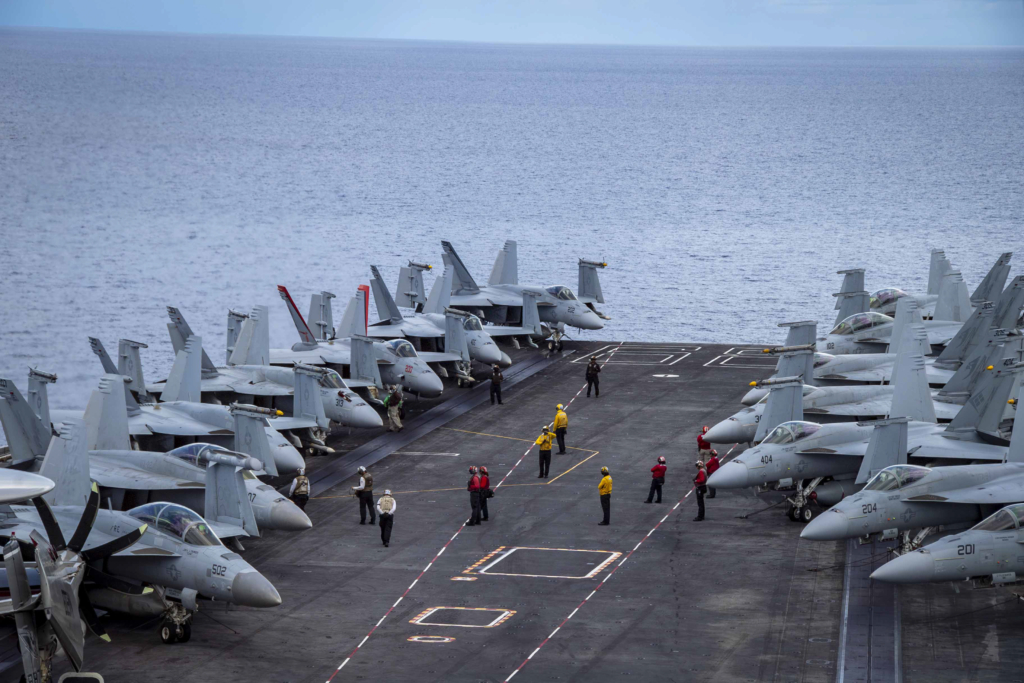
None of this is to say the Gripen doesn’t have design features to better allow it to take off from unprepared runways; it does. For example, its air intakes are situated higher compared with other aircraft, minimising the chance of debris being sucked into the engine.
Featured Image: United States Air Force
Sign up for our newsletter and get our latest content in your inbox.


More from


September 13, 20264 min read

September 12, 20264 min read


