


Revealed: The world’s most valuable airline loyalty programmes, with Delta SkyMiles topping the list at $31.7 billion

5 min read
A new global ranking from loyalty consultancy On Point Loyalty places Delta’s SkyMiles as the world’s most valuable frequent flyer scheme, as the industry’s loyalty programmes continue their transformation from marketing tools into standalone financial assets.
Airline loyalty programmes have become some of the most valuable assets in global aviation, and a new report puts precise numbers on just how valuable.
On Point Loyalty, which last published its ranking in 2023, has released its 2026 edition after evaluating more than 170 airlines worldwide, ranking the 100 most valuable frequent flyer schemes by estimated financial worth.
The findings underscore a structural shift in how airlines generate revenue, with loyalty programmes increasingly outperforming ticket sales as profit engines.
US airlines dominate the rankings
The study places Delta’s SkyMiles comfortably in first place, with a valuation of $31.7 billion.
That puts it well ahead of American Airlines’ AAdvantage, valued at $26.7 billion, and United Airlines’ MileagePlus, estimated at $25.3 billion.
All three hold the same positions as the last edition, reflecting the entrenched dominance of US carriers in loyalty economics, driven largely by the popularity of co-branded credit cards in the American market.
Beyond the “big three,” the next tier of programs includes a mix of major airline groups and individual carriers in Europe, North America and Asia-Pacific:
Top 10 most valuable airline loyalty programs (2026 vs 2023)
| Rank | Loyalty Program | Airline | 2026 Value | 2023 Value |
|---|---|---|---|---|
| 1 | SkyMiles | Delta Air Lines | $31.7B | $27.9B |
| 2 | AAdvantage | American Airlines | $26.7B | $23.9B |
| 3 | MileagePlus | United Airlines | $25.3B | $22.0B |
| 4 | IAG Avios | Aer Lingus, British Airways, Iberia, Vueling | $10.3B | $7.1B |
| 5 | Rapid Rewards | Southwest Airlines | $8.9B | $8.8B |
| 6 | Miles & More | Lufthansa Group airlines | $8.7B | $8.0B |
| 7 | Flying Blue | Air France, KLM, Transavia | $7.5B | $6.9B |
| 8 | Aeroplan | Air Canada | $7.4B | $6.8B |
| 9 | Qantas Frequent Flyer | Jetstar, Qantas | $7.0B | $4.3B |
| 10 | PhoenixMiles | Air China group carriers | $5.9B | $3.1B |
Airline loyalty programmes continue to increase in value
Across the 100 programmes analysed, the average valuation reached $2.4 billion in 2026, up from $2.0 billion in 2023 — a 20% rise that reflects the growing financial weight of loyalty as a standalone business.
While the headline numbers belong to the US big three, the most striking growth in the top ten came elsewhere. IAG Avios surged 45% to $10.3 billion, Qantas Frequent Flyer jumped 63% to $7.0 billion, and PhoenixMiles, Air China’s loyalty programme, nearly doubled in value, rising 90% to $5.9 billion. By contrast, Southwest’s Rapid Rewards grew by just 1%, the most modest gain in the top ten.
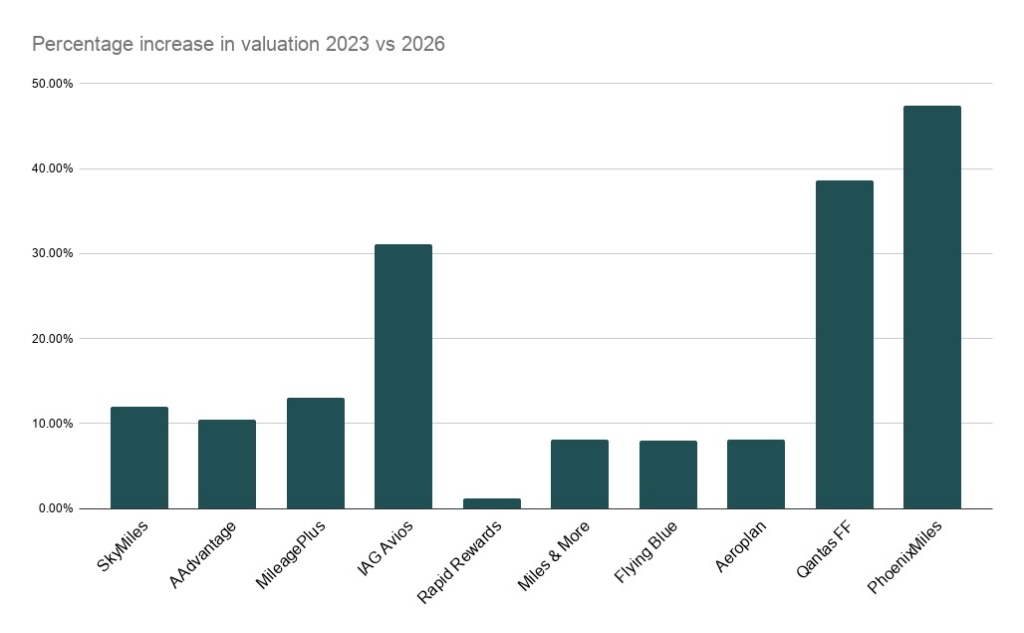
Of the 100 programmes assessed, 62 increased in value, 21 declined, and 17 were new entrants to the ranking. The strongest newcomer was IndiGo’s BluChip programme, valued at $534 million.
On Point Loyalty attributes valuation shifts to a combination of factors, including GDP per capita growth in home markets, airline financial health, and network expansion or contraction. Mergers and acquisitions can also drive value upwards where programmes are combined.
How On Point Loyalty values airline frequent flyer programmes
The 2026 report applied a proprietary financial model drawing on more than 50 variables per programme, covering airline performance, loyalty programme structure and macroeconomic conditions.
Factors assessed include passenger volumes, credit card penetration, reward attractiveness and home-market economic indicators. The final valuations are based on the assumed minority sale of between 10% and 49% equity to investors or through a public listing.
How frequent flyer programmes began, and why they exploded in value
While airlines had experimented with small marketing incentives before, American Airlines’ AAdvantage programme, launched in 1981, was the first large-scale frequent flyer scheme to reward passengers with redeemable miles based on distance flown. Within months, competitors followed:
- MileagePlus — launched in 1981 by United Airlines
- SkyMiles — launched in 1981 by Delta Air Lines
By the mid-1980s, most major carriers had introduced their own schemes. But the real turning point came six years later, when American Airlines partnered with Citibank in 1987 to launch the first co-branded AAdvantage credit card — expanding mileage earning far beyond actual flying.
The other major US carriers followed suit. United partnered with First Chicago Corporation in the late 1980s before signing an exclusive agreement with JPMorgan Chase in 2010, which remains in place. Delta developed SkyMiles-linked cards, initially with Signet Bank, before signing a landmark partnership with American Express in 1996 that endures to this day.
The effect was transformative. Banks buy miles from airlines to distribute to cardholders — giving airlines upfront cash and banks a powerful reward currency to drive card spending.
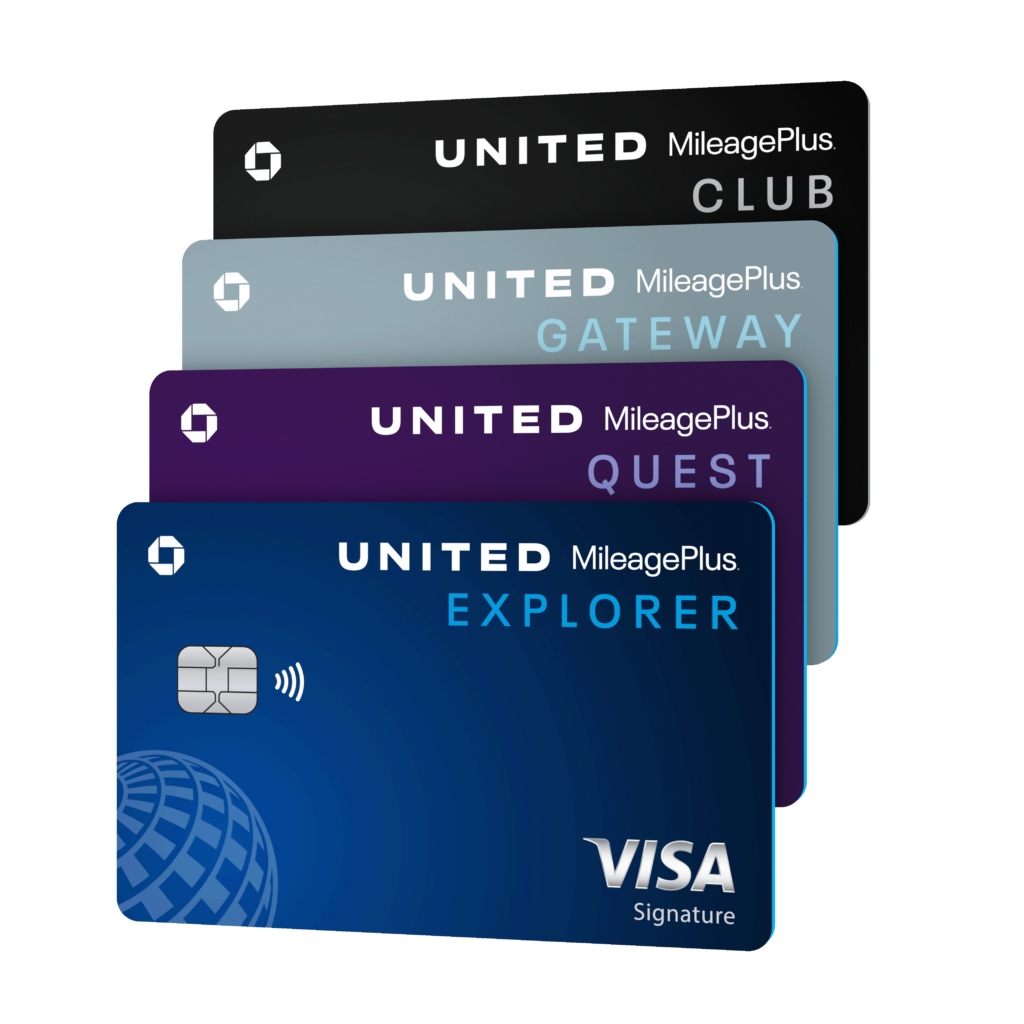
“Airlines invented loyalty programmes, but banks have amplified them into multi-billion-dollar businesses,” said Jay Sorensen, President of IdeaWorksCompany, in a recent report examining the contest between banks and airlines for customer ownership.
“Today, banks and airlines are colliding over who owns the customer relationship. For consumers, the question is simple: are you loyal to the airline, or the bank?”
Sorensen added that competition between the two is ultimately benefiting passengers.
“Travellers are being wooed on all fronts. The competition is creating better rewards, more lounges, and new travel booking options — but it’s also reshaping the balance of power in the travel industry.”
Airline loyalty programmes are now major financial assets
Forty-five years after their creation, loyalty programmes have become indispensable assets for airlines. Once designed primarily as customer retention tools, they now generate large revenues through partnerships with banks, retailers and other travel companies.
Loyalty programs are attractive to airlines because they provide recurring revenue and strong margins. They diversify airlines’ income beyond passenger and cargo transport.
As proof of their value, the authors of the On Point Loyalty report note that during the COVID-19 crisis, airlines used their loyalty programs as collateral to raise billions of dollars in much-needed financing.
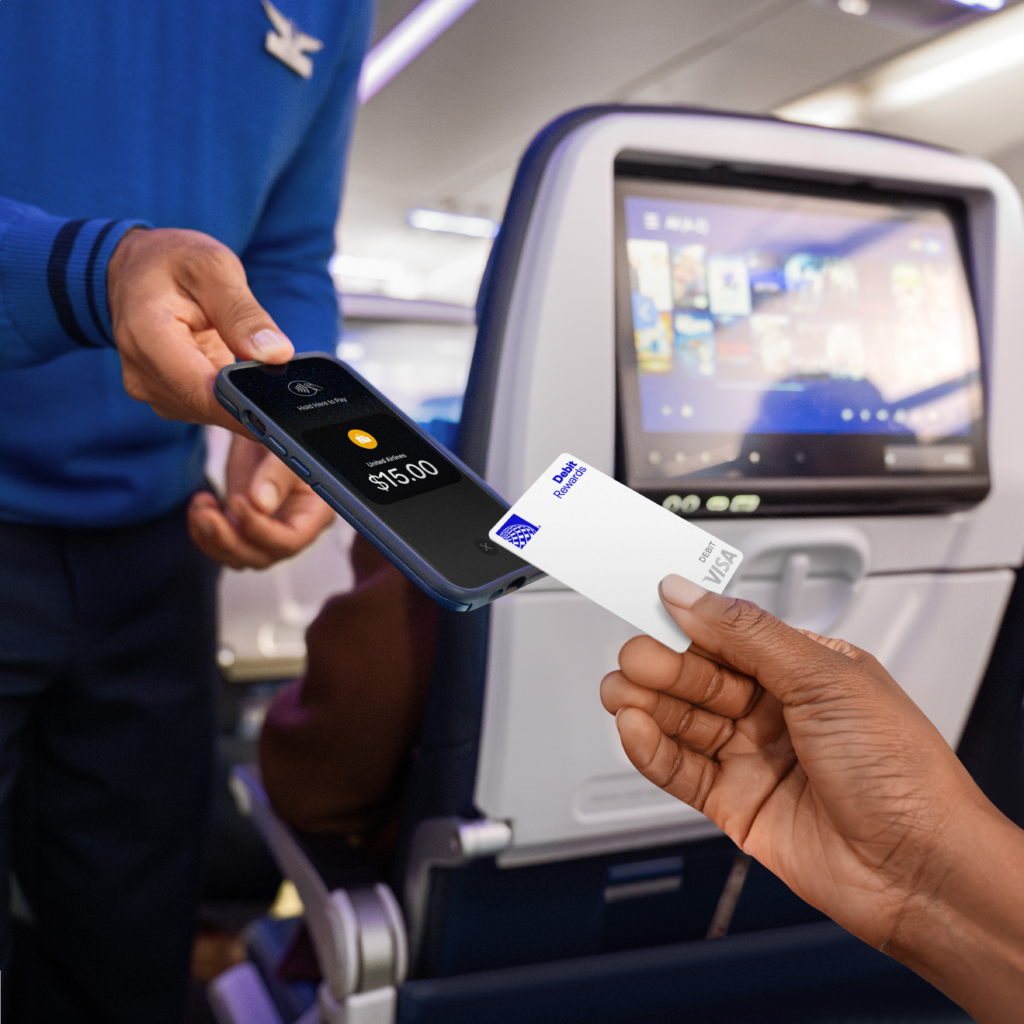
With flying expected to generate only 3.9% margins in 2026, according to the International Air Transport Association (IATA), and profit per passenger transported at $7.90, airlines rely on their strong loyalty programmes as a buffer against the industry’s vulnerability to economic downturns and unforeseen global crises.
“Today, loyalty programmes are increasingly recognised as strategic businesses in their own right,” the On Point Loyalty authors conclude — noting that realising their full value requires dedicated management structures, transparent segmental reporting, and careful consideration of ownership structure.
Featured Image: Delta Air Lines
Sign up for our newsletter and get our latest content in your inbox.


More from

September 21, 20263 min read


September 18, 20263 min read
