Vueling set to resume flights between Madrid and Barcelona after two fatal Spanish rail accidents

February 5, 2026

Spanish low-cost carrier Vueling has announced that it will reintroduce shuttle flights between Barcelona and Madrid airports, just eleven months after shelving the inter-city operation.
With high-speed rail links having dominated the travel corridor between the two cities for many years, two recent rail accidents and looming industrial action on the railways have prompted the IAG-owned carrier to reconsider its approach to serving one of the busiest domestic travel routes in Europe.
Vueling reinstates flights between Madrid and Barcelona
On 4 February, Vueling said that it would reintroduce regular flights between Madrid-Barajas Airport (MAD) and Barcelona-El Prat Airport (BCN) from 9 February until at least 22 February. The route is 301 miles (482 km) in distance and takes around 50 minutes to complete.
The decision comes following two high-profile rail accidents in recent weeks in Spain, meaning that confidence in the Spanish railway system has been shaken. Additionally, industrial action is being taken by railway workers during February, which is likely to further impact the reliability of services on Spain’s primary high-speed rail line.
Vueling has said there will be two daily round-trip flights between the two cities on Mondays to Fridays, with a price cap of €99 for the basic fare. This fare mirrors Iberia’s ‘Puente Aéreo’ pricing structure and is pegged at that level so that Vueling avoids accusations of price-gouging while essential rail links are being affected.

Additionally, the move follows a request from Spain’s Ombudsman for the Transport Ministry for the competition watchdog CNMC to monitor potential fare spikes across all modes, including airlines, while the rail disruption continues.
Departures from Barcelona Airport will be at 07:30 and 19:25, while from Madrid they will be at 09:25 and 21:20. The flights are primarily aimed at business passengers with timings allowing a full day of working in either city.
In addition, there will be two extra daily flights on weekends. One will be on Saturdays, departing at 07:30 from Barcelona and returning at 09:30 from Madrid. The other will be on Sundays, departing at 19: 25 from Barcelona and at 21:30 from Madrid.
Rail disruption leads to increased demand for air travel
Rail disruption following the train accidents in the Adamuz and Gelida regions of Spain has been driving up air travel between Barcelona and Madrid in the weeks since.
At least 41 people were killed and dozens more injured following a two-train collision near the small town of Adamuz, about 223 miles (360 km) south of Madrid, on 18 January.
This was followed by another accident on 20 January when a commuter train collided with a retaining wall after it was struck by a landslide, causing the train to derail near Gelida in Catalonia. A trainee driver who travelled in the driver’s cab was killed, while at least 37 passengers were injured.

With extensive damage to tracks and signalling caused by the two accidents, Spain’s high-speed trains are currently experiencing numerous delays, some reaching six hours in length, according to ARA.
Instead, passengers are once again opting to fly between the two cities, leading Vueling to temporarily reinstate the air shuttle.
“We have worked to offer an additional alternative to help meet an existing need during February,” said Vueling’s Director of Network and Strategy, Jordi Pla.
Looming industrial action adds to inter-city travel woes
In addition to the already substantial travel disruption between Madrid and Barcelona, Spain’s rail unions confirmed on 4 February that a 72-hour nationwide strike will proceed from 9 February after a late-night meeting with the Ministry of Transport ended without agreement.
The walkout will affect state rail company Renfe’s entire network, including the AVE high-speed lines linking Madrid with several business hubs, including Seville, Valencia and Barcelona.
Unions are citing further safety concerns following the two fatal accidents in Adamuz and Gelida and are accusing the Spanish rail infrastructure manager ADIF of under-investing in signalling.
Management at ADIF insists that proposed safety reviews are adequate and that new automatic-braking systems will be rolled out from 2027. However, workers want immediate staffing increases and training to alleviate what it perceives to be ongoing safety risks on the country’s rail system.
Vueling reappears on the Madrid to Barcelona route
Vueling terminated its three-times-daily service between Madrid and Barcelona on 30 March 2025, citing rail travel’s rising market share on the route understood to have influenced its decision.
The airline had operated flights between Madrid and Barcelona airports for more than 20 years by that point, but said at the time the announcement was made that it would be focusing on routes with greater growth potential.

Four train operators currently connect the two cities: Renfe, Iryo and low-cost options Ouigo and Avlo, which, between them, provide more than 40 daily services. The high-speed train line between Madrid and Barcelona opened in 2008, cutting journey times from seven hours to as little as two hours and 30 minutes.
In addition to the extensive rail operations, with Vueling exiting the route last year, air links between Madrid and Barcelona were left in the hands of Iberia and Air Europa. In the case of national carrier Iberia, the route is its most important domestic service, offering 14 daily flights, while Air Europa ranks further behind with just two daily return flights.

Though Vueling normally avoids competing head-to-head with sister airline Iberia on the route, it is understood that temporary slot allocations for Vueling have been authorised by Spanish slot coordinator AENA to preserve connectivity for business travellers between the two cities, as well as for connecting passengers making international connections at Madrid Airport.
Madrid to Barcelona air route is seeing a resurgence of demand
Before the Adamuz and Gelida accidents, air travel had lost all prominence on the Barcelona to Madrid route. Rail travel was gaining market share year after year, reaching 81.5% in 2024.
Door-to-door travel times are slightly higher with air versus rail, but with the current disruptions and looming strikes on the railways, flights have become far more competitive both in terms of journey duration and reliability, hence Vueling’s 180-degree turnaround on its decision to remove the route from its network.
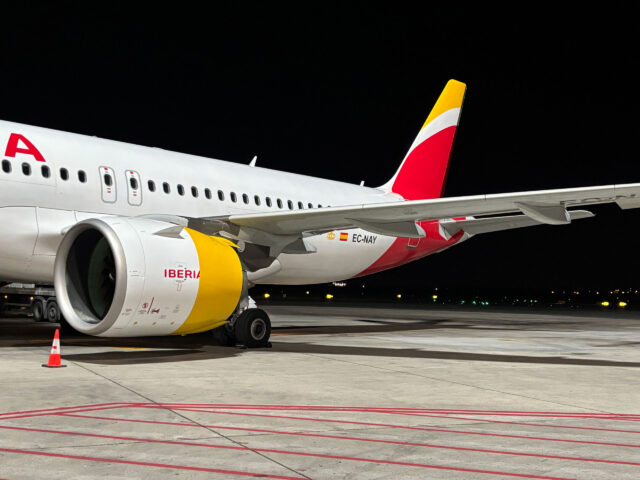
Featured image: Kevin / stock.adobe.com