$1.5T US defence budget reveals shift to drones, NGAD and future air combat

April 13, 2026
President Donald Trump’s proposed $1.5 trillion defence budget does more than set a new spending record. It reveals a decisive shift in how the United States plans to fight in the air, with drones, combat mass and next-generation systems moving to the centre of US Air Force strategy.
Behind the headline number lies a clear rebalancing of priorities, combining continued investment in high-end fighters with the first meaningful push to field autonomous “wingman” drones at scale.
Together, they point to a force being redesigned for high-end conflict, where survivability, scale and speed of decision-making matter as much as stealth and technology.
Trump’s $1.5T defence budget signals major US military shift
The administration is seeking $1.5 trillion in total defence spending for FY2027, representing an increase of more than 40 % on the previous fiscal cycle.
| Category | Approx share | Estimated value ($bn) | What it covers |
|---|---|---|---|
| Operations & Maintenance (O&M) | 30–35% | ~450 | Training, fuel, maintenance, readiness |
| Procurement (P-1) | 25–30% | ~413 | Aircraft, ships, missiles, vehicles |
| RDT&E (R-1) | 12–15% | ~200 | NGAD, CCA, hypersonics, future systems |
| Military personnel | 12–15% | ~200 | Pay, benefits, healthcare |
| Defence-wide & industrial funding | 5–10% | ~100 | Industrial base, strategic programmes |
| Military construction & other | ~2% | ~20 | Bases, infrastructure, facilities |
That rise comes alongside a reduction in non-defence spending of around 10 %, underscoring a broader policy shift towards military modernisation.
For the Department of the Air Force, which includes both the Air Force and Space Force, the allocation stands at just over $101 billion in initial topline figures. While smaller than the Navy’s share, it concentrates heavily on programmes that could define the next two decades of air warfare.
While the $1.5 trillion headline figure spans everything from personnel costs to daily operations, more than $400 billion is directed towards procurement alone, offering the clearest view of how the US military is reshaping its future force.
| Service / Department | Discretionary ($bn) | Mandatory ($bn) | Total ($bn) | Includes |
|---|---|---|---|---|
| Department of the Navy | 126.0 | 24.0 | 150.0 | Navy + Marine Corps, shipbuilding, aircraft, weapons |
| Department of the Air Force | 83.6 | 17.7 | 101.2 | Air Force + Space Force, aircraft, missiles, space systems |
| Department of the Army | 36.0 | 24.5 | 60.5 | Ground systems, aircraft, missiles, ammunition |
| Defence-wide / Other | 12.0 | 89.3 | 101.4 | Industrial base, DPA funding, strategic programmes |
US Air Force fighter plans show tension between cost and combat mass
One of the clearest signals from the FY2027 request is the Air Force’s attempt to balance near-term combat capacity with long-term transformation.
The service is requesting funding for 38 F-35A Joint Strike Fighters and 24 F-15EX Eagle II aircraft.
While this represents a modest increase on the previous year, the total of 62 fighters still falls short of the long-stated requirement of 72 aircraft annually to modernise the fleet.
That gap reflects a deeper tension. High-end stealth platforms such as the F-35 remain essential for contested environments, but their cost limits the scale at which they can be fielded.

The continued investment in the F-15EX, with its larger payload and lower cost, points to a parallel need for capacity and missile-heavy missions where survivability alone is not enough.
Elsewhere, the budget maintains steady progress in key support areas. The KC-46A Pegasus tanker programme remains flat at 15 aircraft, signalling stability rather than acceleration in aerial refuelling recapitalisation.
Training capacity, however, is being strengthened. The T-7A Red Hawk advanced trainer receives $529 million to procure 23 aircraft, reflecting growing urgency to replace the ageing T-38 fleet.
US Air Force FY2027 budget: Aircraft procurement by programme
| Programme | Category | Qty | Base FY27 procurement ($m) | Advance procurement ($m) | Visible FY27 total ($m) | Notes |
|---|---|---|---|---|---|---|
| F-35A | Combat aircraft | 38 | 4,731.8 | 738.1 | 5,469.9 | Includes advance procurement line |
| B-21 Raider | Combat aircraft | — | 2,230.6 | 1,005.7 | 3,236.3 | Quantity not shown in visible FY27 line |
| KC-46A Pegasus | Airlift aircraft | 15 | 3,520.5 | — | 3,520.5 | Main tanker procurement line |
| F-15EX | Combat aircraft | 24 | 2,656.7 | — | 2,656.7 | Net of prior-year advance procurement |
| Collaborative Combat Aircraft | Combat aircraft | — | 996.5 | 150.5 | 1,147.0 | Procurement plus advance procurement |
| C-130J | Airlift aircraft | — | 636.7 | — | 636.7 | Other airlift line |
| T-7A Red Hawk | Trainer aircraft | 23 | 529.5 | 69.7 | 599.2 | Includes advance procurement line |
| Air Force aircraft procurement topline | Account total | — | 26,985.2 | 3,656.0 | 30,641.2 | Entire Aircraft Procurement, Air Force account |
CCA drones move from concept to centrepiece
If there is a single programme that defines the direction of this budget, it is the Collaborative Combat Aircraft.
For the first time, the Air Force is requesting nearly $1 billion to begin procurement of these systems, alongside more than $1 billion in research and development funding.
These are not traditional drones. CCAs are designed as semi-autonomous “wingmen” that operate alongside crewed fighters, carrying out missions ranging from intelligence and electronic warfare to strike operations.
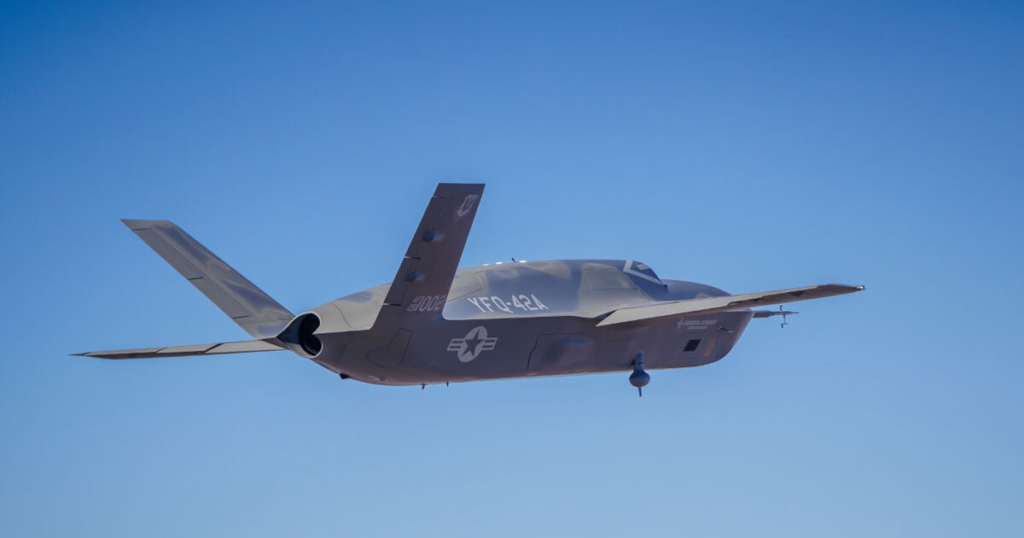
Crucially, they are expected to cost a fraction of a fifth-generation fighter, potentially around one-third of an F-35, allowing the Air Force to field them in significantly larger numbers.
This concept addresses one of the central challenges of modern air warfare: how to generate combat mass in highly contested environments. By pairing crewed aircraft with multiple autonomous systems, the Air Force aims to complicate adversary targeting while expanding operational reach.
The shift also reflects a broader doctrinal change. Air superiority is no longer defined solely by the performance of individual aircraft, but by the integration of manned and unmanned systems operating as a networked force.
NGAD and B-21 anchor US Air Force next-generation air warfare plans
Alongside CCAs, the Air Force continues to invest heavily in its future combat architecture.
The sixth-generation fighter under the Next Generation Air Dominance programme receives $5 billion in FY2027, a significant increase that underscores its role in future high-end conflict.

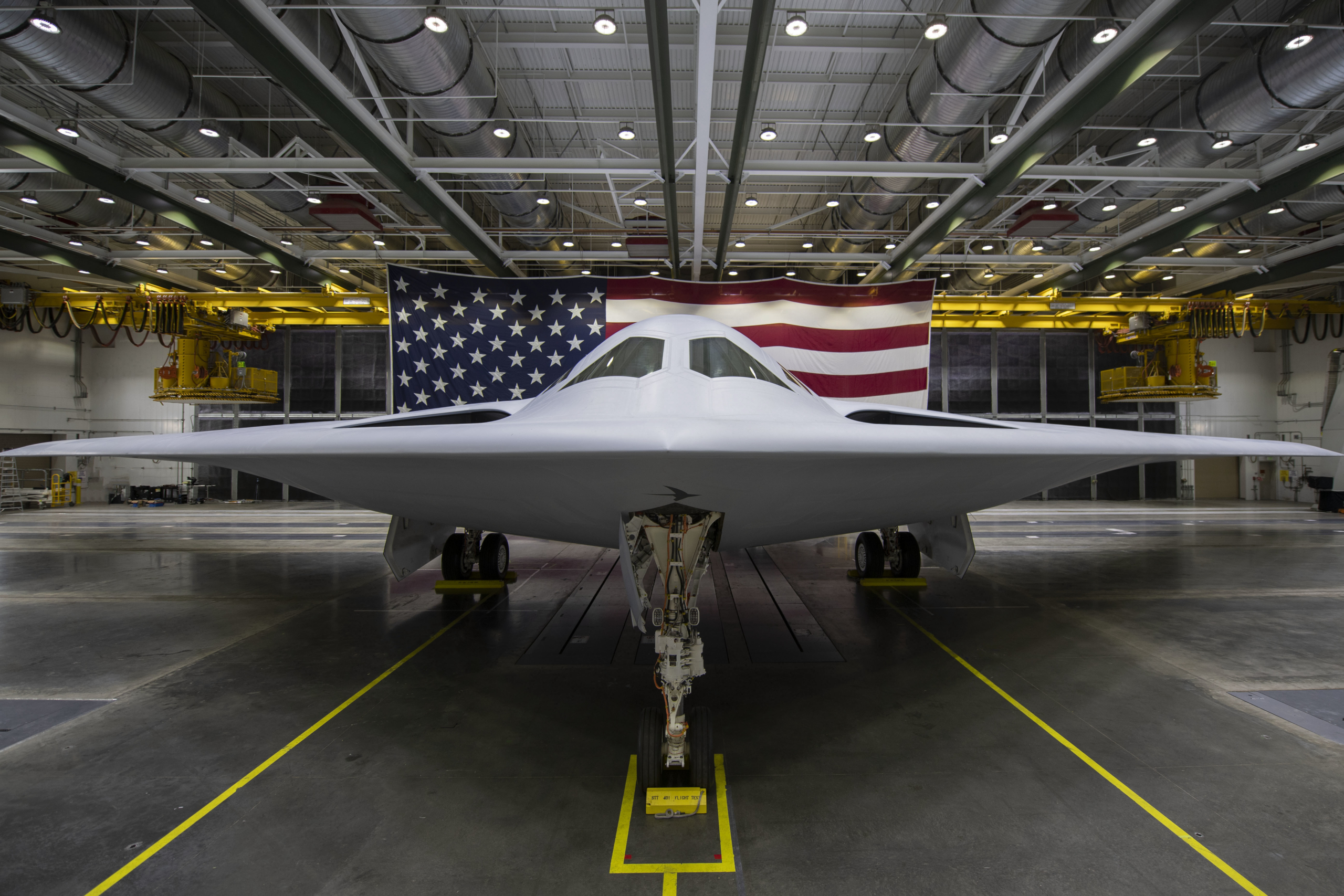
Long-range strike remains a core pillar. The B-21 Raider is allocated $2.2 billion in procurement funding, although the absence of a new acceleration package raises questions about how quickly production can scale.
Together, these programmes form part of a broader “family of systems” approach, combining stealth platforms, autonomous systems and advanced sensors into an integrated combat network.
E-7 Wedgetail cut risks US Air Force airborne early warning gap
Not all signals in the budget point to expansion.
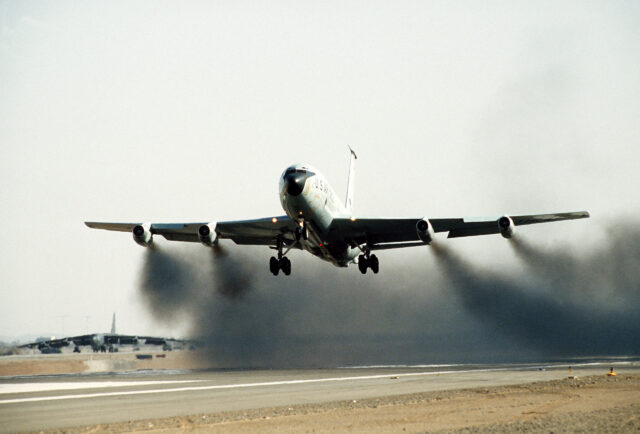
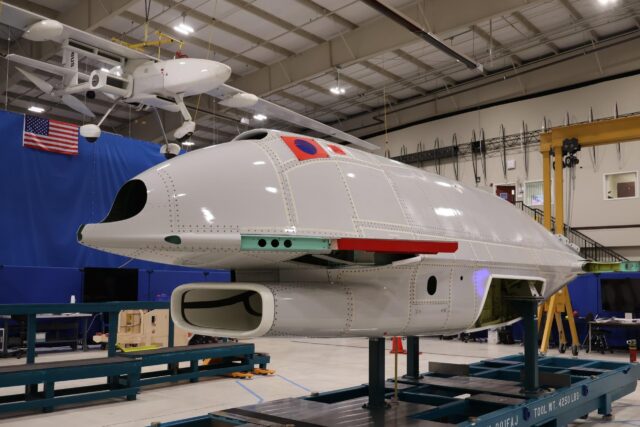
The absence of funding for the E-7 Wedgetail airborne early warning aircraft is particularly notable. Intended to replace the ageing E-3 Sentry fleet, the programme had already faced cancellation attempts, and its omission from the FY2027 request sets up a likely battle in Congress.

This creates a potential capability gap in airborne early warning, a critical function in modern air operations, particularly in contested environments where situational awareness is essential.
The risk is heightened by recent operational strain on the E-3 fleet, underscoring the urgency of finding a viable replacement.
US Air Force procurement surge aims to boost defence industrial capacity
The increase in aircraft procurement funding, which rises to more than $30 billion when mandatory spending is included, highlights another key priority: industrial capacity.
The focus is not just on acquiring new platforms, but on ensuring the ability to build, sustain and upgrade them at scale.
In a strategic environment defined by great power competition, industrial throughput is increasingly seen as a decisive factor.

The trajectory of the budget is closely tied to the evolving threat environment, particularly in relation to China.
Beijing’s continued investment in anti-access and area denial capabilities, long-range missiles and advanced air defence systems has directly challenged the US Air Force’s ability to operate freely in contested regions.
The push towards CCAs, NGAD and distributed force structures reflects an effort to regain operational advantage in this environment, combining survivability with scale and autonomy.
$1.5T defence budget sets direction for future US air warfare
It is a force that relies less on small numbers of exquisite platforms and more on distributed capability, combining high-end fighters with large numbers of autonomous systems.
The shift is both material and conceptual. Air superiority is increasingly defined by integration, network resilience and the ability to generate combat mass, rather than the performance of individual aircraft alone.
Ultimately, the $1.5 trillion defence request is less about the headline number and more about what it reveals. For the US Air Force, it signals a transition already underway, from legacy force structures to a future shaped by autonomy, integration and contested operations.
If approved, the FY2027 budget will not just fund new aircraft. It will define how the United States fights in the air for decades to come.
Featured image: USAF