Singapore’s AirFish wing-in-ground aircraft to fly with BatamFast in 2026

February 3, 2026
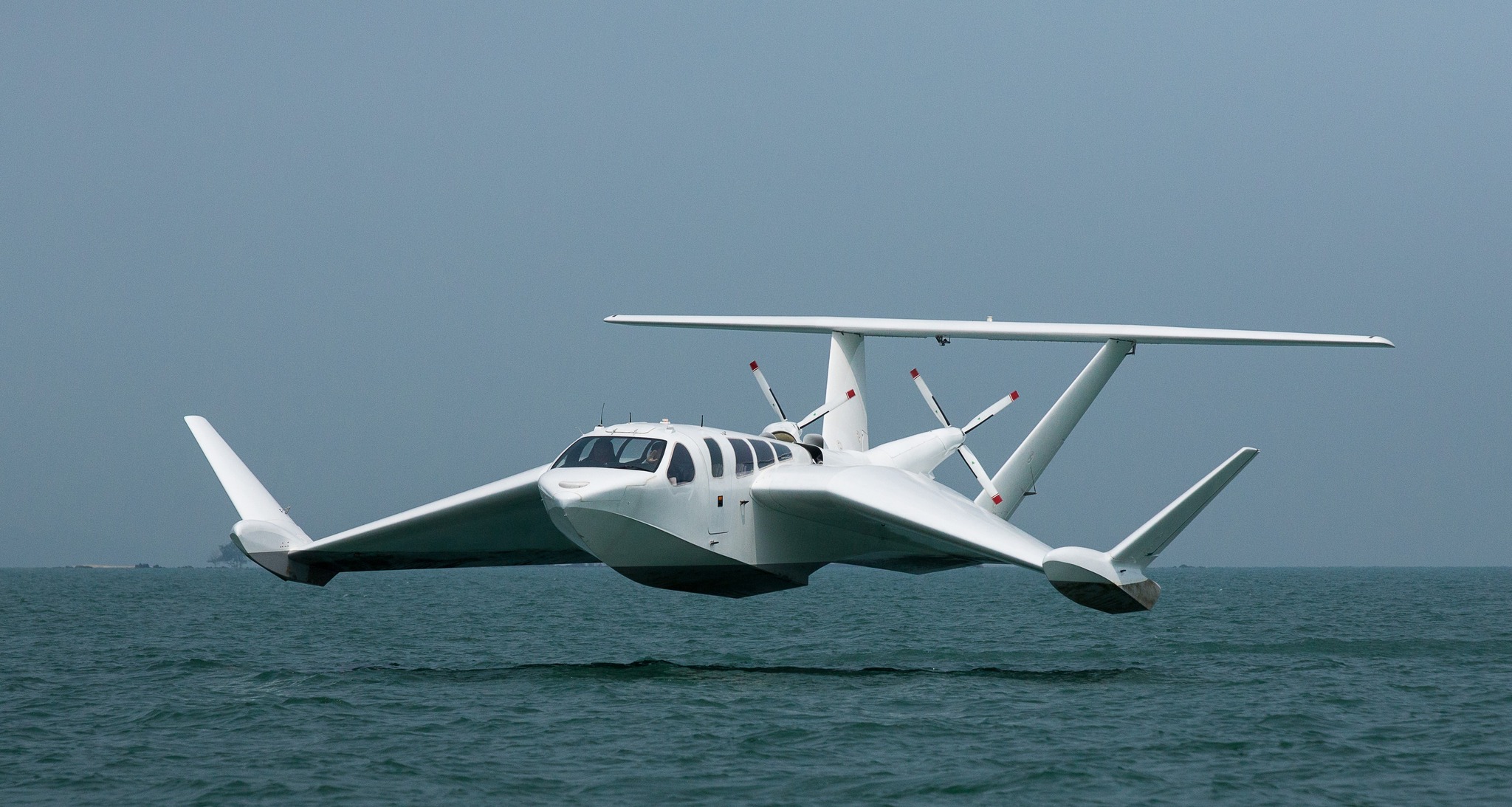
Finally, the first ekranoplan or wing-in-ground-effect flying ferry is set to start operations in Singapore, following confirmed partnerships with ferry operators. This follows decades of mostly dead-end ground effect vehicle development in the US, the Soviet Union, and elsewhere.
ST Engineering signs ferry operator agreements to launch AirFish services
ST Engineering has confirmed its first commercial operating partners for the AirFish wing-in-ground (WIG) craft, signing agreements with ferry operators in Southeast Asia and India as it moves the programme from development into revenue service.
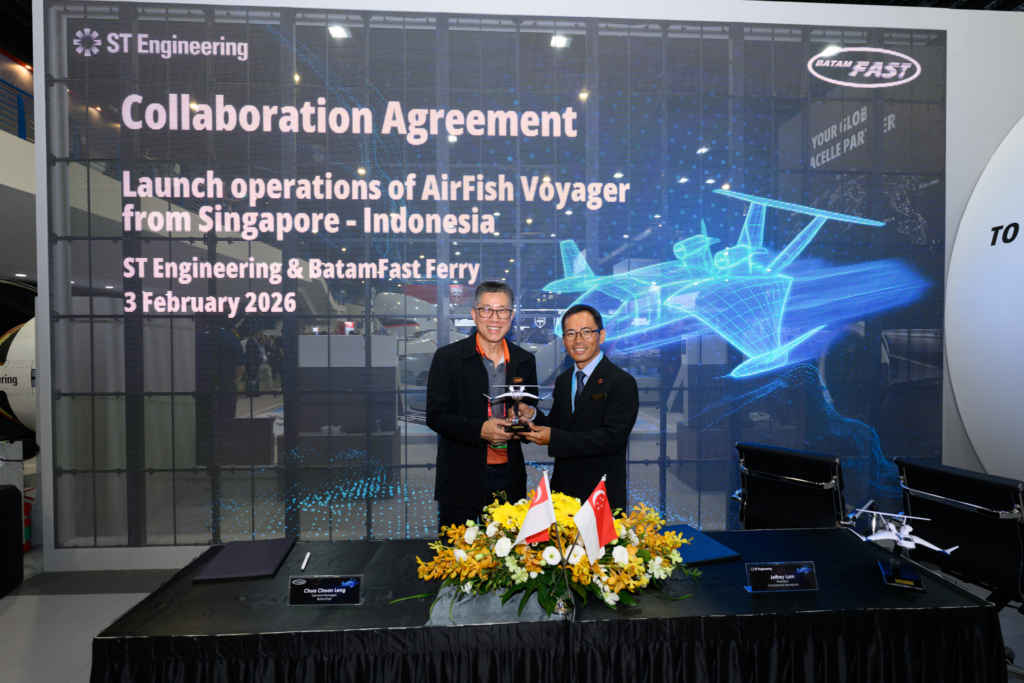
At the 2026 Singapore Airshow, ST Engineering AirX announced that regional ferry operator BatamFast will lease and operate an AirFish Voyager craft on the Singapore–Batam route, marking what is expected to be the first commercial WIG ferry service in the world. Operations are targeted for the second half of 2026, subject to route and regulatory approvals.
In a parallel agreement, Wings Over Water Ferries (WOW) will introduce the AirFish Voyager to India, with plans to lease and operate up to four aircraft from late 2026. Initial routes are expected to focus on high-demand coastal regions, with the partners also exploring local assembly, training and maintenance capabilities in support of India’s Make-in-India objectives.
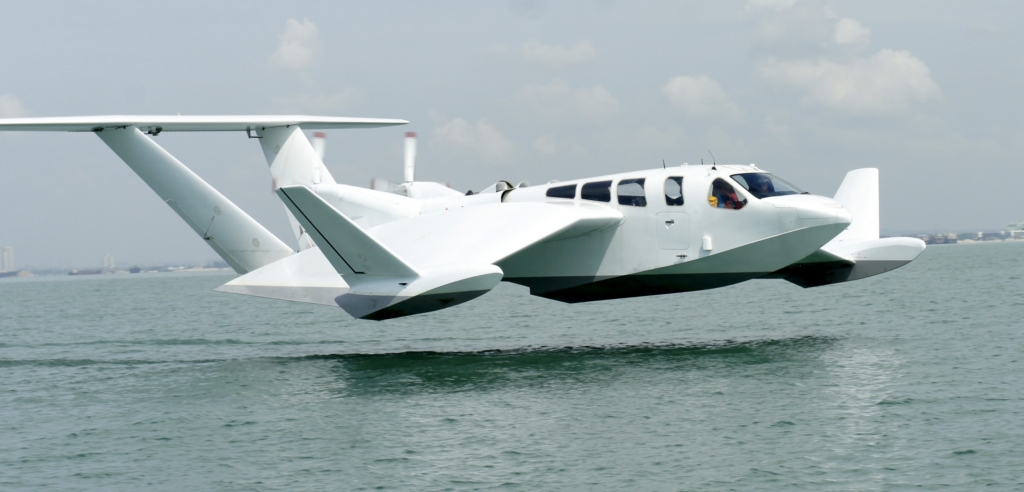
The AirFish Voyager is a 10-seat wing-in-ground craft that flies a few metres above the water surface by harnessing aerodynamic ground effect. Classified as a maritime vessel rather than an aircraft, it is being certified in partnership with Bureau Veritas, with classification targeted by mid-2026.
ST Engineering says the craft is designed to offer speeds of up to 100 knots, significantly faster than conventional ferries, while operating without the need for runway or airport infrastructure.
Where will the AirFish fly first?
The first confirmed commercial route for the AirFish Voyager will be between Singapore and Batam, Indonesia, with regional ferry operator BatamFast planning to introduce the wing-in-ground craft on the busy cross-border corridor once regulatory approvals are in place.
The Singapore–Batam route is a natural testbed for the technology. It is short, heavily trafficked, largely over sheltered coastal waters and already served by high-speed ferries, making it well suited to evaluating AirFish’s performance, reliability and passenger acceptance in a real-world operating environment.
Beyond the initial launch route, ST Engineering AirX and BatamFast have said they will explore additional destinations across Southeast Asia, targeting coastal and island links where speed, frequency and limited infrastructure constrain conventional ferry operations.
In India, Wings Over Water Ferries plans to deploy the AirFish Voyager on high-demand coastal routes once approvals are secured. Early focus areas include the Andaman and Nicobar Islands, Lakshadweep, Maharashtra, Gujarat, Goa, Andhra Pradesh and Tamil Nadu, reflecting a mix of tourism, commuter and regional connectivity markets.
The AirFish series
ST Engineering claims the AirFish “redefines” maritime transport, allowing swift coastal travel and logistics. Its designs tend to be smaller and ferry-focused, although it does mention potential military applications.
The AirFish Voyager is designed to carry eight passengers (four in VIP configuration) and two crew at 100 knots, “thrice the speed of existing marine craft.” The craft is 17 metres long and 15 metres wide and has a range of 300 nautical miles. It is designed to carry a payload of up to 1,000 kgs
It will be able operate in up to Sea State 3 or “Slight” sea conditions. Sea State 3 is defined by sea conditions with wave heights ranging from 0.5 to 1.25 meters or 1.5 to 4 feet.
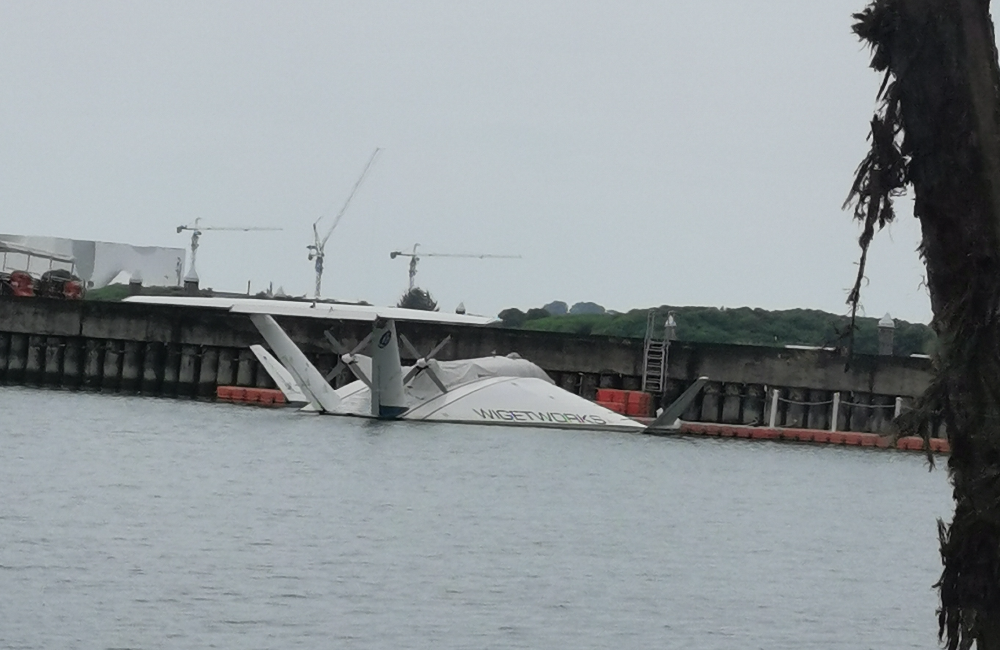
An early customer is Eurasia Mobility Solutions in Turkey, which ordered 10 examples in 2024, with the option for another 10.
Love innovation and technology? Discover more of our stories here.
The troubled history of ekranoplan development
Ground effect vehicles or ekranoplans are nothing new. Famously, the Soviet Union extensively experimented with developing them, including as a type of fast attack warship. It was able to bring the Lun-class into service just before its collapse.

Operating these vehicles in ground effect promises incredible benefits, including being able to combine the heavy loads of a ship with the speed of an aircraft. The US has typically focused on developing freighter GEVs to support its enormous logistics operations.
However, there are extremely difficult engineering challenges to overcome, including how to skim over water in rough seas.
At one point, Boeing designed the giant Pelican, while DARPA worked on the Liberty Lifter until it was cancelled in 2025. In 2025, a new Chinese ekranoplan was spotted, seemingly designed to support Chinese operations in the South China Sea.
Featured Image: ST Engineering