On its 50th mission, SpaceX Dragon carries breakthrough stem cell experiment to ISS

August 25, 2025
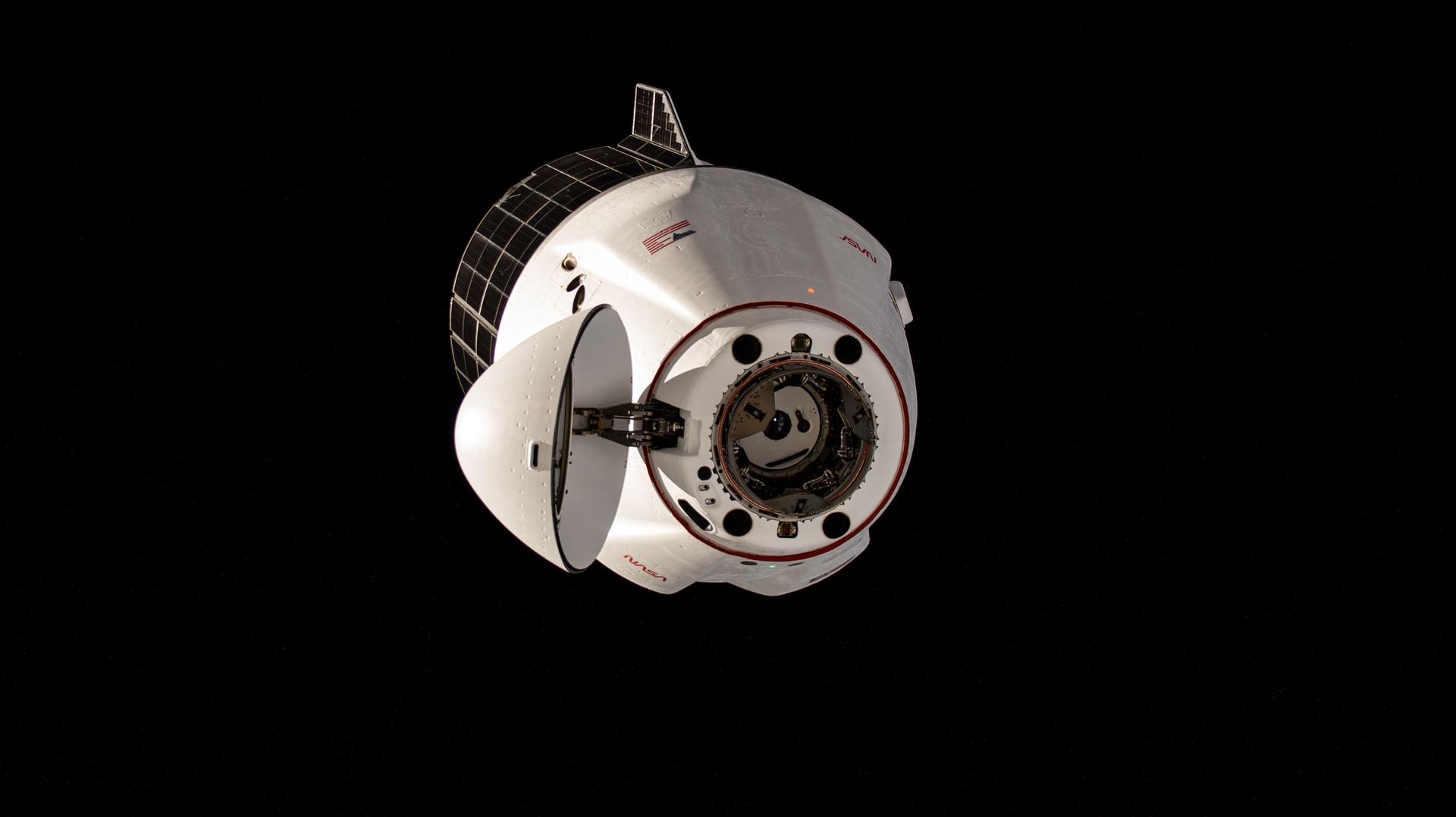
A stem cell experiment that could unlock new treatments for some of the world’s most devastating diseases, from bone loss to brain injury, is en route to the International Space Station (ISS) aboard SpaceX Dragon CRS-33 rocket.
In the early hours of Sunday morning, SpaceX’s Falcon 9 lifted off from Cape Canaveral, Florida, carrying its 50th Dragon spacecraft on a mission to the ISS.
On board the CRS-33 resupply flight: more than 5,000 pounds of equipment, food and science, including a potentially breakthrough study from the Mayo Clinic that could change the future of medicine.

Led by Dr Abba Zubair, a physician and stem cell scientist, the research focuses on how microgravity affects bone-forming stem cells, and whether blocking a single protein could prevent the dangerous bone loss astronauts experience in space – and, more importantly, provide clues for treating osteoporosis and other degenerative conditions on Earth.
“If this compound we are testing is able to block the impact of microgravity to slow or stop bone loss, then we can find a treatment for the bone loss in space,” Dr Zubair said. “And that might also give us a clue into how we may treat people on Earth.”
Bone health is just the beginning for SpaceX Dragon CRS-33
Dr Zubair believes this line of research could eventually support therapies for stroke, brain injury, epilepsy, blood disorders, and even cancer – part of a broader vision he’s been developing for over two decades at the Mayo Clinic’s Florida campus.
NASA selected Zubair’s experiment as one of more than 50 scientific investigations aboard CRS-33. The mission marks a major milestone: the 50th time a Dragon spacecraft has visited the ISS since 2012.

The Dragon capsule, flying for the third time following CRS-26 in 2022 and CRS-29 in 2023, is due to dock autonomously on Monday morning.
Unlike typical cargo missions, this one will remain attached to the ISS for nearly five months, helping periodically reboost the station’s altitude as it drifts downward due to atmospheric drag.
That task, usually handled by Russian Progress vehicles, signals SpaceX’s expanding role in station operations and hints at what autonomous support may look like in future long-duration spaceflight.
Behind the science: Making space travel safer
Zubair’s team is focused on a protein called IL-6, which sends signals that determine whether stem cells build or degrade bone.
The loss of bone density in space is one of the most serious long-term risks for astronauts. Left untreated, it could compromise future missions to the Moon or Mars.
By blocking IL-6 in space, researchers hope to slow or even reverse bone loss – insights that could transform treatment of osteoporosis, cancer-related bone weakness and other chronic illnesses.
“For this project, our goal is to really understand how gravity affects bone formation and bone loss,” Zubair said. “It’s a way to answer fundamental biological questions, but in a way that helps real patients.”
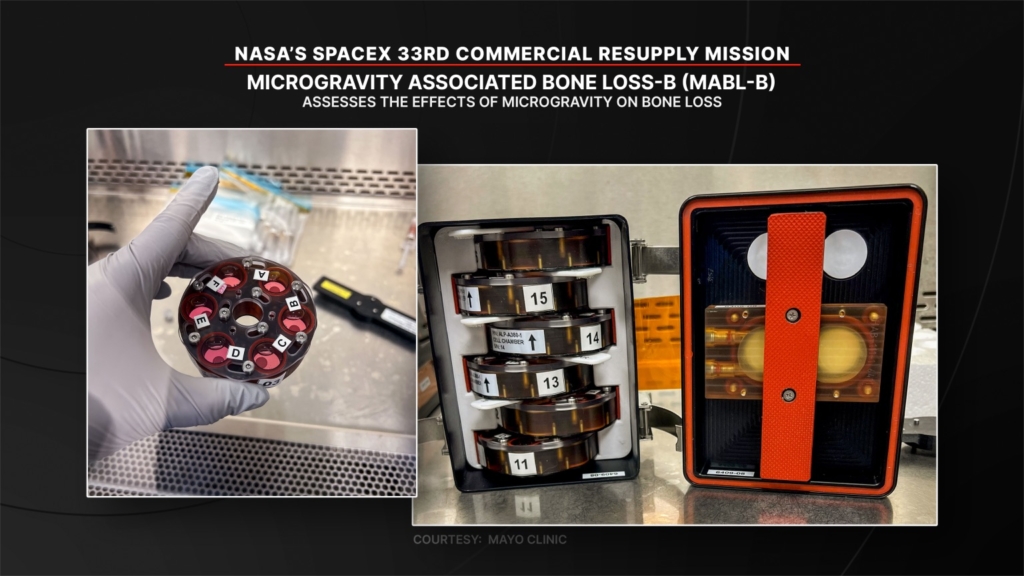
This marks Zubair’s fourth experiment flown aboard a Dragon capsule, building on work that previously earned him NASA’s Exceptional Scientific Achievement Medal.
CRS-33 also carries a range of ambitious biomedical research, including:
- A bioprinted nerve-repair device, designed to bridge gaps caused by traumatic injury, potentially improving outcomes for paralysis and nerve damage.
- The continued development of bioprinted liver tissue, with the long-term goal of printing transplantable human organs.
- A European Space Agency experiment testing the first metal 3D printing in space, enabling crews to create tools and parts on demand instead of relying on resupply.
“This research team is testing the idea that if you block a certain protein known to influence bone health, you might be able to slow down the loss,” explained Heidi Parris, associate program scientist for NASA’s ISS Research Office. “That could be a game-changer not just in space, but for people on Earth too.”
As missions grow longer and travel farther from Earth, the ISS is becoming an orbital incubator for medical innovation. Sunday’s launch is another step toward a future where solutions to human illness may be forged in microgravity.
When will SpaceX Dragon bring back results?
Dragon is expected to return to Earth no earlier than December, bringing with it samples from Zubair’s stem cell experiment and other research that could shape the future of both spaceflight and medicine.
SpaceX’s 50th Dragon mission comes during the ISS’s 25th year of continuous human habitation, a legacy now deeply entwined with SpaceX, which has delivered over 300,000 pounds of cargo and supported more than 1,000 research projects in orbit.
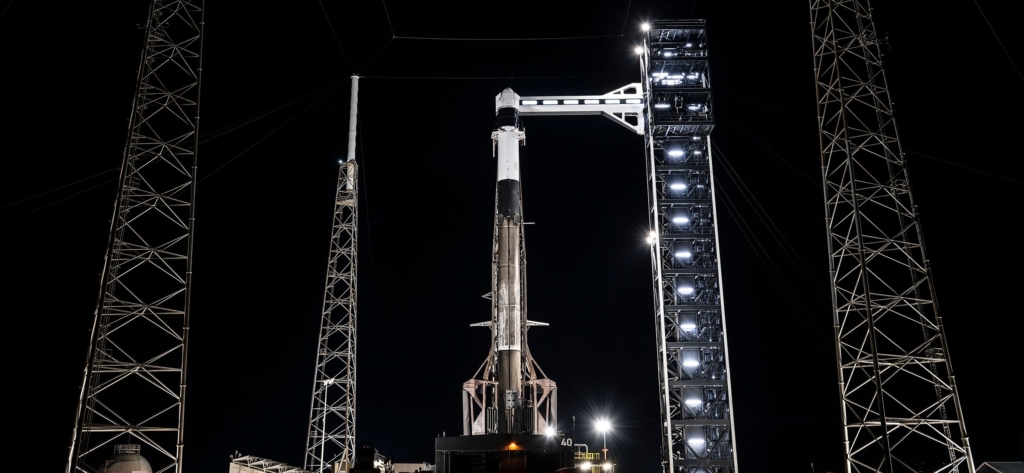
“It’s been exciting for us to support this critical, new effort,” said Sarah Walker, SpaceX’s director of Dragon Mission Management. “It feels like we’re becoming an even more integrated part of the ISS ecosystem.”
Over 25 years, the ISS has hosted more than 280 residents and enabled over 4,000 scientific experiments, with contributions from more than 5,000 researchers across 110 countries.
Dragon remains the only spacecraft currently flying that can return significant amounts of cargo from the ISS. It was also the first private spacecraft to carry humans to the station – and it shows no signs of slowing down.
Looking further ahead, SpaceX is developing NASA’s US Deorbit Vehicle, which will guide the ISS to a controlled end-of-life re-entry, currently expected around 2030.