Singapore Airshow: Singapore to launch national space agency from April

February 3, 2026
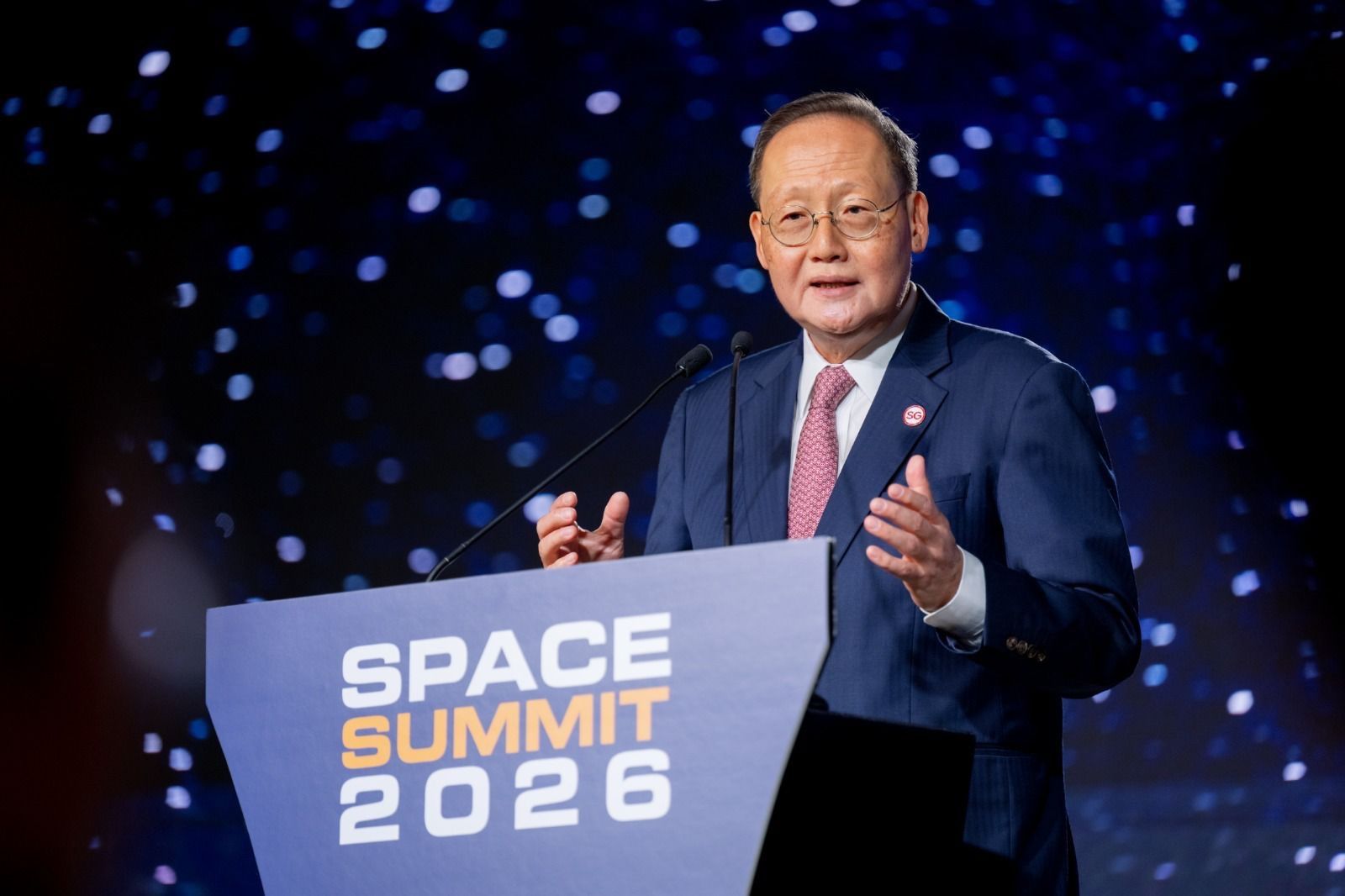
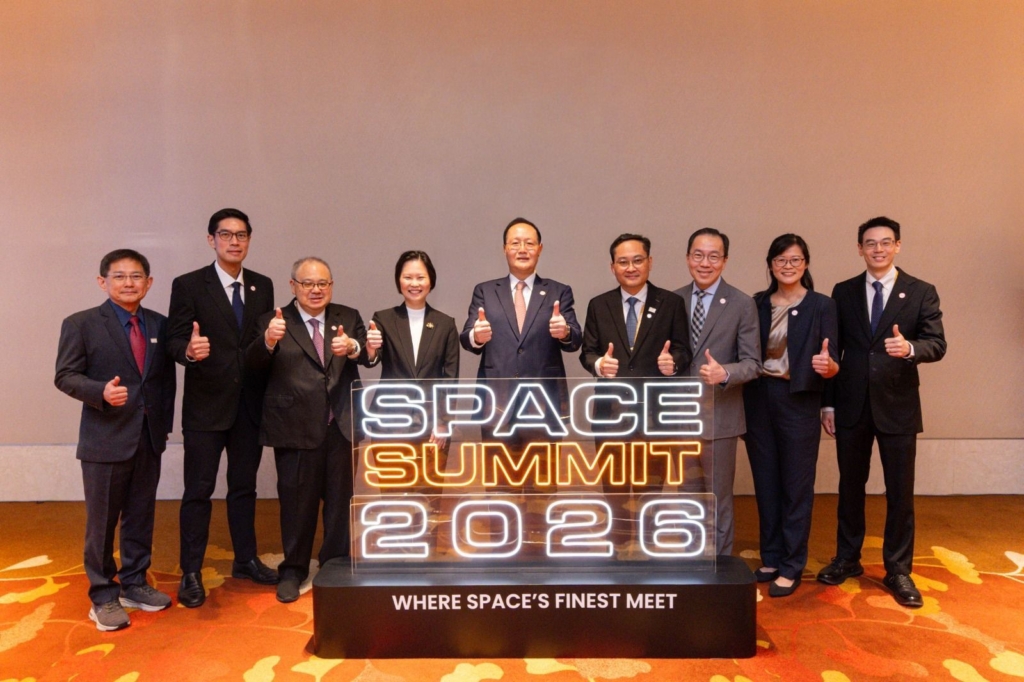
Singapore will establish its own national space agency on April 1, marking a decisive step in the city-state’s ambition to fully harness the opportunities of the rapidly expanding global space economy, as leaders from across government, industry and research gathered in the Republic today for the opening of Space Summit 2026.
The announcement was made by Dr Tan See Leng, Minister for Manpower and Minister-in-charge of Energy and Science & Technology at the Ministry of Trade and Industry, during the inaugural edition of the Space Summit, being held at Marina Bay Sands, in conjunction with the Singapore Airshow.
The new National Space Agency of Singapore (NSAS) will be housed under the Ministry of Trade and Industry and tasked with developing national space capabilities, shaping regulation and legislation, and supporting innovation and commercial growth across the sector.
The move formalises Singapore’s space ambitions at a time when space systems are no longer peripheral technologies, but critical infrastructure underpinning communications, navigation, climate resilience, security and economic activity.
Singapore to establish national space agency for a growing space ecosystem
According to the Ministry of Trade and Industry, Singapore currently hosts around 70 space companies employing approximately 2,000 professionals across the value chain, from satellite manufacturing and engineering to downstream services and data analytics.
The establishment of a dedicated national space agency reflects the government’s assessment that the sector has reached a scale and strategic importance requiring coordinated national oversight.
“Singapore’s strengths in advanced manufacturing, aerospace, micro-electronics, precision engineering and artificial intelligence position us well to capture new opportunities in the space technology sector,” a senior official from the ministry told AGN, adding that the agency will play a central role in aligning policy, regulation and industry development.
While Singapore has never pursued launch vehicles or human spaceflight, officials have long argued that the Republic’s competitive advantage lies in space-enabled services, advanced manufacturing and trusted international partnerships.
Space Summit 2026 opens as space systems grow more interconnected
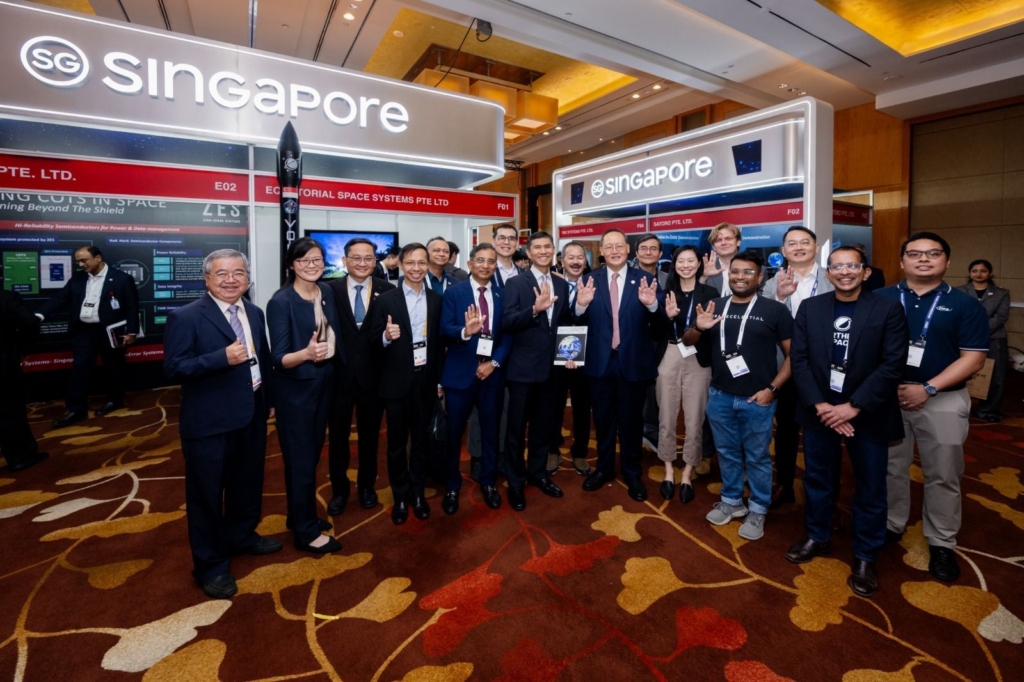
The agency announcement set the tone for Space Summit 2026, which opened Monday, Feb 2, with more than 1,500 attendees and over 300 participating companies and organisations, including representatives from 20 national space agencies and offices.
Held over two days at the Sands Expo and Convention Centre, the Summit is anchored around the theme “New Frontiers: Shaping a Responsible and Inclusive Space Future” and comes at a moment when space systems are becoming increasingly dense, interconnected and commercially integrated.
“Space systems are integral to how societies function and economies operate,” said Leck Chet Lam, Managing Director of Experia Events. “As the space ecosystem becomes more interconnected and operationally dense, alignment across governments, industry and partners is increasingly important.”
Lam said the Summit was designed to capitalise on Singapore’s unique position at the intersection of aviation, aerospace and space, bringing together adjacent sectors that increasingly share infrastructure, technologies and talent.
From OSTIn to national agency, Singapore positions itself as a global space hub
Singapore’s space activities have until now been coordinated through the Office for Space Technology & Industry (OSTIn), which sits under the Economic Development Board. Speaking at the Summit, Jonathan Hung, Executive Director of OSTIn, said the launch of a national agency reflects the sector’s growing economic and strategic weight.
“The growth of Singapore’s space sector leverages our strengths in aerospace, precision engineering, advanced manufacturing and artificial intelligence,” Hung said. “Space Summit 2026 anchors Singapore as a key node for the global space community to come together and explore how space capabilities can be developed and applied responsibly for sustained economic and social impact.”
Hung noted that Singapore’s space strategy is deliberately commercial in orientation, focusing on applications that address real-world challenges, particularly across Southeast Asia and the wider Asia-Pacific.
Space Summit sees Singapore announce international space partnerships
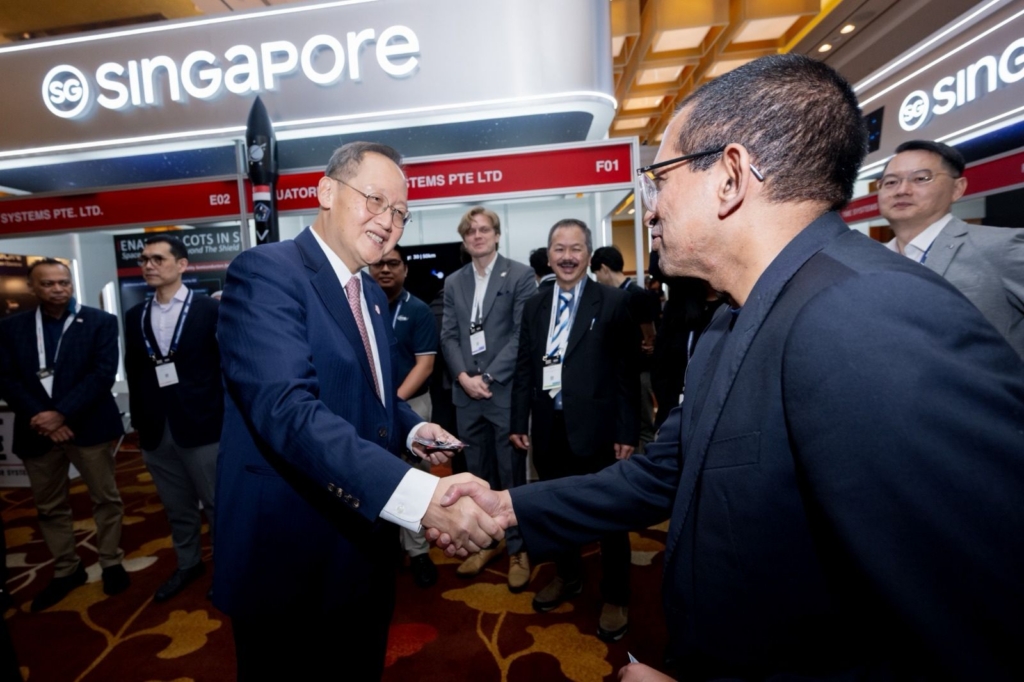
The opening day of the Summit was also marked by a series of memoranda of understanding and partnership announcements, underscoring Singapore’s emphasis on collaboration rather than technological isolation.
Among the agreements announced were Letters of Intent between OSTIn and the Maldives Space Research Organisation and the Spanish Space Agency, covering areas such as Earth observation applications, space situational awareness, policy exchanges and industry collaboration.
The Association of Aerospace Industries (Singapore) signed multiple MOUs with international counterparts, including Australia’s Space Industry Association, Japan’s SPACETIDE Foundation and the Satcom Industry Association–India, aimed at facilitating business exchanges, talent development and regional cooperation.
Commercial partnerships unveiled at the Summit spanned satellite-based climate monitoring, quantum-secure communications, laser communications, non-terrestrial 5G and 6G networks, and space situational awareness, reflecting the breadth of Singapore’s space economy beyond satellites alone.
Earth observation and sustainability emerge as pillars of Singapore’s space strategy
A recurring theme across sessions was the growing role of space technologies in environmental monitoring and sustainability. Singapore’s Earth Observation Initiative, launched in 2025, featured prominently in discussions on disaster resilience, climate monitoring and regional cooperation.

Projects highlighted include satellite-enabled flood prediction with the Mekong River Commission, water quality monitoring under a World Bank-led programme, and disaster mapping platforms demonstrated at the United Nations Committee on the Peaceful Uses of Outer Space.
Officials argued that Singapore’s near-equatorial location, combined with its strength in data analytics and downstream services, positions it well to act as a regional hub for Earth observation applications tailored to Asia-Pacific conditions.
Dual-use space technologies and governance challenges take centre stage
The Summit programme also tackled more sensitive issues, including the dual-use nature of space technologies and the growing need for coordination on orbital safety and regulation.
Panel sessions examined satellites as national critical infrastructure, the convergence of military and commercial space capabilities, consolidation in the global satellite communications industry, and emerging challenges in launcher markets.
With space activity accelerating across both low Earth orbit and cislunar domains, speakers repeatedly stressed that governance frameworks must evolve in step with commercial expansion to ensure long-term sustainability.
Talent and innovation underpin Singapore’s long-term space ambitions
Alongside policy and industry dialogue, Space Summit 2026 continues to place emphasis on workforce development and innovation.
The International Space Challenge, now in its 19th year, returned as part of the programme, engaging students and young professionals in tackling real-world space problems.
Organisers said nurturing future talent is critical if space is to remain a driver of economic growth rather than a bottleneck constrained by skills shortages.
Featured image: Government of Singapore