


Russian Antonov An-22 crashes into a reservoir: All 7 crew feared dead

3 min read

An Antonov An-22, the largest turboprop aircraft in the world, has crashed in the Ivanovo region of Russia.
The transport aircraft, operated by the Russian MoD, was reportedly on a test flight following repairs when it went down in the water of the Uvodskoye Reservoir in the Furmanovsky District.
Responders have found only fragments of the aircraft floating in the water, and initial assessments suggest all seven crew members on board have died.
Russia had intended to retire the An-22 in 2024
Russia had already planned to withdraw the An-22 from frontline use, with officials indicating the type would be retired in 2024.
The An-22 Antei, developed during the time of the Soviet Union, first flew in 1965 and entered service with Russia’s air force a couple of years later. Over the years, some 68 examples were built, including two prototypes, but by the early 2000s, just a handful were considered serviceable.
According to the Russian Planes database, today, just three An-22s are considered to be capable of flight, with a further 10 in storage (seven belonging to Russia and three to Antonov), with the rest scrapped or destroyed.
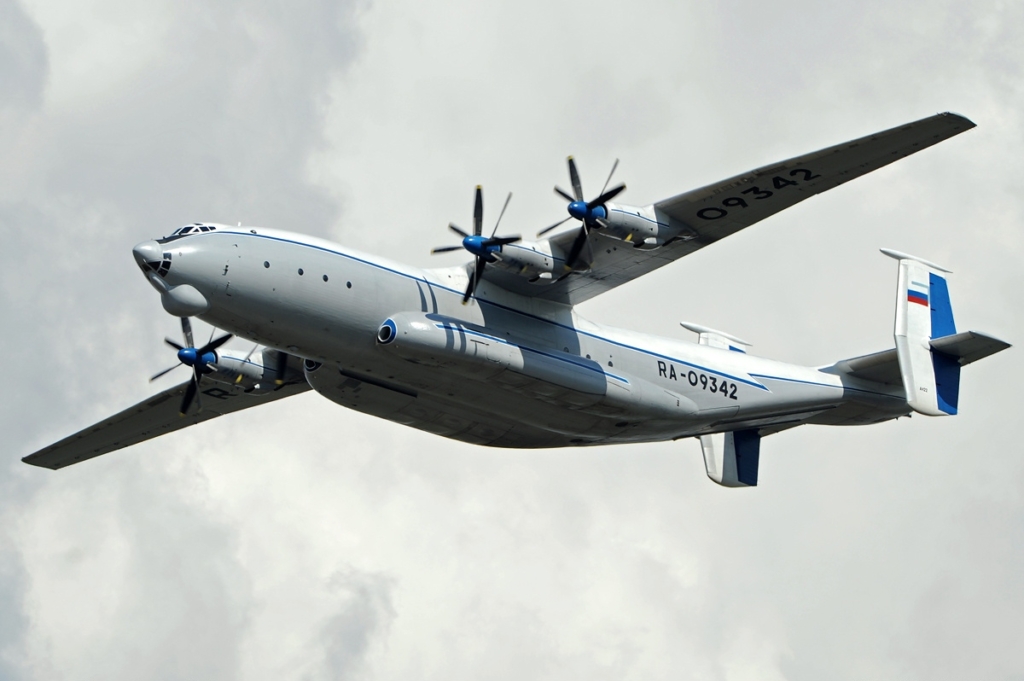
In June 2024, Lt. Gen. Vladimir Venediktov, the commander of Military Transport Aviation, a branch of the Russian Aerospace Forces (Vozdushno-Kosmicheskiye Sily – VKS), was quoted in local media as saying that the An-22 would be retired from service that year.
But Russia’s transport fleet remains under significant strain, with ageing Il-76s, a limited number of An-124s and dwindling stocks of An-12s and An-26s struggling to meet wartime demand. The continued test-flying of an An-22 suggests the VKS lacks sufficient lift capacity and is being pushed to keep even its oldest heavy transports available for service.
The Antonov An-22: The world’s largest turboprop
The Antonov An-22 Antei remains the largest turboprop-powered aircraft ever built, a title it has held unchallenged for nearly 60 years.
When it debuted at the 1965 Paris Air Show, it astonished observers not only with its size but with its extraordinary power: four Kuznetsov NK-12MA turboprops, each producing more than 14,800 horsepower and driving massive contra-rotating propellers.

At more than 57 metres long, with a 64-metre wingspan, the An-22 was the first true widebody transport aircraft, introducing a cavernous fuselage and unprecedented payload capacity for its era.
It set 41 world records, including for payload lifted to altitude and speed over a closed circuit, cementing its place as one of the Soviet Union’s most remarkable engineering achievements.
| Specification | An-22 Antei |
|---|---|
| First flight | 27 February 1965 |
| Length | 57.9 m (190 ft) |
| Wingspan | 64.4 m (211 ft) |
| Height | 12.53 m (41 ft) |
| Maximum take-off weight | 250,000 kg (551,000 lb) |
| Maximum payload | ~80,000 kg (176,000 lb) |
| Engines | 4 × Kuznetsov NK-12MA turboprops |
| Power output per engine | 14,860 hp driving contra-rotating props |
| Cruise speed | 740 km/h (460 mph) |
| Range (with max payload) | ~5,000 km (3,100 mi) |
| World records | 41 payload and performance records |
With a maximum payload of around 80 tonnes, the An-22 enabled missions that were previously impossible, from airlifting armoured vehicles to delivering humanitarian aid into unprepared, rough airstrips thanks to its huge low-pressure tyres and robust STOL performance.
It also played an important role in transporting oversize components for even bigger Russian aircraft, including the An-124 and the sole An-225, which was destroyed in the early part of the invasion of Ukraine.
Today, the An-22 is technologically obsolete, and its dwindling fleet reflects the difficulty of sustaining an aircraft designed nearly six decades ago. As Russia continues to rely on ageing airframes to fill gaps in its transport capacity, the risk of further incidents inevitably grows, particularly as maintenance demands increase and spare parts become harder to source.
Featured image: Dmitry Terekhov / Wikimedia
Sign up for our newsletter and get our latest content in your inbox.


More from


September 24, 20264 min read


September 24, 20265 min read


