Retired USAF F-15s give NASA a proven edge as X-59 quiet supersonic testing approaches

January 16, 2026
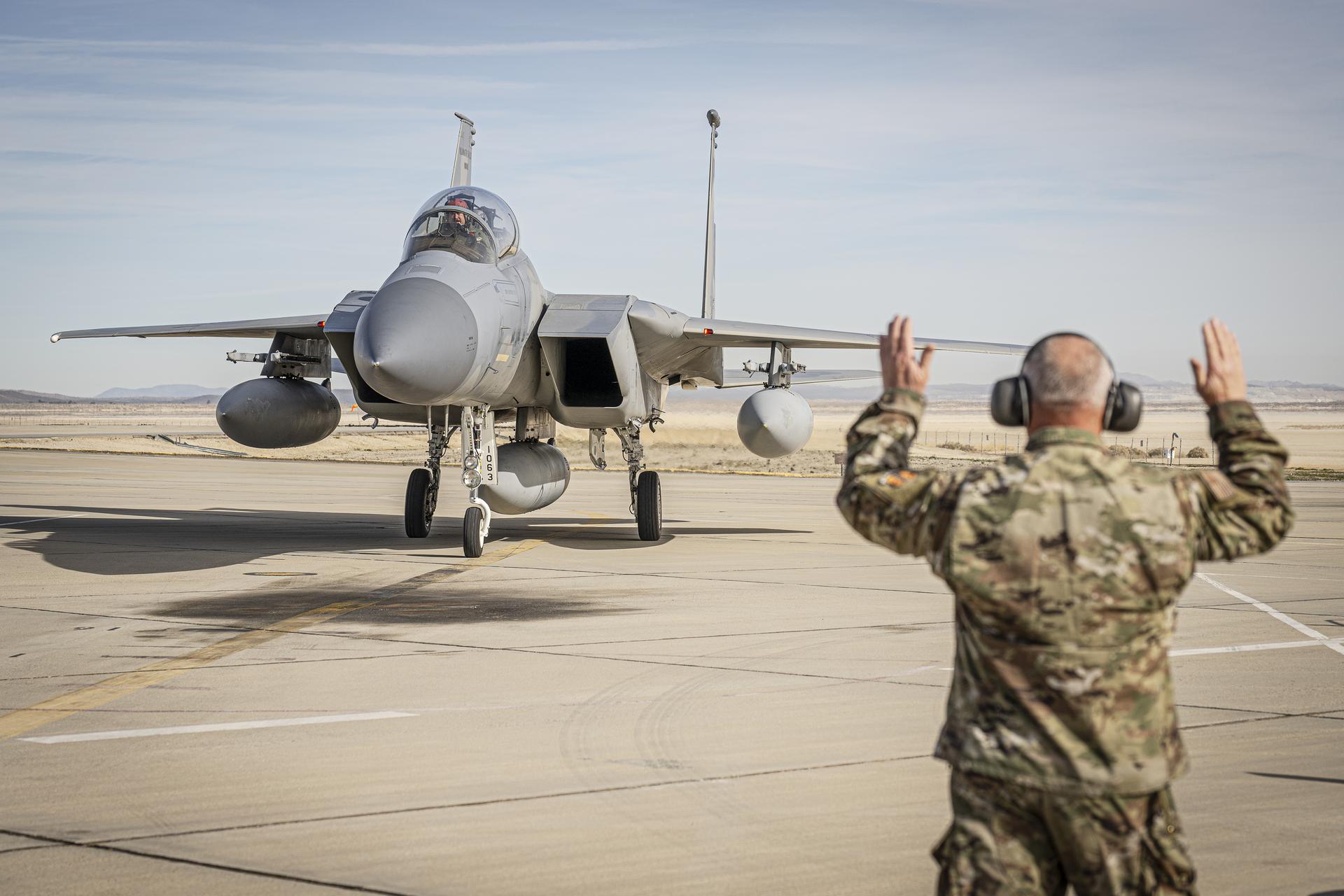
Two retired US Air Force F-15 fighter aircraft have been inducted into NASA’s flight research fleet at Armstrong Flight Research Center, reinforcing the agency’s ability to conduct complex, high-speed flight trials as it prepares for the most visible phase of its quiet supersonic programme.
Transferred from the Oregon Air National Guard’s 173rd Fighter Wing at Kingsley Field, the aircraft arrived at Edwards Air Force Base on 22 December 2025.
One aircraft will be restored to flying condition as an active research and chase platform, while the second will be retained as a source of spares to sustain NASA’s F-15 fleet over the long term.
The decision reflects a calculated investment in reliability and continuity as Armstrong’s test schedule moves towards a more demanding phase.

“These two aircraft will enable successful data collection and chase plane capabilities for the X-59 through the life of the programme,” said Troy Asher, director of flight operations at Armstrong. “They also allow us to re-engage with external partners, including other government agencies and commercial aviation companies.”
Why the F-15 is uniquely suited for supersonic flight research at NASA
Few aircraft combine raw performance with the flexibility required for experimental flight testing in the way the F-15 does. Designed as a front-line air-superiority fighter, the aircraft brings capabilities that translate directly into the research environment.
The F-15 can routinely operate in high-speed, high-altitude regimes that mirror the conditions faced by experimental platforms such as the X-59. With the ability to fly comfortably above 55,000 ft and at sustained supersonic speeds, it can accompany test aircraft throughout much of their envelope, rather than only during limited portions of a sortie.
That makes it invaluable as a chase aircraft, providing visual oversight, real-time observations and an independent safety check during demanding test points.

Equally important is adaptability. The F-15’s large airframe and generous ground clearance allow researchers to install experimental hardware externally under the wings or fuselage, or internally through tailored avionics and software modifications.
NASA has flown dozens of experiments on the type since the early 1970s, spanning aerodynamics, propulsion, structures and high-speed flight.
NASA already operates two modified F-15s that allow pilots to work more comfortably at extreme altitudes for extended periods. The newly inducted aircraft will receive similar upgrades, enabling operation at the top of the X-59’s planned flight envelope, which peaks at around 60,000 ft.
That combination of altitude capability, payload capacity and modification potential remains difficult to match with any off-the-shelf alternative.
NASA’s Flight Demonstrations and Capabilities project explained
The F-15s will be operated under NASA’s Flight Demonstrations and Capabilities (FDC) project, a cornerstone of the agency’s Aeronautics Research Mission Directorate.
While individual programmes such as Quesst often attract attention, FDC provides the backbone that makes those demonstrations possible. The project is responsible for operating, sustaining and upgrading NASA’s specialised flight-test assets, from research aircraft and chase planes to test ranges and ground infrastructure.
By managing a shared pool of aircraft and capabilities, FDC enables NASA to support multiple aeronautics programmes simultaneously, as well as national strategic needs beyond the agency itself. This increasingly includes collaboration with other US government departments and commercial aviation companies exploring advanced flight concepts.
In practical terms, adding two more F-15s improves resilience. One aircraft flying while another supports sustainment may not draw headlines, but for a flight-test organisation, it can be the difference between slipping a campaign and keeping it on track.
NASA’s Quesst mission and the role of the X-59
At the centre of the current push is NASA’s Quesst mission, one of the most closely watched aeronautics efforts in decades. Its aim is to demonstrate that supersonic aircraft can fly over land without producing the disruptive sonic booms that led to widespread bans in the 1970s.
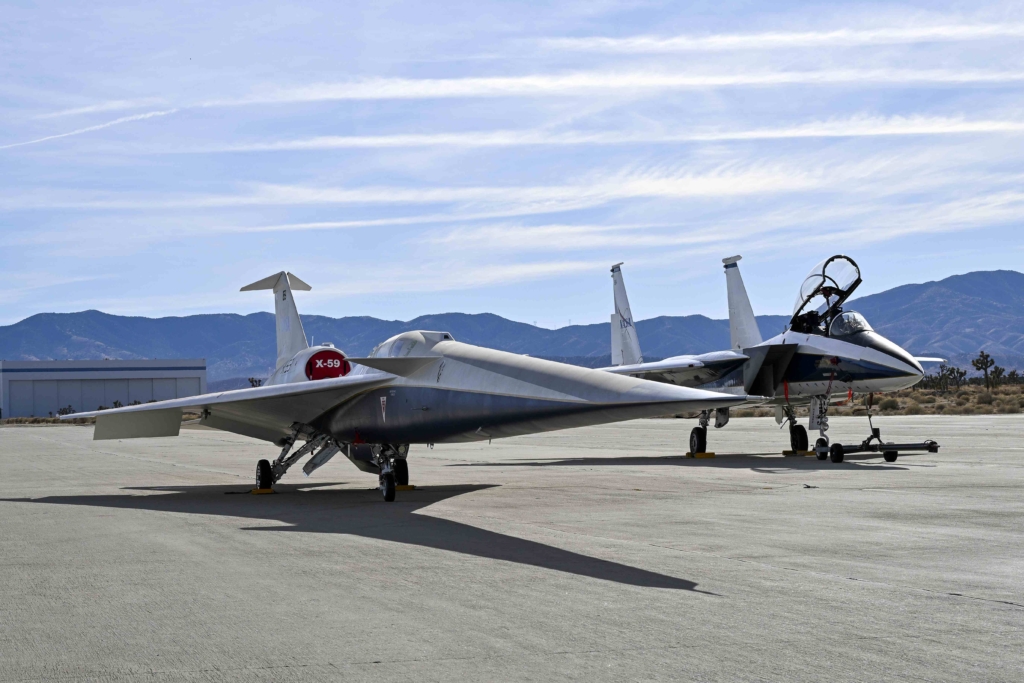
The focal point is the X-59, a slender, single-engine research aircraft being built by Lockheed Martin in Palmdale, California. Its distinctive shape is designed to reshape shock waves during supersonic flight, turning the traditional boom into a softer, far less intrusive sound at ground level.

Quesst is structured in three phases.:
- Phase one covers construction, ground testing and initial flight trials, culminating in NASA taking delivery of the X-59 and expanding its flight envelope.
- Phase two focuses on acoustic validation, with flights conducted over the supersonic test range at Edwards to confirm the aircraft’s low-boom performance.
- Phase three involves community overflights across selected US locations, with residents asked to report what they hear as part of NASA’s data-gathering effort.
The resulting data will be provided to regulators in the US and abroad to help inform future noise standards. If adopted, those standards could open a regulatory path for commercial supersonic passenger and cargo aircraft.
Throughout these phases, the F-15s will play a supporting but essential role, acting as chase aircraft to monitor the X-59 during critical test points and provide an additional layer of safety during envelope expansion and acoustic trials.
Retired Air Force F-15 to support the X-59 project
NASA’s decision to bring retired Air Force F-15s into its fleet underscores a recurring truth of flight research: proven platforms, when thoughtfully adapted, can remain relevant long after their frontline military careers end.
“The priority is to successfully support the X-59 through completion of that mission,” Asher said. “Over the longer term, these aircraft will help position NASA to continue supporting advanced aeronautics research and partnerships.”
As the X-59 edges closer to its first community overflights, the presence of the F-15s at Armstrong is a reminder that tomorrow’s aviation breakthroughs often rely on yesterday’s aircraft, flown in new ways, for new purposes, at the edge of what is possible.
Featured image: NASA