NASA backs student ideas to fix aircraft maintenance, from crawling robots to AR glasses

March 26, 2026
NASA has shortlisted eight student teams as finalists in its 2026 Gateways to Blue Skies competition, in a contest aimed at tackling one of aviation’s most persistent challenges: aircraft maintenance, or MRO (maintenance, repair and overhaul).
The competition, titled RepAir: Advancing Aircraft Maintenance, focuses not on distant future technologies but on practical solutions that could begin reshaping maintenance operations within the next decade.
For an industry grappling with a shortage of skilled technicians and growing pressure to keep ageing and increasingly complex aircraft operational, the timing is deliberate.
What makes this year’s shortlist particularly compelling is the range of ideas, from robotics and artificial intelligence to augmented reality, and the fact that several concepts are already edging beyond theory into demonstrable systems.
NASA’s MRO competition: Solving real-world aircraft maintenance efficiency challenges
Unlike many NASA-led initiatives that focus on long-term aeronautical breakthroughs, the Blue Skies challenge has been structured around immediate operational relevance.
The goal is to improve efficiency, safety and cost-effectiveness in aircraft maintenance by around 2035, a timeline that reflects industry urgency rather than academic ambition.
“Through this competition, students will learn about aviation maintenance and be empowered to change its future,” said Steven Holz, associate project manager for NASA’s University Innovation Project.
Among the finalists, South Dakota State University stands out not just for participation but for breadth. Its three shortlisted concepts, WINGMAN, S.P.A.R.K. and S.P.I.D.E.R., approach aircraft maintenance from entirely different angles, yet converge on the same objective: reducing the time, labour and uncertainty involved in routine inspections and repairs.
The diversity of these approaches reflects a broader shift in MRO, where maintenance is increasingly viewed not as a single process but as a network of interconnected tasks that can be assisted, automated or enhanced through technology.
Robotic aircraft maintenance systems to reduce downtime and eliminate disassembly
One of the most tangible ideas to emerge is a six-legged robotic platform designed for aircraft surface maintenance. The system uses a hexapod configuration to move directly across the aircraft’s exterior.
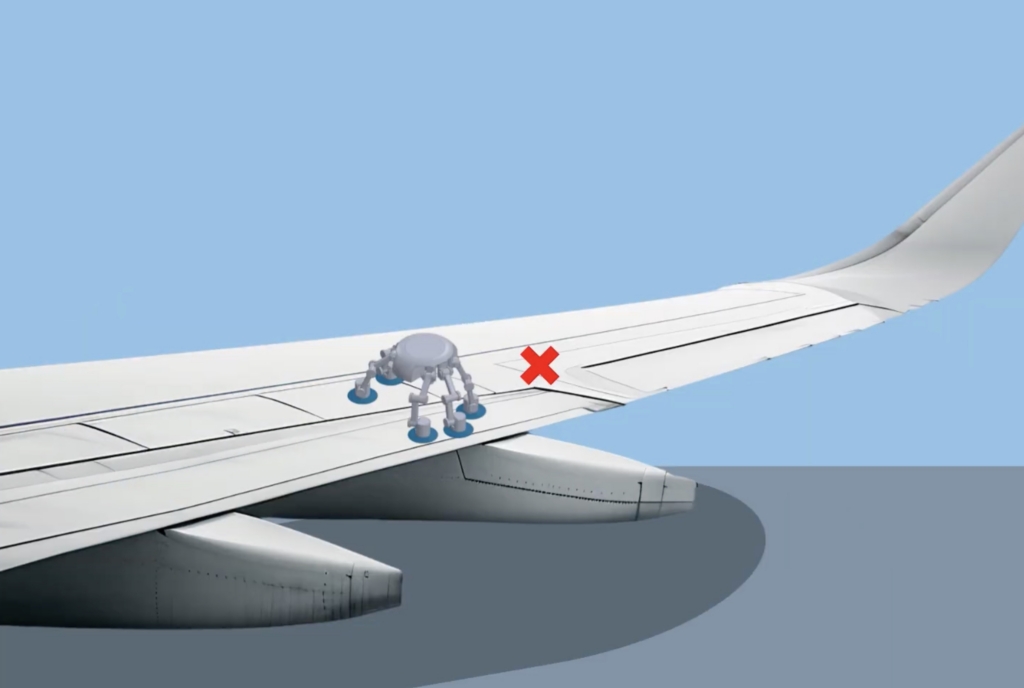
Unlike conventional approaches that require scaffolding, disassembly or extensive manual access, the robot attaches itself to the airframe and traverses curved surfaces while maintaining stability. It performs controlled surface work such as corrosion removal without needing to reposition equipment or remove structural components.
The implication is significant: aircraft maintenance could increasingly be carried out directly on the airframe, reducing downtime, labour intensity and operational disruption.
Augmented reality tools transform how aircraft technicians access data
Alongside robotics, the WINGMAN concept introduces a complementary innovation focused on the technician.
The system consists of augmented reality safety glasses that provide mechanics with real-time information while they work. Equipped with a display, microphone and onboard controls, the glasses allow users to access instructions, retrieve technical data and navigate procedures without stepping away from the task at hand.
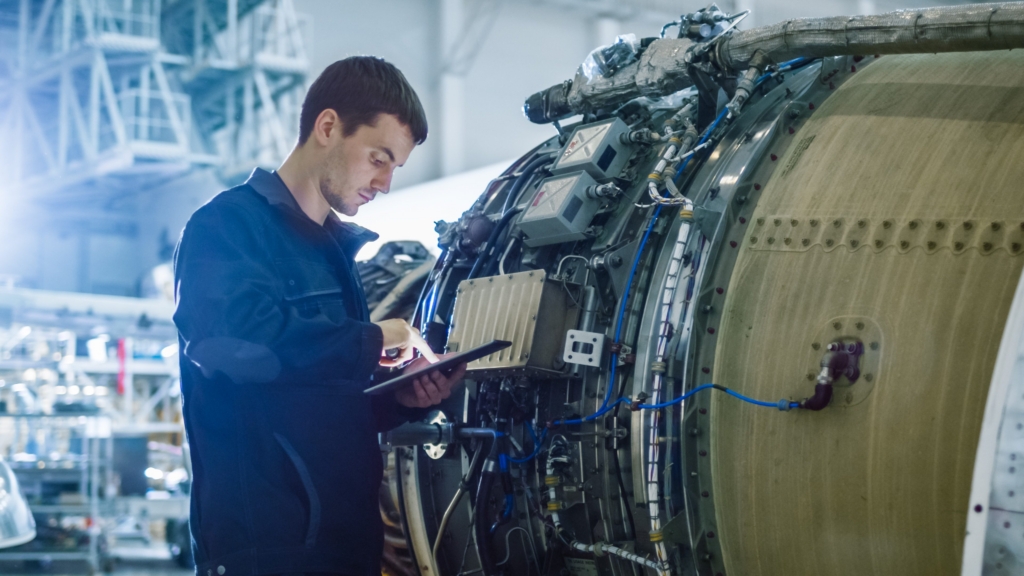
In practical terms, this reduces reliance on manuals or external devices while keeping attention firmly on the aircraft. Step-by-step guidance delivered within the technician’s field of view also introduces a level of consistency that is difficult to achieve through traditional maintenance workflows.
Inspection technology targets hard-to-reach aircraft structures and confined spaces
The third concept, S.P.I.D.E.R. (Surveying Platform and Inspection Device for Enclosed Regions), addresses a less visible but critical aspect of aircraft maintenance: inspection of confined or hard-to-access areas.
While still at an early stage, the system is designed to navigate enclosed regions within aircraft structures where human access is limited, providing inspection capability without requiring extensive disassembly.
Together, these approaches highlight a key trend in modern MRO, where mobility, automation and data access are converging to improve inspection accuracy and efficiency.
NASA Blue Skies finalists highlight shift toward automated and data-driven MRO
Beyond South Dakota State University, the finalist list includes concepts such as smart mechanic glasses, structural health monitoring systems and sensor-driven inspection networks. The full list of finsllists is:
- Embry-Riddle Aeronautical University Daytona Beach with Cecil College Maryland: Advancing Aircraft Maintenance, Smart Mechanic Glasses
- Manhattan University – Aircraft Enhanced Resilience and Intelligence Systems (A.E.R.I.S)
- Michigan State University – Surface Evaluation Network for Tethered Inspection and Nondestructive Evaluation (SENTINEL)
- South Dakota State University – Surveying Platform and Inspection Device for Enclosed Regions (S.P.I.D.E.R.)
- South Dakota State University – WINGMAN, augmented reality data-logging and information-display system for improved efficiency in line maintenance inspections and reporting
- South Dakota State University – Surface Preservation and Rust Killer (S.P.A.R.K.) Crawler
- University of California, Irvine – Aircraft Structural Health Intelligence for Evaluation and Lifecycle Detection (Air SHIELD)
- University of Maryland Eastern Shore – APU Sentinel: A Self-Supervised Learning Framework for APU Fuel Control Unit Health Management in Aircraft
Collectively, these concepts point to an industry in transition, where aircraft maintenance is increasingly supported by data, automation and digital interfaces rather than manual inspection alone.
Each of the seven finalist teams has been awarded $9,000 and will advance to Phase 2 of the challenge. The competition is explicitly geared toward improving efficiency, safety and cost-effectiveness in aviation maintenance by 2035, with an emphasis on solving today’s MRO challenges rather than distant future concepts.
Phase 2 will see teams submit a final paper, infographic and formal presentation, culminating at the 2026 Gateways to Blue Skies Forum on May 18 at NASA’s Langley Research Center in Hampton, Virginia. The event will also be livestreamed globally, extending visibility beyond the immediate aerospace community.
Following the forum, members of the winning team who meet eligibility requirements will be offered internship opportunities with NASA Aeronautics, reinforcing the programme’s dual focus on innovation and workforce development.
NASA’s approach combines workforce development with technological innovation, linking student-led ideas to real-world aircraft maintenance challenges. While the concepts vary in maturity, they point to a future shaped by practical, scalable advances.
Featured image: stock.adobe.com