From Gulfstreams to Super Guppy: Meet the aircraft fleet used by NASA

April 4, 2026
NASA has a diverse fleet of aircraft for various missions, with some owned/operated by other federal agencies. As NASA’s aircraft tend to be extremely specialised, its fleet sometimes resembles more of a menagerie of museum pieces than a modern fleet.
NASA’s Airborne Science Program aircraft
NASA’s Airborne Science Program (ASP) is responsible for providing aircraft systems that further science and advance the use of satellite data.
NASA’s ASP operates a selection of Gulfstream business jets, including the Gulfstream C-20A (GIII) – AFRC, Gulfstream III – LaRC, Gulfstream IV – AFRC, and Gulfstream V – AFRC. These are modified for various roles, e.g., the C-20A “serves as a multi-role cooperative research platform for the earth science community and a variety of flight research customers.”
The ASP also operates NASA’s P-3 Orion, which is based on the Lockheed L-188 Electra that first flew in 1957. The P-3 listed by NASA as unavailable has the tail number N426NA. The Wallops Flight Facility in Virginia manages it, and it is related to the NOAA Hurricane Hunters mentioned below.
NASA’s Airborne Science Program aircraft:
- Gulfstream C-20A: 1 Aircraft
- ER-2: 2 Aircraft
- Gulfstream III: 1 Aircraft
- Gulfstream IV: 1 Aircraft
- Gulfstream V: 1 Aircraft
- Lockheed P-3 Orion: 1 Aircraft
- Boeing 777-200ER: 1 Aircraft (in retrofit)
✈️ Mission Complete!
— NASA Armstrong (@NASAArmstrong) September 29, 2025
NASA Armstrong’s high-flying ER-2 aircraft has completed its 2025 support of the Geological Earth Mapping Experiment (GEMx), a multi-year NASA-U.S. Geological Survey campaign to map critical mineral resources across the Western U.S. 🌍
The 36th and final… pic.twitter.com/weu6bRosm1
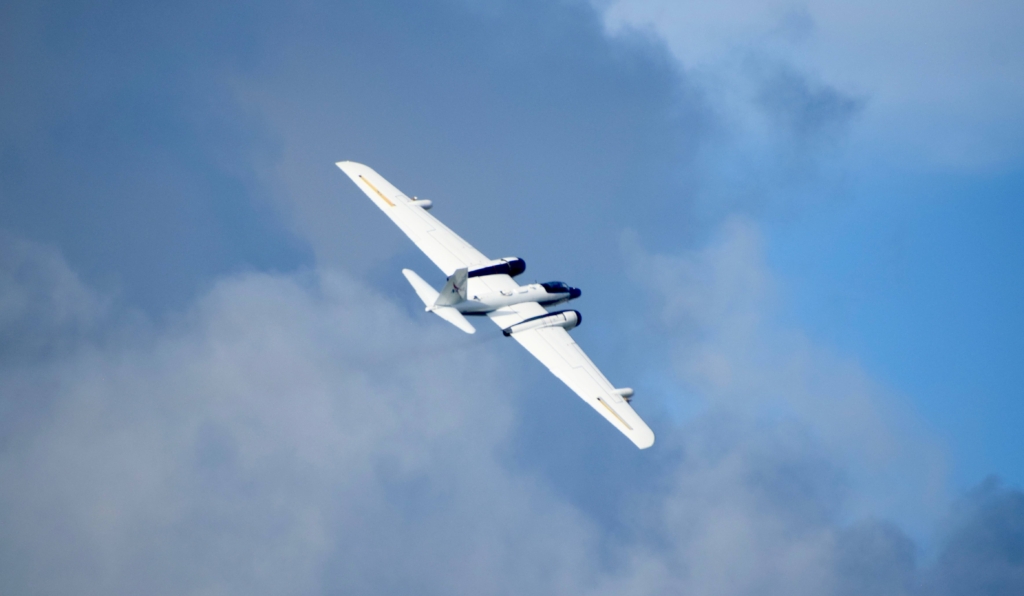
The ASP also operates NASA’s two iconic ER-2 aircraft, which are based on the famous Cold War Lockheed U-2 Dragon Lady. As of the time of writing, one’s (#806) status is listed as “Proficiency Flights,” while the other (#809) is listed as “600-Hr Maintenance.”
Another notable aircraft is its new 777-200ER, more on that below.
NASA’s upcoming Boeing 777 flying laboratory
Planespotters.net focuses on commercial aircraft and so lists NASA with only a single operational aircraft, the Short C-23 Sherpa (which is not related to NASA’s core Airborne Science Program). Planespotters.net also lists a former Japan Airlines Boeing 777-200ER as parked.

According to NASA, the Boeing 777-200ER was acquired to replace and extend the capabilities of its now-retired DC-8. The 777 was procured in 2024 and is currently being retrofitted to carry out “a variety of remote sensing and gas sampling instruments in order to answer some of the most challenging questions in earth science. “
Its first operations are planned for fiscal 2027 from NASA Langley Research Center. It will function as a flying laboratory enabling data collection to better understand “earth system processes.”
NASA says the old DC-8 supported diverse fields such as atmospheric chemistry, archaeology, biology, ecology, hydrology, meteorology, oceanography, and volcanology.
Other NASA aircraft
Aircraft listed by NASA as “other NASA aircraft” include the NASA Langley Beechcraft B200 King Air (NASA 529) and the related Beechcraft Super King Air B200 (#801). The former is currently active, while the second is in flyable storage.
Another aircraft listed by NASA is the Gulfstream V – JSC. This is currently tasked with the pending Human Spaceflight Artemis II programme that will see humans fly by the moon for the first time since the Apollo programme.
BREAKING | Video shows a NASA plane making a belly landing at Ellington Airport. Here’s what we know right now. https://t.co/aqC7z1IMTu
— KHOU 11 News Houston (@KHOU) January 27, 2026
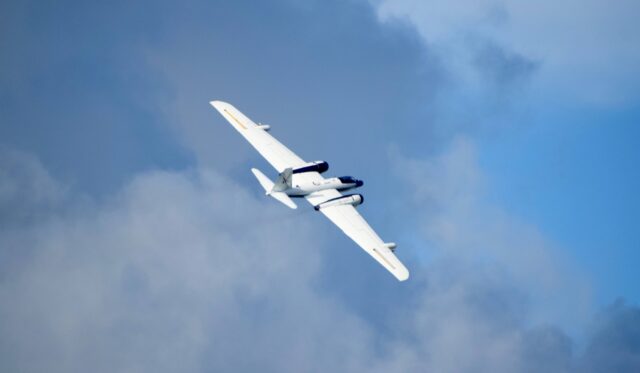
Here, NASA also lists the Black Swift S2 UAS, but more notably, its three Martin WB-57 Canberras. AGN reported in late January 2026 that one of them made a hard belly landing in Houston with the pilots emerging seemingly unharmed. A Canberra also watched over the recent Artemis II launch in Florida.
Other NASA aircraft:
- Beechcraft King/Super King: 2 aircraft
- Gulfstream V: 1 aircraft
- Martin WB-57 Canberra: 3 aircraft
- Aero Spacelines Super Guppy: 1 aircraft
- Northrop T-38 Talon: Multiple aircraft
- F-15 Eagles: 3 aircraft
- F/A-18 Hornets: 3 aircraft
NASA is currently listing its WB-57 #926 as “Major Inspection”, #928 as “Major Inspection On Indefinite Hold”, and #927 as “Imagery Support (Placeholder)”. These aircraft have been used to provide imagery for missions like space launches.
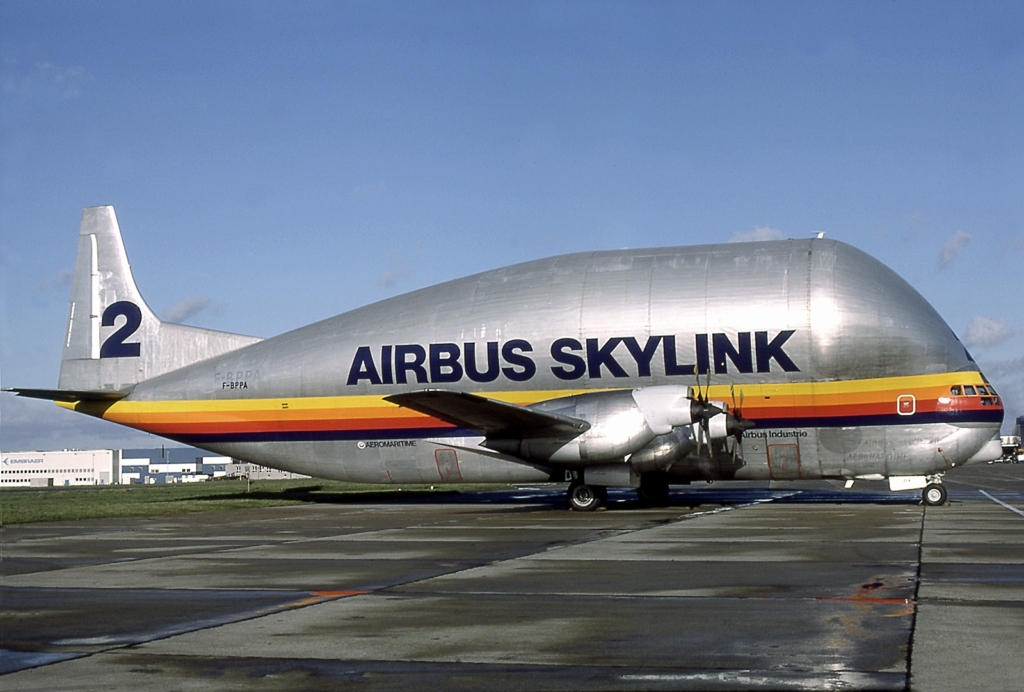
The Aero Spacelines Super Guppy is a modified Boeing 377 Stratocruiser acquired by NASA to carry bulky space equipment. The Boeing 377 first flew in 1947 and is one of the few aircraft still in operational service that can trace its development back to WWII.
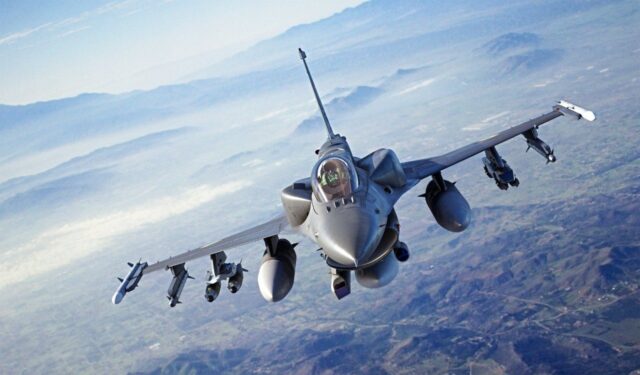
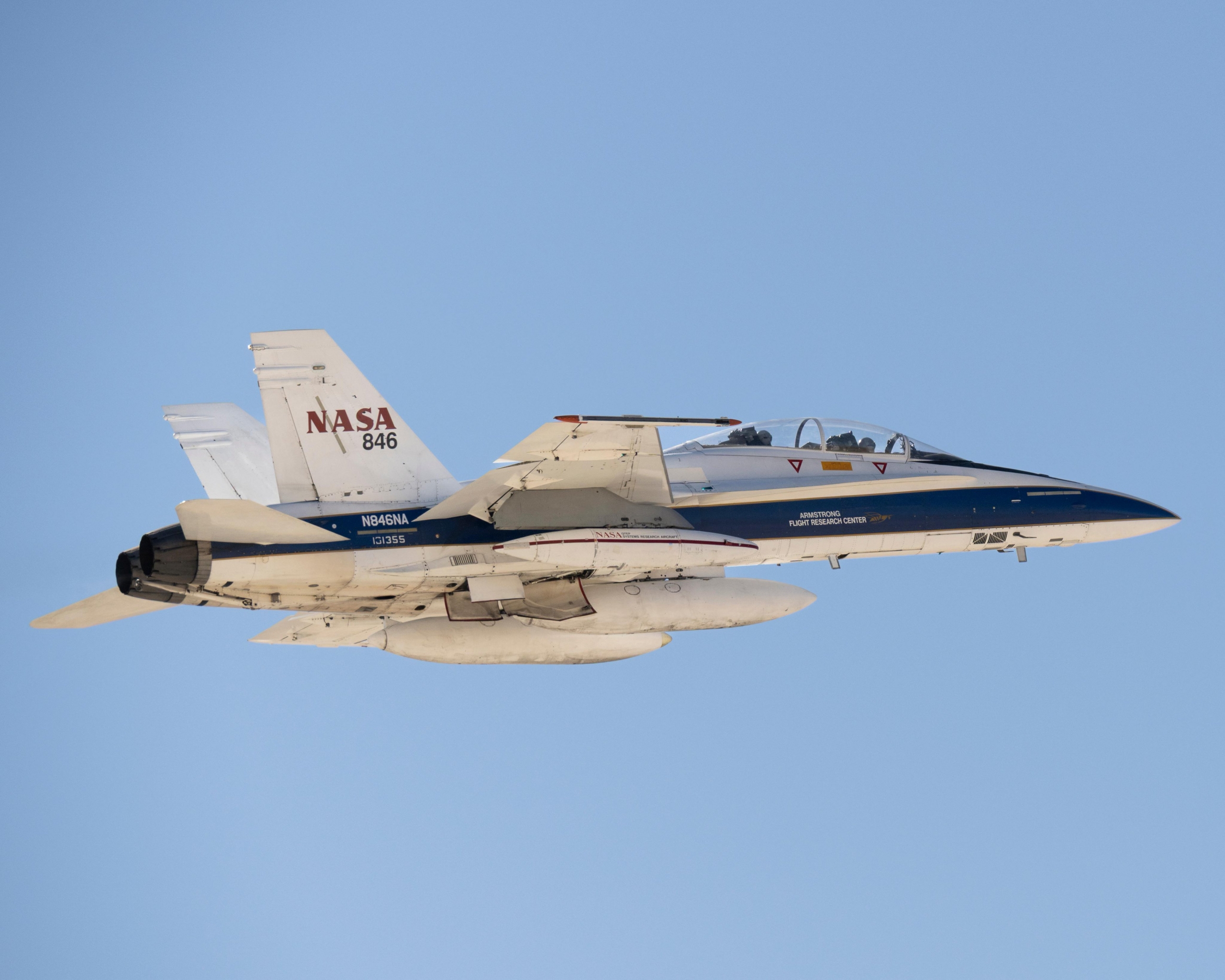
Notably, NASA operates a fleet of fighter jets as chase planes. It has a fleet of three McDonnell Douglas F/A-18 Hornets and three McDonnell Douglas F-15 Eagle fighter jets. These are all based at the Armstrong Flight Research Center.
NASA also operates a fleet of around 20 Northrop T-38 Talon advanced jet trainers used for astronaut training.
Non-NASA aircraft part of its Airborne Science Program
NASA operates a number of aircraft not listed above. NASA explains, “NASA instrumentation may fly on non-NASA Federal aircraft as well as academic and commercial platforms.” These aircraft collaborate with NASA, but are not owned by NASA.
One of the most notable is the Lockheed C-130 NSF/NCAR, a model EC-130Q. NASA says the Hercules is ideal for studies of the middle and lower troposphere. It is also able to carry out other missions, such as deploying specialised equipment like ocean buoys.
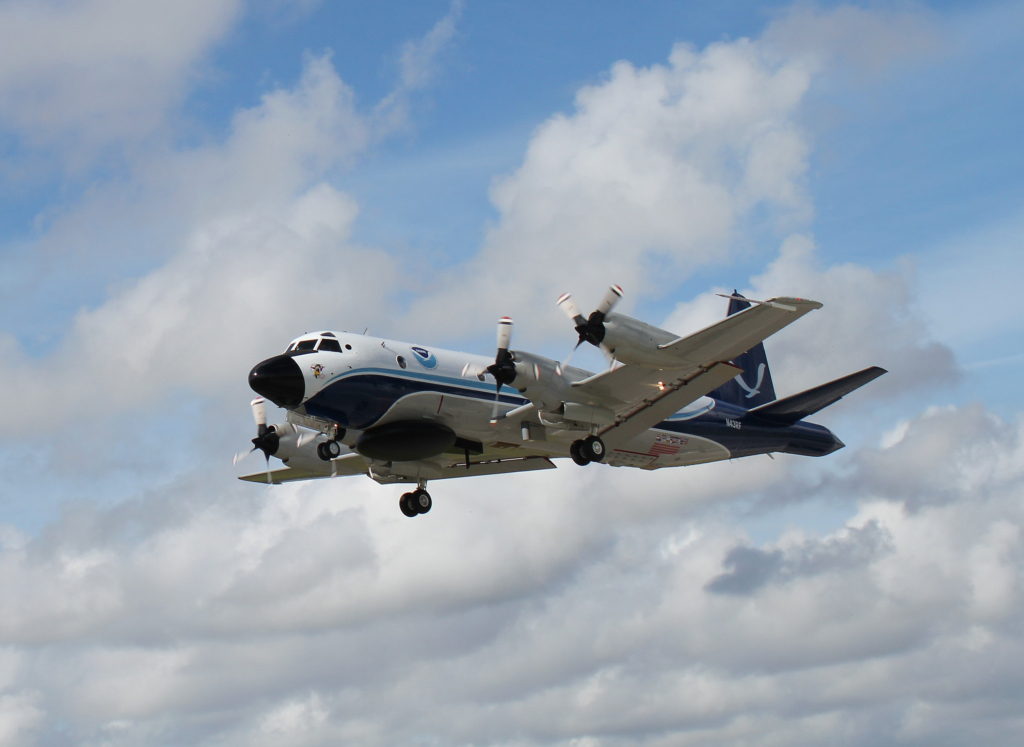
Perhaps most famous are the two NOAA WP-3D Orions, “Hurricane Hunters,” with the tail numbers N42RF “Kermit” and N43RF “Miss Piggy”. These are specifically modified for the National Oceanic and Atmospheric Administration (NOAA)
Non-NASA Airborne Science Program-related aircraft:
- Lockheed C-130 Hercules: Operated by National Science Foundation
- RC-12 Huron: Operated by US Navy
- UV-18 Twin Otter: Operated by US Navy
- NOAA WP-3D Orion: Operated by NOAA
- King Air 350: Operated by National Science Foundation
- Twin Otter: Operated by Naval Postgraduate School
- Gulfstream V: Operated by National Science Foundation
AGN has previously reported that NOAA has awarded a contract to Lockheed Martin to replace its ageing Orions with specialized C-130J Super Hercules hurricane hunters. They are expected to join the fleet in 2030.

Other aircraft listed include the King Air 350. Wyoming, C-130 Hercules, RC-12 Huron, Twin Otters, and Gulfstream V.
Love innovation and technology? Discover more of our stories here.
NASA’s fleet of experimental aircraft & Mars helicopter
Even this understates the scope of NASA’s fleet of various aircraft. NASA is developing and operating a range of experimental aircraft.
NASA has developed the one-of-a-kind Lockheed Martin X-59 QUESST experimental aircraft to study ways to reduce the sonic boom caused by supersonic aircraft. QUESST first flew in October 2025, and has recently undertaken its third flight, setting new milestones in supersonic flight.
NASA was developing the X-66 truss-braced experimental aircraft, but shelved it in 2025 in favour of thin-wing aircraft. NASA developed the X-57 Maxwell, which flew in 2023, but was then cancelled.
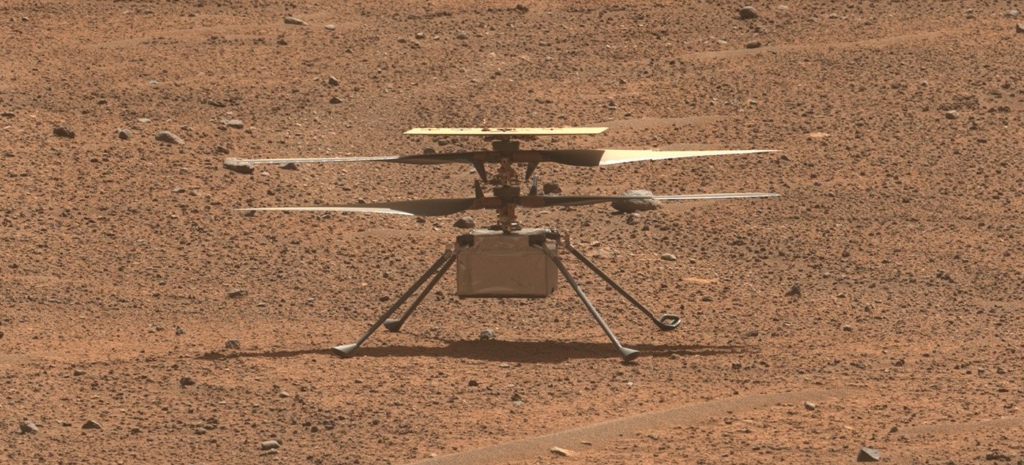
One of the most remarkable is NASA’s Ingenuity Mars Helicopter, which became the first aircraft to fly on another planet in 2021 and remained operational until 2024. As of the time of writing, Ingenuity is grounded permanently on Mars due to rotor blade damage.

Besides these aircraft, NASA operates a range of spacecraft, including the Artemis systems that are set to return humans to the Moon.
Featured Image: NASA