Musk vs O’Leary: How Starlink’s problematic WiFi economics led to an epic airline-supplier showdown and who’s right about the costs?

January 22, 2026

A very public spat flared between SpaceX owner Elon Musk and Michael O’Leary after Ryanair’s CEO poured cold water on installing Starlink in-flight WiFi on Ryanair’s Boeing 737 fleet. Here’s what went down between the two bombastic leaders, and what is known about what it costs airlines to provide the service.
How the Musk-O’Leary Starlink showdown started
O’Leary has previously argued that the economics of providing in-flight WiFi are unsustainable for the carrier’s low-cost model, so it’s not a new position for the airline’s leader, or even particularly focused on Starlink alone. For many years, Ryanair has not considered any type of in-flight connectivity worth the costs of supplying it.
However, O’Leary’s refusal to join the growing number of airlines that have announced they will offer Starlink WiFi evidently triggered Musk (and Starlink engineering execs). They disputed Ryanair’s fuel-burn claims on the social media site X (formerly Twitter), which is also owned by Musk.
The spat “began” after O’Leary ruled out equipping Ryanair’s 600+ jets with Starlink, citing antenna drag/fuel impacts and estimating the program could cost up to $250 million per year.
He is being misinformed. I doubt they can even measure the difference in fuel use accurately, especially for a one hour flight, where the incremental drag is basically zero during the ascent phase due to high angle of attack.
— Elon Musk (@elonmusk) January 15, 2026
And compared to most other connectivity solutions,…
After O’Leary’s comments, Musk responded on X, calling O’Leary “misinformed” and disputing Ryanair’s ability to measure fuel impact.
O’Leary then called Musk an “idiot” on Irish radio (Newstalk), and Musk replied with a tweet calling O’Leary an “utter idiot” and suggesting Ryanair should “fire him.”
Ryanair CEO is an utter idiot. Fire him.
— Elon Musk (@elonmusk) January 16, 2026
Ryanair’s argument against Starlink WiFi in a nutshell
Ryanair’s stated case is essentially a matter of flexible economics and inflexible physics. The airline claims there is a fuel penalty due to the “weight and drag” of fuselage-mounted antenna/radomes required to support Starlink WiFi. The fact that radomes generate drag is an undisputed law of physics that Starlink cannot deny, though it does have thinner antennae than other suppliers. However, the two companies strongly disagree on the impact on fuel burn.
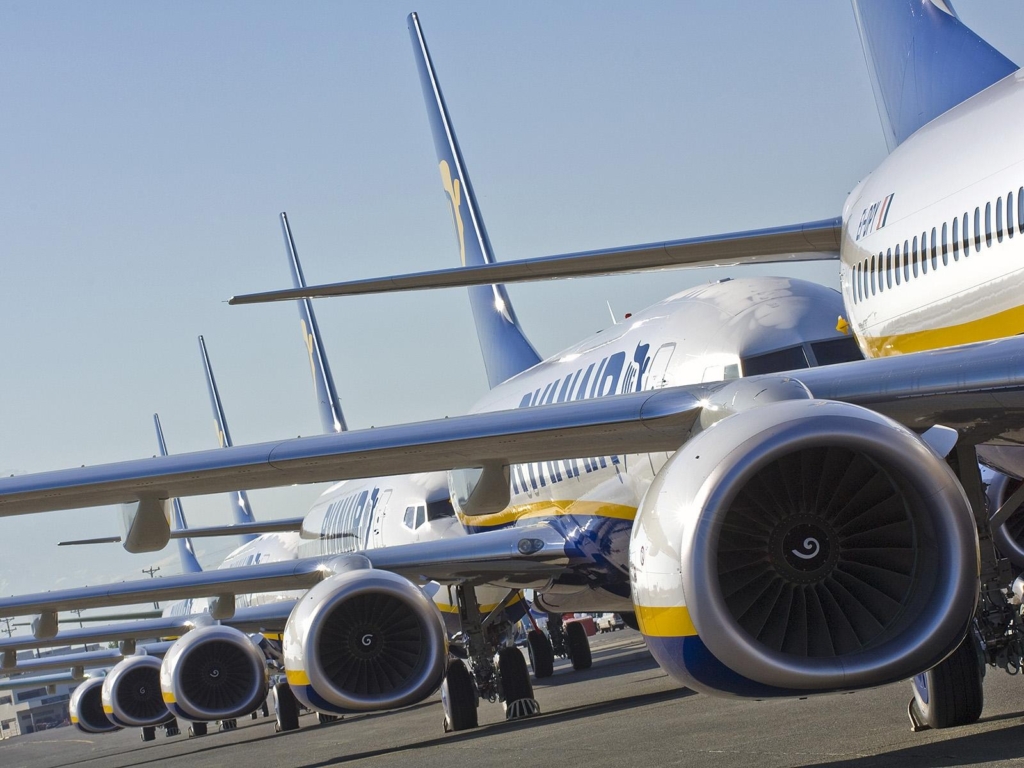
Another economic factor is that Ryanair doesn’t believe enough passengers would pay for WiFi on 1-hour flights to cover the costs of providing Starlink’s service. Other carriers have introduced Starlink as a free service onboard (often with a loyalty program membership requirement), but they make their own commercial decisions. Ryanair has become one of the world’s few consistently profitable airlines (excluding two years during the COVID-19 pandemic) by carefully balancing operating costs and ancillary revenue.
The airline has grown through a “no-frills” approach to flying, and WiFi is a frill. It’s not required to operate the aircraft safely, and unless passengers are willing to pay for it, as they do for food and beverages, then it would not fit Ryanair’s effective commercial strategy to offer it.
As a supplier, Starlink may argue that its fuel burn figures are more accurate, but that doesn’t mean it can persuade (much less bully) the potential buyer. That’s a basic rule of all business, including the airline industry.
Starlink requires two radome antennas, while other IFC providers only require one
All radome antenna installations, regardless of supplier, are expensive and produce drag. However, a key point on the airline costs side is that Starlink installations require installing two radome antennas, whereas other Ku/Ka in-flight connectivity services require only one. The two antennas may contribute to the service’s superior connections, but they still add costs.

FAA documentation for certification on a 737-800 Starlink installation states that “the overall weight of each Starlink Aero Terminal is 38 lbs max”, but that may not include the weight of all wiring and supporting hardware. For its part, United Airlines has stated the Starlink “installation kit” weighs 85 lbs.
Eighty-five pounds added to an aircraft that weighs around 91,300 to 91,700 pounds (41,413–41,594 kg) empty might not seem much, but airlines carefully measure the fuel burn of every pound onboard, down to the added weight of coffee stirrers.
How much does it cost to install Starlink’s radome antennae on aircraft?
The other cost factor is the antenna and initial installation. Starlink has published an MSRP for aviation equipment, putting the antenna costs at $145,000 “for most business jets.” That’s for the equipment only, and installation costs vary.
Independent aviation trade reporting provides common “fly-away” costs—that is, equipment and installation plus STC (special type certificate)—ranging from $225k to $400k, depending on the aircraft and installation complexity.

There is no single, authoritative, public number that says “each Starlink radome antenna costs $X, including installation” for airline retrofits. United Airlines valued its investment in passenger experience enhancements, including the installation of Starlink service at around $1 billion per year, in a Q3 2025 earnings call. However, the airline did not disclose the share of that investment attributable to Starlink installations alone. So we will rely on published industry ranges, averaging $300k per aircraft.
Ryanair’s fleet is nearly 650 aircraft, so Ryanair’s fleet installation costs would be at least $195 million, rounded up to $200 million, not including the operational costs of having aircraft out of service during the installation. That is not far from Ryanair’s Starlink cost claims of $250 million per year in annual fuel consumption, which is a separate cost factor. Combined, it is an expensive investment the cost-conscious airline would not make lightly.
What is the real aircraft fuel burn from Starlink antenna installations?
There are two competing public claims at the centre of the feud. Ryanair’s Michael O’Leary believes the antennae would result in “a 2% fuel penalty because of the weight and drag.”
Michael Nicolls, Starlink VP of Engineering, disputed this figure on X, claiming: “Our analysis shows… fuel increase to a 737-800… is about 0.3%,” adding a rule-of-thumb 737-800 burn figure of 800 gallons/hour.”
A 2% fuel impact might be true for legacy terminals, but @Starlink's terminal is much lower profile and more efficient. Our analysis shows that the fuel increase to a 737-800 (which burns 800 gallons/hour) with our current design is about 0.3%. Also beg to differ on whether… https://t.co/ZtHanpPT7P
— Michael Nicolls (@michaelnicollsx) January 14, 2026
Those two figures are very far apart, and neither side provides hard data to back their claims.
However, even if we were to take Nicolls’ figures as fact, Ryanair published a spend of €5.14 billion ($6 billion) in fuel in 2024. A 0.3% increase would still be a notable sum of $18 million in added fuel costs for the airline’s operations.
Would Ryanair’s passengers pay for in-flight WiFi?
The real question is whether Ryanair’s passengers would pay enough to use Starlink on board that the airline could recoup those added fuel costs, plus make back its $200 million in installation costs.
To keep the calculus simple, let’s assume the airline would try to recoup the $300,000 per aircraft installation over the course of a year. It would need to earn $24,000 per month on the in-flight WiFi from each aircraft to recoup that investment.
An average Ryanair aircraft makes approximately 150 to 180 flights per month, so Ryanair would need to earn at least $133 per flight to offset installation costs, before covering the added fuel costs.
Just as a rough estimate, the average 737 fuel burn that Starlink cited of 800 gallons/hour would cost around $2,500 at average market prices. Adding 0.3% fuel burn would raise that cost by $7.50, so the total costs for Ryanair to recover from Starlink on each flight would be around $140.50. That seems like a reasonable number.

The average Ryanair aircraft carries between 189 and 197 passengers. If every passenger on a full flight on the airline’s densest aircraft were to buy Starlink WiFi—only covering the airline’s costs with no profit at all—that would mean paying $0.71 (€0.60) to connect to the internet for an hour.
That seems really affordable. Of course, Ryanair, being Ryanair, would expect to profit from any ancillary and would probably not charge less than the industry average of $19.70 (€16) per hour of connectivity.
Some Starlink supporters on X claimed they’d be happy to pay far more than that (though the commenter here may not fly with Ryanair often).
Honestly, I would rather pay $50 to $100 for that high speed wifi which can compensate for the fuel cost that they are claiming. Or build that cost into the price of my ticket – BUT GET ME THE HIGH SPEED WIFI on my 2 hour + flight.
— حسن سجواني 🇦🇪 Hassan Sajwani (@Sajwani) January 15, 2026
The problem with that math is passenger uptake on paid WiFi, which is why most airlines charge more per hour for these services.
Ryanair’s main issue with Starlink: most passengers pass on paid in-flight WiFi
The industry’s standard uptake of paid in-flight WiFi is estimated at around 5% to 10% of passengers onboard. Realistically, with a large customer base drawn by cheap tickets, it is far more likely that Ryanair would get WiFi uptake on the lower end of that scale. While Ryanair might earn enough to cover the basic costs, Starlink has not disclosed how much it charges airlines for data consumption.
It is also unlikely that Ryanair will lose passengers because it doesn’t offer in-flight WiFi—it hasn’t yet. WiFi service is simply irrelevant to the airline’s “no frills” paid amenities strategy.
Musk’s big Ryanair-Starlink tactical error
Starlink service is winning over airlines left, right, and centre, but no connectivity service is truly winning over the low-cost sector because the numbers simply do not add up for a low-cost model.
Full-service airlines may see Starlink WiFi as a brand-differentiating passenger experience enhancement and offset some of the costs of offering the service free through loyalty program earnings, but low-cost carriers are far more cautious.
Musk raised the stakes in the dispute, framing it as an issue with Michael O’Leary, and even offering to buy the airline just to oust him. He may want to recall the airline industry aphorism that the fastest way to become a millionaire is to start off as a billionaire and buy an airline.
Starlink WiFi just does not fit Ryanair’s successful strategy, and after Musk now burnt all bridges for Starlink at Ryanair, it probably never will.
Don’t thank us, thank that big “IDIOT” @elonmusk 👀
— Ryanair (@Ryanair) January 20, 2026
Sale now on👇https://t.co/0c6IvsKyyB pic.twitter.com/JAxRNzaYTa
Ryanair will keep flying and offering cheap tickets to its large base of smart passengers and ‘idiots’ alike.
Featured Image: Ryanair