Iran’s hit on E-3 Sentry highlights USAF vulnerability to ground attacks

March 30, 2026
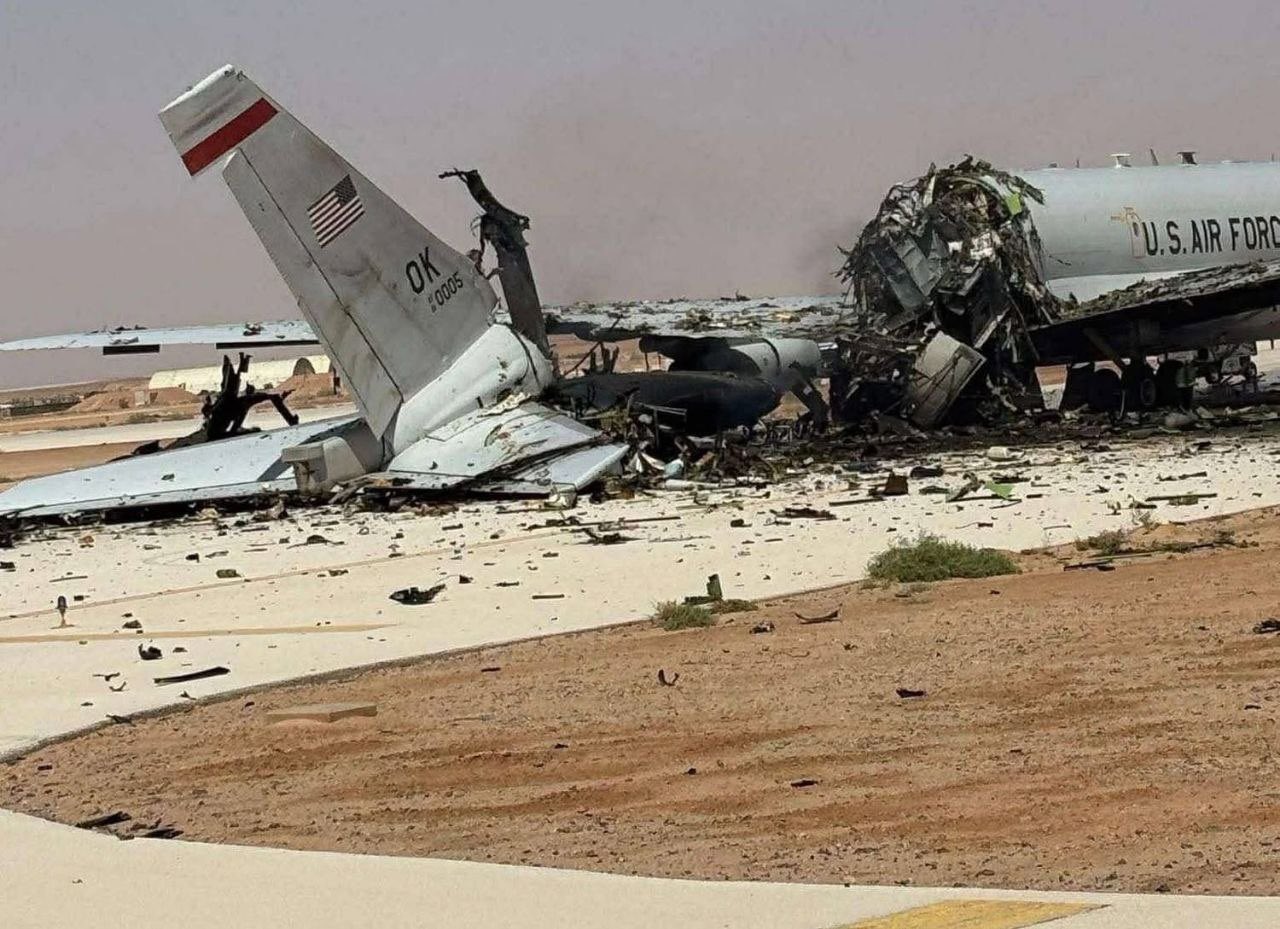
Iran has scored one of its most successful strikes yet, destroying a US E-3 AWACS on the ground. The incident further underlines how little the USAF has learned about how war has changed and how, if it doesn’t adapt, this could be a harbinger of things to come in the event of a war with China.
Iran destroys USAF E-3 Sentry in Saudi Arabia
Over the weekend, images emerged of a hugely successful Iranian strike destroying an E-3 Sentry AWACS aircraft on the ground at Prince Sultan Air Base in Saudi Arabia. The strike also reportedly injured 10 US service members and damaged more KC-135 Stratotankers.
In addition to a number of KC-135 Stratotankers that suffered various levels of damage in yesterday’s Iranian ballistic missile and drone attack on Prince Sultan Air Base in Saudi Arabia, a U.S. Air Force E-3G “Sentry” Airborne Early Warning and Control (AEW&C) Aircraft also… pic.twitter.com/1MFjTKaYoT
— OSINTdefender (@sentdefender) March 28, 2026
The aircraft destroyed is E-3 serial #81-0005, and it is unclear if it was destroyed in a missile or drone attack. Its loss reduces the USAF’s E-3 fleet from 16 to 15 operational airframes.
As with Russia losing its rare and hard-to-replace A-50U Maintstay AWACS aircraft, the loss of even one E-3 Sentry is a blow to the USAF. That said, as it was destroyed on the ground, the USAF has not lost its highly trained crew. A specialized crew is often harder to replace than equipment.
Satellite images showing the aftermath of Iranian strikes on U.S. E-3G Sentry aircraft at Prince Sultan Air Base in Saudi Arabia. https://t.co/SItTmAZTEi pic.twitter.com/gWs5OuWNBv
— Special Kherson Cat 🐈🇺🇦 (@bayraktar_1love) March 29, 2026
According to OSINT account Steffan Watkins, five more E-3 Sentry aircraft remain stationed at Prince Sultan Air Base supporting the air campaign against Iran.
No lessons learned from Ukraine and wargaming
The war in Ukraine has shown how vulnerable aircraft on the ground have become. Ukraine and Russia (especially after Operation Spiderweb) have to be extremely agile with their aircraft deployments. AGN previously reported how Ukraine is operating its F-16s from dispersed bases.
This was likely a shahed or an SRBM hit
— Hûrin (@Hurin92) March 29, 2026
Now imagine what havoc will 00s era DF-16 wreak with submunitions and cep of <10m in a WestPac contingency 😉 https://t.co/PccwsRJhtv pic.twitter.com/UeLKZT78Jh
Wargaming by thinktanks like CSIS has also shown that in a conflict with China, most US aircraft that are destroyed are lost on the ground.
In response, the USAF has developed its Agile Combat Employment (ACE) doctrine that will see the aircraft dispersed across airfields and kept mobile.
And yet, in this Iran conflict, OSINT accounts have remarked how the US has concentrated its high-value aircraft at airbases, parking them closely, and leaving them in the open with no hardened shelters for extended periods of time.
Writing a doctrine like ACE is easy; implementing it in the real world is hard.
Hopefully there will FINALLY be a real wake up call here on hardened infrastructure for air bases. They (DoW leadership) have and are living in a fantasy land with this. It's maddening. It's easier to kill your most potent combat aircraft on the ground, where they sped the vast…
— Tyler Rogoway (@Aviation_Intel) March 29, 2026
The War Zone’s Tyler Rogoway took to X (Twitter) to post, “Hopefully there will FINALLY be a real wake up call here on hardened infrastructure for air bases. They (DoW leadership) have and are living in a fantasy land with this. It’s maddening… This is Iran. China will be a bloodbath.”
Get the latest aerospace defence news here on AGN.
USAF’s E-3 Sentry options
OSINT account, Armchair Admiral posted, “I’m not sure people are quite realising that these things are literal gold dust. They cannot be replaced; they’re incredibly unreliable as it is, and they’re mission-critical. To lose a single E-3 is a big problem.”
🇺🇸 #USAF E-3G Sentry AWACS fleet (now 15); last reported locations 2026-03-28Z
— Steffan Watkins (@steffanwatkins) March 29, 2026
Prince Sultan AB 🇸🇦 (5)
➢ 🇺🇸 81-0005 #AE11EE 💀
➢ 🇺🇸 79-0001 #AE11E7
➢ 🇺🇸 82-0007 #AE11F0
➢ 🇺🇸 75-0556 #AE11D6
➢ 🇺🇸 76-1605 #AE11DC
➢ 🇺🇸 76-1604 #AE11DB
Elmendorf AFB 🇺🇸 (2)
➢ 🇺🇸 80-0137… https://t.co/ry2hSKEv5L pic.twitter.com/8J97NenIml
The US has been phasing out its fleet of E-3s as the rickety old aircraft reach the end of their service lives. But whereas the Royal Air Force sold its E-3s to Chile, the US still has its E-3s mothballed in the Davis-Monthan boneyard, and it is unclear if any could be reactivated.
In the medium term, the Air Force has a couple of options to replace its E-3 Sentries. One option is to continue with its original plan and purchase a fleet of new E-7 Wedgetails. The second option is to purchase a limited number of less-capable naval E-2D Hawkeyes as an interim measure.
Following completion of the assembly, the two USAF configuration E-7 AEW&C's will head to the UK for conversion. https://t.co/BbG3kALejT
— Air-Power | MIL-STD (@AirPowerNEW1) March 28, 2026
The Pentagon said last year it wanted to cancel the E-7 programme, while Congress seems to be pushing back and providing funding. The first two prototypes are funded. These are being built by Boeing and are soon to head to England for conversion.
Long-term, the Air Force wants to move its E-3 missions into space.
Featured Image: X