A sneak peek at Casablanca’s new $1bn airport terminal as Morocco targets global hub status

March 23, 2026
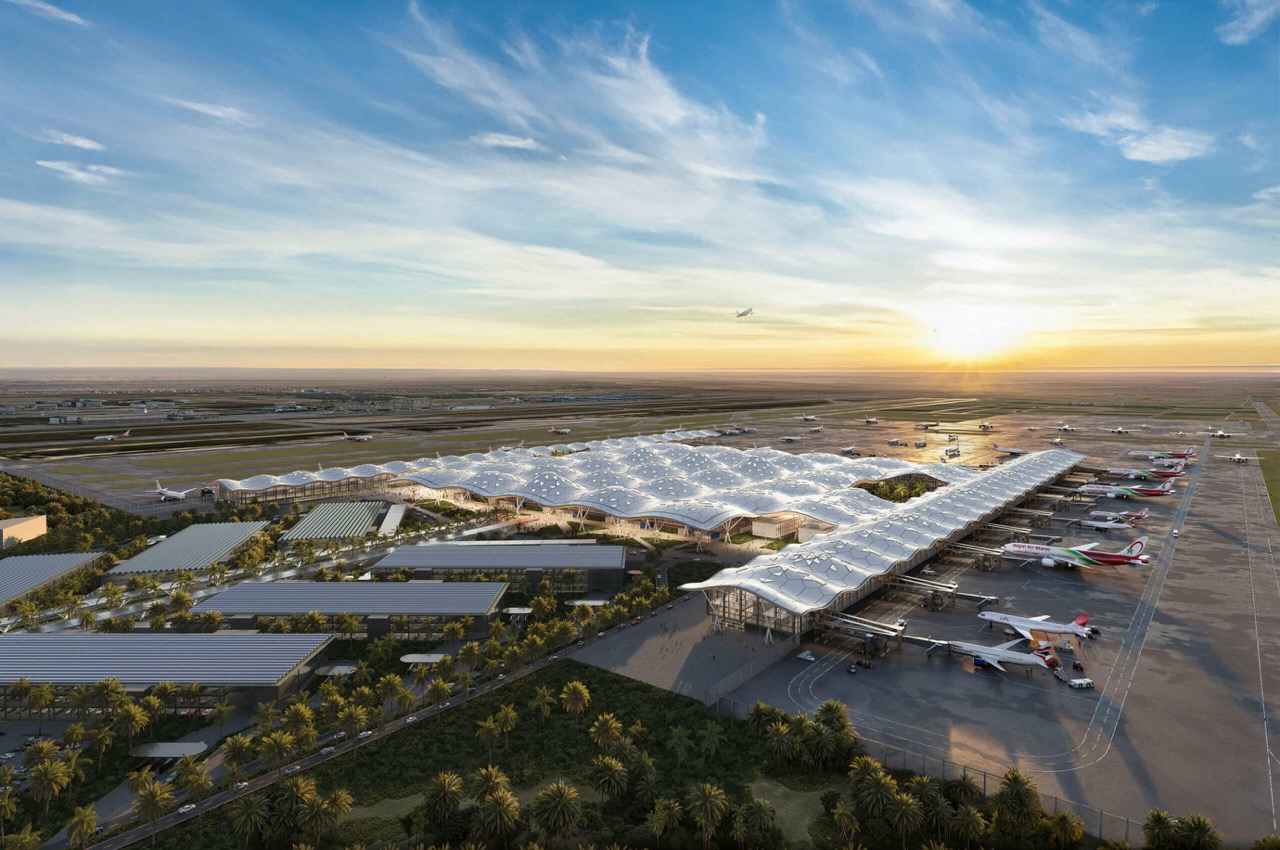
A striking new terminal design for Casablanca’s Mohammed V International Airport has been unveiled, offering a first look at Morocco’s ambitions to transform the airport into a major intercontinental hub ahead of the 2030 FIFA World Cup.
Designed by British architecture firm RSHP, the new terminal blends large-scale infrastructure with a distinctly local architectural identity, positioning Casablanca as a key gateway between Africa, Europe and the wider world.
A landmark “H-shaped” hub terminal
The National Office of Airports (ONDA) will invest 12 billion Dirhams (around $1.3 billion) in building the new terminal, which will form the centrepiece of Morocco’s busiest airport, significantly increasing its capacity and operational efficiency.
Planned as an “H-shaped” structure, the terminal will feature a central building flanked by two wings—an approach designed to optimise passenger flows and aircraft movements.
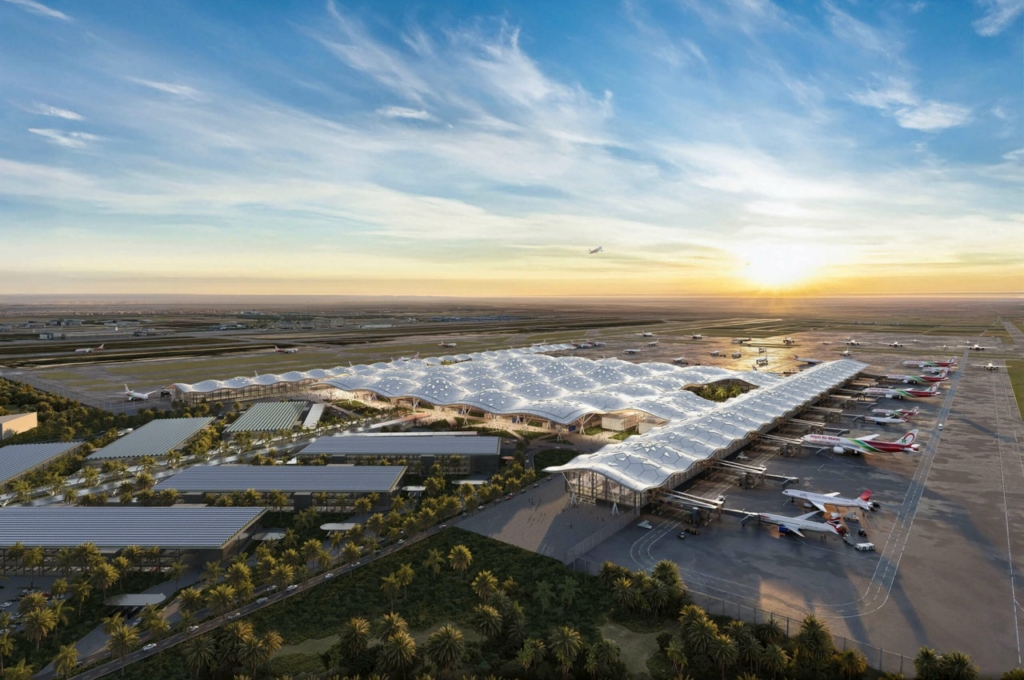
Initial capacity is expected to reach around 20 million passengers annually, with scope to expand to 30 million or more as demand grows.
Overall, the expansion will boost the airport’s total capacity to roughly 35 million passengers per year, more than doubling current throughput of 11.5 million passengers in 2025.
Design inspired by the Atlantic and Moroccan heritage
RSHP’s design concept draws heavily on Casablanca’s coastal setting and cultural identity. The architects intend to build the terminal as a modular system for “rapid, component-based construction.”
The terminal’s sweeping rooflines are inspired by the movement of Atlantic waves, while interior spaces incorporate traditional Moroccan elements. “An ochre-toned soffit articulated by a hexagonal motif and punctuated with rooflights references the bejmat and terracotta zellige of Moroccan architecture, the craftsmanship of the country’s southern provinces,” RSHP writes in its announcement.
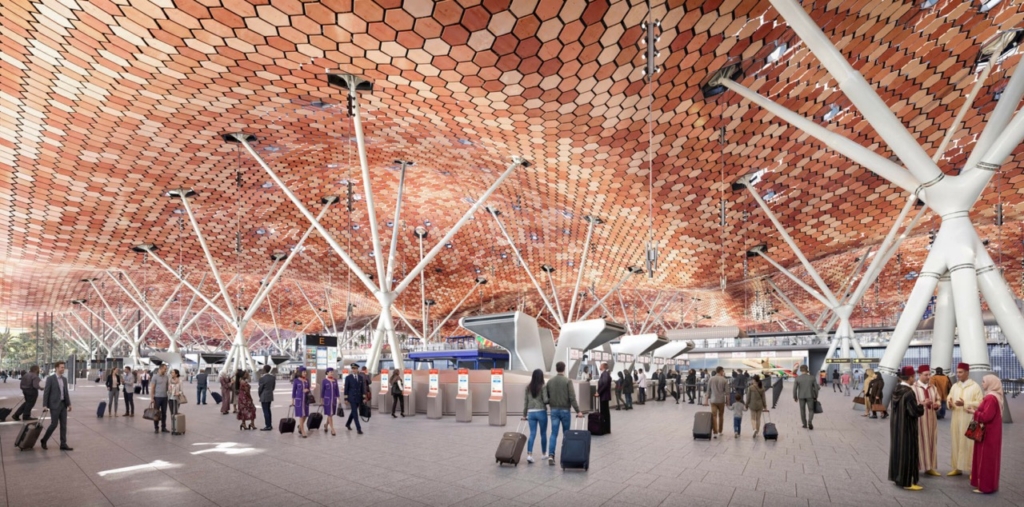
Architects describe the building as a progression from large, light-filled public spaces to more intimate, calming areas, creating a passenger experience that ensures “comfort, efficiency and hospitality.”
“The airport will be a celebration of light, warmth and human scale, undulating from grand central spaces to intimate and calming oases, a memorable experience for all travelling through it,” said Ivan Harbour, Senior Design Director RSHP. “It will be a state-of-the-art, responsible, building that interprets and celebrates the landscape of its place to create a graceful threshold between Casablanca and the world beyond.”
Across three main levels, green “oasis” areas, natural light, and landscaped zones create a welcoming airport environment that feels like a destination in its own right.
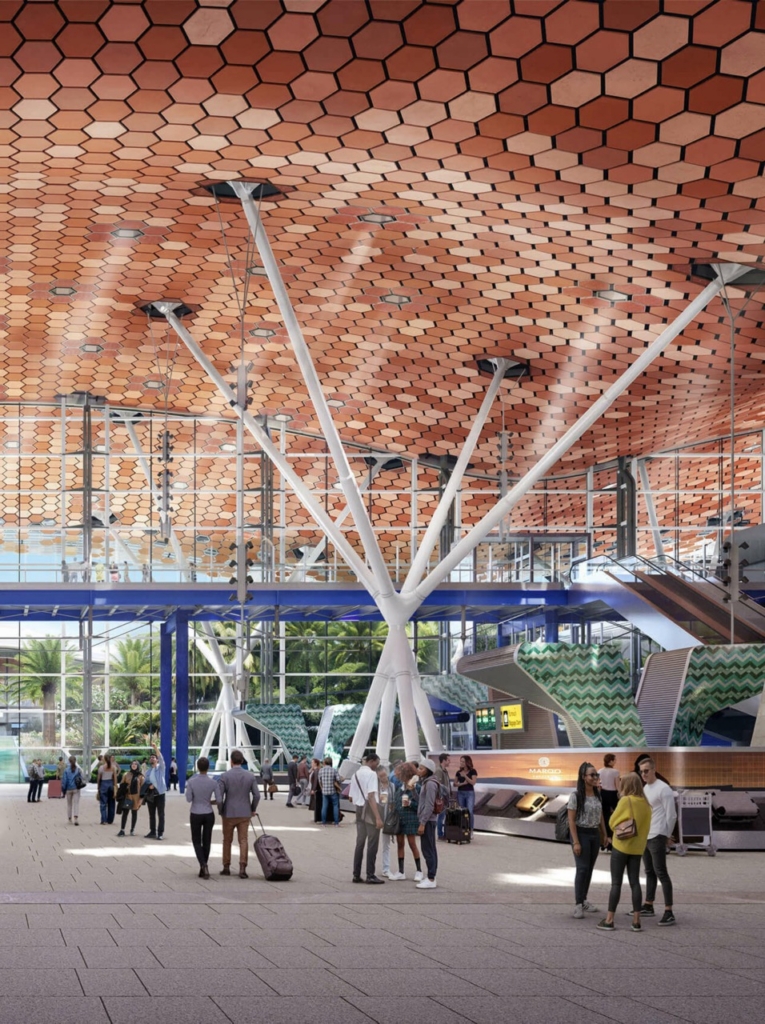
“Beyond the responsibility of designing buildings that are environmentally and socially sustainable, a key architectural challenge in airport design is capturing a spirit of place—avoiding the creation of in-between spaces where a traveller can feel themselves to be both everywhere and nowhere,” said Stephen Barrett, Director RSHP / Gérant RSHP France. “While resolutely contemporary, this project seeks to offer a distinctly Moroccan experience, giving passengers the unmistakable sense that they have arrived in Casablanca.”
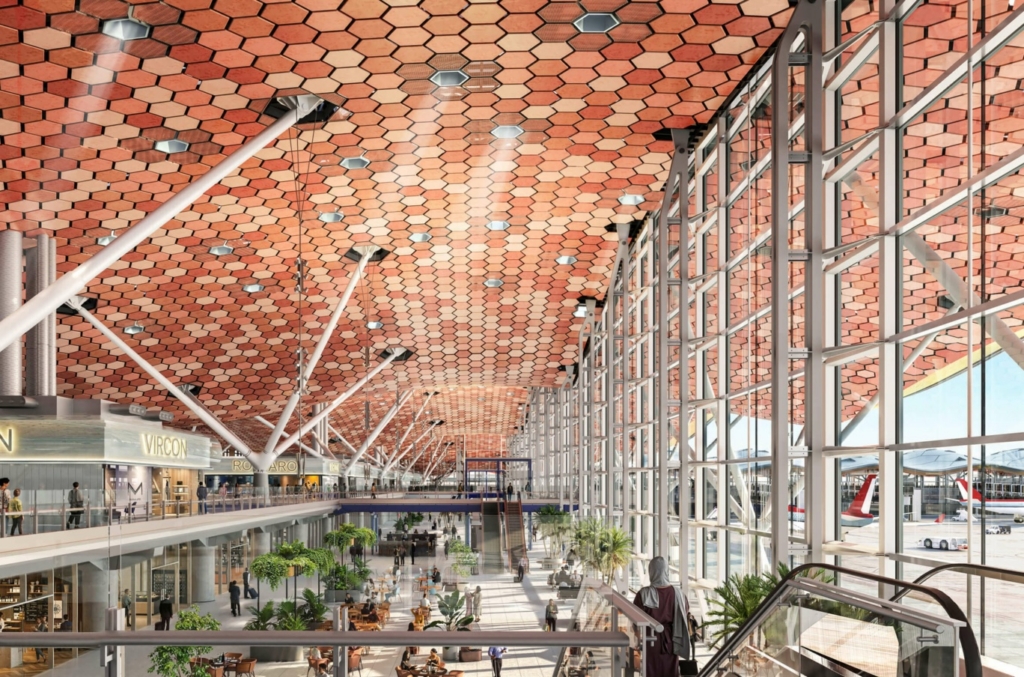
Experiential features include “an expansive Duty-Free area, VIP lounges, and a premium airport hotel,” all with “sweeping views of the airfield.”
Built for multi-modal connectivity and the 2030 World Cup
The project is a cornerstone of Morocco’s “Airports 2030” strategy, which aims to modernise infrastructure and support rapid growth in tourism and aviation demand.
Key infrastructure elements of the Mohammed V International Airport’s new terminal project include:
- A new 3,700-metre parallel runway
- Expanded taxiways and aircraft stands
- A 42-metre air traffic control tower
- A high-speed rail station linking Casablanca to Rabat and Marrakech
“This high-speed link will not only reduce travel times between Casablanca and key urban centres but also improve accessibility for both domestic and international passengers,” the architects state.
Construction is a joint venture between Morocco’s two largest contractors, SGTM and TGCC. The levelling and excavation, which began in July 2025, have been completed. The terminal is scheduled to open by 2029, just ahead of Morocco co-hosting the 2030 FIFA World Cup with Spain and Portugal.
An experience-led airport design that positions Casablanca as a key gateway to the world
Casablanca’s Mohammed V Airport is already among Africa’s busiest hubs, and the expansion is designed to elevate its role as a key intercontinental connector.
With enhanced capacity, improved passenger flows and integrated rail links, the airport is expected to strengthen connections across Africa, Europe, the Middle East and the Americas.
The development also supports Royal Air Maroc‘s growth ambitions, positioning Casablanca as a strategic hub for long-haul and connecting traffic.
Beyond capacity, the RSHP design signals a broader industry shift toward experience-led airport architecture, where passenger comfort, cultural identity, and seamless journeys are as important as operational efficiency—all while “meeting international standards for connection times, baggage handling, and aircraft gate access.”
“This project represents an important step in Morocco’s evolving infrastructure,” said Jack Evans-Newton, Associate Director, RSHP. “By bringing together a major international airport and the high-speed rail network, the new terminal strengthens national connectivity while positioning Casablanca as a key gateway between Africa, Europe, and the wider world.”
Featured image: RSHP



![NASA's X-59 Quesst [registration N859NA '859'] is seen in-flight over California during the experimental supersonic aircraft's brief second test sortie on 21 March 2026. Image: NASA/Jim Ross](https://aerospaceglobalnews.com/wp-content/uploads/2026/03/X-59-Second-Flight-21-03-26-NASA-Jim-Ross-crop-scaled-640x0-c-default.jpg)