Four years after its destruction, will Ukraine’s Antonov An-225 Mriya ever fly again?

February 27, 2026

Four years ago today, on 27 February 2022, the one-of-a-kind Antonov An-225 Mriya was destroyed during the battle for Hostomel Airport in the opening days of Russia’s full-scale invasion of Ukraine.
Within weeks, Kyiv vowed that the world’s largest aircraft would fly again, framing its reconstruction as a symbol of national resilience. Yet turning that promise into reality remains profoundly difficult, dependent not only on funding and engineering, but on the outcome of a war that is still being fought.
Battle of Hostomel Airport and the destruction of the Antonov An-225
The An-225 Mriya was destroyed in the opening stages of Russia’s full-scale invasion of Ukraine during the decisive Battle of Hostomel Airport. The airfield northwest of Kyiv had long served as the home base of the mighty aircraft.
Russian VDV paratroopers were airlifted in to seize the airfield as a forward staging ground for what Moscow appeared to envisage as a rapid, decapitating strike on Kyiv and the Ukrainian government.
Despite months of invasion warnings from the United Kingdom and the United States, Ukraine was caught off balance. Available units in the area were hastily assembled and dispatched to counter the assault. In fierce fighting, Ukrainian forces succeeded in driving the paratroopers from the airfield
The intensity of the battle was later captured in accounts reported by the Kyiv Independent. Georgian volunteer fighter Mamuka Mamulashvili recalled racing toward the airport in his 2000 BMW 5 Series, running out of ammunition and, in desperation, using his car to ram Russian paratroopers. “I can show you the dents in my BMW,” he later said.
Video of Russian forces in Hostomel from the beginning of the war. Not a particularly tactical posture. No surprise Ukrainian artillery did so much damage to VDV units there.https://t.co/CJFZ4b3dO4 pic.twitter.com/y2wDOXnyOx
— Rob Lee (@RALee85) September 8, 2022
The main Russian ground thrust advancing from the north to relieve the isolated paratroopers soon stalled in what became a sprawling, highly visible convoy stretching for kilometres along the approach to Kyiv.
By the time conventional army units reached the area and reinforced the embattled airborne troops, the strategic opportunity had already slipped away. Momentum had been lost and the airfield was too heavily damaged to serve as the rapid air bridge Moscow had intended.
February 24, 2022.
— Status-6 (War & Military News) (@Archer83Able) February 24, 2026
A stunned Ukrainian girl watches as Russian forces commence the assault on the Hostomel Airport in Ukraine's Kyiv Oblast.
Russian helicopters pass just next to her apartment, while sounds of battle can be heard in the distance and piles of smoke seen rising… pic.twitter.com/YxDrekXeA6
Fighting in and around the airport continued for weeks before Russian forces ultimately withdrew from the Kyiv region and retreated toward Belarus.
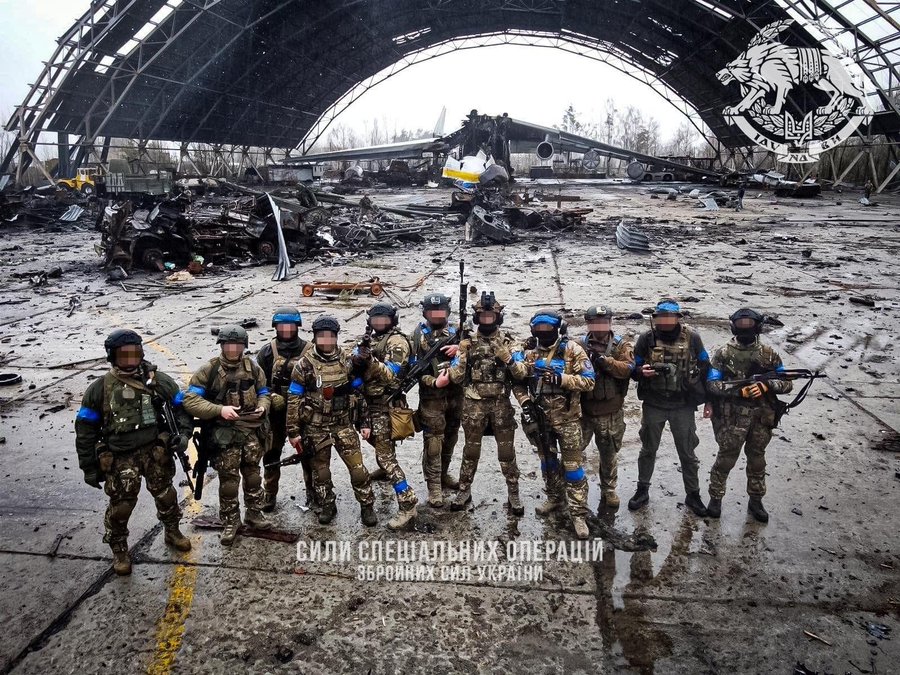
When Ukrainian troops re-entered the site, the full scale of the destruction became clear. Among the wreckage inside its hangar lay the Antonov An-225 Mriya, the pride of Ukraine’s aviation industry, destroyed during the battle.
The destruction of the Antonov An-225 Mriya was a national blow to Ukraine
The An-225 was more than the world’s largest aircraft. In Ukraine, it symbolised national pride and industrial ambition. On the fourth anniversary of the invasion, President Volodymyr Zelensky released the first footage from his bunker, where a model of the Mriya is visible among the personal effects.
Today marks exactly four years since Putin started his three-day push to take Kyiv. And that says a great deal about our resistance, about how Ukraine has fought all this time. Behind those words stand millions of our people, immense courage, incredibly hard work, endurance, and… pic.twitter.com/9qiqACurhx
— Volodymyr Zelenskyy / Володимир Зеленський (@ZelenskyyUa) February 24, 2026
The destruction of the An-225 was a significant symbolic blow for Ukraine, even as Kyiv successfully repelled the initial assault on the capital.
In the aftermath, questions were raised about why the aircraft had remained at Hostomel despite mounting warnings of a large-scale invasion. Most of Ukraine’s surviving Antonov transports were flown out to safety, many relocating to Leipzig in Germany, where Antonov Airlines now maintains a key operational base.
3 years ago today, Antonov's An-225 Mriya was destroyed by shelling after Russian troops occupied its base at Hostomel Airport, northwest of Kyiv. pic.twitter.com/6RmAhxoaju
— OSINTtechnical (@Osinttechnical) February 27, 2025
An appeal for donations to fund an An-225 replacement was launched. One website dedicated to collecting donations to fund its reconstruction is the An-225 Fund.
Ukraine quickly swore it would build the An-225.
Antonov’s plan to rebuild the An-225 Mriya
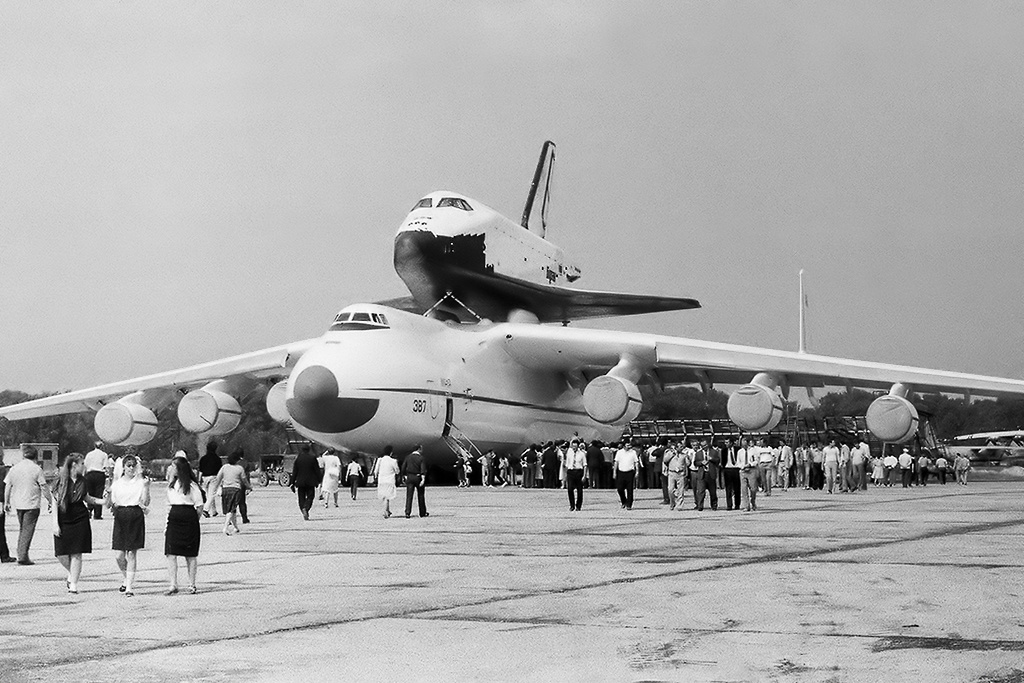
In November 2022, CNN reported that Antonov had begun early preparatory work on a replacement aircraft. The original An-225 had been developed in the late Soviet era to transport the Buran space shuttle, a role that dictated its extraordinary size and payload capacity.
I saw the An-225 Mriya in November 2021 before it was destroyed at Hostomel 3 months later. 640 tons of pure aeronautical genius. Built to thrive in the harshest conditions. It was our ambassador with wings.
— Klitschko (@Klitschko) December 21, 2025
„Mriya“ means dream in Ukrainian. Rebuilding it isn’t a dream, it’s a… pic.twitter.com/VtaAB5JNKR
Antonov later confirmed that initial design work on a rebuild was underway and said it possessed roughly 30% of the components required to complete a new airframe. The company indicated that returning the aircraft to flight condition would cost in excess of €500 million and that fuller details would only emerge after the war.
Earlier estimates from Ukraine’s state defence conglomerate, Ukroboronprom, had been far higher, suggesting restoration costs could exceed $3 billion and take at least five years to complete. Officials at the time pledged that Russia would ultimately bear the financial burden.
Momentum, however, slowed. By September 2024, Ukrainska Pravda reported that Antonov had paused further work on the project until the end of hostilities, reflecting both financial constraints and the priority given to wartime needs.

Antonov confirmed that it had completed an initial assessment of the destroyed aircraft, including restoration planning and a detailed fault diagnosis.
Some components from the wreckage were salvaged. In addition, there remains the partially completed second An-225 airframe, which was under construction when the Soviet Union collapsed. Work halted with the aircraft estimated to be roughly 70% complete, and it has remained unfinished ever since.
The An-225 will not be replaced while Ukraine is at war
Rebuilding the An-225 would require vast financial and industrial resources that Ukraine simply cannot prioritise while fighting an existential war. Funding, engineering capacity and political attention are being directed toward the immediate demands of national defence rather than long-term symbolic projects.
A similar dynamic is visible in Russia, where the war has strained parts of its commercial aviation sector and complicated the maintenance of certain high-profile military assets. Large legacy surface combatants and other prestige platforms have reportedly faced increasing logistical and financial pressures.
Under these conditions, there is little realistic prospect of the An-225 being rebuilt while the conflict continues. Over the past year, Antonov has provided no substantive updates, and most recent coverage has largely revisited earlier announcements rather than signalling renewed momentum.
#an225 takeoff by @flyrosta at GML pic.twitter.com/WJwV4ozxkm
— ANTONOV Airlines (@AirlinesAntonov) August 13, 2021
That does not mean the project is abandoned. The case for rebuilding the aircraft may ultimately rest less on commercial logic than on symbolism. A revived An-225 would represent more than restored lift capacity; it would serve as a powerful marker of national recovery and industrial resilience.
History offers precedent. Concorde, the Anglo-French supersonic airliner, was sustained by governments despite persistent doubts over its economic viability. Its value lay as much in prestige and technological ambition as in profitability.
What a new Antonov An-225 could look like
At present, there are no detailed public design disclosures outlining what a future An-225 might look like. However, the unfinished second airframe, left incomplete when the Soviet Union collapsed, is widely expected to form the structural basis of any rebuild. Antonov has also salvaged usable components from the destroyed aircraft and retains parts commonality with the related An-124 Ruslan.
National Ukrainian Flag Day – colors of Freedom and Independence 💙💛 pic.twitter.com/SRdf8YYU2Y
— ANTONOV Airlines (@AirlinesAntonov) August 23, 2023
Any revived Mriya would almost certainly incorporate modernisation measures, though the extent of those upgrades remains unclear. As a one-off, symbolic flagship rather than a commercially competitive programme, the aircraft would not necessarily need to match contemporary heavy-lift efficiency standards. Its primary objective would be restoration to operational flight.
Propulsion presents one of the most significant technical questions. The original Progress D-18T turbofans are no longer in production and are markedly less efficient than modern high-bypass Western engines. In theory, a re-engining with powerplants such as the Rolls-Royce Trent family, GE CF6, or Pratt & Whitney PW4000 could deliver substantial gains in fuel efficiency and potentially reduce the aircraft’s engine count from six to four.
However, such a change would demand major structural and aerodynamic redesign, including pylon geometry, wing loading, systems integration and certification work. In practical terms, that path would amount to developing an almost entirely new aircraft. Based on available statements, Antonov appears more likely to retain the D-18T configuration, preserving continuity and limiting redesign risk.

Avionics offer a more straightforward upgrade pathway. The original cockpit was largely analogue and dated by modern standards. A rebuilt aircraft could incorporate digital flight displays, updated flight management systems and improvements already introduced into segments of the An-124 fleet, including glass cockpit architecture, modernised hydraulics and refined flight control systems.
For now, the future of the An-225 is inseparable from the future of Ukraine itself. Any decision to rebuild will come after the war, shaped as much by national priorities as by technical capability. Until then, the world’s largest aircraft remains a powerful memory and an open question.
Featured Image: Antonov Company