Aircraft deliveries climb to 7-year high as orders surge and backlog stretches further

February 3, 2026

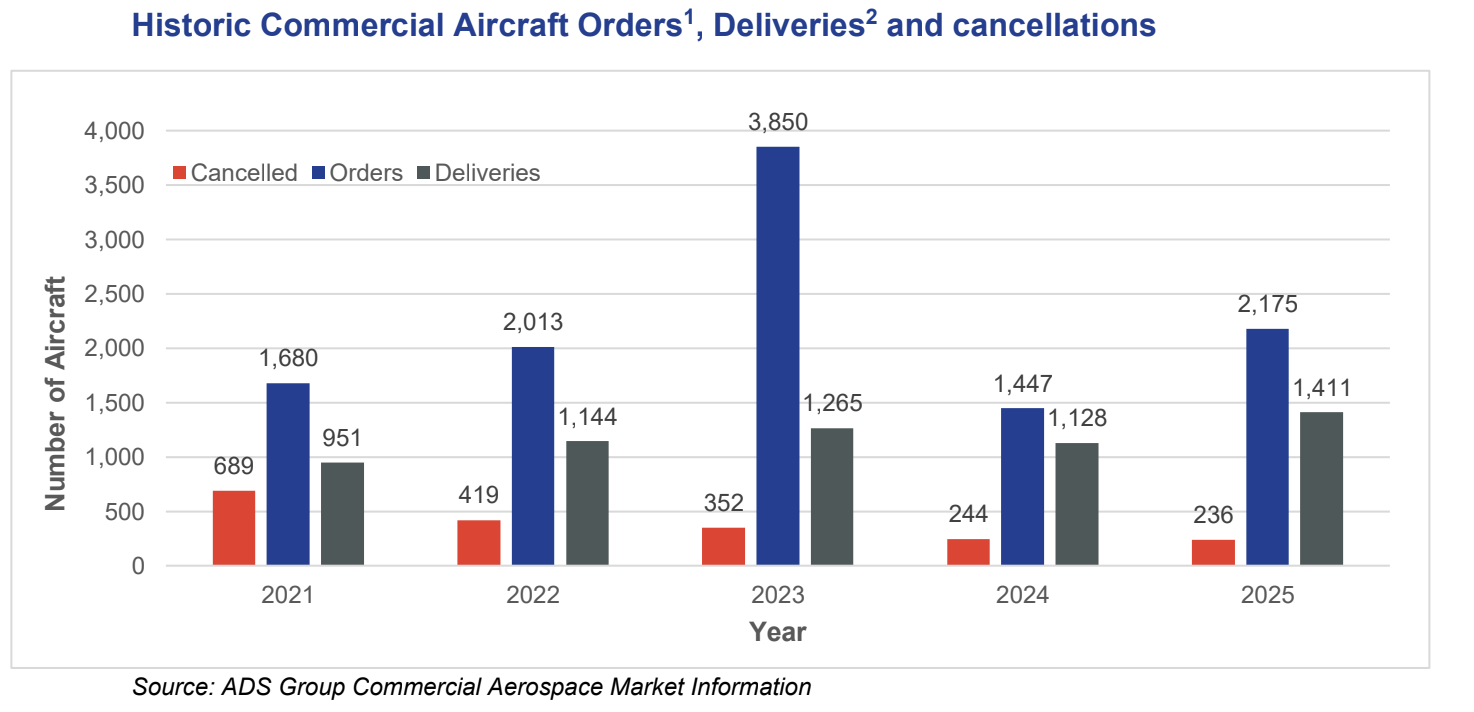
Global commercial aircraft deliveries climbed to their highest level in seven years in 2025, as manufacturers accelerated output and airlines stepped up orders amid a sustained recovery in air travel demand, according to new industry data from ADS.
The UK aerospace trade body reports that 1,411 commercial aircraft were delivered worldwide last year, a 25% increase on 2024 and the strongest annual performance since 2018.
The rebound came despite ongoing supply chain disruption and geopolitical uncertainty that continued to weigh on production rates across the sector.
Alongside higher deliveries, aircraft orders surged sharply.
A total of 2,175 new aircraft were ordered during 2025, representing a 50% year-on-year increase and signalling renewed confidence among airlines in both short- and long-haul markets.
The combination of stronger output and robust demand pushed the global order backlog to a new record of 16,371 aircraft by year-end, extending visibility for manufacturers well into the next decade.
More widebody aircraft deliveries highlights scale of the recovery
While single-aisle aircraft continued to dominate overall volumes, the standout feature of the 2025 data was a sharp rebound in widebody activity.
Deliveries of twin-aisle aircraft reached 246 units, up 43% on the previous year, while widebody orders climbed to 869 aircraft – more than double the level recorded in 2024.
ADS attributes this shift to a sustained recovery in long-haul flying and airline efforts to modernise ageing fleets with more fuel-efficient widebody types.
As a result, the widebody backlog expanded by 24% year-on-year and now accounts for almost 3,000 aircraft, a notable change after several years in which long-haul programmes lagged behind narrowbody production.
Single-aisle deliveries also rose solidly, increasing 22% to 1,165 aircraft.
Orders for the segment reached 1,306 aircraft, underlining the continued importance of short-haul and domestic markets even as international traffic recovers.
Record aircraft order backlog underpins UK aerospace sector value
For the second consecutive year, the global aircraft backlog reached a record high.
ADS estimates that the current order book represents more than 13 years of production at prevailing rates and could be worth up to £269 billion ($368 billion) to the UK aerospace sector, reflecting the country’s extensive role across aircraft structures, systems and engines.

The data covers reported commercial aircraft deliveries from Airbus, Boeing and Comac, with order and backlog figures based on Airbus and Boeing programmes.
Although Comac deliveries remain small by comparison, ADS notes that global production momentum is broadening beyond the traditional duopoly.
Commercial aircraft deliveries exceed industry expectations in 2025
The 2025 delivery total surpassed ADS’s own most optimistic scenario for the year.
Faced with market volatility, trade tensions and shifting manufacturer guidance, ADS opted not to publish a formal forecast, instead modelling modest, medium and high growth outcomes.
Actual deliveries exceeded the high-growth scenario by 71 aircraft, with the strongest performance coming in the second half of the year.
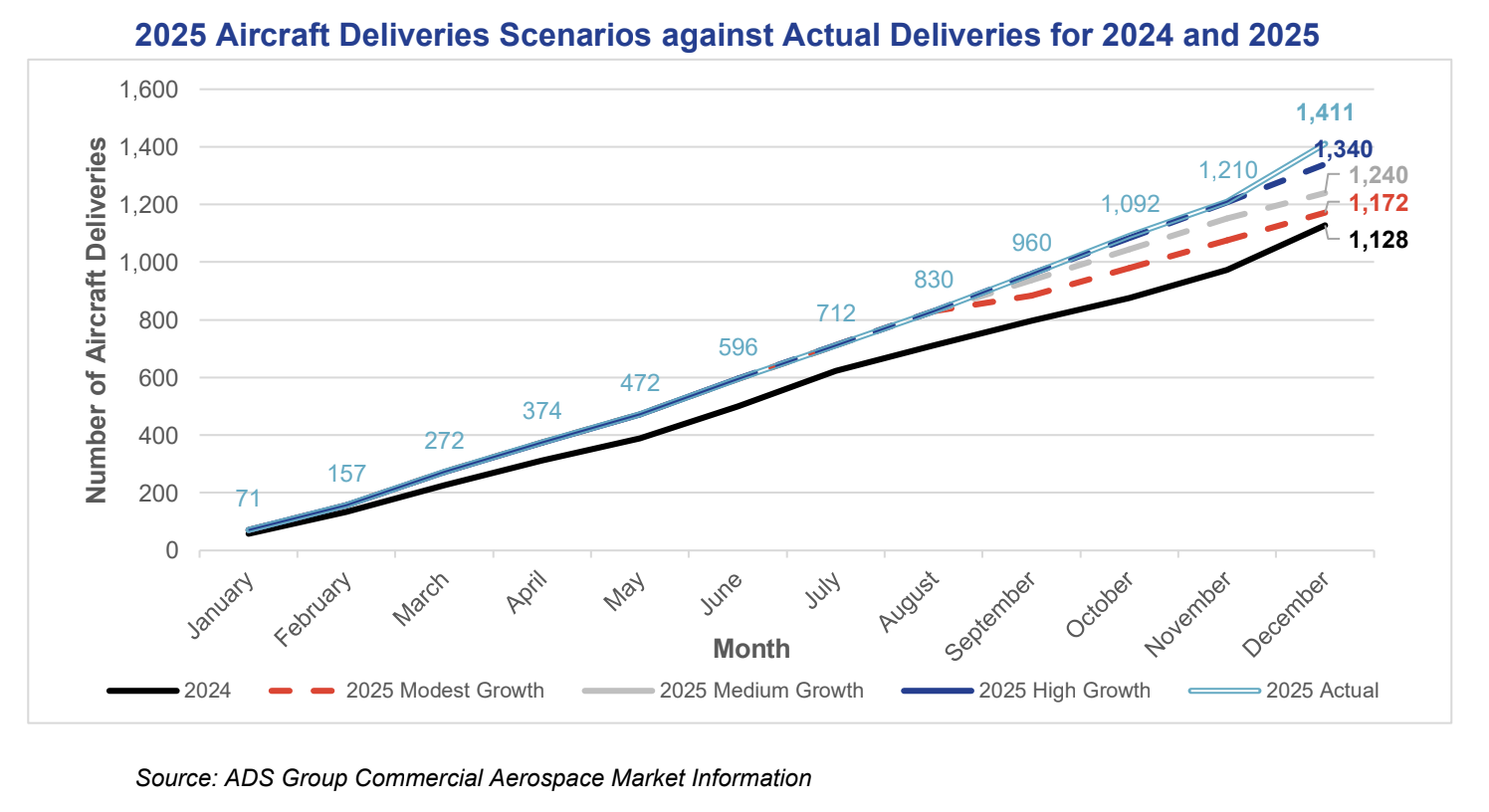
December alone accounted for more than 200 aircraft deliveries, marking the busiest year-end output since before the pandemic and highlighting the seasonal push by manufacturers to meet annual targets.
“2025 proved to be a positive year for the aerospace sector, despite supply chain challenges and a testing geopolitical climate,” says Aimie Stone, Chief Economist at ADS. “The second half of the year in particular delivered stronger than expected results, with deliveries 5% above the ADS ‘high-growth scenario’ for 2025.
“As confidence in the aerospace sector also continues to rise following a drive in aircraft orders, it is vitally important that over the next year, governments around the world work together to create a stable regulatory, policy, and investment environment that allows our sector to thrive.”
Supply chain constraints continue to limit aircraft production
Despite the upbeat headline figures, ADS cautions that supply chain fragility remains the principal constraint on production. Shortages of skilled labour, raw materials and certain components have limited the pace at which manufacturers can raise output, even as demand accelerates.
“The aerospace sector has always been at the cutting edge of innovation, setting ourselves ambitious targets and adhering rigorously to the highest quality and safety standards,” says Balaji Srimoolanathan, Director for Aerospace and the Aerospace Growth Partnership at ADS.
“While the global climate is increasingly unstable and supply chain challenges continue, major manufacturers have ramped up production to surpass their expected delivery capability. As the skies begin to clear for aerospace manufacturers, 2026 will be an important moment to strengthen the UK’s supply chain and to act decisively to ensure our sector remains competitive.”
ADS outlook points to sustained but uneven aircraft production growth
Looking ahead, ADS expects underlying growth in orders and deliveries to continue into 2026, supported by fleet renewal programmes and the long-term push for more efficient aircraft.
However, it also highlights a complex operating environment shaped by geopolitical tensions, trade policy uncertainty and the challenge of scaling production without further stressing supply networks.
Featured image: Delta Air Lines