


KF-21 Boramae enters production as South Korea joins elite fighter-building nations

6 min read
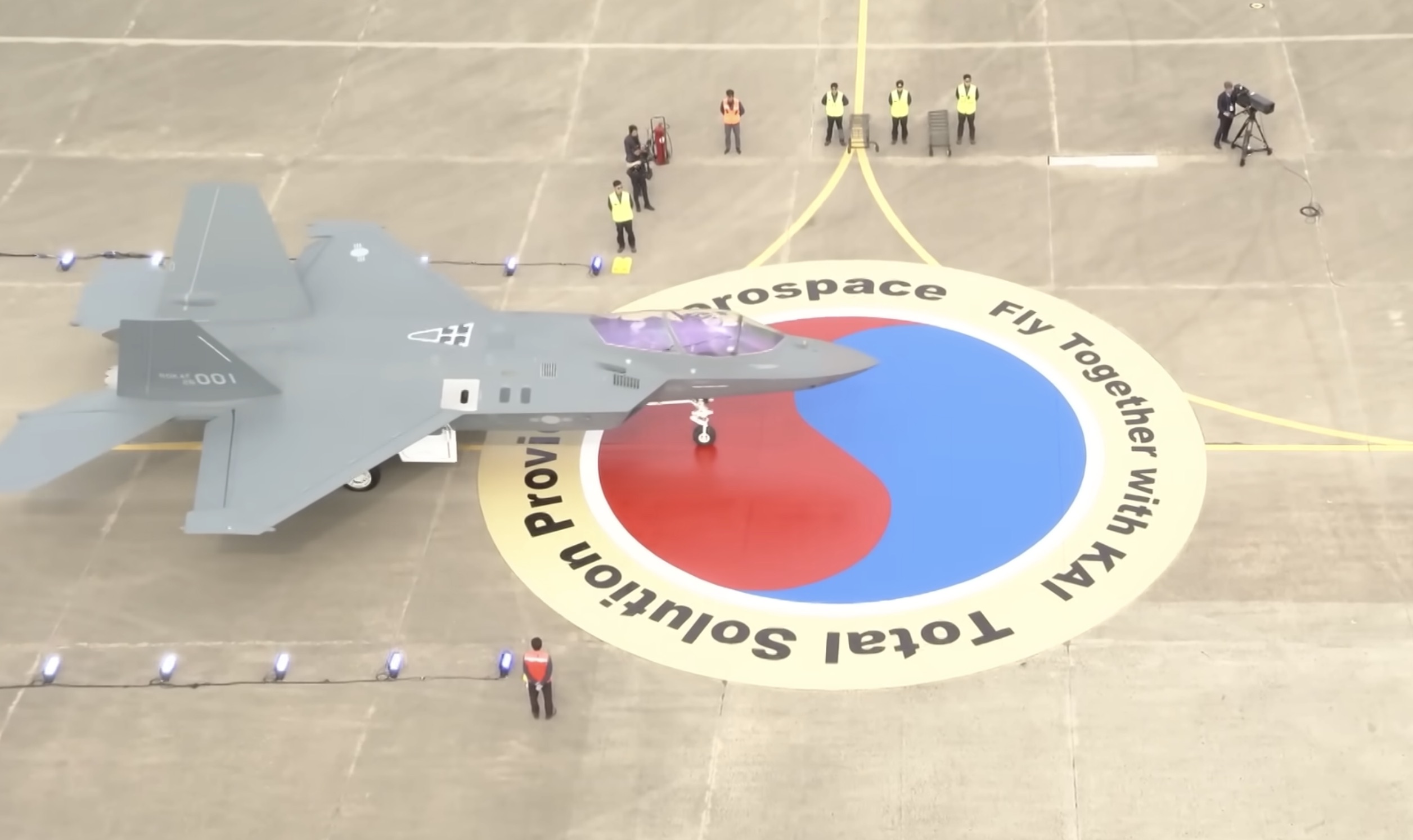
South Korea has rolled out the first production-standard KF-21 Boramae fighter, marking the transition of the long-running programme from development into full-rate manufacturing and signalling Seoul’s growing ambitions in the global combat aircraft market.
The aircraft was unveiled at the Korea Aerospace Industry (KAI) facility in Sacheon, with President Lee Jae-myung in attendance, in what officials described as a milestone more than two decades in the making.
President Lee Jae-myung attended the roll-out ceremony for the first mass-produced Korean fighter jet, KF-21, on 25th, for the ROKAF 🇰🇷. Defense officials said on 25th, that the Philippines 🇵🇭 is among the countries that will buy the KF-21s. Expected to be signed before mid-year. pic.twitter.com/TxTeCtw7Om
— Para Bellum (@ReHorizon3) March 25, 2026
The event, first reported by Arirang TV, the country’s state-run English-language broadcaster, and official news agency Yonhap, underscores the strategic weight attached to the programme as South Korea pushes for greater defence self-reliance.
KF-21 fighter reaches production after 25-year push for defence autonomy
The rollout marks the culmination of a programme that traces its origins back to the early 2000s, when South Korea first set out to develop an indigenous fighter aircraft to replace its ageing fleet of F-4 and F-5 jets.
Over the intervening years, the KF-21 has evolved into one of the most ambitious aerospace projects undertaken by the country, involving domestic industry, government agencies and international collaboration, including Indonesia.
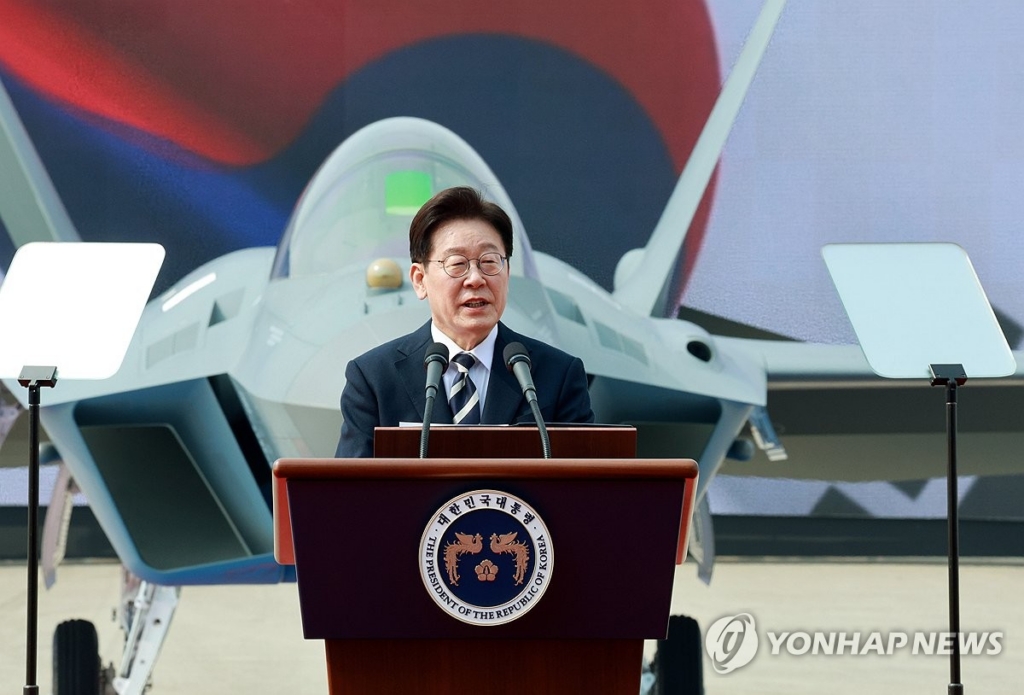
President Lee described the aircraft as a symbol of “self-reliant defence”, noting that South Korea now possesses the capability to design and produce advanced fighter aircraft independently, an achievement previously limited to a handful of nations.
“South Korea has finally secured weapons to protect peace with its own technology, not only on land and sea but also in the air,” Lee said
KF-21 Boramae: South Korea’s 4.5-generation multirole fighter
The KF-21 is designed as a multirole combat aircraft intended to bridge the gap between legacy fourth-generation fighters and more advanced fifth-generation platforms.
According to KAI, the aircraft is built to deliver both air superiority and precision strike capability, with a focus on survivability, networked operations and sustainment efficiency.
It is equipped with an active electronically scanned array (AESA) radar, infrared search and track (IRST), electro-optical targeting systems and an integrated electronic warfare suite, capabilities that place it in the same broad category as other modern 4.5-generation fighters.
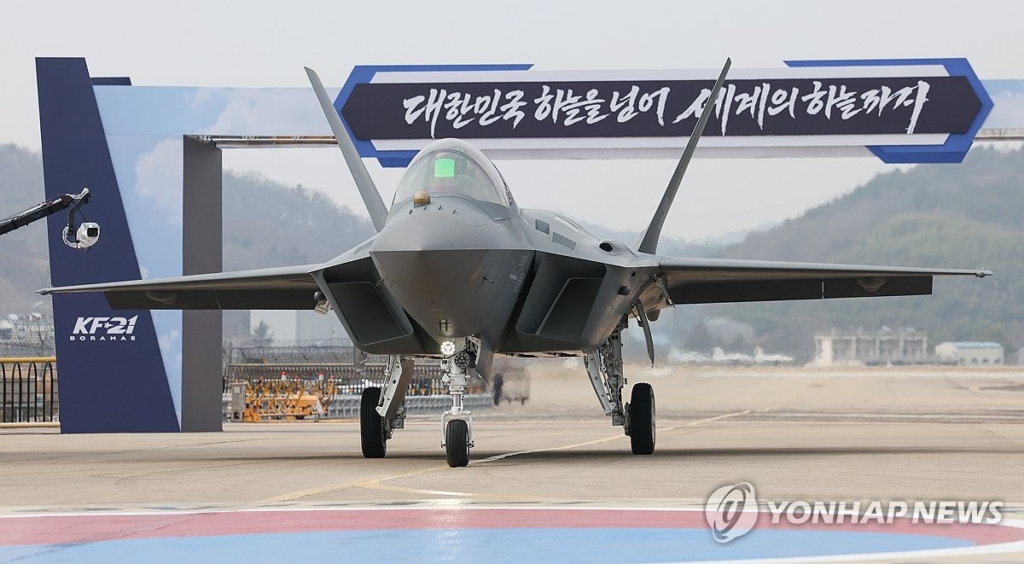
In terms of performance, the twin-engine aircraft is powered by General Electric F414 engines and is capable of speeds approaching Mach 1.8, with a ferry range of around 1,550 nautical miles and a maximum payload of approximately 17,000 pounds.
The platform features multiple external hardpoints for weapons carriage, with future variants expected to introduce internal carriage options to enhance survivability.
KF-21 production ramps up with 40 aircraft planned by 2028
South Korea launched the KF-21 development program in 2015 to acquire a homegrown supersonic fighter to replace the Air Force’s ageing fleet of U.S.-made F-4 and F-5 jets.
Under current plans, the KF-21 Block 1 configuration will begin entering service with the Republic of Korea Air Force from 2026, with an initial batch of 40 aircraft scheduled for delivery by 2028.
The Blk. 1 standard is primarily focused on air-to-air operations, providing a replacement for older fighter fleets while establishing the foundation for subsequent upgrades.
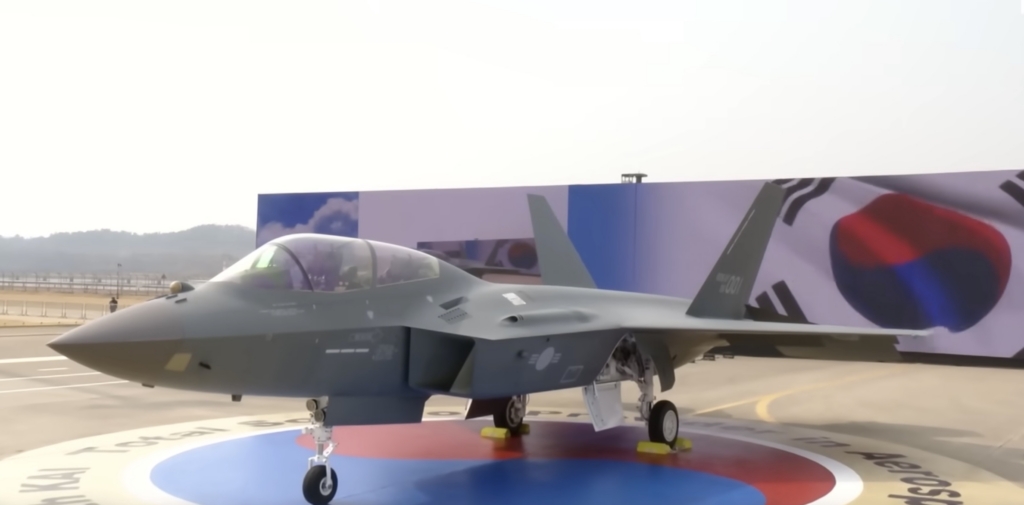
A more advanced Blk. 2 configuration is already in development and will expand the aircraft’s role to include air-to-ground missions. This phase is expected to integrate weapons such as the GBU-31 Joint Direct Attack Munition, GBU-39 Small Diameter Bomb and indigenous cruise missile systems, significantly enhancing the aircraft’s strike capabilities.
The programme is expected to undergo an extensive flight test campaign, with hundreds of sorties planned through the end of the decade to validate these capabilities.
KF-21 upgrades to add electronic warfare and internal weapons capability
Beyond the baseline configurations, KAI has outlined a broader roadmap for the platform.
This includes specialised variants such as the KF-21EA, designed for suppression of enemy air defences, and the KF-21EX, which is expected to incorporate internal weapons carriage, an important step towards reducing radar signature and improving survivability in contested environments.
🇰🇷KF-21EJ (Escort Jammer) / KF-21EX (true 5th-generation variant with internal weapons bay) Concept.These concepts were introduced in the rollout ceremony video of the first mass-produced KF-21, showcasing potential future evolutions of the platform—ranging from dedicated… https://t.co/j7BvtoZQ39 pic.twitter.com/PRaAJHZWbW
— 笑脸男人 (@lfx160219) March 25, 2026
The aircraft’s modular design is intended to support incremental upgrades over time, allowing new systems and capabilities to be integrated without requiring a complete redesign of the airframe.
That flexibility is being positioned as a key selling point in export markets, particularly for countries seeking modern capabilities without the cost and complexity associated with fifth-generation platforms.
South Korea targets indigenous engine development for KF-21
While the KF-21 represents a major step forward in domestic capability, the programme still relies on several imported components, most notably its engines.
President Lee indicated that the government intends to increase the level of indigenous content over time, including the development of a domestically produced “Advanced Aero Engine” to eventually replace the GE F414.

Efforts are also underway to localise materials, subsystems and key technologies, reflecting a broader strategy to strengthen the country’s defence industrial base and reduce reliance on foreign suppliers.
KF-21 to support crewed-uncrewed teaming in future combat operations
Looking ahead, South Korea is also exploring how the KF-21 could operate alongside uncrewed systems.
Officials have outlined plans to develop the aircraft into a platform capable of supporting manned-unmanned teaming (MUM-T), allowing it to control or operate in coordination with autonomous aircraft in future combat scenarios.
Such concepts are increasingly central to next-generation air warfare, as air forces look to combine human decision-making with the scale and flexibility offered by uncrewed systems.
KF-21 export ambitions grow as global interest builds
Even before entering full service, the KF-21 is already gaining traction internationally.
Indonesia remains the most immediate prospect, with Seoul reportedly preparing to finalise a deal for 16 aircraft, a move that would mark the first export of a domestically developed South Korean fighter. But interest is not limited to Jakarta. The UAE has been linked to the programme, while Poland is understood to be exploring the platform as part of its ongoing modernisation efforts.
That early momentum reflects how the KF-21 is being positioned, not as a direct rival to fifth-generation fighters, but as a more accessible alternative. With lower operating costs and a flexible upgrade path, it sits in a space that could appeal to air forces looking to modernise without taking on the full complexity and price tag of top-tier stealth platforms.
The rollout of the first production aircraft marks a shift from development into industrial scale, placing the country in a small group of nations capable of designing, building and sustaining advanced combat aircraft. The focus now moves to delivery, proving capability in service, and turning early interest into firm orders.
As President Lee put it: “The success of the KF-21 jet does not simply mean strengthening defense capabilities but signifies that South Korea has secured new momentum to compete with the world’s leading defense powers.”
Featured image: Yonhap
Sign up for our newsletter and get our latest content in your inbox.


More from

October 3, 20267 min read


