


Russian airlines suffer 9 engine failures on commercial aircraft in just one week


In a sign of Russia’s worsening state of its civil aviation fleet, the Federal Air Transport Agency, Rosaviatsiya, is investigating nine incidents involving engine failures and malfunctions within a week. Four of these nine incidents occurred within hours on a single day.
Russia’s flurry of engine failures
According to reporting by Aviatorschina, the first of these incidents occurred on a Boeing 737 (RA-73231) operating as Pobeda Flight DP-6532 flying from Barnaul to Moscow-Sheremetyevo. The pilots reported that the engine was not responding to thrust changes, causing them to shut the engine down.
The aircraft managed to land safely, and a post-flight inspection found traces of oil leakage on the outer cowling of the left engine.
On the 11th, an IrAero Superjet 100 (RA-89001) suffered an uncommanded shutdown of the right engine during its climb after taking off from Turkey’s Antalya bound for Sochi in Russia. The pilots were able to restart the engine and complete the flight.
The 13th saw the only crash resulting from an engine failure when a Cessna 172 lost thrust at Russia’s Novinki airfield. One of its two occupants sustained an injury. Aviatorschina reported that “the aircraft did not have a certificate of airworthiness or authorisation to use the airspace.”
✈️Moment of the crash of the Russian military transport aircraft An-22
— Special Kherson Cat 🐈🇺🇦 (@bayraktar_1love) December 14, 2025
One engine failure occurred on 14th December, as a Boeing 757 (RA-73072) operated by AZUR Air suffered a right-engine failure while landing at Barnaul Airport. The aircraft was en route from Thailand when the engine shut down automatically at an altitude of 460 meters.
The crew was able to land the stricken aircraft safely with a single engine. On the same day, a Russian Azimut Superjet 100 (RA-89094) was forced to shut down an engine after a thrust-reverser malfunction message after landing at Georgia’s Tbilisi Airport.
Get all the latest commercial aviation news on AGN here.
Four engine incidents in one day
The 16th of December was a black day for engine failures across Russia. Fortunately, these did not result in any crashes.
The most notable occurred in the morning at Moscow’s Sheremetyevo t
Airport as a Nordwind Boeing 777 (RA-73340) was forced to abort its takeoff roll following a surge in its right engine and a flame burst accompanied by a “bang” sound.

The engine failure caused a yawing moment to the right. The aircraft aborted at a speed of 185km/h or 100 knots and managed to stop on the runway.
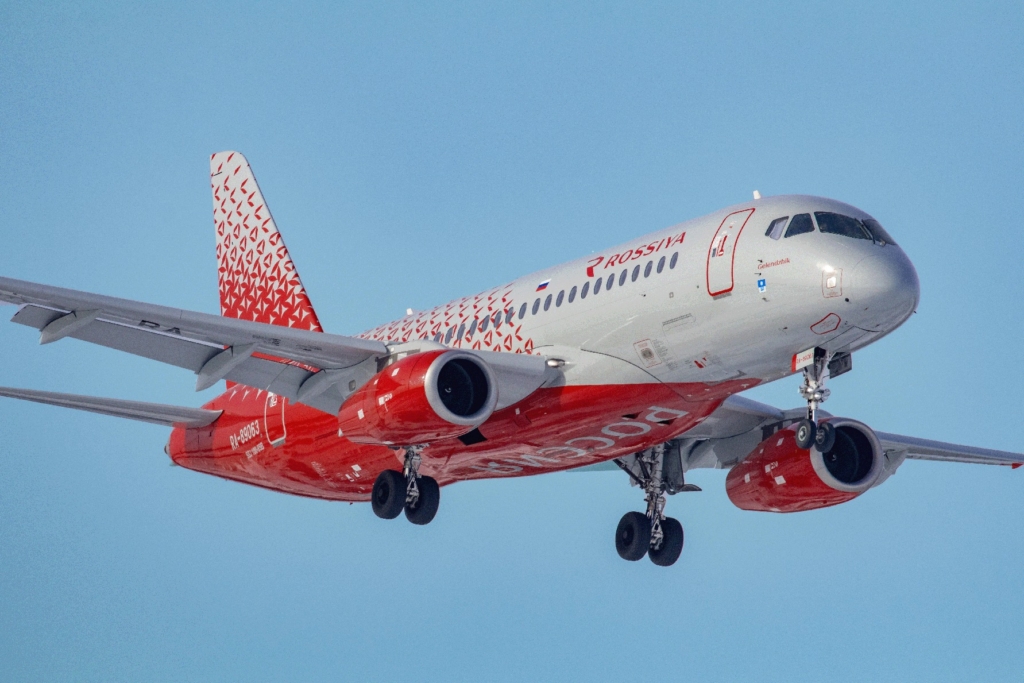
Two incidents involved two Rossiya-operated Sukhoi Superjets. One (RA-89134) experienced vibration flying from Yerevan in Armenia to Sochi. After safely landing at Sochi, an inspection “revealed the absence of the fairing on the 17th fan blade, damage to the acoustic panels, and damage to five stator vanes.”
The other Rossiya Superjet (RA-89124) displayed a message indicating the malfunction of the thrust reverser doors of the left engine during the landing roll. The aircraft landed safely, and maintainers fixed the thrust reverser and cleared it for flights with a deferred defect.
Finally, a left engine malfunction on a Ural Airlines Airbus A320 (RA-73832) flying from Khujand to Yekaterinburg occurred after takeoff and forced the aircraft to return to its departure airport. The crew heard a bang accompanied by increased engine vibration.
The pilots responded by reducing thrust and then shutting the engine down before landing.
The worsening condition of Russia’s commercial aircraft
Russia’s civil aviation industry is heading to dire straits as the impacts of sanctions bite ever more, aircraft age, and its own domestic industry fails to deliver replacement aircraft. The first Russified commercial aircraft is now expected in 2026.

Russia has been forced to ground most or all of its A320neo and A321neo fleet due to its inability to maintain the modern Pratt & Whitney GTF engines.
Some of Russia’s regional aircraft serving remote regions were built in the Soviet Union and are over 50 years old.
This is leading to catastrophic accidents, like the Angara Airlines Antonov An-24 crash in July and the old Antonov An-22 that broke up mid-flight weeks ago.
Featured Image: Wikimedia Commons


