


Bombardier Global 8000 marks Farnborough debut with speed record and environmental declaration
Bombardier’s Global 8000 has marked its Farnborough International Airshow debut by setting a new speed record between Los Angeles and Farnborough and receiving an Environmental Product Declaration covering the aircraft’s lifecycle impact.
The flagship business jet completed the flight from California to the UK in 8 hours and 46 minutes, reaching Mach 0.93 despite challenging wind conditions. Bombardier said the journey was 2.2% faster than the previous record for the city pair, although some of the record information remains subject to review by the World Air Sports Federation.
The manufacturer announced the achievement shortly before the Global 8000 made its first appearance in a Farnborough flying display.
On the second day of the show, Bombardier also confirmed that the aircraft had received a Type III Environmental Product Declaration. The document discloses environmental indicators including carbon emissions, noise and water consumption across the Global 8000’s lifecycle, from raw material extraction to its eventual end of life.
Speed record followed by low-speed Farnborough display
With a maximum operating speed of Mach 0.95, the Global 8000 is the fastest certified civil aircraft since Concorde. It also offers a maximum range of 8,000nm.
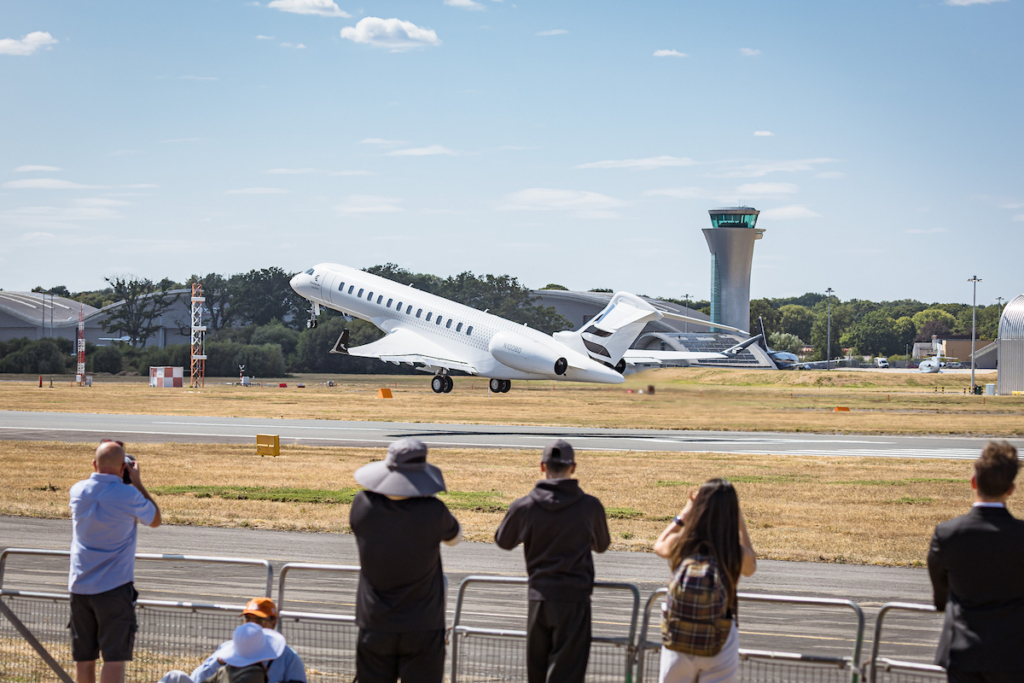
However, Bombardier senior director of communications Mark Masluch told Aerospace Global News that the Farnborough display was designed to demonstrate the aircraft’s capabilities at the opposite end of its performance envelope.
“The flying display itself is going to be special because we’re really showcasing the low-speed performance,” Masluch said. “People often think, ‘Well, it’s the fastest civil jet in the world,’ but it really handles the best at low speeds.”
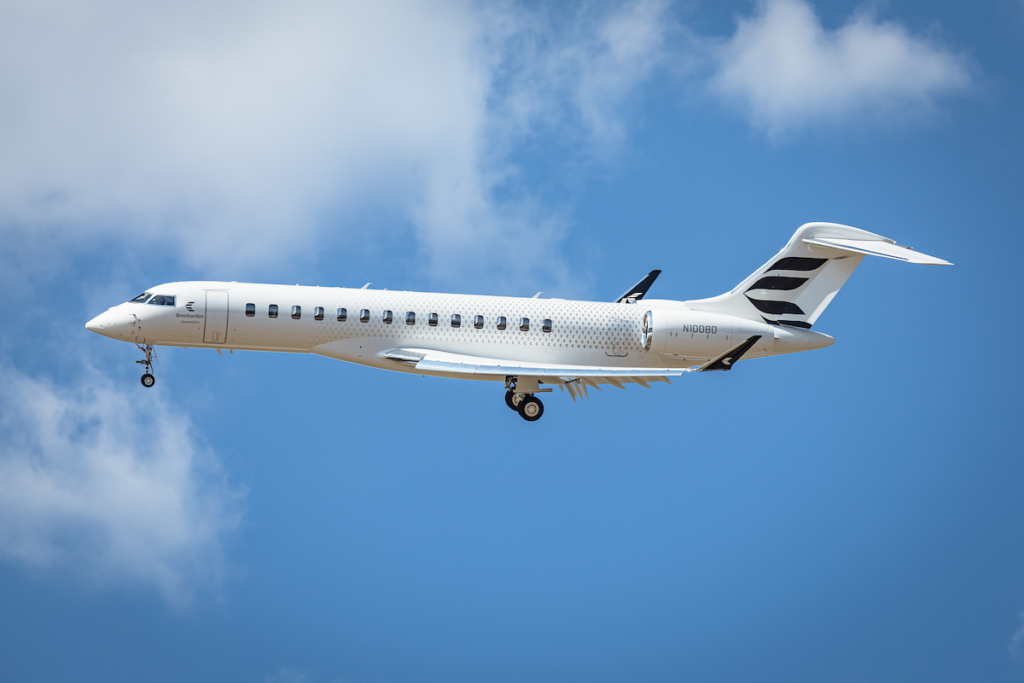
The Global 8000’s wing, leading-edge devices and double-slotted flaps allow it to retain control at lower speeds while supporting shorter take-offs and landings.
Its Farnborough routine highlights low-speed turns, rapid rotation on departure, deceleration after landing and an idle pass above the runway.
Masluch said this performance helps give Global 8000 customers access to airfields that might otherwise be unavailable to an ultra-long-range business jet. Bombardier claims the aircraft can reach up to 30% more airports than its nearest competitor, subject to operating conditions.
The first Global 8000 was delivered in December 2025. Masluch said customer demand had since been “overwhelmingly positive”, although Bombardier has not disclosed an updated order total for the programme.
“The order book is frankly exploding for this programme,” he said. “There’s such high demand because the aircraft fundamentally does what it’s built to do: fly fast, fly far, no compromise and access airfields that others can’t.”

Bombardier is also positioning passenger wellbeing as a central element of the Global 8000’s appeal. The aircraft maintains a cabin altitude of 2,691ft at its cruising altitude, which Bombardier describes as the lowest cabin altitude available on an in-production business aircraft. It’s equivalent to standing at the top of the Burj Khalifa tower in Dubai.
That becomes particularly significant during missions lasting 14 or 16 hours, Masluch explained, when passengers may spend much of a day aboard the aircraft.
“Cabin pressure is the key feature of this aircraft in terms of wellness,” he said. “It really makes a difference to the stress your body takes, dehydration, and you arrive feeling so much better.”
Bombardier is also positioning the Global 8000 for government and defence customers, particularly for long-range head-of-state transport. Masluch said the combination of speed, range and airport access could also support aircraft carrying specialist communications or defensive systems.
The company’s defence business adapts aircraft from the Global family for missions including intelligence, surveillance and reconnaissance and airborne early warning.
Global 8000 receives environmental declaration
The Global 8000’s Farnborough debut coincided with the completion of its Environmental Product Declaration, providing greater visibility of the aircraft’s environmental impact across its complete lifecycle.
Registered through the International EPD System, the Type III declaration follows the ISO 14025 standard. It assesses environmental indicators beginning with the extraction of raw materials and continuing through manufacturing, aircraft operations and end of life.
Bombardier said the assessment would help it identify opportunities for improvement across its value chain while giving customers access to more detailed information about the impact of the aircraft they operate.
The Global 8000 joins the Challenger 650, Challenger 3500, Global 5500, Global 6500 and Global 7500 in carrying environmental declarations.
However, the manufacturer clarified that the Global 8000 carries a Type III declaration, while its other business jets have Type II declarations developed in accordance with different ISO standards.
Bombardier claims it is the only business jet manufacturer to publish scientifically analysed environmental information for all of its in-production aircraft through environmental declarations, based on its assessment of publicly available data.
The two announcements give the Global 8000 a distinctive Farnborough debut: arriving from Los Angeles at record speed, demonstrating its low-speed performance above the runway and providing new disclosure about its environmental footprint.


