US Air Force CCA contenders YFQ-42A Dark Merlin and YFQ-48A Talon Blue formally unveiled

February 24, 2026

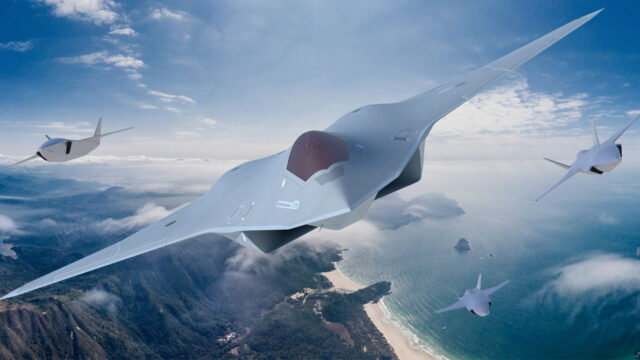
General Atomics and Northrop Grumman have formally unveiled the names of their respective Collaborative Combat Aircraft, with the YFQ-42A Dark Merlin and YFQ-48A Talon Blue emerging as leading contenders in the US Air Force’s drive to field autonomous combat mass.
Far more than branding exercises, the announcements signal accelerating momentum behind the Air Force’s effort to pair uncrewed fighters with its shrinking, but increasingly capable, fleet of manned aircraft.
General Atomics names YFQ-42A Dark Merlin for US Air Force CCA programme
There has already been a steady stream of developments in the US Air Force’s Collaborative Combat Aircraft programme, but this week marked a more symbolic milestone as the service’s future autonomous fighters began to take on formal identities.
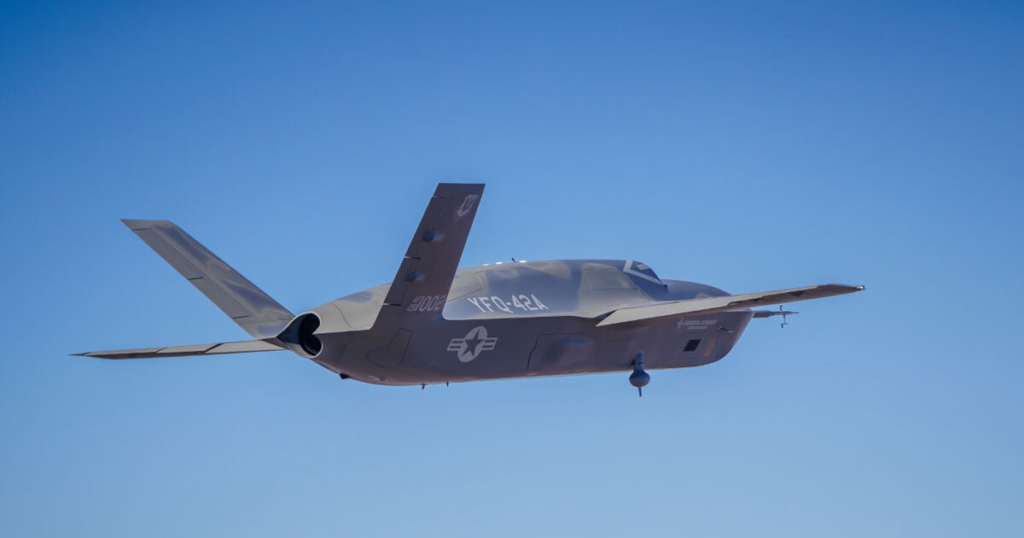
General Atomics Aeronautical Systems, Inc. (GA-ASI) announced that it has selected Dark Merlin as the name for its YFQ-42A uncrewed combat aircraft, currently in development for the Air Force’s Increment 1 CCA programme. The company described the aircraft as drawing inspiration from a nimble predator, noting that dark merlins, small but aggressive falcons, are known for operating in coordinated groups to overwhelm their targets.
The naming comes as the aircraft continues to mature technically. Collins Aerospace recently completed a successful test flight of its Sidekick mission autonomy software aboard the Dark Merlin, demonstrating further progress in integrating mission systems and autonomous teaming capabilities.
At the same time, Collins Aerospace has also completed a successful test flight of its Sidekick mission autonomy software using the Dark Merlin.
Taking inspiration from a nimble predator, GA-ASI announces #YFQ42A Dark Merlin.
— General Atomics Aeronautical Systems, Inc (GA-ASI) (@GenAtomics_ASI) February 23, 2026
Read the news: https://t.co/Bt74bVOGRR#DarkMerlinUAS #UCAV pic.twitter.com/nhvBRtUn5Y
While the YFQ-42A is competing within the Air Force’s CCA framework, interest in the platform extends beyond a single service. The US Marine Corps has selected an adapted version of the Kratos XQ-58 Valkyrie for its own CCA-aligned effort, yet it is also understood to be monitoring the Dark Merlin’s development as it evaluates future autonomous combat options.
Northrop Grumman names YFQ-48A Talon Blue for future US Air Force CCAs
Northrop Grumman has also formally unveiled the name of its Collaborative Combat Aircraft contender, confirming that the YFQ-48A will be known as Talon Blue.
The aircraft was first revealed in December under the provisional title “Project Talon”, before receiving its official US Air Force designation as the YFQ-48A. At the time, the service described it as a strong contender for its future CCA fleet, signalling serious interest in the platform’s role within the Air Force’s long-term autonomous combat architecture.
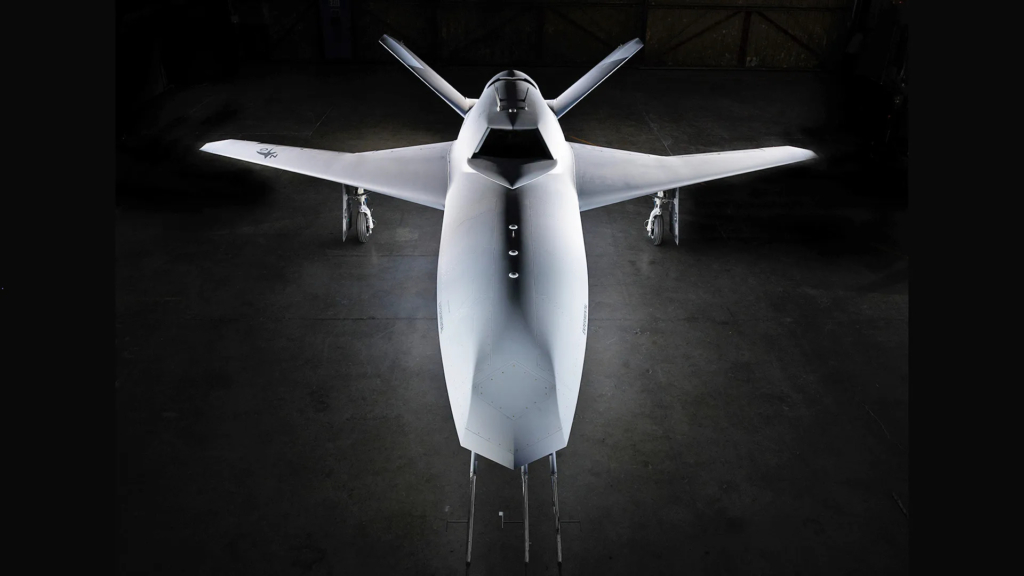
Unlike General Atomics, Northrop did not provide a detailed explanation for the origin of the name. However, Talon Blue continues the company’s tradition of avian-themed aircraft while subtly echoing its historic Tacit Blue demonstrator, the experimental stealth platform that helped pave the way for the B-2 Spirit.
Although the Air Force has already selected General Atomics and Anduril for Increment 1 of the CCA programme, Northrop’s YFQ-48A is widely expected to compete in Increment 2, where the service is likely to refine requirements based on early operational lessons and evolving threat assessments.
With Dark Merlin and Talon Blue now formally named, the Air Force’s next-generation autonomous fighters are beginning to take clearer shape as tangible components of its future force structure rather than abstract development efforts.
General Atomics says it is ready to mass-produce autonomous combat aircraft
As the US Air Force accelerates its Collaborative Combat Aircraft programme, General Atomics is making clear that speed and scale will be just as important as capability.
The war in Ukraine has reshaped global thinking around uncrewed systems, but it also carries the risk of oversimplified conclusions. The widespread use of small, inexpensive FPV drones has demonstrated the power of mass and rapid adaptation. However, that dynamic emerged in part because Russia failed to establish and maintain air superiority, leaving contested airspace in which lower-cost systems could proliferate.
A high-end conflict involving the United States and China would present a markedly different scenario. Both nations possess advanced air forces, dense integrated air defence systems, and industrial bases capable of sustaining prolonged operations across vast distances, particularly in the Pacific theatre. In such an environment, air superiority would be fiercely contested from the outset.
For General Atomics, the central lesson is not that crewed fighters are obsolete, but that they must be complemented by scalable, attritable autonomous combat aircraft capable of absorbing risk, extending sensor reach, and adding combat mass. As President David Alexander stated on uncrewed combat aircraft, “If you wait 5-8 years … they’re too late.”

“They need to come out now, and they need to come out in large numbers,” Alexander added. “That’s really where we are now. The time for talk is done.”
Alexander argues that General Atomics has already built the industrial capacity to move quickly. The company’s Gambit Series architecture is designed for rapid adaptation and variant development, allowing new mission configurations to be fielded with shorter development cycles and reduced cost compared with traditional fighter programmes.
For the US Air Force, the challenge now is translating the CCA concept into operational reality, balancing autonomy, survivability and production scale. With Dark Merlin and Talon Blue now formally named and development accelerating, the focus is shifting from experimentation to fielding, and from prototypes to production-ready autonomous combat mass.
Featured Image: DVIDS